

Brother Rice Baseball, Lacrosse Standouts Live Out National Team Dreams
By
Steve Vedder
Special for MHSAA.com
October 23, 2026
Broder Katke sees it as a once-in-a-lifetime opportunity, a stepping stone and also a chance to showcase himself not only on a national level, but eventually an international one.
Not least of all, however, is the chance to represent his country.
When the Bloomfield Hills Brother Rice senior and Vanderbilt University commit found out he'd made the USA Baseball U-18 team for the recently commenced WBSC Americas U-18 Pan Am Championships in the Dominican Republic, he didn't dwell on the pressure and long odds he overcame, but instead on what a tremendous opportunity the selection offers.
"There are definitely a lot of ways to look at it," said Katke, one of three Brother Rice athletes selected to compete in select United States national competitions this fall. "I just looked at it like, don't press, don't make the situation bigger than it is. You just go about it like any other game, any other at-bat.
"It was super cool to make the team a cold-weather state. Putting that "USA" across your chest and representing your country is a big thing."
A senior catcher for Brother Rice, Katke made the U-18 team following tryouts at the USA Baseball facility in Cary, N.C., in late August. Eighty-eight players were invited including other catchers from California, Florida, Georgia, Tennessee, Indiana, Minnesota and Puerto Rico. Katke impressed a coaching staff comprised of predominantly former major leaguers by going 5-for-17 with two RBIs in eight games.
The Pan Am Championships are a qualifier for the 2027 U-18 World Cup in China. Katke is the first Michigan native to make the U-18 roster since Billy Killian of Remus Chippewa Hills in 2003. Just 10 Michigan high schoolers have made that team since its founding in 1981.
Recent graduates of the U-18 program include current major leaguers Pete Crow-Armstrong, Bobby Witt Jr., Riley Greene, C.J. Abrams, Corbin Carroll, Nolan McLean, Jackson Holiday and Dylan Crews. Among USA Baseball coaches at the tryouts were former big leaguers Brian Schneider, Rick Ankiel, Ryan Zimmerman, Ian Desmond and Brad Wilkerson.
Katke made Michigan's all-state Dream Team at Brother Rice last spring after batting .410 with 21 RBIs and 34 runs. In three seasons at Brother Rice, Katke has hit .371 with 78 RBI, 31 doubles and eight homers in 275 at-bats.
He knows the rarity of making a national team when 14 of the 20 players come from baseball-popular, warm-weather states California, Florida, Texas and Georgia.
"Michigan is a cold-weather state, but it doesn't get enough credit in baseball," said Katke, rated as the nation's 37th-best player by Perfect Game and 31st by Prep Baseball. "But (cold-weather) teams haven't faced some of the pitching we have. I was never stressed out at the tryout; I just wanted to compete and give myself the best shot at making the team. I thought of it as a chance to express myself rather than trying to impress.
"There are bigger and faster players than me, but I was there to do the best I could. It was nice to go there knowing you were representing your school, our coaches, community and state. If you go there thinking anything else, you're playing the wrong game."
Katke said one of his strengths as an athlete is the ability to put pressure aside. Katke followed up his performance at the tryouts by playing for the West team last month at the 2026 Dick's Perfect Game All-American Classic at Citizens Bank Park in Philadelphia. He was the first Michigan player to make that game since Northville's Dante Nori in 2023.
"Pressure is a privilege," Katke said. "You feel intensity and you're excited, and there's a thin line between the two. You're going to have anxiety, but the preparation I had leading up to the event was some of the best I've ever had."
Katke is one of three Brother Rice athletes who have recently donned USA national team jerseys. Senior Ben Waechter made the USA Lacrosse U-19 team while junior Michael Burkhart made the U-17 team. The Brother Rice lacrosse players were the only Michigan players to make either team, both of which competed in the Sept. 27-29 Brogden Cup held at the USA Lacrosse headquarters in Sparks, Md.
Committed to continue at Duke, Waechter was all-state and All-American last season and scored the game-winning goal in overtime in the 2025 Division 1 championship game against Detroit Catholic Central. He was one of 85 players invited to the original tryouts who later were cut down to the final 25.
"Everyone dreams of having "USA" stitched across your chest," he said. "That's awesome. You're playing with some of the best lacrosse players in the country, which is always a goal you have in mind. Getting to the highest step you can make is great, something awesome to be part of."
While Katke competed against well-known southern and western baseball players, many of lacrosse's top high school-age players come from the East. The talent level at the tryouts was an eye-opening experience, Waechter said.
"It was definitely hard because the East has so many players, but I've always had good coaches who do the same things that coaches in the East do," he said. "It just comes down to how much you want to put into it."
The USA U-19 team defeated Canada 8-7 in the final to go undefeated in three games.
Burkart lettered for Brother Rice as a junior last season. He went through a Regional qualifier and then 100-player combine to make the U-17 roster.
"It was an amazing experience," he said. "You have to go out there level-headed and not wanting to get out of yourself and play badly. I felt I was pretty composed and not overconfident, and that worked for me."
Like Katke and Waechter, Burkhart was aware there are limited chances to impress coaches at tryouts. He credits the national team coaches, however, for giving all players an equal shot at making the roster.
"I thought we had a lot of chances to make plays," he said. "Things move pretty fast. You do drills and technical stuff, but there is an opportunity to be seen. That's what you want."
The U-17 team beat Canada 16-3 in the final to earn a gold medal.
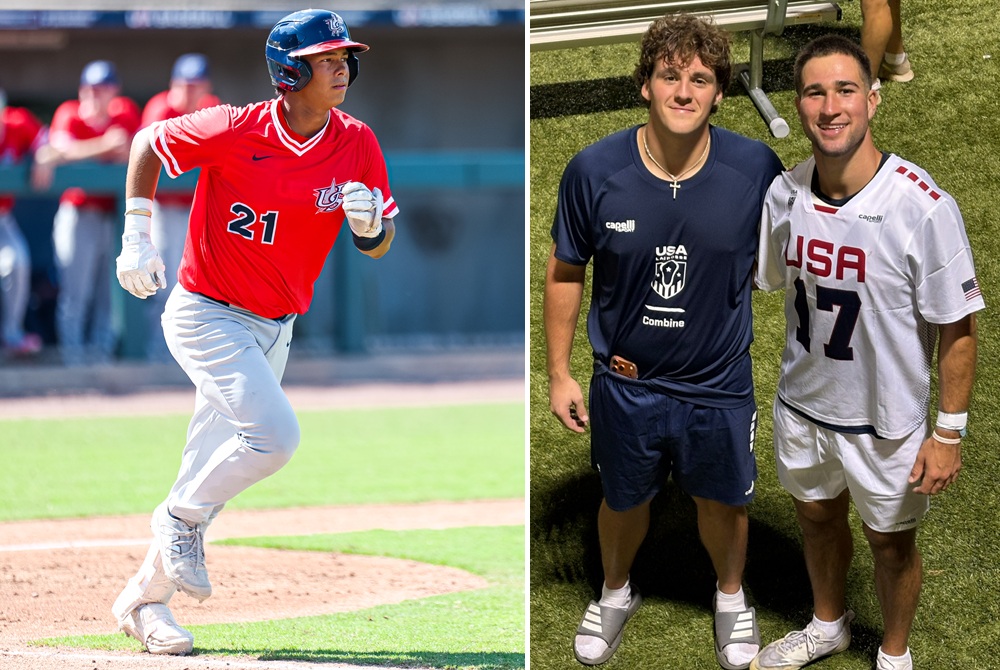
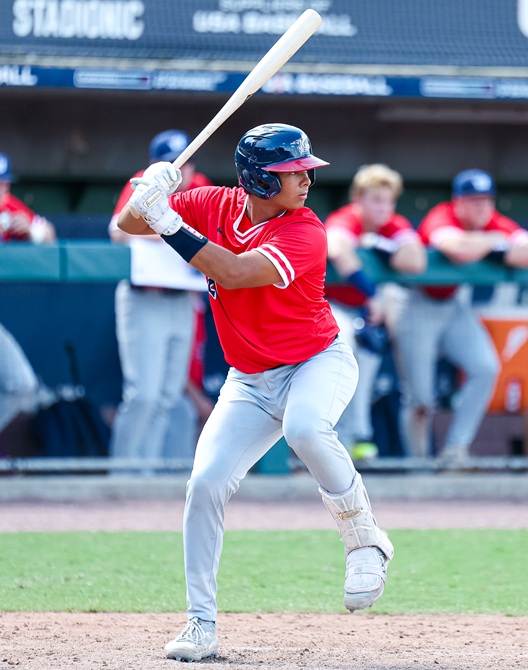
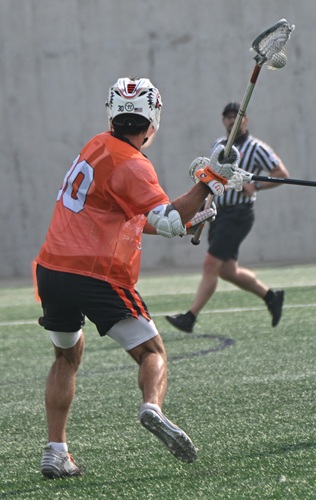
PHOTOS (Top) At left, Broder Katke heads to first base while playing for his national baseball team. At right, Michael Burkhart and Ben Waechter pose for a photo together. (Middle) Katke waits on a pitch during an at bat for USA Baseball. (Below) Waechter launches what would become the game-winning shot for Brother Rice in the 2025 Division 1 Final. (Katke photos courtesy of USA Baseball.)
Despite Annual Early-Season Challenges, Northern Teams Carve Space Among Contenders
By
Steve Vedder
Special for MHSAA.com
June 4, 2025
It may be 35 years later, but whenever Brian Endres touches base with old Traverse City St. Francis baseball teammates, the conversations invariably turn to one unpleasant topic.
They still wonder how they survived Michigan's brutal early spring ballgames played in temperatures which barely crept over the freezing mark, while wearing a sweatshirt beneath their uniforms offered little help or when a hitter prayed he wouldn't take a fastball off the handle of his bat.
They remember games played in a cold rain, dodging swirling snowflakes and trying to survive blustery, bone-chilling winds.
It's a wonder, the players reminisce now, how they ever shivered through baseball in northern Michigan in April.
"You just never knew about the weather," said Endres, a senior outfielder on the 1990 Traverse City St. Francis team that defeated Climax-Scotts 7-6 to win the Class D title. "You never knew what you'd have to deal with. You just took note of it and played; it was part of the game. You would get to a game and it'd be pouring rain, but you played because it was tough to find a day to squeeze in a game. It was always tough to get in a flow."
Getting in a flow of a northern Michigan baseball season is a slow process which begins with the official start of practice in gyms – this season kicking off March 10.
While teams in southern Michigan will enjoy a handful of days when they can escape outside to practice, teams in the northern part of the state are confined to limited drills in often undersized gymnasiums. It's not uncommon, coaches say, that the first time getting outside coincides with the team's opening game.
Until teams finally step on a baseball field, coaches prioritize fundamentals, utilize drop-down indoor batting cages, round pitching arms into shape, roll ground balls in carpeted school hallways, conduct Wiffle ball home run derbies and even teach seminars on how to score a baseball game just to break up the monotony. Some coaches even bring umpires into the gym during practices to help players sharpen their batting eyes.
Coaches say finding a variety of work to keep ballplayers interested after they've chased Wiffle around a gymnasium for a month is an annual challenge.
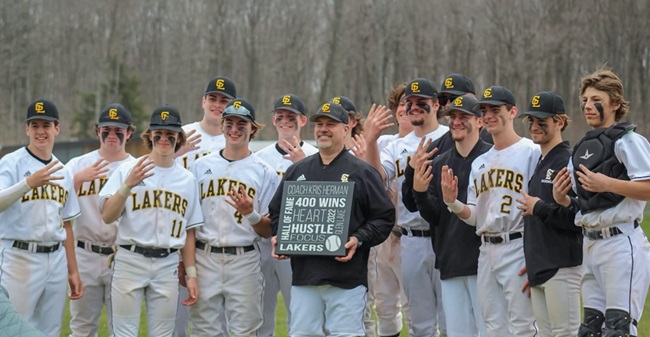 "We maximize every space," current St. Francis coach Tom Passinault said. "You're in small gyms so you have to be creative. But it's tough."
Maple City Glen Lake coach Kris Herman, who recently won his 500th game, has witnessed high school baseball from both a downstate perspective and from coaching in the north. A former assistant for legendary Blissfield coach Larry Tuttle, Herman said he's had teams which can't get outside for the first eight weeks of the season. Herman recalls one season when the team didn't open until May 1 and a game where the team played in rain, sun and snow – at the same time. His team has been snowed out as late as May 10.
Herman said being stuck in a gym when southern teams have already been outside gaining valuable work in for several weeks can get old.
"I tell people we are the best bunt-scrimmage team in America," Herman said. "Everyone is used to it, but we still grumble. Nobody wants to play an outdoor sport indoors. What you want is for things to be in place for when there is good weather."
Former St. Francis coach Craig Bauer, who brought baseball to that school in 1979 then won that Class D title 11 years later, said northern coaches have the same goals and priorities as southern Michigan coaches, but those ideas must be implemented along a different timeline. He said northern teams often have a couple of credible pitchers, but can use inside time to find up 4-6 more arms. Batting cages and hitting machines are helpful, but because of a hitter's timing, can only mimic live pitching to a certain level.
The only true solution is getting outside, which doesn't happen until mid-April – and that's with a seasonable spring.
"The weather is continually a factor. It's usually well into April when you're getting out for the first time," Bauer said. "Sometimes your opening game is the first time you've got outside. But you get into a season and make do."
It's even worse for the smattering of Upper Peninsula teams. Rudyard coach Billy Mitchell, the 2023 Michigan High School Baseball Coaches Association Coach of the Year, said it's a major challenge trying to field a program north of the Mackinac Bridge. In fact, it may sound crazy, but when it comes to besting horrible weather, ignorance is bliss, Mitchell said.
"Weather plays a big factor," he said. "But the players don't know any different. They know Rudyard wants to play the best competition, and we have to travel to do it. A lot of northern schools, whether it's just the school (philosophy) or the administration, they don't play a lot of games. We try to load up on games."
 With this year's 44th MHSAA Tournament underway – and set to conclude June 14 at Michigan State’s McLane Stadium – the question arises how northern Michigan teams have fared since the first in 1971. If you define "northern" schools as ones located north of the east/west M-55 corridor from Manistee in the west through Cadillac to Tawas City in the east, only four schools – Cheboygan Catholic Central (1973-74), Mesick (1982), Traverse City St. Francis (1990) and Hillman (1992, 1994, 1997)) – have won MHSAA Finals championships.
Granted, there have been myriad near-misses by northern teams such as the 1981 Mesick team which lost 1-0 to Reading in the Class D Final, or the 2017 and 2021 Traverse City St. Francis clubs that lost in Division 3 championship games. Frankfort finished second in Class D in 1978 and 1979, losing those two Finals 4-1 and 4-3, respectively. Gaylord St. Mary was the Class D runner-up in 1988 and 1989.
Considering that tournament history, a natural question arises as to whether northern teams are at a disadvantage, even though the tournament doesn't start until late May. Coaches don't necessarily have a definitive answer, but most believe their programs have caught up to the rest of the state in terms of games by District time.
Numbers bear that out. For instance, according to the May 14 MHSBCA poll, the top eight ranked teams in Division 1 have played an average of 28 games while the same number of ranked Division 2 teams have averaged 24. The seven Division 3 and 4 schools considered "northern" schools ranked in the polls have averaged 23 games this season.
While competition and a challenging schedule are factors in postseason success, coaches believe they're on par with downstate schools by June 1.
"By May we're playing good baseball, we can compete with teams downstate," Herman said. "(The MHSAA Semifinals) is absolutely a goal, and you should be shooting for the ultimate goal. But if you don't make it, you're still satisfied by how far you got. We're got environmental things to work around, but we're starting to build programs up here and people are enthusiastic about it."
Passinault said scheduling plays a major factor. To compensate for the weather, St. Francis travels south to Kalamazoo, Grand Rapids, Muskegon, Lansing and even Detroit for games. When the weather improves, the schedule changes to playing teams closer to Traverse City.
"We're caught up by then," said Passinault, whose team once won 53 consecutive Lake Michigan Conference games. "I've never heard anyone up here say we can't win."
Bauer and former Mesick coach James Linna say winning a championship can come down to a single, Cinderella-type season where all the chips fall into place. Considering that many northern schools are among the smallest in the state, most of the programs get only a single, once-in-a-generation shot at a championship.
For instance, Bauer recalls the 1990 team getting a couple of key transfers, a freshman and a junior who had played in southern Michigan and who became the starting shortstop and second baseman. The team relied on a deep bench, benefitted from playing only two games against Class C and D teams, and had a powerful lineup that combined to hit nearly .350 for the season while scoring a combined 14 runs across the Semifinal and Final games.
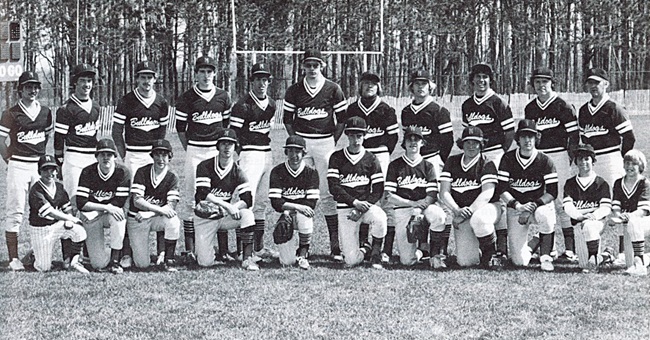 "All the cards fell together," Bauer said.
Linna, now 90 years old, actually had two once-in-a-lifetime opportunities. The 1981 Mesick club lost in the Finals before going 30-0-1 with a tie against Frankfort en route to the Class D championship the next season.
"We had pretty decent weather that year and once it was warm, it was so much easier to play by late April," said Linna, who coached from 1967-98. "But you've still got to have the players to win. We had kids who wanted to play and win, and I wasn't going to hold them back.
"But we just don't have the same weather that the teams in the south have, and that makes for a difficult time. Put it this way: Upper Michigan teams have to deal with disadvantages more than southern teams. They definitely have an advantage, but we hang in there."
Like Traverse City St. Francis, Mitchell said Rudyard will travel south early to play games, a choice that ultimately helps a program at tournament time. Rudyard plays at places such as Mount Pleasant, Alpena, Gaylord and Cheboygan – basically utilizing the I-75 corridor – to strengthen its schedule. That's much of what Mitchell credits for four District and two Regional titles and two Semifinals trips since 2020.
"It's like being a college team," he said. "You go south early and play, come back home to practice, then go south again. People look at us and see an Upper Peninsula team, but our goal is to make it to Michigan State.
"Just because we're a U.P. team, that doesn't hold us back."
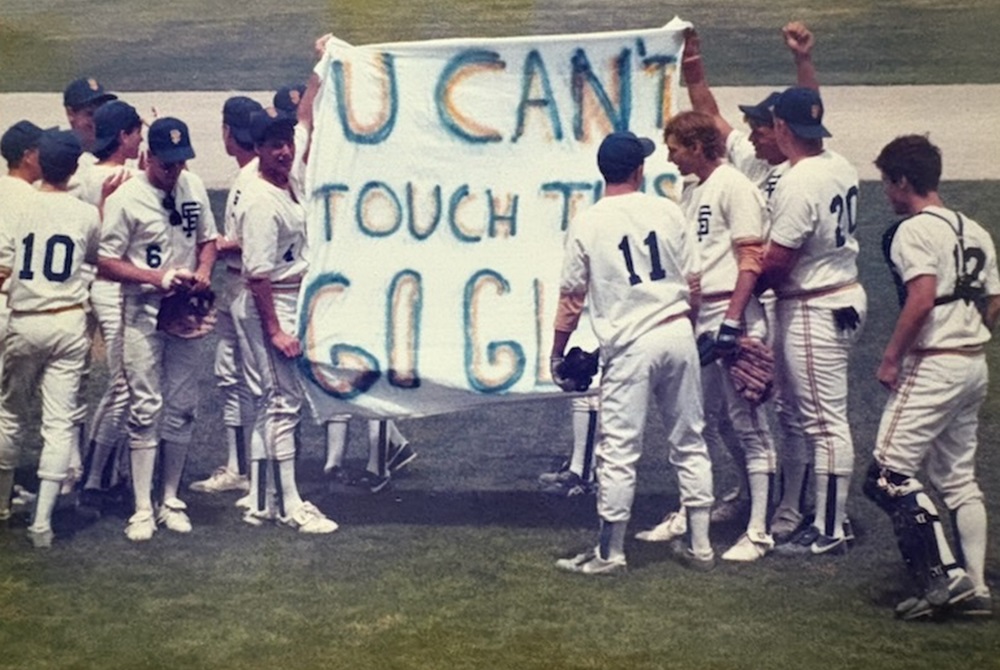
PHOTOS (Top) Traverse City St. Francis players hold up a banner after clinching the 1990 Class D baseball title at Battle Creek’s Bailey Park. (2) Maple City Glen Lake players gather around coach Kris Herman to celebrate his 400th victory during the 2022 season. (3) Rudyard’s Eli Sprague, left, fist-bumps his first-base coach during a 2023 Division 4 Semifinal. (4) The Mesick baseball team won the 1982 Class D title. (St. Francis and Glen Lake photos are courtesy of those respective programs’ past/current coaches.)