

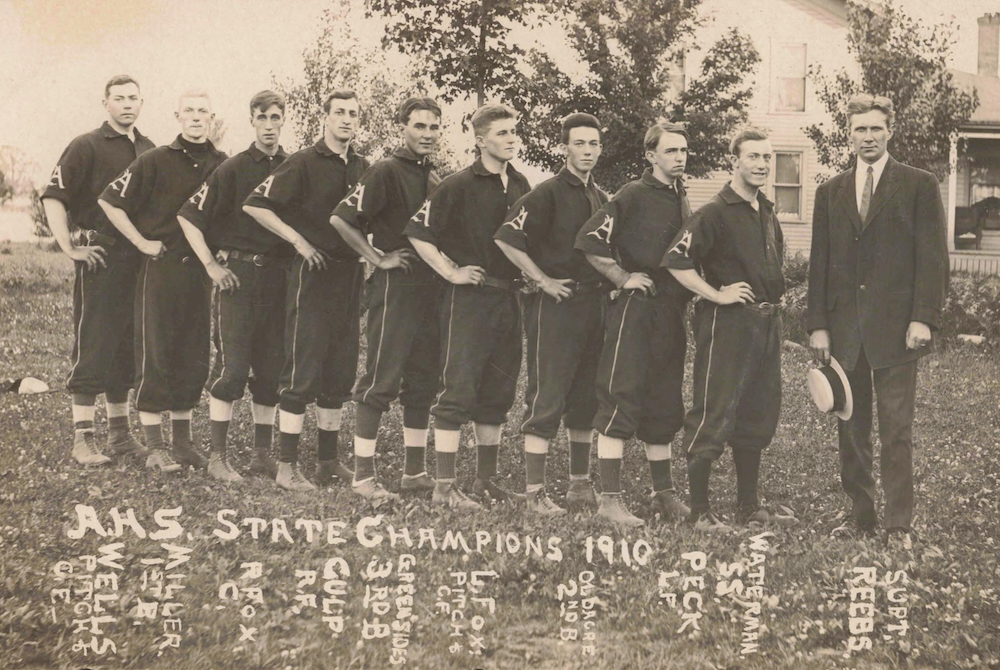
Century-Old Postcard Inspires Researcher to Tell Story of Athens Baseball Dynasty
By
Ron Pesch
MHSAA historian
June 25, 2026
Shortly after graduation from little Athens High School in 1969, Larry DeBow had the chance to head east for a three-day music festival. Held that August on a dairy farm in upstate New York, Woodstock attracted some 400,000 and became one of the most famous cultural moments of the 1960s.
“I didn’t know what it was and blew it off,” he recalled. “I’ve always regretted that.”
That fall, DeBow left the Calhoun County village south of Battle Creek and made his way to Western Michigan University in Kalamazoo. There, he crammed four years of education into three, then, starting in Tecumseh, began a 41-year career in industrial sales with various companies and bounced around the world.
He retired in 2013, took up photography, and started a small business. Unexpectedly, the trip east not taken decades ago, would influence what came next.
“In 2016 I added video when a friend and I decided to take a just-you-and-I road trip,” said DeBow, capsulating life’s path. Their destinations: Woodstock and the Baseball Hall of Fame.
“We were at Woodstock, and my friend Dave – he always talked like this – said ‘Dude, we gotta make a movie about this.’ So, I just started to snap pictures, and I used my iPhone taking video. Then I got home and go, ‘What am I going to do with this? I don’t know how to make a video.’ But on my computer was Movie Maker 7. I created my first video … I think it (runs) only about 10 minutes.”
Eventually, he found Movie Maker couldn’t keep up with his growing technology needs. Now a videographer and tinkering with AI tools, DeBow is ready to debut his latest work – a baseball documentary.
Subject Matter
Following the road trip, DeBow experimented with technology and posted short films to YouTube. In 2017, at the suggestion of another Athens graduate, John Royer, they started assembling material for 1969 – A Celebration of Accomplishment, a documentary initially shared at Larry’s 50th class reunion. The Indians had fielded two pretty good sports teams during DeBow’s senior year.
“John was a year behind me (in high school). He was on the track team … and was (one) of the four guys who still hold the mile relay record for the school. I was on the basketball team, although I was the 12th man,” recalled DeBow, laughing. “I was far from a star. We were the first team to win a Regional game in school history that winter. In the spring, the track team took second in the state Finals.”
Running 26 minutes in length, the finished video included interviews, snapshots, memorabilia, and some old family 8mm film footage from the state track meet.
DeBow followed the production up with another documentary on the Athens’ 2022 girls volleyball team, runner-up in Class D in the annual MHSAA Tournament. While digging around on that project, he came across a real picture postcard. It would set the stage for the current project.
A Baseball Dynasty
The image features members of a team riding on a horse-drawn wagon. Inscribed is, “Athens High School State Champions, 1910, Base Ball Team.”
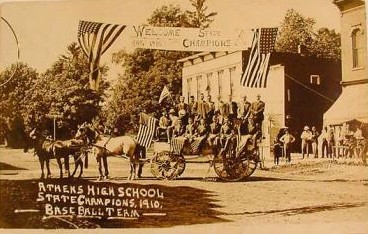 “Tom Doubleday doesn’t like the (professional) title,” states DeBow. “I give it to him anyway. He’s like the curator of the sports section at the Athens Area Historical Society. He asked, ‘Can we do something with this (to tell their story).’"
DeBow immediately recognized the challenge. “If this is all we’ve got, I can’t do anything with that.”
With Doubleday’s assistance they dug into the Society’s archives. The story grew. Intrigued, DeBow was quickly hooked. But this one would highlight the challenges and requirements needed to tell a story cast more than 100 years ago.
Sharing stories
For roughly 30 of the 45 years that I’ve delved into the history of high school sports, the vast majority of time was spent perched on a chair in a library, mostly in Michigan, occasionally somewhere in the Midwest, scrolling through the pages of microfilmed reels of newspapers and periodicals or scanning old school yearbooks, searching for data.
That frequently included trips from Muskegon to the State of Michigan Library in Lansing, where a warehouse of nearly pristine reels of microfilm is maintained for a majority of the state’s newspapers. Over the last 15 years, dramatic changes have allowed searchable scans of the nation’s newsprint to be moved online. Initially, it was a handful of smaller long-defunct publications. Today, the archives of most of the state’s largest dailies are now included in subscription databases, and the listings continue to grow.
One of the great joys of serving as the MHSAA historian is sharing knowledge and resources with sportswriters, coaches, players, school administrators – past and present. Often, individuals reach out, looking for information and guidance on projects on which they are working. Occasionally, we strike up friendships, mostly via telephone calls and email, where we each cheer on each other’s projects and share news of our successes and challenges. Sometimes we meet in person.
In February 2024, I received my first email from DeBow. With the subject line, “Athens Michigan HS 1907 thru 1918 Perhaps a Michigan Baseball Dynasty?”
A Cutout
Tapping into the collection of the Athens Area Historical Society, they found additional postcards and artifacts that would visually expand the lost tale from the early days of prep baseball, featuring an interesting cast of characters.
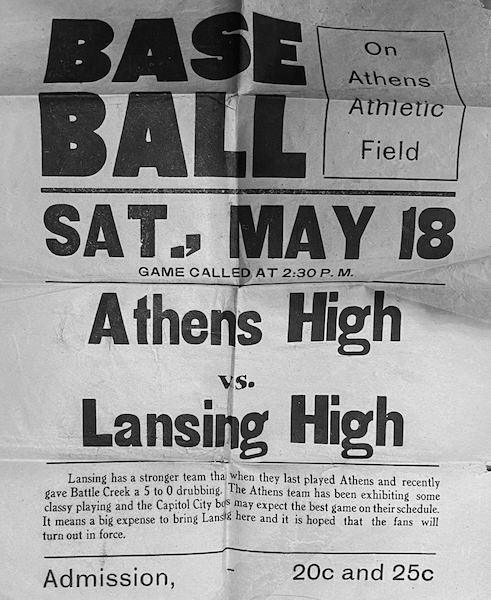 “They found some posters or bills saying Athens was playing North Adams, or Athens was playing Marshall or Athens is playing somebody,” recalled DeBow. “These would be displayed in store windows. There was a poster for (a) 1909 (championship) game with Mt. Pleasant. I don’t know where they found it … but it was literally cut off a wall. None of us had really noticed it before in the historical society. It could have slapped you right in the face because it was right on the side of a doorway going from one section (of the building) to another. I’ve got a lot of that stuff in the documentary.”
Hitting the internet with searches on high school baseball from the era, DeBow came across a list prepared by Kevin Askeland, a staff writer at MaxPreps.
Using research from multiple sources, MaxPreps has retroactively chosen national champions back to 1910, designed to recognize a single champion for each year. The compiled list is a consolidation of previous work produced over the years by various organizations and historians, according to Askeland. MaxPreps credits those individuals and expands on their work via research using modern day access to online newspaper databases that now allow deeper dives into the scanned recorded print history of cities, towns, and villages, with tools previously unavailable.
DeBow asked Askeland if the list was malleable. Askeland said it could happen but would require documentation and detail that strongly made a case for a change.
Contact
DeBow’s conversation with Askeland added a new dimension to his research and led to our connection.
Shortly after his email, we spoke on the phone. At the time, DeBow’s initial newspaper research was limited to the Athens Times microfilm stored at Lansing’s State Library. Purchasing database subscriptions allowed DeBow to conduct research on the first two decades of the century behind a laptop without the road trip. He keyed in countless combinations of words and phrases in search of clues. Before long, he was waist-deep in a long-forgotten and expanding story. Hours flew by. By June of 2025, he had a strong outline, focused on the 10-year span 1907-1916.
 By August 2025, DeBow estimated he had viewed approximately 500 individual articles. Larger newspapers from nearby Battle Creek and Marshall included scores from games. Kalamazoo, Saginaw, and Detroit papers provided additional hints. The Times provided much of the color and detail.
Certain questions hovered above his research. Claims over eligibility of certain players often surfaced in newspaper game coverage. What were governing rules during those days? How did playing “summer ball” affect eligibility? Were there age rules?
Without question, baseball was the “national pastime” during the era. Reports of games in the state of Michigan appear in print as early as 1860. Old Reach and Spalding Baseball Guides help explain the hierarchy, structure, and importance of the sport in these years as foundry, city, independent, and semi-professional minor league teams dominated the landscape in many cities and towns.
The teams competed for talent. "Base ball" was popular in high schools, but certainly not sponsored by all schools. Initially governed by a subcommittee of the Michigan State Teachers’ Association, and then from 1909 through 1924 by the Michigan Interscholastic Athletic Association (MIAA) – both predecessors to the MHSAA – prep athletics at member schools voluntarily cooperated with regulations of eligibility pertaining to amateurism, enrollment, semesters of athletic competition, and school scholarship.
DeBow mentioned he had come across articles that spoke of state champions in track & field, football, basketball, tennis, and summer independent baseball … even MARBLES. But there was no mention of an official “state high school baseball champion” for the years he studied.
Outside of track & field championships, the MIAA did not sponsor postseason tournaments. Hence, all other titles claimed by schools in other sports were generally made by the press, school administration, and/or admiring followers, justified by outstanding results in the win-loss column. That led to challenges from other schools elsewhere in the state making similar claims, and often contests between the schools were arranged, meant to resolve the debate.
 Utilizing modern tools, DeBow collected schedules and final results, and compiled folders full of detail. Slowly, he distilled data into a narrative covering forgotten games and players who represented Athens, and the opponents that they faced. His focus narrowed to a remarkable four-year span – 1909 through 1912 – where the Indians compiled a stunning 42-0 record. Before stellar crowds they triumphed over bigger schools including Dexter, Millington, Mount Pleasant, Battle Creek and Saginaw Arthur Hill.
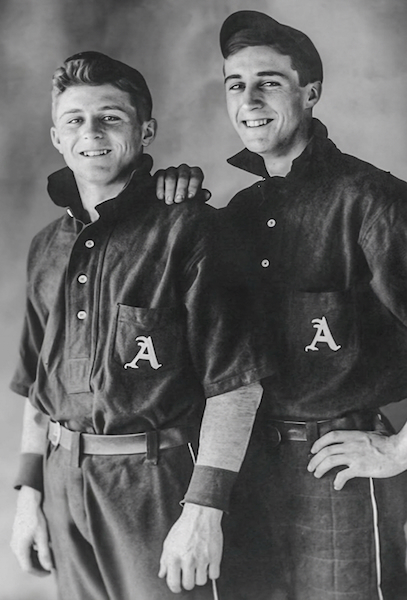
In September 2025, DeBow penned an e-mail to Askeland, detailing the Athens seasons in a 51-page document. The 1909 team finished 12-0 after defeating Mount Pleasant, 1-0, in a title game at Athens, while 1910’s squad downed Arthur Hill in Saginaw in another 1-0 championship contest, to finish 11-0. Both teams featured the Fox brothers – Loyd, pitcher/outfielder, and Roy, catcher – perhaps the team’s top players. As a sophomore in 1910, Loyd struck out 16 in the title game – the first loss in three years for Arthur Hill.
So, DeBow pitched the 1910 squad to Askeland for consideration as a replacement to 9-1 Commercial High of Brooklyn, N.Y. as the list’s new national champion. Impressed with Athens’ accomplishments, this past February, MaxPreps updated its list accordingly.
Thrilled by the news, and with his research complete, DeBow’s focus narrowed on wrapping up the documentary. His biggest challenge was the limited number of photographs available from the timeframe. To help move the story along, he tapped into the latest Google and Microsoft-funded AI tools to generate period newspaper-style illustrations. The finished film flows like a modern-day graphic novel come-to-life.
After three-plus years of work, the half-hour production, “The Dynasty” Athens High School Baseball 1909-1912, is now available to view on YouTube.
Next, DeBow plans to submit the story to a film festival. With the project complete, he’s given up pretty much all the software subscriptions he’s used on the project – except one.
“I’m probably going to convince myself to keep Chat GPT,” DeBow noted, “just because I’m having too much fun doing other stuff!”
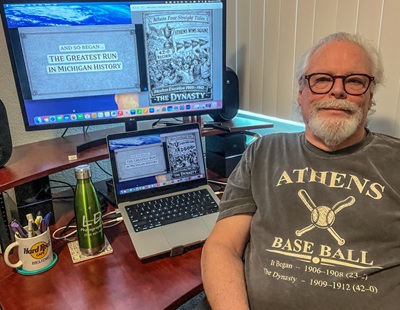
PHOTOS (Top) The 1910 Athens baseball team poses for a photo celebrating its championship season. (2) The 1910 team is welcomed during a parade through its hometown. (3) A sign advertises a matchup with Lansing that season. (4) Brothers Roy and Loyd Fox pose for a photo together in 1911. (4) Videographer Larry DeBow sits at his work station with his latest work on Athens baseball displayed on his computer screen. (Team photo courtesy of the David V. Tinder Collection of Michigan Photography, William L. Clements Library, University of Michigan Library Digital Collections. All others were gathered by Larry DeBow and the Athens Area Historical Society.)
Adams' Multi-Sport Gem Picot Providing Robust Reminder of Value on Diamond
By
Keith Dunlap
Special for MHSAA.com
May 11, 2023
ROCHESTER HILLS – In a way, it’s ironic for anyone watching Rochester Adams senior Parker Picot thriving and excelling at his best sport right now during the spring.
 The small twist of irony is that a few months ago during the fall, some felt the same thing while he was playing a different sport.
For any observers of high school sports who follow football and not much else, they likely know all about Picot and how much of an all-around force he was for Adams on the gridiron. He was a lockdown defensive back and a dual-threat quarterback who did just about everything for a Highlanders team that advanced to the Division 1 championship game in 2021 and a Regional Final this past November.
People probably watched and wondered where his future in college football would take him, and for good reason given Central Michigan and University of Massachusetts headlined programs that offered him football scholarships.
But if those same observers are wondering why Picot isn’t going to play college football, all they have to do is watch him play baseball for Adams this spring.
If they do, it’s likely a collective “Oh” would be coming out of their mouths.
No doubt, as good as Picot was at football, he is even better at baseball, and will rightfully pursue that sport going forward after signing with Alabama in November.
“I’ve always loved football,” Picot said. “But I enjoy baseball more.”
Entering a Tuesday game against fellow Oakland County power Lake Orion, Picot owned the career school records for home runs (19) and stolen bases (57).
Playing in a tough league and against a formidable nonconference schedule, Picot was batting .339 with six home runs, 23 RBI and 10 stolen bases this spring hitting primarily out of the No. 2 spot in the Adams lineup.
 Also a hard-throwing ace pitcher, Picot was 4-0 and had allowed four earned runs in 19 innings pitched going into Tuesday.
“He’s pretty good at everything,” Adams head coach Jeff Hall said. “He’s solid all the way around. He’s a great center fielder and one of the fastest kids in the country. I think in Chicago, he ran some ridiculous 60-yard dash.”
It’s not out of the realm of possibility that there could be something even greater ahead for Picot in baseball that has nothing to do with college.
“We have about five MLB scouts at every game,” Hall said.
Whether his name is called during July’s Major League Baseball draft remains to be seen, but regardless, Picot will go down as one of Adams’ all-time greatest athletes.
All the battles he has had on the baseball and football fields probably were nothing compared to all the battles he had in the backyard growing up with older brother Nick and twin brother Tait, who also was an invaluable two-player player for Adams in football and was batting close to .400 for the baseball team this spring going into Tuesday.
It didn’t matter if it was Wiffle Ball or tackling drills, the competition was intense enough to where maybe the brothers should have charged admission for neighbors to watch.
“They were pretty intense,” Picot said. “We definitely had fun. A lot of my success comes from there. We just went at it. It was brotherly love and brotherly competition. We had fun.”
Parker and Tait Picot obviously dream of leading Adams baseball to its first MHSAA Finals championship in June before Parker begins his college career at Alabama, or even gets drafted high enough to where it becomes tempting to bypass college altogether.
Assuming Picot eventually winds up in Tuscaloosa, there will be no lobbying Alabama football coach Nick Saban or anyone else on his staff for a walk-on spot on the football team.
Picot couldn’t be more in his passion and element going full-steam ahead in baseball from this point forward.
“It’s nice,” he said. “You don’t have to worry about anything else. I can just focus in and grind on baseball.”
 Keith Dunlap has served in Detroit-area sports media for more than two decades, including as a sportswriter at the Oakland Press from 2001-16 primarily covering high school sports but also college and professional teams. His bylines also have appeared in USA Today, the Washington Post, the Detroit Free Press, the Houston Chronicle and the Boston Globe. He served as the administrator for the Oakland Activities Association’s website from 2017-2020. Contact him at [email protected] with story ideas for Oakland, Macomb and Wayne counties
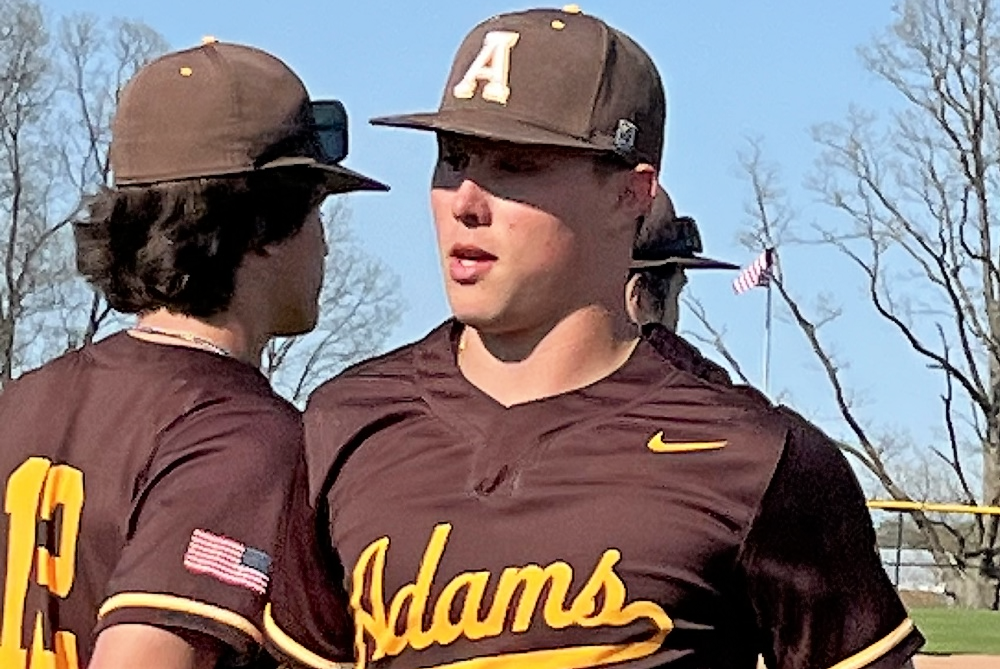
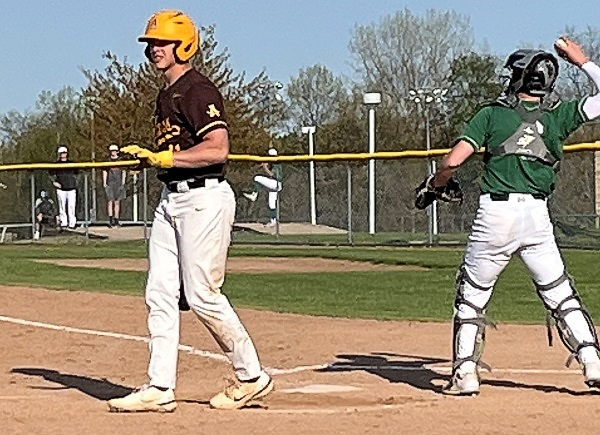
PHOTOS (Top) Rochester Adams’ Parker Picot comes to the dugout during a game against Lake Orion on May 9. (Middle) Picot looks to his third-base coach for signs while at the plate. (Photos by Keith Dunlap.)