

D1 Semis: South Seeks to Unseat Champ
June 12, 2014
By Andy Sneddon
Special for Second Half
EAST LANSING – One big inning, one big relief performance.
And Grosse Pointe South will play for an MHSAA baseball championship.
The Blue Devils used a five-run fourth inning and the clutch relief pitching of Andrew Eaton in topping Battle Creek Lakeview, 6-4, on Thursday in an MHSAA Division 1 Semifinal at Michigan State’s McLane Baseball Stadium.
South (27-17), seeking its first championship since 2001, will play defending champ Bay City Western (37-7) in the title game Saturday.
Western, ranked No. 4, advanced with a 6-1 victory over Clarkston and will attempt to become the first school in the 43-year history of the MHSAA tournament to win back-to-back championships at the highest level (Division I or Class A).
South is unranked and largely unheralded, but far from untested. The Blue Devils overcame a 7-12 start to win the rugged Macomb Area Conference Red and upset second-ranked Sterling Heights Stevenson on Tuesday in a Quarterfinal. South had lost three times, by a combined 26-5, to Stevenson during the regular season.
“I’m so proud of this group,” said Dan Griesbaum, who is in his 31st season as South’s coach and is the state’s ninth all-time winningest coach with 707 victories. “They’ve just come such a long way.
“What we’ve done the last three weeks has just been amazing. We’re not seeing anyone in the playoffs who’s better than what we saw in the regular season. We’re used to this kind of stuff. We’re used to playing good competition.”
South could muster just one hit, a Ronald Williams single, off Lakeview starter Jacob Herbers through three innings.
Trailing 1-0, the Blue Devils broke through in the fourth, batting around and using five hits, an error, and a wild pitch to seize a 5-1 lead.
Lakeview (32-6) responded in the next half inning, batting around and scoring three runs on four hits to draw to 5-4.
“The thing that you want, right after you get up like that, is to come out and shut them down, and that’s exactly what we didn’t do,” Griesbaum said. “It was kind of frustrating. But a good team keeps battling, and that’s exactly what we did.”
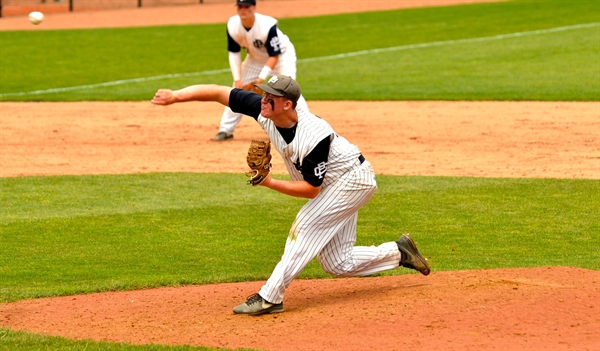
Eaton came on for starter Douglas Graham with a runner on third base and no one out after the Spartans had pulled close. Eaton, a sophomore right-hander, got a lineout and a groundout, but then issued a walk and hit a batter to load the bases. He got a strikeout to end the inning.
James Fishback’s RBI double in the fifth inning extended South’s lead to 6-4. Lakeview threatened in the seventh, using an error, a single and a walk to load the bases. Eaton induced a game-ending flyout to end the drama.
“I was a little nervous there, but I just knew I had to calm myself down and get through it,” said Eaton, who allowed two hits, walked two and struck out four over three innings. “I think we’re sort of like a Cinderella team. No one really expected us to be here. … It’s just been a great run for us.”
Graham earned the win, allowing nine hits while striking out four over four innings.
Herbers surrendered nine hits in taking the loss. He struck out six and walked two. Just three of South’s six runs were earned.
Lakeview finished with 11 hits – Gavin Homer, Herbers and Russell Mathiak had two apiece – but stranded 11 runners, including eight in scoring position. Click for the full box score.
Bay City Western 6, Clarkston 1
Brandon Wise had three hits and Scott Badour tossed a five-hitter for Western, a team that lost seven starters to graduation after winning the 2013 Division 1 championship.
 “I am (surprised), but I don’t want to downplay my team,” said coach Tim McDonald, who is in his 22nd year at Western. “They have been rock-solid for six straight (tournament) games. It’s going to take a really good team to beat us, because we don’t beat ourselves.
“In high school baseball and in probably any high school sport, if you don’t beat yourselves then that’s half the battle. If you don’t walk people and you don’t make errors – its tough to put two, three hits together at any level, and that’s what we’re making teams do.”
The Warriors graduated 10 players total off last year’s team, which became just the second in school history to win an MHSAA championship, along with the 1999 boys golf squad.
Six players from that 2013 baseball squad have gone on to play college ball.
“We have two starters back from last year, and we start four sophomores,” McDonald said. “They’ve stopped surprising me. I think they don’t think of themselves as sophomores anymore. We don’t have any stars on this team. We don’t have that one guy that you’ve really got to be careful of. It’s a team in every aspect of the word. We play baseball the way I think baseball should be played. We move runners along, we take advantage of opportunities, and it’s fun to watch.”
Western gave Badour all the support he would need with two runs in the second inning. The runners were driven home by Tyler Snover (sacrifice fly) and Jason Clark (two-out single), both sophomores.
Badour’s sacrifice fly and Snover’s RBI single in the fourth inning extended Western’s lead to 4-0, and the Warriors upped their advantage to 5-0 in the fifth when Carson Eby was hit by a pitch and eventually scored on a throwing error.
Clarkston got back-to-back doubles in the fourth inning from Nathan Witt and Mitch Smith to plate it’s only run.
Badour struck out four and walked two. The Wolves (20-13) stranded seven runners.
“That’s Scott Badour,” McDonald said. “Not overpowering, but he’s a pitcher with a capital ‘P.’ He knows what he’s doing; he uses his defense. He stepped up huge for us.”
Witt allowed nine hits and walked one over 5 1/3 innings in taking the loss.
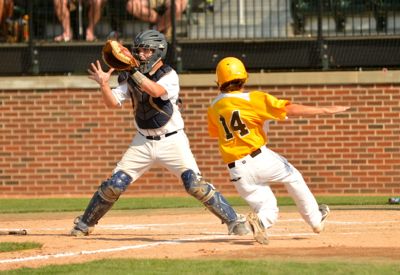
PHOTOS: (Top) Grosse Pointe South’s Andrew Eaton threw three innings of relief to help his team return to the Division 1 Final. (Middle) Bay City Western’s Zach Schirmer scores in the second inning past Clarkston catcher Nick Morey.
Ace Paces Richard's Championship Triumph
June 16, 2018
By Jason Schmitt
Special for Second Half
EAST LANSING – He’d seen a dropped third strike 100 times before Saturday’s championship game.
Excuse Riverview Gabriel Richard’s Matthew Silka for getting caught up in the moment.
With two outs in the seventh inning, the junior got a swinging third strike to seemingly clinch his team’s first MHSAA baseball title. But his biting breaking ball ended up in the dirt – so he looked at the catcher, then glanced at first. Finally, he turned and looked at his second baseman, who was charging toward him to celebrate.
At that moment, he figured it out. His team had just won the Division 3 championship, defeating reigning champ Madison Heights Bishop Foley, 3-0.
“I was so confused,” said Silka, smiling with a championship medal hanging from his neck. “That’s not an ideal way to end the game, because I’m not sure if we won or not. I was looking at the first base ump to see if he was going to call him out or not. We were all waiting for someone to say something.”
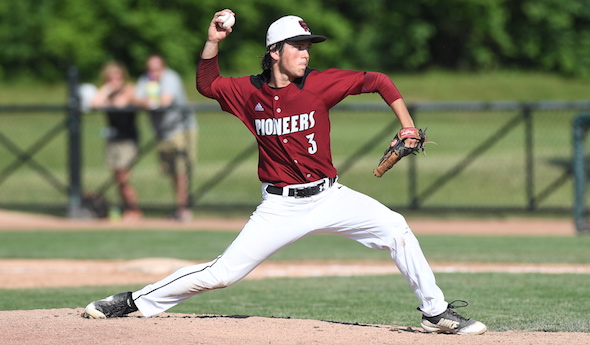
The game-ending strikeout was his seventh of the game, one he dominated from start to finish. Silka, a junior, allowed just one hit, that coming in the seventh inning. Prior to that single, he was on his way to becoming the first pitcher to toss a complete-game no hitter in MHSAA Finals history.
Instead, he became just the fifth pitcher in Finals history to allow just one hit in a complete game.
“I was trying to keep (the ball) to the corners, and not make too many mistakes and leave the ball over the heart of the plate,” Silka said. “I was just trying to throw strikes and help my teammates out.”
His teammates helped him out early on, scoring a run in the second, third and fourth innings to stake him to a 3-0 advantage.
 The Pioneers scored their first run unconventionally. Leadoff batter Hayden Burke reached on a dropped third strike. The junior then moved over to second base on a walk to fellow junior Frank Klamerus. Those two advanced to second and third thanks to a pair of wild pitches. Burke then scored on a fielder’s choice by junior Hayden Flynn to make it 1-0.
In the third inning, Richard pieced together three singles – the last by Flynn plated junior Niko Maloney. In the fourth inning, the Pioneers used a walk, sacrifice bunt and an RBI-single by sophomore David Zubor to cap off their scoring, giving Silka more than he needed to get the job done.
“I think momentum is one of the biggest parts of the game,” Silka said. “That was really huge for us to get out in front. I knew once we had a lead and we got rolling, it was going to be a lot easier to pitch.”
Richard coach Mike Magier said Silka’s success was due to his ability to keep the Ventures off balance.
“He went through the lineup one time and he gained a little confidence, and he could use his secondary pitches a little bit more,” Magier said. “(Silka) has been a workhorse for us. He’s really been a competitor.
“He’s been our ace. He’s pitched against all our tough teams.”
Bishop Foley (19-18-1) could muster just one hit – from sophomore Liam Pollock to lead off the seventh inning.
“That’s baseball,” Foley coach Tim McEvoy said. “We ran into a stud pitcher who threw strikes. He kept us off balance, and we weren’t able to get out in front of his fastball. That was the main issue.
“I want to congratulate their coaching staff. They have a great staff and a great pitcher.”
For Richard (29-3), this could be just a taste of what’s to come next year. There are no seniors on the roster, so everyone should be back for another title run in 2019.
“I guess it’s kind of unusual,” said Magier, talking about a lack of seniors on his roster. “That (junior) class, as soon as they came in in ninth grade, we had three or four guys come up on varsity and we knew we had a pretty good class there.
“It takes a lot to win a state championship, so we won’t take it for granted. We’re going to enjoy this one, and hopefully next year we can do the same.”
VIDEO: Gabriel Richard pitcher Matthew Silka finishes his seventh strikeout, which wrapped up the 3-0 win over the Ventures.
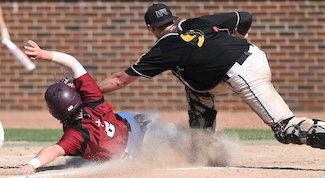
PHOTOS: (Top) Gabriel Richard ace Matthew Silka makes his move toward the plate Saturday. (Middle) A Pioneers runner tries to slide in under the tag of Bishop Foley catcher Mason Minzey.