

D2 Semis: Finals Veterans Book Return
June 12, 2014
By Andy Sneddon
Special for Second Half
EAST LANSING – Dillon McInerney delivered at the plate for Richmond on Thursday.
On Saturday, it may be his arm that helps bring the Blue Devils an MHSAA Division 2 championship.
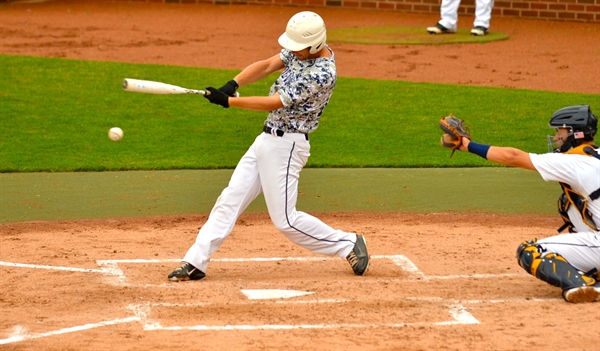
McInerney’s sixth-inning RBI double broke a 1-1 tie and lifted Richmond to a 2-1 win over DeWitt in their Semifinal at Michigan State University’s McLane Baseball Stadium.
Richmond (35-3) will play Mount Pleasant (31-8-1) in the title game Saturday. The Blue Devils, ranked No. 10, could turn to McInerney – or any number of standout arms – as they try to take the step that eluded them last season when they lost, 3-0, in the Final to Grand Rapids Christian.
“We just want it more this year because we lost last year,” said McInerney, who had two of Richmond’s eight hits. “We’re hungry. We’re not done yet, that’s for sure.”
Zach Leach went the distance for the win, striking out five, walking two and surrendering four hits. Leach improved to 11-1, while McInerney is 12-0 with a 1.00 earned run average and could get the ball in Saturday’s Final.
Third-year Richmond coach Scott Evans would not tip his hand as to who would start, but did say his players know full well what it’s going to take to win their 33rd consecutive game Saturday.
“You’ve got to have that stud rise up, and (Leach) was our guy today,” Evans said. “When it comes time for Saturday’s game, one of our studs has to play like a stud. Last year, no one stepped up for us in that final game.”
Leach stepped up big time when his team most needed him Thursday. Trailing 1-0 in the fifth inning, DeWitt loaded the bases on a Chris Ruby single and two walks. Ruby scored on a wild pitch, but Leach regained his composure and got the final out of the inning on a called third strike, stranding runners at second and third and keeping the game tied.
“I’ve just learned to clear my head and not worry about the base runners or what’s going on behind me and just throw the next strike,” Leach said. “(The umpire) gave me a low strike call, and I thank him for that because that was definitely a tight spot and if I wouldn’t have gotten that call it would have been bases loaded with two outs.”
“That was a good opportunity,” DeWitt coach Alan Shankel said. “It was a close call and it didn’t go our way. That’s the way the game is. It’s an uncontrollable factor. We don’t worry about those things, and you go to the next opportunity. They did a great job of keeping us off balance and limiting our opportunities.”
It didn’t take long for Richmond to regain the lead. Evan Kratt singled with one out in the top of the sixth inning, and then McInerney smoked the ball over the head of the centerfielder for a double, scoring Kratt with the go-ahead run.
Leach held the fort one last time when the Panthers threatened in the bottom of the seventh. Timmy Lowe doubled and reached third with two outs, but Leach got a game-ending grounder.
Evans stuck with Leach, a senior right-hander, despite several relief options, including Ryan Boyd, his shortstop and closer.
“He’s a four-year starter,” Evans said of Leach, “and he’s a guy that when you go out to talk to him at about 85 or 90 pitches, he says ‘I’m just getting loose Coach, get back to the dugout.’”
Leach doubled with two out in the second inning and scored on a Boyd single to break a scoreless tie.
Sam Smith struck out five and walked two in taking the loss. DeWitt, making its first Semifinal appearance since 2003, finished 23-11. Click for the box score.
Mount Pleasant 7, Richland Gull Lake 1
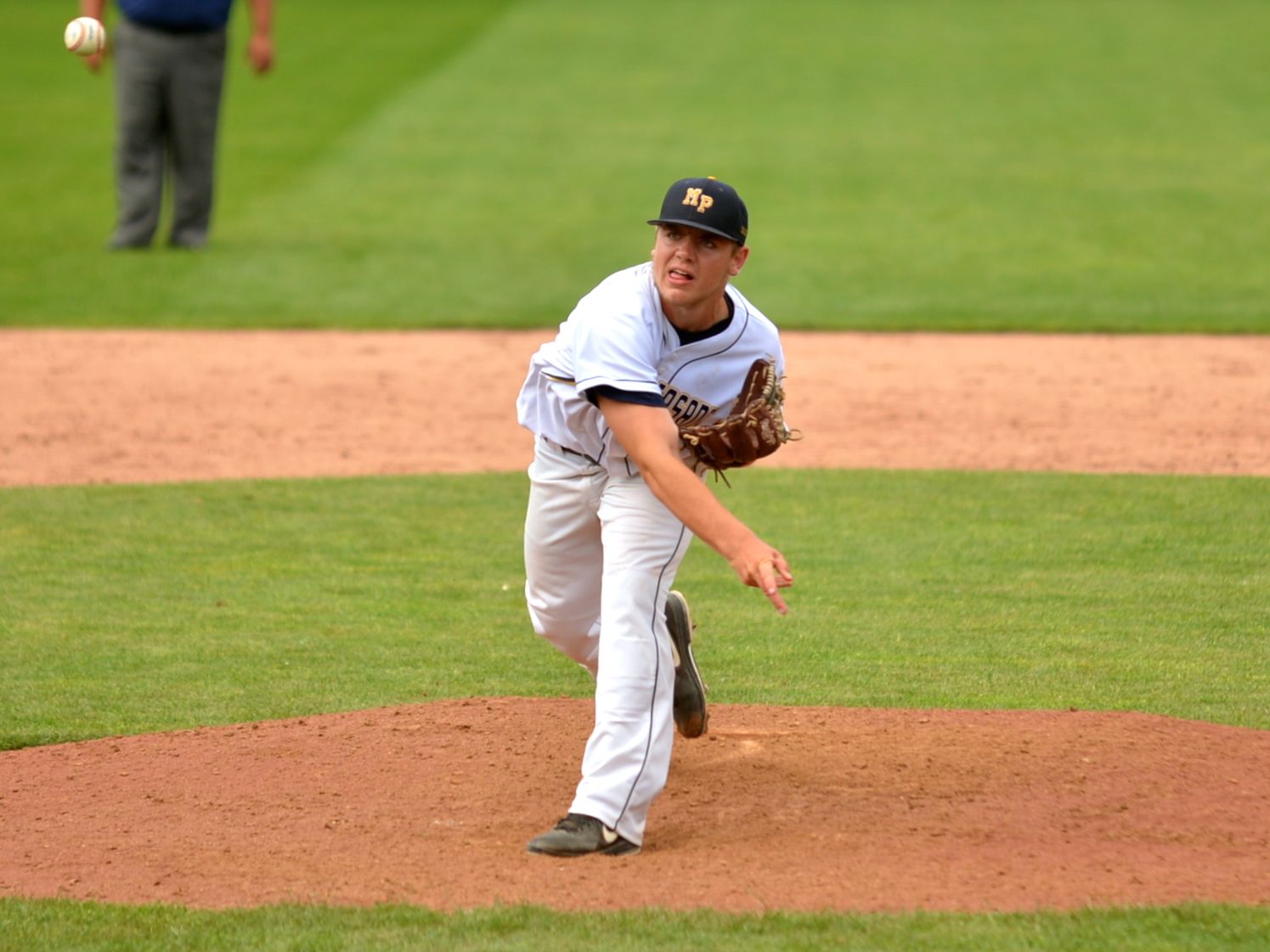
Hunter Buczkowski had three hits, drove in three runs and pitched a complete game in leading the Oilers to their first MHSAA title game since 2008.
Buczkowski struck out four, walked three and allowed five hits.
 Dean Marais also had three hits including a two-run double off the top of the fence in right field in the first inning, staking the Oilers – who had 12 hits – to a 2-0 lead.
Joe Genia added a pair of two-run singles for Mount Pleasant, which will vie for its third MHSAA title and first since 2007.
The Oilers fell in the Quarterfinals last season.
“They weren’t playing not to lose; they came here to win, and that’s what I’m most proud of,” Mount Pleasant coach Luke Epple said. “We thought we could have been here last year pretty easily, but we didn’t execute at the end (of the Quarterfinal loss) and we didn’t throw strikes.
“This year we’ve played much better defense and our pitching has been strong just like last year, but you’re seeing some of our young guys swing the bat and hit with men on. These are big games for us. Five of our (starting) guys today were underclassmen. We have confidence in them, and we know that they’re going to be good ballplayers.”
Buczkowski, one of four sophomores in the Oilers’ lineup Thursday, issued all three of his free passes and hit a batter in the seventh inning when the Blue Devils (30-10) scored their only run.
Buczkowski struck out Gull Lake cleanup hitter Jarod Burton with the bases loaded to end the game. Epple twice visited Buczkowski on the mound in the seventh.
“He said, ‘This is your game and I want you to finish it,’” said Buczkowski, who threw 115 pitches in improving to 8-2. “That seventh inning was the longest inning I think I’ve ever played.”
Walter Graf walked two and struck out two in taking the loss for Gull Lake. Click for the box score.
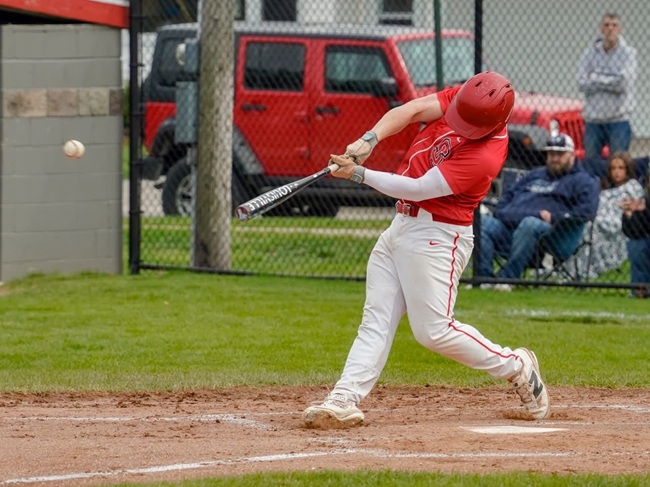
PHOTOS: (Top) A Richmond hitter connects during his team’s 2-1 Semifinal win over DeWitt on Thursday. (Middle) Hunter Buczkowski threw a complete game for Mount Pleasant as it advanced to Saturday’s Division 2 championship game.
Senior-Powered Spring Lake Answering Anticipation, Pursuing High Expectations
By
Dean Holzwarth
Special for MHSAA.com
April 29, 2026
SPRING LAKE – The time is now for the Spring Lake baseball team.
 With the return of 11 veteran seniors, the Lakers entered this spring with lofty expectations and an eye on an extended postseason run.
Anticipation has come to fruition in the form of a state ranking and a nearly perfect start.
“Our motto is we are going to worry about next year next year, and we are going to do all we can this year,” Lakers fourth-year coach Bill Core said. “We knew we were going to have a big experienced group coming back, and that's just how the roster folded out. We have a lot of experience, a lot of returners and pretty high expectations.”
Spring Lake, which finished as Division 2 runner-up in 2024 and won a conference title last year for the first time since 2014, is off to an impressive 13-1 start (9-0 in the Ottawa-Kent Conference Black) and has climbed to No. 7 in the latest coaches poll.
Core said the vast number of returners, which includes five players who will play in college next year, has paid early dividends.
“I think that’s been a big difference,” he said. “We’ve played some younger teams that were breaking in sophomores or juniors or new kids, and our guys were ready to go right from the start. It’s been an advantage early on.”
Senior starting pitchers Oliver Smies and Maddux Kipling believe the strong bond among the senior class has been a major factor in the torrid start.
 “I think something that’s really important about this team is our team chemistry and the amount of seniors we have on the team,” Smies said. “That alone allows us to have a ton of experience, and I think that's a big reason why we are off to such a hot start. We have been playing good team baseball and complementary baseball with good defense and good offense.”
Added Kipling: “We genuinely like being around each other, and every day we show up ready to get a little better. Our team has a real gritty and energetic identity, and I think that shows in how we compete and support each other.”
Kipling and Smies have been dominant on the mound this season. They haven’t allowed an earned run while combining for 80 strikeouts. Kipling earned a second-team all-state accolade as a junior and is headed to Michigan State next year. Smies will play at Calvin University.
“It starts with our pitching,” Core said. “Any time you are going to make a run, it starts with your pitching and we are pretty lucky, especially with our top two.”
Offensively, the Lakers possess a balanced lineup and boast a .330 batting average.
Senior Owen Smies, who will join his twin brother at Calvin, is hitting a team-best .432 with 13 RBIs. Seniors Alex Strauss (Adrian College) and Max Feltner (Muskegon Community College) are both batting .333 and have combined to score 25 runs.
As a team, Spring Lake has produced eight shutouts and nine wins by run differential.
“We got off to a good start, but we are going to play a lot better competition,” Core said. “This is a good week for us because we play Northview and state-ranked East Grand Rapids. We just picked them up, so we were excited to fill in the week with those two schools.”
Spring Lake is 62-6 over its last 68 games and trying to remain focused on each game as it attempts to erase the disappointment of last year’s early exit from the postseason.
 Despite winning 30 games, the Lakers suffered a 3-2 loss to Grand Rapids West Catholic in District play.
“I think there is some motivation there from that loss,” Oliver Smies said. “And I think that loss last year taught us that any team can beat any team, so you have to play your best baseball every single game no matter the opponent.”
Core said last year hasn’t been discussed, but believes it still sits in the back of his players’ minds.
“I think they think about that, but we've had quite a few mercies to start the season, and I said to them that when we get to the tournament it's going to be a one-run game and we are going to have to do the little things to make a difference because we are not going to win 14-0 all the time,” he explained. “We try to keep everyone in the moment.”
Kipling isn’t dwelling on the past – or looking too far ahead.
“As a group we’ve done a great job staying focused on the present and not getting caught up in the past or worrying too much about the future,” Kipling said. “My dad has always told me to focus on what you can control because putting energy into things you can’t control is a waste.
"That mindset has stuck with me, especially on the field. I try to live by ‘one pitch at a time,’ and because of that I haven’t really spent time thinking about last year’s loss. That’s behind us, and we’re just focused on what we can do right now.”
 Dean Holzwarth has covered primarily high school sports for Grand Rapids-based WOOD-TV for five years after serving at the Grand Rapids Press and MLive for 16 years along with shorter stints at the Ionia Sentinel and WZZM. Contact him at [email protected] with story ideas for Allegan, Kent and Ottawa counties.
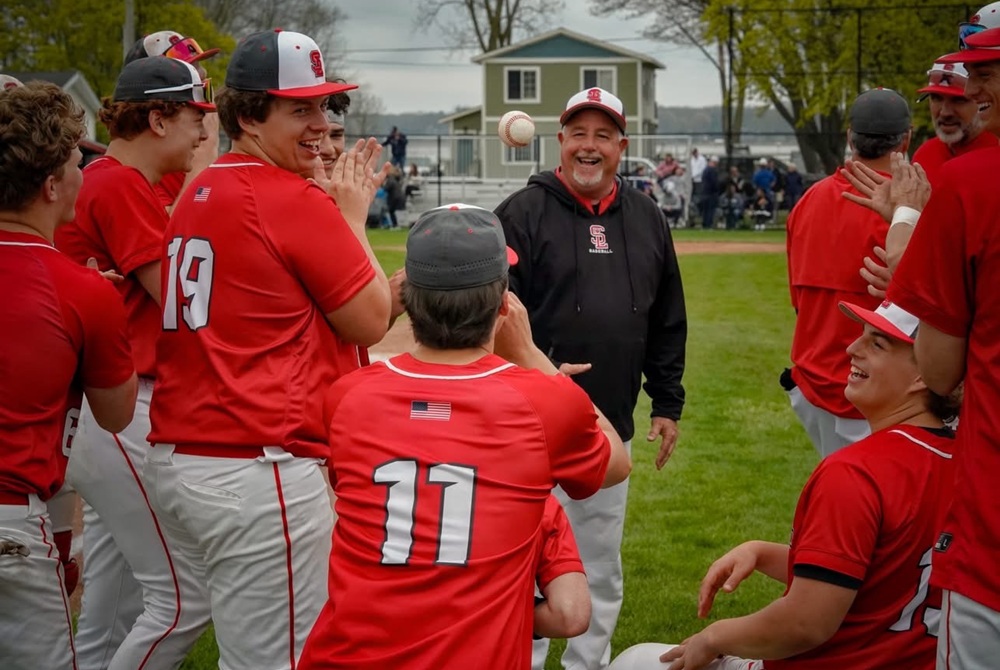
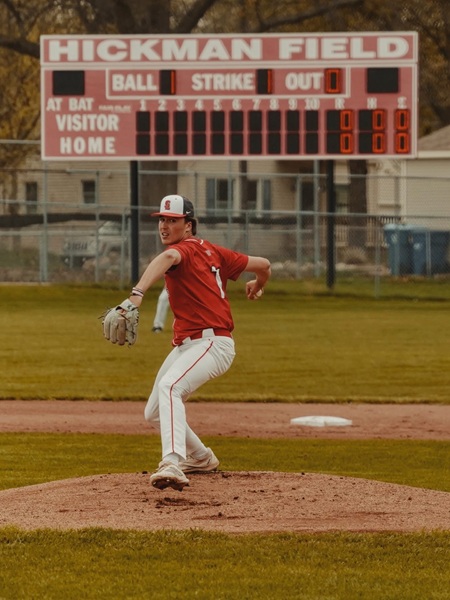
PHOTOS (Top) Spring Lake baseball coach Bill Core tosses Maddux Kipling his home run ball after a win over Fruitport. (Middle) Kipling pitching at Spring Lake's Hickman Field. (Below) Senior Oliver Smies connects with a pitch. (Photos by Trevor McCue/Grand Haven Tribune.)