

D3 Contenders Hold On for 1-run Wins
By
Tom Markowski
Special for Second Half
June 16, 2017
EAST LANSING – It looked like a mismatch. Madison Heights Bishop Foley, an annual powerhouse with plenty of pitching that had breezed through the tournament, against a sub-.500 team with little past tournament success.
It was anything but. Caro put a scare into the Ventures, but Bishop Foley held on for a 3-2 victory in a Division 3 Semifinal at Michigan State’s McLane Stadium on Friday.
Bishop Foley (24-12) will play top-ranked Traverse City St. Francis for the title at 2:30 p.m. Saturday.
St. Francis (38-3) advanced to its first Final thanks to some fine pitching and Cooper Peterson’s sacrifice fly in the eighth inning that pushed across the winning run in a 3-2 victory over Schoolcraft.
Bishop Foley, ranked No. 7 heading into this postseason and Division 3 champ from 2011-13, is a member of the highly competitive Detroit Catholic League, and the Ventures weren’t expected to be tested by a team that started 0-7 and had to adjust to a coaching change after the slow start.
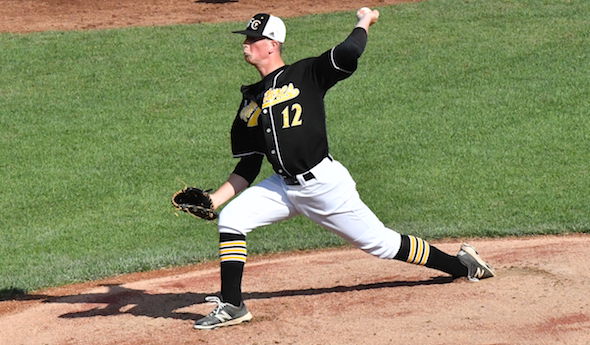
Ethan Hoffman went the distance for the victory as he struck out 11 and surrendered two hits, one walk and one earned run.
The Ventures scored runs in the first, third and fifth innings off Deven Hodder. Although they didn’t have many hard-hit balls, the Ventures appeared to be in good shape going into the top of the sixth inning.
But Caro’s Dylan Brown led off with a triple and scored on Conner Langenburg’s sacrifice bunt. Langenburg reached base on an error and later scored on a failed pickoff attempt. The Tigers had the tying run on first when Steven Strachan III was hit by a pitch, but the inning ended on a failed stolen base attempt.
Hoffman then set the side down in order in the seventh inning, sending the Ventures to their fifth MHSAA Final.
“I came in and did my routine,” Hoffman said. “Everything was working. I established my fastball early. That sixth was pretty nerve-racking. That seventh showed I could come back from that.”
Bishop Foley made a couple of base-running miscues as well. Evan Finegan knocked in the Ventures’ first run with a single but Justin Campbell, who had drawn a walk one batter earlier, was picked off of second to end the inning.
A Campbell single scored Finegan for Bishop Foley’s third run in the fifth inning, but a pickoff ended that rally as well.
Second-year Bishop Foley coach Greg Fettes is happy to be in the Final, but he wasn’t pleased with the overall play of his team.
“I told my guys that the only team that’s going to beat us in this tournament is ourselves,” Fettes said. “You almost saw that in the sixth. We haven’t done that all year. We looked like a Little League team.”
Fettes wasn’t pleased with his players’ approach at the plate either. Bishop Foley had scored 36 runs over its last three games entering Friday.
“That’s what we do, swing, swing, swing,” he said. “Look at our playoff wins. I’ll have them ready to go (on Saturday).”
Caro (15-22) outplayed Bishop Foley defensively. Shortstop Mason Campbell made a leaping catch to rob Finegan of a hit to start the sixth and Strachan, the first baseman, made an over-the-shoulder catch going down the foul line to retire the next batter.
Caro coach Victor Gomez said it was a smooth transition for him when he took over the program. He was an assistant for two seasons and was familiar with the players.
“We just had to let the kids know we believed in them,” he said. “I watched them grow up. I saw they had the skill set.”
Traverse City St. Francis 3, Schoolcraft 2
Joe Muzljakovich pitched the first 6 2/3 innings for St. Francis and kept his team in the game by getting out of bases loaded situation in the fifth. He was removed with the bases loaded in the seventh, and Conner Sweet came on in relief and threw one pitch to get out of that jam.
 Gabe Callery, the leadoff hitter, led off the eighth for St. Francis with a walk and ended up at third base after a failed pick-off and sacrifice. Junior Cooper Peterson came up to bad and did what coach Tom Passinault told him to do.
“He told me just to get a piece of the ball,” Peterson said. “He said get it to the outfield. I just kind of poked it. (Darren Kehoe) threw me a curve and I was a little out front.”
Ricky Clark batted in Schoolcraft’s first run in the first inning with a ground out that scored Nolan Anspaugh, who had tripled. Anspaugh also scored in the third on a sacrifice fly after reaching base on a double.
Blake Bales pitched well for No. 5 Schoolcraft (25-11), as he went 6 2/3 innings, allowed three hits and struck out eight.
Sweet picked up the victory for the Gladiators, allowing a walk and one base hit.
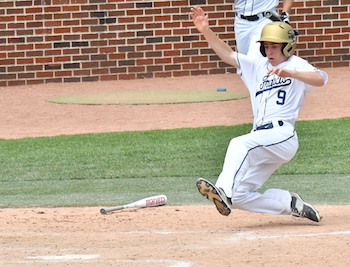
PHOTOS: (Top) Bishop Foley's Ethan Hoffman delivers a pitch during the first Division 3 Semifinal on Friday. (Middle) St. Francis' Artie Dutmers slides into home for one of his team's three runs.
Ace Paces Richard's Championship Triumph
June 16, 2018
By Jason Schmitt
Special for Second Half
EAST LANSING – He’d seen a dropped third strike 100 times before Saturday’s championship game.
Excuse Riverview Gabriel Richard’s Matthew Silka for getting caught up in the moment.
With two outs in the seventh inning, the junior got a swinging third strike to seemingly clinch his team’s first MHSAA baseball title. But his biting breaking ball ended up in the dirt – so he looked at the catcher, then glanced at first. Finally, he turned and looked at his second baseman, who was charging toward him to celebrate.
At that moment, he figured it out. His team had just won the Division 3 championship, defeating reigning champ Madison Heights Bishop Foley, 3-0.
“I was so confused,” said Silka, smiling with a championship medal hanging from his neck. “That’s not an ideal way to end the game, because I’m not sure if we won or not. I was looking at the first base ump to see if he was going to call him out or not. We were all waiting for someone to say something.”
The game-ending strikeout was his seventh of the game, one he dominated from start to finish. Silka, a junior, allowed just one hit, that coming in the seventh inning. Prior to that single, he was on his way to becoming the first pitcher to toss a complete-game no hitter in MHSAA Finals history.
Instead, he became just the fifth pitcher in Finals history to allow just one hit in a complete game.
“I was trying to keep (the ball) to the corners, and not make too many mistakes and leave the ball over the heart of the plate,” Silka said. “I was just trying to throw strikes and help my teammates out.”
His teammates helped him out early on, scoring a run in the second, third and fourth innings to stake him to a 3-0 advantage.
 The Pioneers scored their first run unconventionally. Leadoff batter Hayden Burke reached on a dropped third strike. The junior then moved over to second base on a walk to fellow junior Frank Klamerus. Those two advanced to second and third thanks to a pair of wild pitches. Burke then scored on a fielder’s choice by junior Hayden Flynn to make it 1-0.
In the third inning, Richard pieced together three singles – the last by Flynn plated junior Niko Maloney. In the fourth inning, the Pioneers used a walk, sacrifice bunt and an RBI-single by sophomore David Zubor to cap off their scoring, giving Silka more than he needed to get the job done.
“I think momentum is one of the biggest parts of the game,” Silka said. “That was really huge for us to get out in front. I knew once we had a lead and we got rolling, it was going to be a lot easier to pitch.”
Richard coach Mike Magier said Silka’s success was due to his ability to keep the Ventures off balance.
“He went through the lineup one time and he gained a little confidence, and he could use his secondary pitches a little bit more,” Magier said. “(Silka) has been a workhorse for us. He’s really been a competitor.
“He’s been our ace. He’s pitched against all our tough teams.”
Bishop Foley (19-18-1) could muster just one hit – from sophomore Liam Pollock to lead off the seventh inning.
“That’s baseball,” Foley coach Tim McEvoy said. “We ran into a stud pitcher who threw strikes. He kept us off balance, and we weren’t able to get out in front of his fastball. That was the main issue.
“I want to congratulate their coaching staff. They have a great staff and a great pitcher.”
For Richard (29-3), this could be just a taste of what’s to come next year. There are no seniors on the roster, so everyone should be back for another title run in 2019.
“I guess it’s kind of unusual,” said Magier, talking about a lack of seniors on his roster. “That (junior) class, as soon as they came in in ninth grade, we had three or four guys come up on varsity and we knew we had a pretty good class there.
“It takes a lot to win a state championship, so we won’t take it for granted. We’re going to enjoy this one, and hopefully next year we can do the same.”
VIDEO: Gabriel Richard pitcher Matthew Silka finishes his seventh strikeout, which wrapped up the 3-0 win over the Ventures.
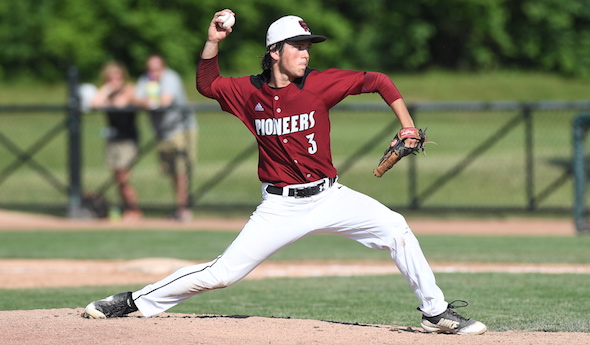
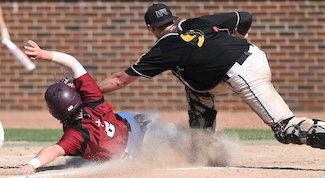
PHOTOS: (Top) Gabriel Richard ace Matthew Silka makes his move toward the plate Saturday. (Middle) A Pioneers runner tries to slide in under the tag of Bishop Foley catcher Mason Minzey.