

Freshmen Spark Royals' Regional Return
June 8, 2018
By Doug Donnelly
Special for Second Half
Larry Tuttle has seen just about everything in his 51 seasons of coaching the Blissfield varsity baseball team. So much, in fact, that there’s not a lot of “firsts” anymore on the diamond.
 But, when the Royals went out and won the 27th District title in Tuttle’s career last weekend, something new did happen. A 14-year-old pitched the Royals to the championship.
“He’s 60 years younger than me,” Tuttle said about his freshman pitcher, Ty Wyman. “That’s a lot of years.”
It’s also a lot of championships. The Royals are 25-9 this season and in the Regionals for the first time since 2010. The biggest reason they are still alive has been the development of the young players on the team. Eight of the 14 players on the Royals roster are either freshmen or sophomores, including Wyman.
“We started out a little shaky. We couldn’t find our groove,” said Wyman, who doesn’t turn 15 until late October. “It was mostly our defense. Once we started playing better defense, everything started coming together.”
When the Lenawee County Athletic Association coaches picked the all-league team this week, three of the Blissfield freshmen made first team – Wyman at first base, catcher Zach Horky and outfielder Gavin Ganun. That’s a rare feat, even for a coach as experienced as Tuttle.
“They are not just good baseball players, they are smart and outstanding athletes,” Tuttle said. “The success they are having now is a testament to how hard they have worked. They’ve had good coaching all along. They are intelligent baseball players. They know the game. Their parents have done a great job.”
Wyman said his teammates push each other on the field, court or diamond.
“We’ve been playing together since we were 6 years old,” he said. “We always push each other to do better.”
Ganun burst onto the Lenawee County sports scene in the fall when the ninth-grader was named the Blissfield starting varsity quarterback. All he did was guide the Royals to the third round of the MHSAA Playoffs and lead the county in passing yards. He also was a starter on the varsity basketball team in the winter and an immediate starter for the Royals baseball team. During the regular season, he batted .400 and tied for the county lead in hits, doubles and home runs.
“His dad played for our 1992 team that won a state championship,” Tuttle said of Ganun. “Next year, he’ll probably move into the infield and pitch for us.”
Horky started the season as an outfielder but became the starting catcher as the season went on.
“He worked his way into the catcher’s spot,” Tuttle said. “That really solidified our team.”
Growing up, Wyman mainly played second base. With that position already handled, he had to find a different spot to play on the Royals varsity team.
“I just wanted to play,” he said. “I wanted to work hard so that the coaches couldn’t keep me out of the lineup.”
He found a home at first base. As the season wore on, he also became one of Blissfield’s starting pitchers. In the District Final against Dundee, Wyman allowed just three hits and shut out the Vikings.
“I just wanted to throw strikes,” Wyman said. “I knew my defense was going to pick me up.”
Wyman comes from a strong background in sports. His mother, the former Melissa Stahl, is among the top girls basketball scorers in state history. His sister Kelsey was a Class C Associated Press basketball Player of the Year, and he has a brother on the current Royals baseball team.
Tuttle said the three freshmen all earned their spots in the lineup because of their work ethic in practice.
“It’s always been my philosophy that you earn your playing time in practice,” Tuttle said. “I tell the kids it doesn’t matter what grade you are in or what your name is. If you want to play, you have to earn it in practice.”
Wyman could get another shot to pitch Saturday if the Royals make the Regional Final at Clinton. Ann Arbor Greenhills (18-12) plays Jonesville (21-11-2) at 10 a.m. and the Royals take on Michigan Center (24-7) in the second Regional Semifinal.
Tuttle, who turned 74 on Wednesday, has won seven MHSAA championships during his tenure at Blissfield. He has no plans to leave the game that has meant so much to his life. He entered the season ranked second on the all-time Michigan high school baseball coaching victory list with 1,245. The leader is Grand Ledge’s Pat O’Keefe. A District champion as well, Grand Ledge is 32-3 this season, giving O’Keefe 1,286 wins, 16 more than Tuttle.
“These kids keep me young,” Tuttle said. “This was a pivotal year for us, but we have a great group of parents and I have a great coaching staff. I’m not able to do some of the things I used to be able to do, physically, but I still work with the kids. I can still teach the fundamentals, and I love working with them. I’m not going anywhere.”
 Doug Donnelly has served as a sports and news reporter and city editor over 25 years, writing for the Daily Chief-Union in Upper Sandusky, Ohio from 1992-1995, the Monroe Evening News from 1995-2012 and the Adrian Daily Telegram since 2013. He's also written a book on high school basketball in Monroe County and compiles record books for various schools in southeast Michigan. E-mail him at [email protected] with story ideas for Lenawee and Monroe counties.
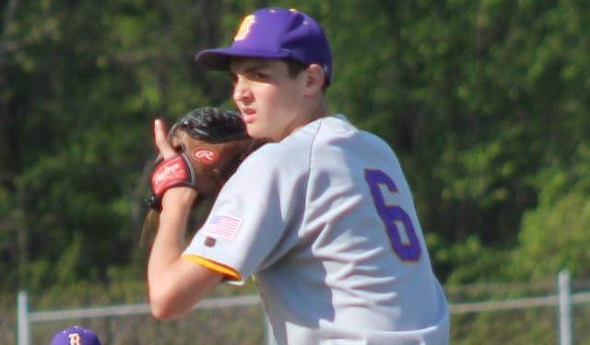
PHOTO: Blissfield pitcher Ty Wyman winds up during one of his turns on the mound this spring. (Photo courtesy of the Blissfield baseball program.)
Be the Referee: Injured Runner
By
Paige Winne
MHSAA Director of Brand Management
April 21, 2026
Be The Referee is a series of short messages designed to help educate people on the rules of different sports, to help them better understand the art of officiating, and to recruit officials.
Below is this week's segment – Injured Runner - Listen
We have a baseball scenario for you today:
Your team is down one in the ninth and you are standing on second base when your teammate hits a mammoth game-winning home run.
You are understandably excited. But – in your excitement of rounding the bases – you trip on third base and tear your Achilles tendon. You are unable to get up and continue to home plate.
The home run hitter stops at second base – unsure of where to go.
Because you are entitled to the next base on a home run, your team is able to bring in a pinch runner for the injured runner, and that person can finish running the bases and cross home plate.
The home run hitter can then continue rounding the bases and score the winning run.
Previous 2025-26 editions
April 14: Officiate Michigan Day - Listen
March 11: Basketball Replay - Listen
March 3: Over the Back - Listen
Feb. 24: Wrestling Out-of-Bounds - Listen
Feb. 17: Backwards Skiing - Listen
Feb. 10: Faking Being Fouled - Listen
Feb. 3: Bowling Pins - Listen
Jan. 27: Ski Gates - Listen
Jan. 20: Cheer Judges - Listen
Jan. 13: Basketball Over the Back - Listen
Jan. 6: Bowling Ball Bounces Out of Gutter - Listen
Dec. 9: Puck on Goal Netting - Listen
Dec. 2: Goaltending vs. Basket Interference - Listen
Nov. 25: Football Finals Instant Replay - Listen
Nov. 18: Volleyball Libero Uniforms - Listen
Nov. 11: Illegal Substitution/Participation - Listen
Nov. 4: Losing a Shoe - Listen
Oct. 28: Unusual Soccer Goals - Listen
Oct. 21: Field Hockey Penalty Stroke - Listen
Oct. 14: Tennis Double Hit - Listen
Oct. 7: Safety in Football - Listen
Sept. 30: Field Hockey Substitution - Listen
Sept 23: Multiple Contacts in Volleyball - Listen
Sept. 16: Soccer Penalty Kick - Listen
Sept. 9: Forward Fumble - Listen
Sept. 2: Field Hockey Basics - Listen
Aug. 26: Golf Ball Bounces Out - Listen