

Garden City Tackles Turnaround Together
May 17, 2019
By Geoff Kimmerly
Second Half editor
Few would argue that the formula for a successful high school baseball team usually includes hard throwers, slick fielders and a lineup stacked with guys who can move runs across the plate.
 But team chemistry is an often-overlooked part of that formula that this spring has meant everything to Garden City, one of the best turnaround stories in the state this season and the MHSAA/Applebee’s Team of the Month for April.
A year ago, the Cougars were on their way to an 8-20 finish. This spring, Garden City is 22-3 with a share of the Western Wayne Athletic Conference title and a No. 12 ranking in this week’s Division 1 state coaches poll.
“It sounds like something simple and an easy thing (to say), but team chemistry wasn’t there – it truly was an issue the last few years,” first-year varsity coach Jon Evans said. “They’d start out hot, and just out of nowhere the team would fall off the cliff. … They’d have tight ballgames, but they couldn’t win a one-run game.
“This year, it seems like the team is a lot closer. They play for each other. That’s helping us. When we’re in close games, we’re winning them now. Every day in practice, every day on the field, the kids are playing for each other.”
It’s impossible to argue with the results. Garden City equaled last season’s win total by April 8 and earned one of its best victories of the season by just a run, 1-0 over preseason Division 2 No. 1 Detroit Country Day.
Chemistry on the field no doubt has been cultivated in part from familiarity with the coach. Evans graduated from Garden City when his seniors were in junior high, in 2014, and after a year playing at Defiance College in Ohio coached the Cougars’ junior varsity the last three seasons while finishing his studies at Eastern Michigan University.
“It's nice because they know when I can say I can relate to them, they know that's true,” Evans said. “I was just in their shoes five years ago, even in the classroom, with things they go through inside the school. I had all the teachers. They have assignments, and I look at the assignment and say I remember doing this. It’s easy for me to help them, and it’s good for players building trust with their coach to know their coach just went through this.”
He took over the varsity in February and previously coached 15 of 18 players on this spring’s roster. Evans’ JV went 15-7 a year ago – a nice sign for this season and the next few to come.
 He also had paid attention to behind-the-scenes workings of running a varsity program over the last few years, and all of that familiarity made for a smooth transition when he took over.
“(The success) is not because of me, but having the same coach, I saw them every game they played freshman and sophomore year and I know what their tendencies are, what’s going through their minds,” he said. “It’s tougher competition, but I know how the kids are going respond. It didn’t take a few weeks for me – I knew right away what they were going to do, and the kids knew my coaching style and knew me stepping up to varsity was not going to change who I was.”
A trio of seniors has led the way offensively. First baseman Kevin Widner is hitting .457 with a .636 on-base percentage and 15 RBI, while catcher Trevor McCorry comes in at .438 with six doubles and Jacob Grant is hitting .426 with seven extra-base hits, 17 RBI, 28 runs scored and a .614 on-base percentage. Junior second and third baseman and pitcher Jacob May is adding a .379 average, 29 runs scored and 19 RBI to the offensive output.
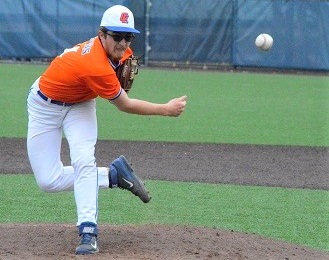
Grant is the ace on the mound with a 6-0 record and 1.04 ERA over 34 innings. A number of other pitchers fill out a deep staff of contributors – Widner again stands out with a perfect ERA and 19 strikeouts over 10 innings pitched.
The program had postseason success as recently as 2016, when it won a District title. There is reason to be excited with this spring’s District less than two weeks away, but the Cougars are being cautious – the District opener is against Livonia Franklin, one of just two teams to beat Garden City this season (they split; the other losses came in a sweep by Trenton), and the bracket is competitive throughout.
Evans had a feeling this group would do the little things that, combined with their talent, have sparked a memorable run. Regardless of how this spring finishes up, it’s fair to say it’s been unforgettable so far.
“I had a feeling we’d have a good year this year – it’s a talented group, and when they play hard, when they do the little things right, they succeed,” Evans said. “I saw it on JV – when they played good defense, ran the bases well, put the ball in play, those teams did well.”
Past Teams of the Month, 2018-19
March: Holland West Ottawa boys swimming & diving – Read
February: Lowell wrestling – Read
January: Farmington United gymnastics – Read
December: Warren Woods-Tower wrestling – Read
November: Rochester Adams girls swimming & diving – Read
October: Leland boys soccer – Read
September: Pickford football – Read
August: Northville girls golf – Read
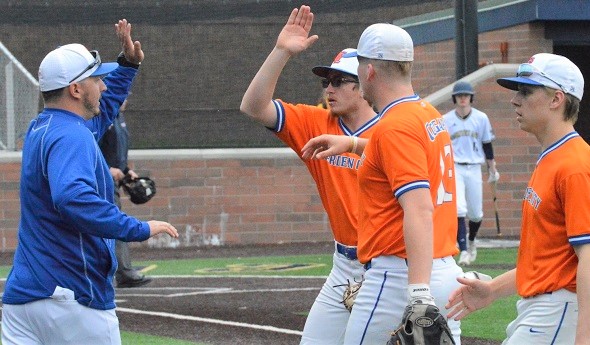
PHOTOS: (Top) Garden City celebrates during a win over Detroit Country Day last month. (Middle) Senior Jacob Grant fires a pitch – he’s 6-0 this spring. (Photos courtesy of State Champs Sports Network.)
Senior-Powered Spring Lake Answering Anticipation, Pursuing High Expectations
By
Dean Holzwarth
Special for MHSAA.com
April 29, 2026
SPRING LAKE – The time is now for the Spring Lake baseball team.
 With the return of 11 veteran seniors, the Lakers entered this spring with lofty expectations and an eye on an extended postseason run.
Anticipation has come to fruition in the form of a state ranking and a nearly perfect start.
“Our motto is we are going to worry about next year next year, and we are going to do all we can this year,” Lakers fourth-year coach Bill Core said. “We knew we were going to have a big experienced group coming back, and that's just how the roster folded out. We have a lot of experience, a lot of returners and pretty high expectations.”
Spring Lake, which finished as Division 2 runner-up in 2024 and won a conference title last year for the first time since 2014, is off to an impressive 13-1 start (9-0 in the Ottawa-Kent Conference Black) and has climbed to No. 7 in the latest coaches poll.
Core said the vast number of returners, which includes five players who will play in college next year, has paid early dividends.
“I think that’s been a big difference,” he said. “We’ve played some younger teams that were breaking in sophomores or juniors or new kids, and our guys were ready to go right from the start. It’s been an advantage early on.”
Senior starting pitchers Oliver Smies and Maddux Kipling believe the strong bond among the senior class has been a major factor in the torrid start.
 “I think something that’s really important about this team is our team chemistry and the amount of seniors we have on the team,” Smies said. “That alone allows us to have a ton of experience, and I think that's a big reason why we are off to such a hot start. We have been playing good team baseball and complementary baseball with good defense and good offense.”
Added Kipling: “We genuinely like being around each other, and every day we show up ready to get a little better. Our team has a real gritty and energetic identity, and I think that shows in how we compete and support each other.”
Kipling and Smies have been dominant on the mound this season. They haven’t allowed an earned run while combining for 80 strikeouts. Kipling earned a second-team all-state accolade as a junior and is headed to Michigan State next year. Smies will play at Calvin University.
“It starts with our pitching,” Core said. “Any time you are going to make a run, it starts with your pitching and we are pretty lucky, especially with our top two.”
Offensively, the Lakers possess a balanced lineup and boast a .330 batting average.
Senior Owen Smies, who will join his twin brother at Calvin, is hitting a team-best .432 with 13 RBIs. Seniors Alex Strauss (Adrian College) and Max Feltner (Muskegon Community College) are both batting .333 and have combined to score 25 runs.
As a team, Spring Lake has produced eight shutouts and nine wins by run differential.
“We got off to a good start, but we are going to play a lot better competition,” Core said. “This is a good week for us because we play Northview and state-ranked East Grand Rapids. We just picked them up, so we were excited to fill in the week with those two schools.”
Spring Lake is 62-6 over its last 68 games and trying to remain focused on each game as it attempts to erase the disappointment of last year’s early exit from the postseason.
 Despite winning 30 games, the Lakers suffered a 3-2 loss to Grand Rapids West Catholic in District play.
“I think there is some motivation there from that loss,” Oliver Smies said. “And I think that loss last year taught us that any team can beat any team, so you have to play your best baseball every single game no matter the opponent.”
Core said last year hasn’t been discussed, but believes it still sits in the back of his players’ minds.
“I think they think about that, but we've had quite a few mercies to start the season, and I said to them that when we get to the tournament it's going to be a one-run game and we are going to have to do the little things to make a difference because we are not going to win 14-0 all the time,” he explained. “We try to keep everyone in the moment.”
Kipling isn’t dwelling on the past – or looking too far ahead.
“As a group we’ve done a great job staying focused on the present and not getting caught up in the past or worrying too much about the future,” Kipling said. “My dad has always told me to focus on what you can control because putting energy into things you can’t control is a waste.
"That mindset has stuck with me, especially on the field. I try to live by ‘one pitch at a time,’ and because of that I haven’t really spent time thinking about last year’s loss. That’s behind us, and we’re just focused on what we can do right now.”
 Dean Holzwarth has covered primarily high school sports for Grand Rapids-based WOOD-TV for five years after serving at the Grand Rapids Press and MLive for 16 years along with shorter stints at the Ionia Sentinel and WZZM. Contact him at [email protected] with story ideas for Allegan, Kent and Ottawa counties.
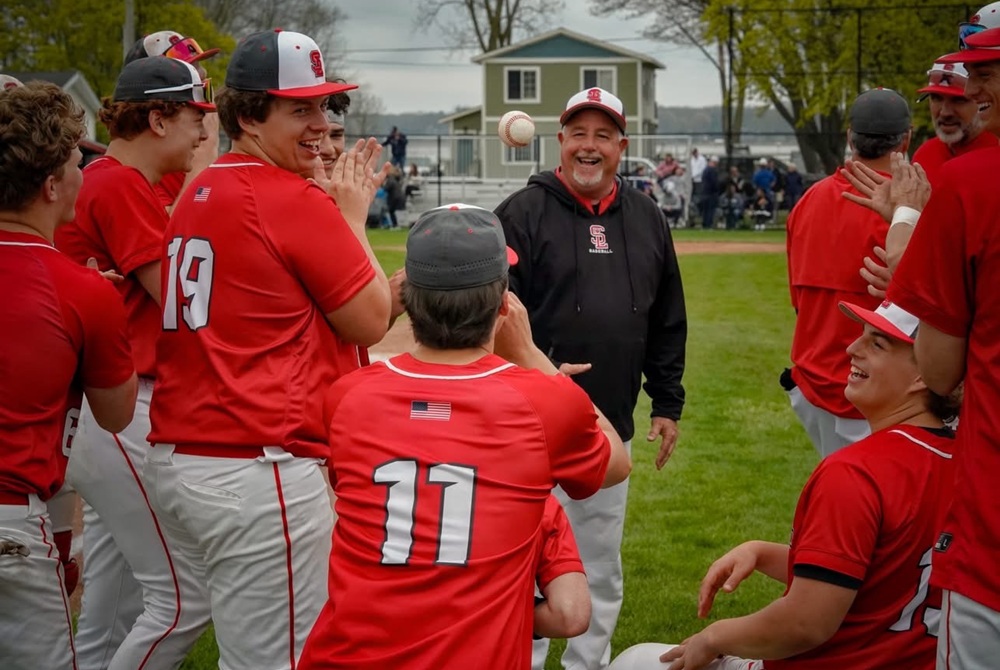
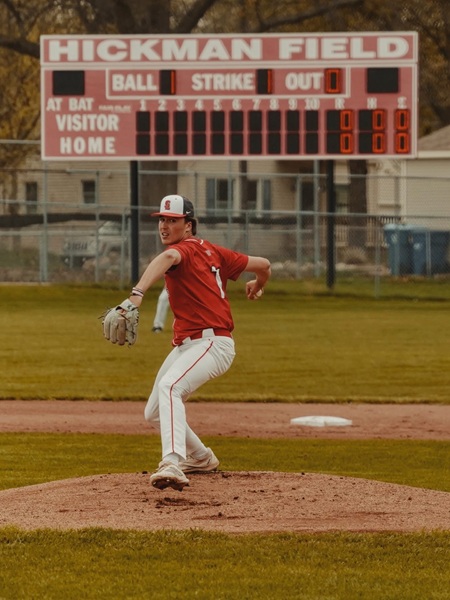
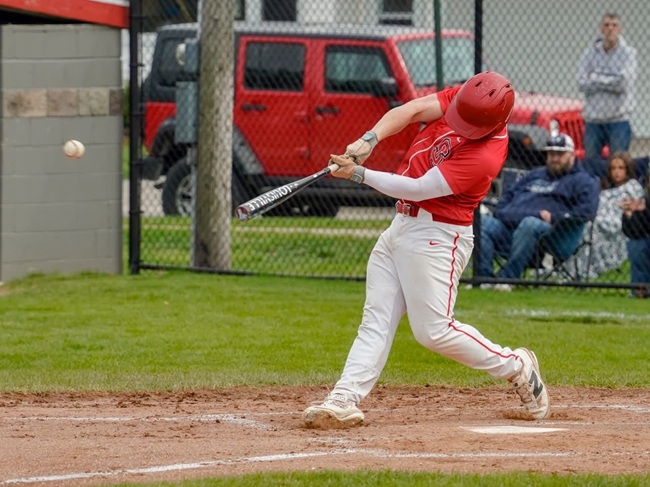
PHOTOS (Top) Spring Lake baseball coach Bill Core tosses Maddux Kipling his home run ball after a win over Fruitport. (Middle) Kipling pitching at Spring Lake's Hickman Field. (Below) Senior Oliver Smies connects with a pitch. (Photos by Trevor McCue/Grand Haven Tribune.)