

Orchard Lake St. Mary's, Grosse Pointe North Follow Aces to D1 Final

By Keith Dunlap
Special for MHSAA.com

June 17, 2022

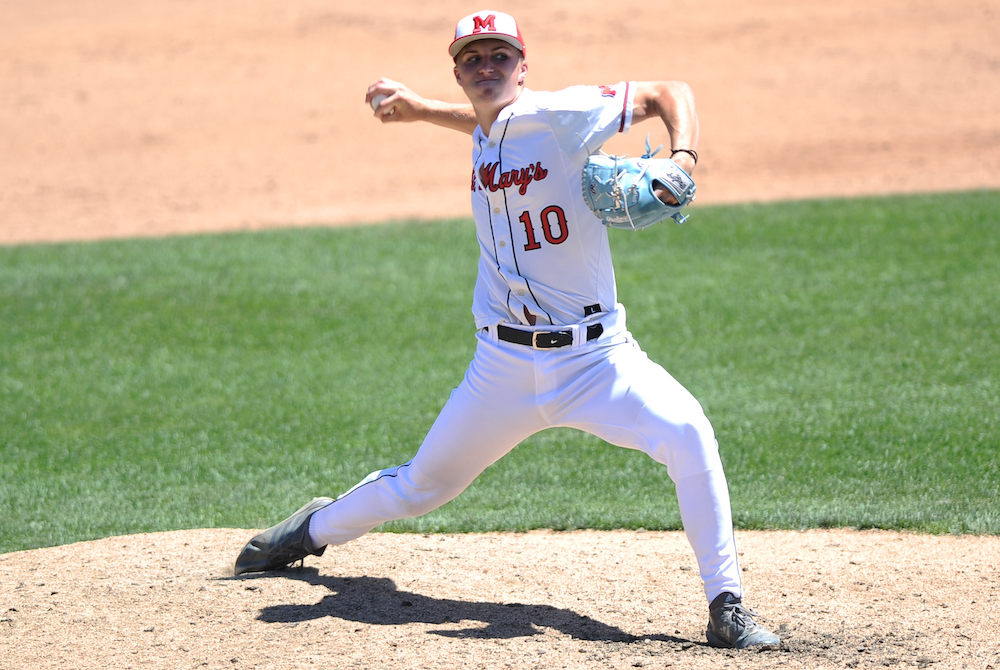
EAST LANSING – For the final time during his high school career, the Brock Porter show did not disappoint. 

There was a lot of anticipation for the second Division 1 Baseball Semifinal between Orchard Lake St. Mary’s and Grand Rapids Forest Hills Northern on Friday. Casual baseball fans, other teams, and of course professional scouts were in attendance at McLane Stadium to get a look at Porter, a senior pitcher for St. Mary’s and possible first-round pick in this summer’s Major League Baseball Draft. 

In his final high school appearance, Porter tossed a no-hitter to help lead the Eaglets to a 9-0 win. 

St. Mary’s (43-0), which won the last two Division 2 championships before moving into Division 1 this year, tied a state record for most wins in a season, and will look to set the record and finish this spring unbeaten in Saturday’s Final against Grosse Pointe North. 

Porter didn’t blow away Forest Hills Northern (24-12) with strikeouts like he has so many other opponents this year, recording only six. But he walked just two and didn’t allow much hard contact. 

“I kind of knew it was coming along once I was pitching a little bit,” said Porter, who has committed to play in college for Clemson, pending his draft situation. “I was just trying to go out there and give everything for my team.” 

St. Mary’s opened the scoring with two runs in the first inning when senior Jack Crighton stole home on a double-steal play and senior Ike Irish hit an RBI single up the middle.

The Eaglets tacked on another run in the second inning on an RBI single by Crighton to make it 3-0 before delivering a crushing blow in the fourth.

With the bases loaded and two outs, senior Nolan Schubart blasted a grand slam over the fence in right field to give the Eaglets a 7-0 lead.

“That was a huge hit for us,” St. Mary’s coach Matt Petry said. “It’s a 3-0 ballgame, and to make it 7-0 gave us some breathing room and some room for error.”

St. Mary’s added a single run in the sixth inning to round out the scoring. 

Scubart, Crighton and Irish all finished with two hits to lead an eight-hit attack for the Eaglets. 

Forest Hills Northern coach John Dolce praised his players for getting the program to the state’s final four for the first time. But Porter was just too much.

“Obviously he’s an incredible pitcher,” Dolce said. “He gets every pitch across. He’s a competitor, and we just ran into an incredible baseball team today. I told our players

it’s not life and death and to just enjoy the experience. We enjoyed the opportunity.”

Click for the full box score.

Grosse Pointe North 8, Battle Creek Lakeview 0

North coach Kevin Shubnell said his team lost the coin flip that determined whether it would be home or away for the first Division 1 Semifinal against Lakeview, but he wasn’t all that disappointed.

“Our philosophy the whole tournament has been to be the visiting team,” Shubnell said. “We’ve won the toss a few times and chosen to be visitors because we felt like our lineup could put up  a run or two and give our starting pitcher a little cushion.”

Grosse Pointe North baseballThe Norsemen did just that, scoring two runs in the first inning and five runs in the second to jump out to a big early lead.

Grosse Pointe North (23-7) advanced to its first Final since winning it all in 2006. 

After getting staked to a big lead, North junior ace Jordan Arseneau – who entered having allowed just one earned run all year – was able to pitch relaxed the whole game. 

“It puts a lot of pressure off of me,” Arseneau said. “It puts me into a good mindset that I just have to do my game, throw the ball over the plate and let my defense make plays.”

Arseneau finished with a five-hit shutout, striking out five and walking two. 

Grosse Pointe North loaded the bases with nobody out in the first inning on two walks and a hit batter, and then made it 1-0 when senior Luke Babcock walked with the bases loaded.

North then took a 2-0 lead on a sacrifice fly by sophomore Brennan Hill. 

The Norsemen took advantage of more Lakeview pitching miscue in the second inning, taking a 4-0 lead on a passed ball and a bases-loaded walk to senior Jake Tedesco. 

Babcock drove in another run on a fielder’s choice to make it 5-0, a lead which grew to 7-0 following a sacrifice fly by Hill and an RBI single by senior Bryan Carney. 

Grosse Pointe North added another run in the fourth inning on another bases-loaded walk. 

“We didn’t play terrible, but we didn’t play great,” Lakeview coach Kyle Kracht said. “It was a tough time for us to not play our best baseball, but these kids have nothing to hang their (heads) on. They did a great job and had a great season.”

Click for the full box score.

PHOTOS (Top) Orchard Lake St. Mary’s Brock Porter makes his move toward the plate during Friday’s second Division 1 Semifinal. (Middle) Grosse Pointe North’s Drew Hill tracks a fly ball during his team’s Semifinal win.
Despite Annual Early-Season Challenges, Northern Teams Carve Space Among Contenders

By Steve Vedder
Special for MHSAA.com

June 4, 2025

It may be 35 years later, but whenever Brian Endres touches base with old Traverse City St. Francis baseball teammates, the conversations invariably turn to one unpleasant topic.

They still wonder how they survived Michigan's brutal early spring ballgames played in temperatures which barely crept over the freezing mark, while wearing a sweatshirt beneath their uniforms offered little help or when a hitter prayed he wouldn't take a fastball off the handle of his bat.

They remember games played in a cold rain, dodging swirling snowflakes and trying to survive blustery, bone-chilling winds.

It's a wonder, the players reminisce now, how they ever shivered through baseball in northern Michigan in April.

"You just never knew about the weather," said Endres, a senior outfielder on the 1990 Traverse City St. Francis team that defeated Climax-Scotts 7-6 to win the Class D title. "You never knew what you'd have to deal with. You just took note of it and played; it was part of the game. You would get to a game and it'd be pouring rain, but you played because it was tough to find a day to squeeze in a game. It was always tough to get in a flow."

Getting in a flow of a northern Michigan baseball season is a slow process which begins with the official start of practice in gyms – this season kicking off March 10.

While teams in southern Michigan will enjoy a handful of days when they can escape outside to practice, teams in the northern part of the state are confined to limited drills in often undersized gymnasiums. It's not uncommon, coaches say, that the first time getting outside coincides with the team's opening game.

Until teams finally step on a baseball field, coaches prioritize fundamentals, utilize drop-down indoor batting cages, round pitching arms into shape, roll ground balls in carpeted school hallways, conduct Wiffle ball home run derbies and even teach seminars on how to score a baseball game just to break up the monotony. Some coaches even bring umpires into the gym during practices to help players sharpen their batting eyes.

Coaches say finding a variety of work to keep ballplayers interested after they've chased Wiffle around a gymnasium for a month is an annual challenge.

Maple City Glen Lake players gather around coach Kris Herman to celebrate his 400th victory during the 2022 season. "We maximize every space," current St. Francis coach Tom Passinault said. "You're in small gyms so you have to be creative. But it's tough."

Maple City Glen Lake coach Kris Herman, who recently won his 500th game, has witnessed high school baseball from both a downstate perspective and from coaching in the north. A former assistant for legendary Blissfield coach Larry Tuttle, Herman said he's had teams which can't get outside for the first eight weeks of the season. Herman recalls one season when the team didn't open until May 1 and a game where the team played in rain, sun and snow – at the same time. His team has been snowed out as late as May 10.

Herman said being stuck in a gym when southern teams have already been outside gaining valuable work in for several weeks can get old.

"I tell people we are the best bunt-scrimmage team in America," Herman said. "Everyone is used to it, but we still grumble. Nobody wants to play an outdoor sport indoors. What you want is for things to be in place for when there is good weather."

Former St. Francis coach Craig Bauer, who brought baseball to that school in 1979 then won that Class D title 11 years later, said northern coaches have the same goals and priorities as southern Michigan coaches, but those ideas must be implemented along a different timeline. He said northern teams often have a couple of credible pitchers, but can use inside time to find up 4-6 more arms. Batting cages and hitting machines are helpful, but because of a hitter's timing, can only mimic live pitching to a certain level.

The only true solution is getting outside, which doesn't happen until mid-April – and that's with a seasonable spring.

"The weather is continually a factor. It's usually well into April when you're getting out for the first time," Bauer said. "Sometimes your opening game is the first time you've got outside. But you get into a season and make do."

It's even worse for the smattering of Upper Peninsula teams. Rudyard coach Billy Mitchell, the 2023 Michigan High School Baseball Coaches Association Coach of the Year, said it's a major challenge trying to field a program north of the Mackinac Bridge. In fact, it may sound crazy, but when it comes to besting horrible weather, ignorance is bliss, Mitchell said.

"Weather plays a big factor," he said. "But the players don't know any different. They know Rudyard wants to play the best competition, and we have to travel to do it. A lot of northern schools, whether it's just the school (philosophy) or the administration,  they don't play a lot of games. We try to load up on games."

Rudyard’s Eli Sprague, left, fist-bumps his first-base coach during a 2023 Division 4 Semifinal. With this year's 44th MHSAA Tournament underway – and set to conclude June 14 at Michigan State’s McLane Stadium – the question arises how northern Michigan teams have fared since the first in 1971. If you define "northern" schools as ones located north of the east/west M-55 corridor from Manistee in the west through Cadillac to Tawas City in the east, only four schools – Cheboygan Catholic Central (1973-74), Mesick (1982), Traverse City St. Francis (1990) and Hillman (1992, 1994, 1997)) – have won MHSAA Finals championships.

Granted, there have been myriad near-misses by northern teams such as the 1981 Mesick team which lost 1-0 to Reading in the Class D Final, or the 2017 and 2021 Traverse City St. Francis clubs that lost in Division 3 championship games. Frankfort finished second in Class D in 1978 and 1979, losing those two Finals 4-1 and 4-3, respectively. Gaylord St. Mary was the Class D runner-up in 1988 and 1989.

Considering that tournament history, a natural question arises as to whether northern teams are at a disadvantage, even though the tournament doesn't start until late May. Coaches don't necessarily have a definitive answer, but most believe their programs have caught up to the rest of the state in terms of games by District time.

Numbers bear that out. For instance, according to the May 14 MHSBCA poll, the top eight ranked teams in Division 1 have played an average of 28 games while the same number of ranked Division 2 teams have averaged 24. The seven Division 3 and 4 schools considered "northern" schools ranked in the polls have averaged 23 games this season.

While competition and a challenging schedule are factors in postseason success, coaches believe they're on par with downstate schools by June 1.

"By May we're playing good baseball, we can compete with teams downstate," Herman said. "(The MHSAA Semifinals) is absolutely a goal, and you should be shooting for the ultimate goal. But if you don't make it, you're still satisfied by how far you got. We're got environmental things to work around, but we're starting to build programs up here and people are enthusiastic about it."

Passinault said scheduling plays a major factor. To compensate for the weather, St. Francis travels south to Kalamazoo, Grand Rapids, Muskegon, Lansing and even Detroit for games. When the weather improves, the schedule changes to playing teams closer to Traverse City.

"We're caught up by then," said Passinault, whose team once won 53 consecutive Lake Michigan Conference games. "I've never heard anyone up here say we can't win."

Bauer and former Mesick coach James Linna say winning a championship can come down to a single, Cinderella-type season where all the chips fall into place. Considering that many northern schools are among the smallest in the state, most of the programs get only a single, once-in-a-generation shot at a championship.

For instance, Bauer recalls the 1990 team getting a couple of key transfers, a freshman and a junior who had played in southern Michigan and who became the starting shortstop and second baseman. The team relied on a deep bench, benefitted from playing only two games against Class C and D teams, and had a powerful lineup that combined to hit nearly .350 for the season while scoring a combined 14 runs across the Semifinal and Final games.

The Mesick baseball team won the 1982 Class D title. "All the cards fell together," Bauer said.

Linna, now 90 years old, actually had two once-in-a-lifetime opportunities. The 1981 Mesick club lost in the Finals before going 30-0-1 with a tie against Frankfort en route to the Class D championship the next season.

"We had pretty decent weather that year and once it was warm, it was so much easier to play by late April," said Linna, who coached from 1967-98. "But you've still got to have the players to win. We had kids who wanted to play and win, and I wasn't going to hold them back.

"But we just don't have the same weather that the teams in the south have, and that makes for a difficult time. Put it this way: Upper Michigan teams have to deal with disadvantages more than southern teams. They definitely have an advantage, but we hang in there."

Like Traverse City St. Francis, Mitchell said Rudyard will travel south early to play games, a choice that ultimately helps a program at tournament time. Rudyard plays at places such as Mount Pleasant, Alpena, Gaylord and Cheboygan – basically utilizing the I-75 corridor – to strengthen its schedule. That's much of what Mitchell credits for four District and two Regional titles and two Semifinals trips since 2020.

"It's like being a college team," he said. "You go south early and play, come back home to practice, then go south again. People look at us and see an Upper Peninsula team, but our goal is to make it to Michigan State.

"Just because we're a U.P. team, that doesn't hold us back."

PHOTOS (Top) Traverse City St. Francis players hold up a banner after clinching the 1990 Class D baseball title at Battle Creek’s Bailey Park. (2) Maple City Glen Lake players gather around coach Kris Herman to celebrate his 400th victory during the 2022 season. (3) Rudyard’s Eli Sprague, left, fist-bumps his first-base coach during a 2023 Division 4 Semifinal. (4) The Mesick baseball team won the 1982 Class D title. (St. Francis and Glen Lake photos are courtesy of those respective programs’ past/current coaches.)