

Sontag Inspires Amid 'Miracle' Cancer Fight
January 3, 2020
By Doug Donnelly
Special for Second Half
PINCKNEY – Dave Sontag could tell something was wrong.
 The gymnasium at Petersburg-Summerfield High School is bigger than most in Monroe County. But when Sontag, a veteran official, was running up and down the floor, he felt unusually tired and began feeling pain in his back.
“I knew something was wrong,” Sontag said. “During a timeout, I told one of the other officials who was in the stands watching that he might have to finish the game.”
Sontag, however, pushed through and made it.
“That’s when it all began,” he said.
A few weeks later, as the Saline varsity baseball coach, Sontag was hitting fly balls to the Hornets’ outfielders.
“I was struggling,” he said. “I called the players in and told them something was wrong. I had to stop.”
Still trying to fight through whatever was wrong, Sontag was coaching third base during a Saline intra-squad scrimmage a short time later.
“I started to see white,” he said.
He had another member of the Saline coaching staff call his wife, Michelle, who came and picked him up and took him to the hospital in Chelsea.
“My blood counts were trash, just trash,” he said. “The doctors said I need to have a blood transfusion.”
He was rushed to a Detroit-area hospital for the transfusion. After tests, Sontag was diagnosed with acute lymphoblastic leukemia, an extremely vigorous, aggressive cancer. That was May 15, 2018.
During the 18 months since, Sontag has gone through chemotherapy and radiation treatments. He’s watched multiple communities respond with fundraisers and benefits and amazing support. He’s had more than one bone marrow transplant. He’s heard from countless friends and ex-players who have continued to lift his spirits day after day via e-mails and text messages. He’s been counted out more than once.
Yet, he’s survived.
“Every day has been a challenge,” he said.
***
Sports and Sontag have gone together from the beginning.
He is a Monroe County native who was The Monroe Evening News Player of the Year in baseball in 1978 and went on to play at the University of Toledo. He taught journalism and English at his alma mater, Monroe Jefferson, before becoming a counselor for another 12 years. He was also the Jefferson director of athletics and recreation for a time.
 He coached baseball for the Bears, leading the team to nearly 400 victories and the Division 2 championship in 2002. He stepped down from coaching to follow his kids, who were playing at higher levels; Ryan Sontag played at Arizona State University and in the Chicago Cubs organization. Susan played softball at Bowling Green State University, and Brendan played ball at Indiana Tech University.
Still, the desire to coach never left their dad.
“After my kids were done playing, I coached freshman baseball at Jefferson,” he said. “I missed it and still wanted to be part of it.”
With his wife a principal in the Saline district, Sontag was asked by Scott Theisen, Saline’s head coach, to join his staff in 2015. He was with the Hornets when they captured the Division 1 championship in 2017, then was named head coach before the 2018 season started.
“That was the year I got sick,” he said. “I didn’t even finish the year.”
Sontag also has been a basketball official for years, getting his start in the early 1980s. He’s been a registered MHSAA high school basketball official for 40 years and has trained officials for the Monroe County Basketball Officials’ Association. He’s called four MHSAA Finals championship games.
“My first varsity game ever was when I was 21,” Sontag said. “I refereed a game at Whiteford.”
***
Sontag previously battled non-Hodgkin’s lymphoma in 1995-1996, beating that disease after a nine-month battle.
Although this cancer battle began as he was new to the Saline community, they embraced his fight, selling “Team Tags” T-shirts and painting the youth baseball diamond with a big ribbon. His son, Ryan, was invited to throw out the first pitch before the youth baseball season started in Dave’s honor.
Back home, in Monroe County, Sontag’s school held similar fundraisers and blood drives.
“I had so much support,” he said. “It was quite amazing to see.”
He tried all sorts of treatments, ultimately boarding an airplane and heading to Seattle for a clinical trial. It didn’t work.
“At that point, I didn’t think I was going to live,” Sontag said. “They told me there was nothing more they could do. They just were giving me something to take the pain away. I was miserable.”
Still, Sontag said, he held out hope.
“I felt it wasn’t time yet,” he said. “I have three grandkids. There are things I want to do. There’s so much I haven’t accomplished yet. In Seattle, they didn’t count on me living.”
But, for a still-unexplained reason, a combination of the medicine he was given to “take the pain away,” on his flight home and a different medicine he received when he returned to Michigan, started to change the way he felt. His blood counts started getting better.
“The side effects were lousy, but, for some reason, it threw me into remission. They checked for leukemia and it was not there.
“We called it a miracle.”
***
Sontag, who lives in Pinckney now, is still dealing with the side effects of nearly two years of treatments. He has a tingling sensation in his arms and legs – the feeling people get when their hands or feet ‘fall asleep’ – and he has a weak immune system.
 But he gets a little better every day.
“Every day is a blessing,” he said.
In addition to the community support and constant praying, he credits his wife with guiding him through this process.
“Michelle has been a rock through all of this,” he said. “She’s been by my side every single day. Without her, I don’t know if I would have made it.”
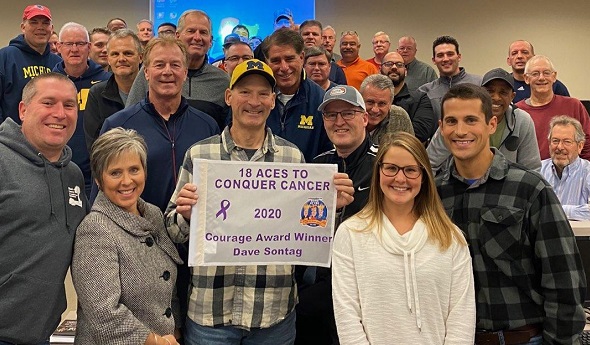
Recently, the Monroe County Officials’ Association held a banquet during which Sontag was presented with a “Courage Award.” He isn’t sure if he’ll be able to referee again anytime soon.
“I told them that night that I’d like to do it again, somewhere,” he said. “I don’t care of it’s a seventh-grade game. I just want to get out there again.”
In addition to the outpouring of love from multiple communities, family and friends, Sontag said sports has kept him alive.
“Sports is part of my fabric,” he said. “Baseball and officiating basketball games has given me that motivation I’ve needed to fight through this. I don’t know if I will coach again or referee again. I’m definitely not going to jump into the same schedule. But there are things I would like to do.
“Will I become a head coach again? Probably not. The task of being a head coach is probably too big right now. But I’d like to be involved. I’d still like to run camps and clinics. I’d still like to officiate too. I want to be a part of it. It’s something that’s in my blood.”
His son Ryan lives in Saline and has three children. Ryan coaches his son in a youth baseball league.
“He called me the other day and asked if I’d help him out,” Dave Sontag said. “I told him I think he will get me out there at some point.”
 Doug Donnelly has served as a sports and news reporter and city editor over 25 years, writing for the Daily Chief-Union in Upper Sandusky, Ohio from 1992-1995, the Monroe Evening News from 1995-2012 and the Adrian Daily Telegram since 2013. He's also written a book on high school basketball in Monroe County and compiles record books for various schools in southeast Michigan. E-mail him at [email protected] with story ideas for Jackson, Washtenaw, Hillsdale, Lenawee and Monroe counties.
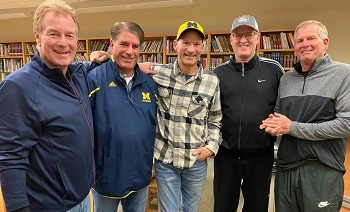
PHOTOS: Longtime official and coach Dave Sontag – standing in front row with wife Michelle, daughter-in-law Amy and son Brendan – is presented a “Courage Award” by the Monroe County Officials Association. (Middle) Sontag, formerly baseball coach at Monroe Jefferson and Saline, mans his spot on the baseline. (Below) Sontag with officials, from left, Mike Gaynier, Mike Bitz, Mike Knabusch and Dan Jukuri. (Top and below photos courtesy of Knabusch; middle photo courtesy of the Monroe News.)
D1 Semis: South Seeks to Unseat Champ
June 12, 2014
By Andy Sneddon
Special for Second Half
EAST LANSING – One big inning, one big relief performance.
And Grosse Pointe South will play for an MHSAA baseball championship.
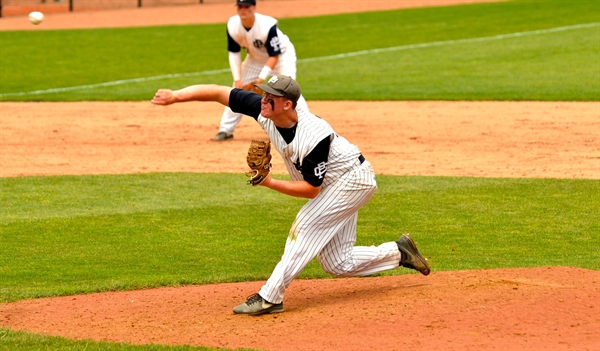
The Blue Devils used a five-run fourth inning and the clutch relief pitching of Andrew Eaton in topping Battle Creek Lakeview, 6-4, on Thursday in an MHSAA Division 1 Semifinal at Michigan State’s McLane Baseball Stadium.
South (27-17), seeking its first championship since 2001, will play defending champ Bay City Western (37-7) in the title game Saturday.
Western, ranked No. 4, advanced with a 6-1 victory over Clarkston and will attempt to become the first school in the 43-year history of the MHSAA tournament to win back-to-back championships at the highest level (Division I or Class A).
South is unranked and largely unheralded, but far from untested. The Blue Devils overcame a 7-12 start to win the rugged Macomb Area Conference Red and upset second-ranked Sterling Heights Stevenson on Tuesday in a Quarterfinal. South had lost three times, by a combined 26-5, to Stevenson during the regular season.
“I’m so proud of this group,” said Dan Griesbaum, who is in his 31st season as South’s coach and is the state’s ninth all-time winningest coach with 707 victories. “They’ve just come such a long way.
“What we’ve done the last three weeks has just been amazing. We’re not seeing anyone in the playoffs who’s better than what we saw in the regular season. We’re used to this kind of stuff. We’re used to playing good competition.”
South could muster just one hit, a Ronald Williams single, off Lakeview starter Jacob Herbers through three innings.
Trailing 1-0, the Blue Devils broke through in the fourth, batting around and using five hits, an error, and a wild pitch to seize a 5-1 lead.
Lakeview (32-6) responded in the next half inning, batting around and scoring three runs on four hits to draw to 5-4.
“The thing that you want, right after you get up like that, is to come out and shut them down, and that’s exactly what we didn’t do,” Griesbaum said. “It was kind of frustrating. But a good team keeps battling, and that’s exactly what we did.”
Eaton came on for starter Douglas Graham with a runner on third base and no one out after the Spartans had pulled close. Eaton, a sophomore right-hander, got a lineout and a groundout, but then issued a walk and hit a batter to load the bases. He got a strikeout to end the inning.
James Fishback’s RBI double in the fifth inning extended South’s lead to 6-4. Lakeview threatened in the seventh, using an error, a single and a walk to load the bases. Eaton induced a game-ending flyout to end the drama.
“I was a little nervous there, but I just knew I had to calm myself down and get through it,” said Eaton, who allowed two hits, walked two and struck out four over three innings. “I think we’re sort of like a Cinderella team. No one really expected us to be here. … It’s just been a great run for us.”
Graham earned the win, allowing nine hits while striking out four over four innings.
Herbers surrendered nine hits in taking the loss. He struck out six and walked two. Just three of South’s six runs were earned.
Lakeview finished with 11 hits – Gavin Homer, Herbers and Russell Mathiak had two apiece – but stranded 11 runners, including eight in scoring position. Click for the full box score.
Bay City Western 6, Clarkston 1
Brandon Wise had three hits and Scott Badour tossed a five-hitter for Western, a team that lost seven starters to graduation after winning the 2013 Division 1 championship.
 “I am (surprised), but I don’t want to downplay my team,” said coach Tim McDonald, who is in his 22nd year at Western. “They have been rock-solid for six straight (tournament) games. It’s going to take a really good team to beat us, because we don’t beat ourselves.
“In high school baseball and in probably any high school sport, if you don’t beat yourselves then that’s half the battle. If you don’t walk people and you don’t make errors – its tough to put two, three hits together at any level, and that’s what we’re making teams do.”
The Warriors graduated 10 players total off last year’s team, which became just the second in school history to win an MHSAA championship, along with the 1999 boys golf squad.
Six players from that 2013 baseball squad have gone on to play college ball.
“We have two starters back from last year, and we start four sophomores,” McDonald said. “They’ve stopped surprising me. I think they don’t think of themselves as sophomores anymore. We don’t have any stars on this team. We don’t have that one guy that you’ve really got to be careful of. It’s a team in every aspect of the word. We play baseball the way I think baseball should be played. We move runners along, we take advantage of opportunities, and it’s fun to watch.”
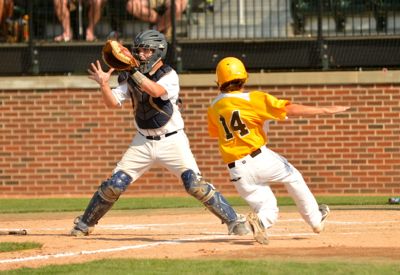
Western gave Badour all the support he would need with two runs in the second inning. The runners were driven home by Tyler Snover (sacrifice fly) and Jason Clark (two-out single), both sophomores.
Badour’s sacrifice fly and Snover’s RBI single in the fourth inning extended Western’s lead to 4-0, and the Warriors upped their advantage to 5-0 in the fifth when Carson Eby was hit by a pitch and eventually scored on a throwing error.
Clarkston got back-to-back doubles in the fourth inning from Nathan Witt and Mitch Smith to plate it’s only run.
Badour struck out four and walked two. The Wolves (20-13) stranded seven runners.
“That’s Scott Badour,” McDonald said. “Not overpowering, but he’s a pitcher with a capital ‘P.’ He knows what he’s doing; he uses his defense. He stepped up huge for us.”
Witt allowed nine hits and walked one over 5 1/3 innings in taking the loss.
PHOTOS: (Top) Grosse Pointe South’s Andrew Eaton threw three innings of relief to help his team return to the Division 1 Final. (Middle) Bay City Western’s Zach Schirmer scores in the second inning past Clarkston catcher Nick Morey.