

St. Mary's Earns Another Saturday Return, Taking on History-Making Kenowa Hills
By
Steve Vedder
Special for MHSAA.com
June 11, 2026
EAST LANSING – Death, taxes and Orchard Lake St. Mary's baseball team finding itself in another MHSAA Finals championship game.
The last of those three certainties was affirmed again Thursday when the torrid Eaglets blanked Dearborn Divine Child 8-0 in a Division 2 Semifinal at Michigan State.
Orchard Lake St. Mary’s used two productive innings to soar into Saturday's 9 a.m. title game against Grand Rapids Kenowa Hills. The spot in the Finals will be the program's 10th since 2007, with three titles won from 2019-2022 and six since 1998.
Despite the long track record of success, Eaglets coach Nick DiPonio said the winning never gets old or taken for granted. The program has averaged 33 victories per season since claiming the 2019 Division 2 title.
"This was definitely not just another game," said DiPonio, whose No. 1-ranked team upped its winning streak to 26 games. "We're battle-tested. We play in a great league with great players, and we're used to competition. We've become good at blocking out all the extraneous noise."
Orchard Lake St. Mary's sent 12 batters to the plate to score five runs in the third inning and added three more runs in the fifth. The third inning barrage included three triples, including one by Hudson Brzustewicz with the bases loaded. Luke Crighton drove in a run with another triple.
The trio of runs in the fifth included an RBI single by Zach Essig, one of three current Eaglets who had older brothers play on previous state champions. Essig said his current teammates are well-aware of the program's previous success.
"It's crazy," said Essig, who has two older brothers on former champs. "I'm the only one without a ring; we haven't won anything yet. Those guys were role models for us. Our older brothers pushed us. We've got a lot of good guys on this team, and we're capable of beating anyone when we play well."
Crighton, who scattered four hits and faced only three batters over the minimum, thought he did a quality job of wading through a Divine Child lineup which scored 30 runs over the Regionals and Quarterfinal.
"I threw strikes and felt strong, and overall I thought I did okay," he said. "I was able to trust the defense to make the plays.
DiPonio said Crighton is a big-game pitcher.
"I expected him to go out and do this, the last two years, really," DiPonio said. "He always gives us a good chance to win. He throws strikes with multiple pitches."
Brzustewicz said there is no doubt one of the team's foremost goals is to carry on the long history of success in June. That success is felt by virtually all the players, he said.
"There is a brotherhood; we're going out there for our brothers,” he added. “We like to have fun and win, and we're right there this year. We've won like 26 in a row, but I don't know if we're at the same level yet as some of those teams. A couple won 40-some games."
Dearborn Divine Child coach Jeremy Shay, who has seen plenty of talented Eaglets teams in his four years, says the current club is a good one because it covers all parts of the game.
"They're very good," he said. "They obviously can hit and have very good pitching and play well defensively. They're tough to beat.”
Grand Rapids Kenowa Hills 9, Vicksburg 6
While Kenowa Hills may be known for an outstanding pitching staff, it was a pair of clutch seventh-inning hits that propelled the Knights into their first MHSAA Baseball Final.
Trailing 6-5 entering their final at-bats and having blown a 5-0 lead earlier, the Knights got a two-run triple from senior outfielder Andrew Lake and run-scoring single by Jack Stoddard to up their winning streak to 20 games.
 "I was looking fastball and I choked up on the bat, and (the pitcher) hung a curve and I turned on it," Lake said. "You dream for this moment."
The clutch hits aside, Kenowa Hills (36-2) entered the game with a remarkable pitching staff which included three pitchers who had combined for a 26-1 record and ERA of under two runs a game. Kenowa Hills pitchers have 13 shutouts this season and 28 games where they have held teams to three runs or fewer.
"That's been our team all year – we battle," Stoddard said. "We come together as a team and have stayed motivated."
Kenowa Hills led 5-0 in the third inning with Hudson Drake driving in one run on a sacrifice fly and Brennan Gustinis adding an RBI triple.
But Vicksburg (30-8) cut the margin to 5-2 in the bottom of the third and then took a 6-5 lead into the seventh. Bulldogs junior outfielder Maguire Bowles drove in three runs with a single, bases loaded walk and triple. Graham Kubiak also drove in a pair of runs.
Despite the eye-popping numbers posted by the pitchers, first-year Kenowa Hills coach Todd VandenHeuvel said his club can hit and score clutch runs. The team entered Thursday with a .380 team batting average and come-from-behind wins over Grand Rapids Forest Hills Central and East Grand Rapids that proved to players that despite being unranked to start the season, they could be a power.
"Can we be really good or great?" he asked players earlier this season. "I think we've moved the needle toward being great. We've played from behind late before. It was an unusual situation, but I think it allowed us to play an aggressive game. That doesn't surprise me; that's what great teams do.
"I think we have a perfect balance of both (hitting and pitching). We like getting a run every inning; we don't do a lot of three or four-run innings."
Vicksburg coach Brian Deal, who is retiring after 28 years and 487 wins, said a team from a small town like Vicksburg making a Semifinal is a major feat.
"It's great for all the small towns," he said. "We did this for all those small towns. We think we can go toe-to-toe with any team. We had our chances to put more runs on the board."
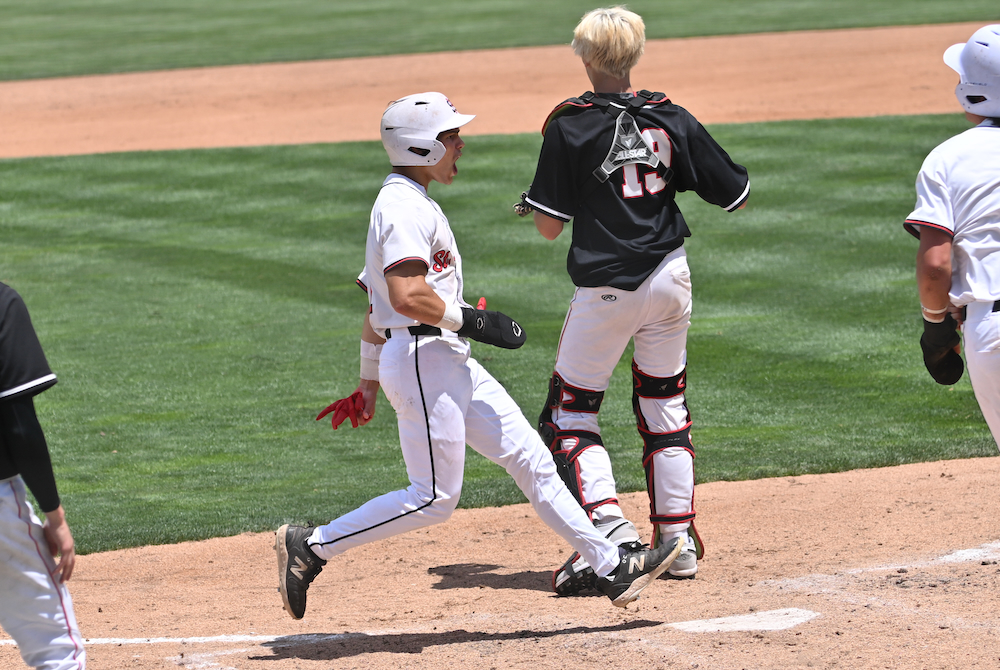
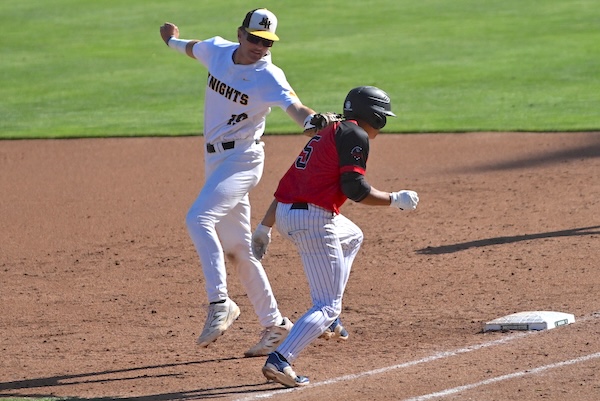
PHOTOS (Top) An Orchard Lake St. Mary’s runner crosses the plate during the Eaglets’ Division 2 Semifinal win Thursday at McLane Stadium. (Middle) Kenowa Hills’ Bobby Haisma (19) applies a tag on Vicksburg’s Maddox Rosalin a few steps in front of first base.
Marine City Makes More History, St. Francis Outlasts Historic Opponent
By
Drew Ellis
Special for MHSAA.com
June 12, 2025
EAST LANSING – Winning its first Regional championship in program history was a big accomplishment for the 2025 Marine City baseball team.
Now, the Mariners find themselves one win away from their first Finals championship.
Utilizing aggressive base running and timely hits, Marine City defeated Olivet, 8-5, in a Division 3 Semifinal on Thursday at McLane Stadium.
“It means everything to us,” Marine City coach Ryan Felax said of his team’s first Finals appearance. “Marine City hasn’t won a Regional up until this year, so we’re three games beyond the first time ever. For us to be able to come out here and do what we have done, feeling like we were the underdog since the District Finals, is a special feeling. I can’t even express what it means to the program, what it means for our city, and what it means for the seniors, especially.”
Marine City (26-10) will face Traverse City St. Francis in Saturday’s championship game at 9 a.m. The Mariners believe they are going into the title-deciding contest with nothing to lose.
“We don’t have any pressure on us,” said Marine City senior Daniel VandeVyver, who got the win on the mound Thursday. “We’ve been looked down this whole tournament. There’s no pressure, so we’ve all just been coming out here, playing the game, and having a blast while doing it. We’re coming out with the (wins), so it’s great.”
VandeVyver threw 6.1 innings to earn his eighth win of the season for Marine City. After giving up a pair of runs in the first, the senior would go on to pitch five straight scoreless innings, allowing only three hits during the stretch.
“I came into that second inning with a lot more confidence,” VandeVyver said. “I was working more off-speed pitches and not using as many fastballs. It was working for me.”
The senior was also a key piece to the offense, finishing with three hits and three RBI.
“Danny VandeVyver is a special player,” Felax said of his senior. “He’s been doing this for me for four years. He’s a special pitcher. He’s a special kid. When he stays out of his own head, he can do pretty much anything.”
Olivet (22-7) got out to the 2-0 start in the first inning thanks to five singles in six batters, but the Eagles would strand the bases loaded as they looked to establish a larger advantage.
“We had bases loaded in the first inning and should have gotten more out of that,” Olivet coach Mike Whitley said. “We didn’t get as many as we should.”
Marine City answered in the top of the second, utilizing stolen bases and bunts to set up a sacrifice fly from freshman Tucker Volkman. VandeVyver than had an RBI single to even up the score at 2-2.
In the fifth inning, the Mariners broke the game open with four runs. The go-ahead run came when junior Dakota Droptiny was unable to get a bunt down, so he had to take a swing with two strikes. Droptiny proceeded to hit an RBI double to put Marine City up 3-2.
“Hey, I’ll take it,” Felax said. “He’s just a kid that doesn’t rattle.”
Lukus DeSmyther followed with an RBI single, then VandeVyver had a two-run double to make it 6-2 for Marine City.
The Mariners tacked on two more runs in the top of the eighth inning thanks to an error by Olivet and a double steal. All together, Marine City had 10 stolen bases in the win.
“You have to give (Marine City) credit. They are a heck of a team,” Whitley said. “They played a little small ball on us, which you don’t see in this area a whole lot. We just didn’t take care of business when we had the opportunity.”
Olivet made a late push in the bottom of the seventh inning, scoring three runs thanks to an RBI double from freshman Andrew Rigelman and a two-run single from senior Lucas LaPaugh.
The tying run reached the plate before the Mariners recorded the final out.
“They just battled every day for me, and I think that showed in the seventh inning,” Whitley said. “Who knows, one more hit, it might have been a different ball game.”
Lalo Aguirre finished with four hits and two runs for Olivet, while Trip Burkett had two hits and an RBI.
Droptiny finished with two hits, two runs and an RBI, while Paul Muscat stole three bases for the Mariners.
Traverse City St. Francis 4, Grosse Pointe Woods University Liggett 3
In order to play for its first Finals championship since 1990, Traverse City St. Francis had to overcome the one baseball program with more championship game appearances than anyone else.
The Gladiators took advantage of some early Liggett errors to establish a 4-1 lead. From there, they held on behind the pitching of junior Sam Wildfong for a 4-3 victory in the first Division 3 Semifinal on Thursday.
 “It was a great, great high school baseball game. Ligget is a great, great program. We felt like we had to knock the giant off to get to the Finals,” Traverse City St. Francis coach Tom Passinault said. “It feels great, because we have a lot of respect for their program. Our guys really battled today.”
Liggett, which has appeared in 10 Finals, defeated St. Francis 12-0 in the 2021 Division 3 championship game, the last Finals appearance for the Gladiators.
St. Francis (30-8-1) struck first, taking advantage of a few Knights miscues. An error put runners on the corners for the Gladiators, and then Wildfong scored on a wild pitch to make it 1-0.
A two-run single from junior Tyler Thompson in the second inning extended the St. Francis lead to 3-1.
Junior Matthew Kane opened the bottom of the fourth inning with a double to left field. He then scored two batters later when freshman Colton Peterson laid down a squeeze bunt to put the Gladiators up 4-1.
“We had our best bunter at the plate. Colton Peterson is so calm and cool, and Matt is a great base runner, so it was just a perfect combination for us,” Passinault said of the play.
With the three-run lead, Passinault believed that Wildfong would be able to pitch his team to victory.
“In games where we got up a few runs and we had Sam pitching, we felt pretty good about our chances,” Passinault said. “Sam is a gym rat in the baseball sense. He’s 365 baseball. He is always ready. He’s the guy you want in that moment.”
Liggett was able to get the Gladiators’ lead down to one as it manufactured one run each in the fourth and fifth innings. However, the Knights stranded a pair in the sixth inning who could have changed the game.
“We put the ball in play all game; that wasn’t the issue. We just couldn’t get them around,” Liggett coach Jay Ricci said. “We started to make that happen later in the game, but we just couldn’t get that last run across the plate.”
Wildfong found another gear in the seventh inning, striking out the first two batters before getting a ground out to end the game. The junior finished with three strikeouts for the contest, allowing one earned run over seven innings.
“I treated it like any other inning. I was just having fun with my friends out there,” Wildfong said of the seventh. “The fastball was really working that last inning, and it was really fun to dial in and locate it well.”
Thompson finished with a pair of hits to go with his two RBI. Liggett was led by Ravi Hines, who had a single and an RBI. Reliever Joey Harris pitched three scoreless innings to keep the Knights in the game when down 4-1.
“He did great, and we were real confident he would come in and shut the door,” Ricci said of Harris. “That was expected. Joey Harris has done a great job all year for us.”
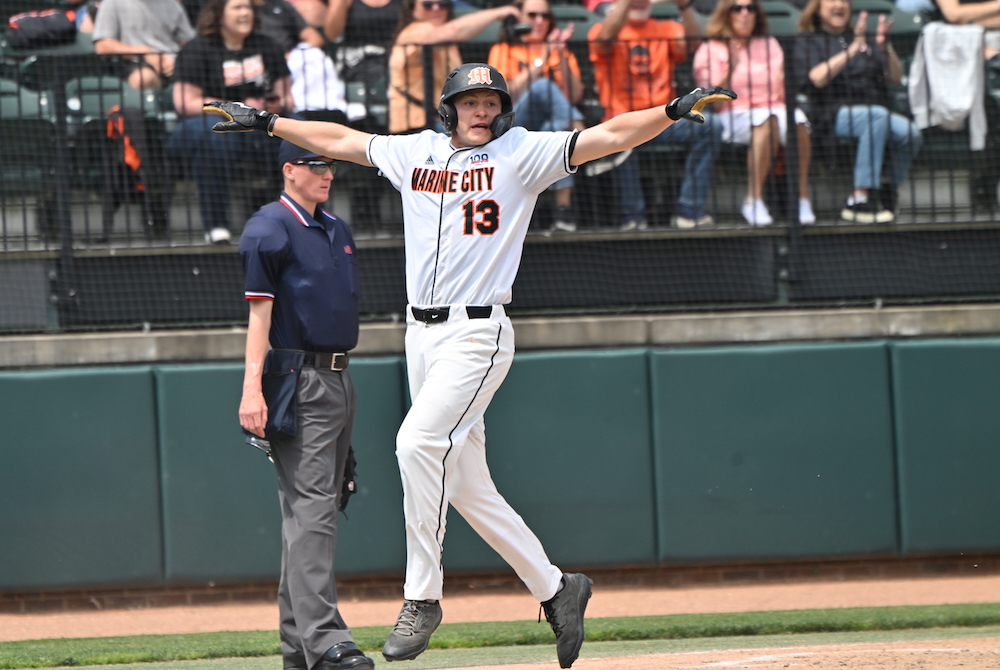
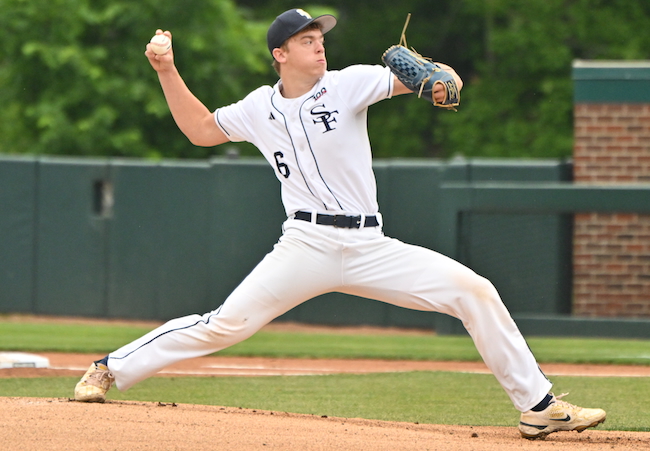
PHOTOS (Top) Marine City's Michael Blunden signals "safe" during his team's Semifinal win over Olivet. (Middle) St. Francis pitcher Sam Wildfong makes his move toward the plate.