

Top-Ranked St. Francis Earns Repeat Try, Unranked K-Christian Walks Off To Advance
By
Steve Vedder
Special for MHSAA.com
June 11, 2026
EAST LANSING - You can say much about a defending state champion, but opportunistic likely describes Traverse City St. Francis best.
The Gladiators remained in the hunt to become the first team to win back-to-back MHSAA Division 3 titles in 13 years after topping Rochester Hills Lutheran Northwest 13-3 in Thursday's five-inning Semifinal at Michigan State.
St. Francis didn't necessarily pound the ball offensively and two pitchers scattered six hits, just four fewer than the Gladiators (33-5) tallied. But St. Francis took advantage of eight Crusaders errors, either bunted the ball for hits or used a sacrifice to involve scoring seven runs, and stole 10 bases en route to the win.
That, said coach Tom Passinault, is typically how the team rolls.
"Absolutely," he said. "There were the errors and that compounds things. But Rochester is a good team. You can't yell at the kids because it's just baseball. But there are things that we can do."
The win sent St. Francis into Saturday's 11:30 a.m. Final against Kalamazoo Christian.
Gladiators freshman infielder John St. Peter said taking advantage of opponents' mistakes is a trademark for the team, which won Division 3 a year ago and will be playing in its fourth Final since 2017.
"That's always how we roll," said St. Peter, who contributed a two-run triple and RBI single. "We pick up on what they can't do and the things we can do. I'm just a freshman and this is my first year, and I know I have some big shoes to fill. There's a lot of responsibility for sure."
There was no more of an opportunistic inning for St. Francis than the third. Already ahead 3-0, the Gladiators bunched three singles, a fielder's choice, a walk, three stolen bases, three errors and a wild pitch to score four more runs.
 St. Francis senior captain Sam Wilfong said the ability to capitalize on mistakes added to the experience from playing in last year's Final likely makes the current team better than last season’s champion.
"I would say better because we're battle-tested," he said. "We know what we have to do and how to keep our emotions in check. We know what it takes to win much better this year. Guys have been there before."
St. Francis pitcher Lanse Vos, who gave up four hits in 3 1/3 innings, won't necessarily compare the two teams. But there's little doubt last year's run has affected this season.
"I think we've built off last year," he said. "Our four seniors we lost from last year said go run it back this year. That's what we're trying to do. We put the ball in play, and good things happen. We make those plays this year."
Kalamazoo Christian 6, Detroit Edison 5
Who says Kalamazoo Christian is too young to cause ripples in the MHSAA baseball tournament?
The Comets rallied with a pair of runs in the bottom of the seventh inning to outlast Detroit Edison and to sail into Saturday's 11:30 a.m. Final.
Despite having just two seniors on the roster, the unranked Comets – who start six juniors and a sophomore – overcame a 5-4 deficit during their final at bats to win the game on a based-loaded single by junior outfielder Max Johnson. Kalamazoo Christian (26-8) let a 4-2 lead slip away in the fifth inning and was tied as late as 4-4 in the sixth before trailing 5-4 going into the last half inning.
Comets coach Russ Meyer said the young team "hasn't flinched" in handling big moments, even with just two seniors.
"I knew and they knew we had incredible talent last year, that people expected a lot and things didn't happen for us," he said. "We played with a chip on our shoulder this year. It's like what about us?"
Johnson, who entered the game hitting .304 but with just nine RBIs in 79 at-bats, said his clutch hit was the first walk-off he's ever had, going back to Little League.
"I was down in the count and I knew I had to battle," he said. "Everyone on base trusted me, and that trust helped. It was like see ball, hit ball. We've done this all year; we just had to stick it out."
Comets junior outfielder Noah Zichterman had a pair of huge hits, including a third inning RBI double that gave the team a 3-2 lead, and a game-tying triple in the seventh two batters before Johnson's heroics.
Zichterman said it doesn't bother his teammates that the team isn't ranked or that few expected the club to be in an MHSAA Final.
"No one expected us to be this good," he said. "We've had some adversity that we overcame. I believe in us, we believe in ourselves and we just play the game."
Another key hit for the Comets was a two-run third-inning double by Jace Rarick. Crosby Croel had an RBI single in the fourth that put Kalamazoo Christian up 4-2.
Among Edison's highlights were a run-scoring single by Javarious Jackson that tied the game at 4-4 in the sixth inning and an RBI single by Jerrell Crosson II that gave Edison (23-9) a 5-4 lead in the top of the seventh.
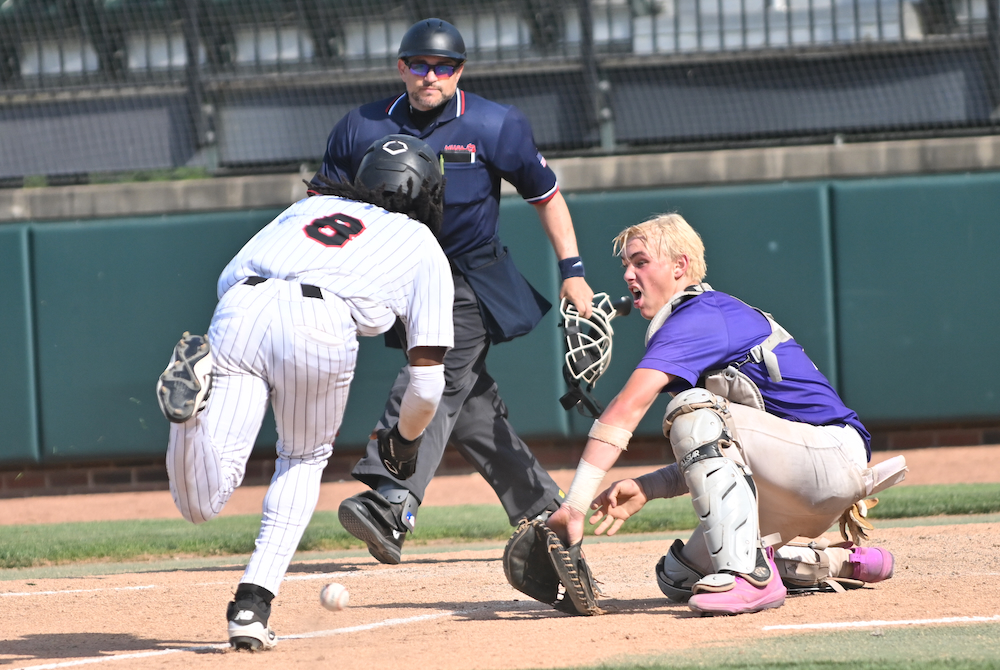
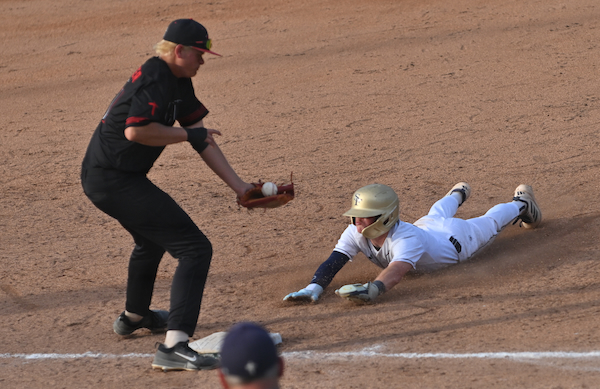
PHOTOS (Top) Kalamazoo Christian catcher Jace Rarick prepares to put a tag on Detroit Edison's DaiJon Brooks (8) during the Comets' Division 3 Semifinal win Thursday at McLane Stadium. (Middle) A Traverse City St. Francis runner attempts to get back to first base during his team's win over Rochester Hills Lutheran Northwest.
Marine City Makes More History, St. Francis Outlasts Historic Opponent
By
Drew Ellis
Special for MHSAA.com
June 12, 2025
EAST LANSING – Winning its first Regional championship in program history was a big accomplishment for the 2025 Marine City baseball team.
Now, the Mariners find themselves one win away from their first Finals championship.
Utilizing aggressive base running and timely hits, Marine City defeated Olivet, 8-5, in a Division 3 Semifinal on Thursday at McLane Stadium.
“It means everything to us,” Marine City coach Ryan Felax said of his team’s first Finals appearance. “Marine City hasn’t won a Regional up until this year, so we’re three games beyond the first time ever. For us to be able to come out here and do what we have done, feeling like we were the underdog since the District Finals, is a special feeling. I can’t even express what it means to the program, what it means for our city, and what it means for the seniors, especially.”
Marine City (26-10) will face Traverse City St. Francis in Saturday’s championship game at 9 a.m. The Mariners believe they are going into the title-deciding contest with nothing to lose.
“We don’t have any pressure on us,” said Marine City senior Daniel VandeVyver, who got the win on the mound Thursday. “We’ve been looked down this whole tournament. There’s no pressure, so we’ve all just been coming out here, playing the game, and having a blast while doing it. We’re coming out with the (wins), so it’s great.”
VandeVyver threw 6.1 innings to earn his eighth win of the season for Marine City. After giving up a pair of runs in the first, the senior would go on to pitch five straight scoreless innings, allowing only three hits during the stretch.
“I came into that second inning with a lot more confidence,” VandeVyver said. “I was working more off-speed pitches and not using as many fastballs. It was working for me.”
The senior was also a key piece to the offense, finishing with three hits and three RBI.
“Danny VandeVyver is a special player,” Felax said of his senior. “He’s been doing this for me for four years. He’s a special pitcher. He’s a special kid. When he stays out of his own head, he can do pretty much anything.”
Olivet (22-7) got out to the 2-0 start in the first inning thanks to five singles in six batters, but the Eagles would strand the bases loaded as they looked to establish a larger advantage.
“We had bases loaded in the first inning and should have gotten more out of that,” Olivet coach Mike Whitley said. “We didn’t get as many as we should.”
Marine City answered in the top of the second, utilizing stolen bases and bunts to set up a sacrifice fly from freshman Tucker Volkman. VandeVyver than had an RBI single to even up the score at 2-2.
In the fifth inning, the Mariners broke the game open with four runs. The go-ahead run came when junior Dakota Droptiny was unable to get a bunt down, so he had to take a swing with two strikes. Droptiny proceeded to hit an RBI double to put Marine City up 3-2.
“Hey, I’ll take it,” Felax said. “He’s just a kid that doesn’t rattle.”
Lukus DeSmyther followed with an RBI single, then VandeVyver had a two-run double to make it 6-2 for Marine City.
The Mariners tacked on two more runs in the top of the eighth inning thanks to an error by Olivet and a double steal. All together, Marine City had 10 stolen bases in the win.
“You have to give (Marine City) credit. They are a heck of a team,” Whitley said. “They played a little small ball on us, which you don’t see in this area a whole lot. We just didn’t take care of business when we had the opportunity.”
Olivet made a late push in the bottom of the seventh inning, scoring three runs thanks to an RBI double from freshman Andrew Rigelman and a two-run single from senior Lucas LaPaugh.
The tying run reached the plate before the Mariners recorded the final out.
“They just battled every day for me, and I think that showed in the seventh inning,” Whitley said. “Who knows, one more hit, it might have been a different ball game.”
Lalo Aguirre finished with four hits and two runs for Olivet, while Trip Burkett had two hits and an RBI.
Droptiny finished with two hits, two runs and an RBI, while Paul Muscat stole three bases for the Mariners.
Traverse City St. Francis 4, Grosse Pointe Woods University Liggett 3
In order to play for its first Finals championship since 1990, Traverse City St. Francis had to overcome the one baseball program with more championship game appearances than anyone else.
The Gladiators took advantage of some early Liggett errors to establish a 4-1 lead. From there, they held on behind the pitching of junior Sam Wildfong for a 4-3 victory in the first Division 3 Semifinal on Thursday.
 “It was a great, great high school baseball game. Ligget is a great, great program. We felt like we had to knock the giant off to get to the Finals,” Traverse City St. Francis coach Tom Passinault said. “It feels great, because we have a lot of respect for their program. Our guys really battled today.”
Liggett, which has appeared in 10 Finals, defeated St. Francis 12-0 in the 2021 Division 3 championship game, the last Finals appearance for the Gladiators.
St. Francis (30-8-1) struck first, taking advantage of a few Knights miscues. An error put runners on the corners for the Gladiators, and then Wildfong scored on a wild pitch to make it 1-0.
A two-run single from junior Tyler Thompson in the second inning extended the St. Francis lead to 3-1.
Junior Matthew Kane opened the bottom of the fourth inning with a double to left field. He then scored two batters later when freshman Colton Peterson laid down a squeeze bunt to put the Gladiators up 4-1.
“We had our best bunter at the plate. Colton Peterson is so calm and cool, and Matt is a great base runner, so it was just a perfect combination for us,” Passinault said of the play.
With the three-run lead, Passinault believed that Wildfong would be able to pitch his team to victory.
“In games where we got up a few runs and we had Sam pitching, we felt pretty good about our chances,” Passinault said. “Sam is a gym rat in the baseball sense. He’s 365 baseball. He is always ready. He’s the guy you want in that moment.”
Liggett was able to get the Gladiators’ lead down to one as it manufactured one run each in the fourth and fifth innings. However, the Knights stranded a pair in the sixth inning who could have changed the game.
“We put the ball in play all game; that wasn’t the issue. We just couldn’t get them around,” Liggett coach Jay Ricci said. “We started to make that happen later in the game, but we just couldn’t get that last run across the plate.”
Wildfong found another gear in the seventh inning, striking out the first two batters before getting a ground out to end the game. The junior finished with three strikeouts for the contest, allowing one earned run over seven innings.
“I treated it like any other inning. I was just having fun with my friends out there,” Wildfong said of the seventh. “The fastball was really working that last inning, and it was really fun to dial in and locate it well.”
Thompson finished with a pair of hits to go with his two RBI. Liggett was led by Ravi Hines, who had a single and an RBI. Reliever Joey Harris pitched three scoreless innings to keep the Knights in the game when down 4-1.
“He did great, and we were real confident he would come in and shut the door,” Ricci said of Harris. “That was expected. Joey Harris has done a great job all year for us.”
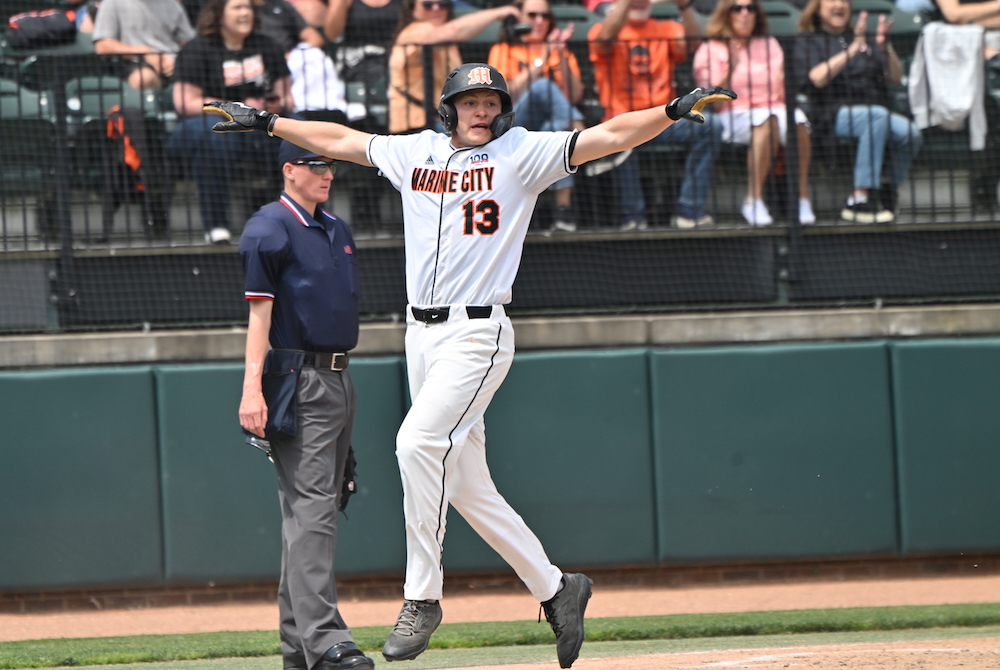
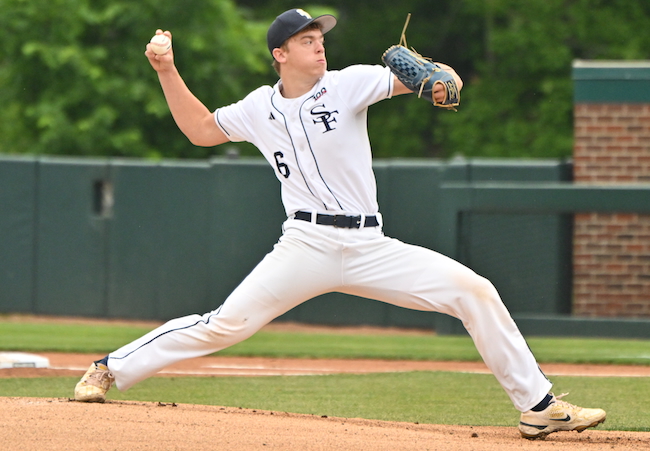
PHOTOS (Top) Marine City's Michael Blunden signals "safe" during his team's Semifinal win over Olivet. (Middle) St. Francis pitcher Sam Wildfong makes his move toward the plate.