Vermontville Ace Joins NFHS Hall (Video)
August 15, 2016
By Geoff Kimmerly
Second Half editor
Michigan celebrated its eighth inductee to the National High School Sports Hall of Fame with the honoring of Vermontville baseball star Ken Beardslee during the annual National Federation of State High School Associations summer meeting, this summer in Reno, Nevada.
 Beardslee, who died in 2007, has been proclaimed as “prep baseball’s first ace” in the NFHS National High School Sports Record Book and was featured in the former print version of the book for his incredible feats from 1947-49. In his three years on the mound for Vermontville, Beardslee won 24 of his 25 starts (the team was 31-1 during that time). His 24 victories included eight no-hitters, with two perfect games, and seven one-hitters.
He set seven national records, and two still stand after 66 years: his per-game season strikeout mark of 19.0 and his per-game career strikeout mark of 18.1. He was drafted by the New York Yankees immediately after graduating from high school and pitched in the minor leagues from 1949 to 1956, when an injury ended his playing career. Beardslee went on to scout for the Pittsburgh Pirates for 21 years, and he received a World Series ring after the team’s championship win in 1971. He also went on to write eight books including novels, poetry and an instructional on pitching.
He was one of 12 individuals, including five athletes, inducted as part of this year’s class. His wife Marilene represented Beardslee in accepting the honor, and offered this as to the role high school athletics played in her husband’s life and career:
“My time with Ken was long after his high school days. I'm sure Ken's career gave him joy, happiness. It allowed him to accomplish goals. It opened doors; it opened doors to friendships throughout his life ... Terry Collins with the Mets, Doug Melvin (who) just this year stepped down with the Milwaukee Brewers. Those are things that high school opened doors for him.”
Beardslee was nominated for the NFHS Hall of Fame by the Michigan High School Athletic Association after years of research by Charlotte resident Terry Lowery. Lowery didn't have an immediate connection to Beardslee and only moved to Eaton County as an adult. But during a funeral for one of Beardslee’s high school teammates, Lowery heard the stories of the high school ace – and went to work building his application.
Below is the video produced by the NFHS that played during Beardslee’s portion of the induction ceremony and includes a touching interview with Marilene, who received Ken’s plaque from MHSAA assistant director Kathy Vruggink Westdorp.
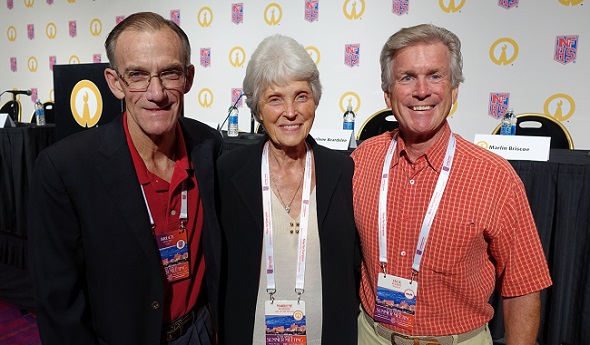
PHOTOS: (Top) Marilene Beardslee stands with the NFHS’s Bruce Howard (left) and MHSAA Executive Director Jack Roberts during the Hall of Fame festivities in Reno, Nev. (Middle) Ken Beardslee, during his high school days at Vermontville. (Top photo courtesy of Terry Lowery.)
'Check-in Champ' App Rewards Fans
January 10, 2017
By Geoff Kimmerly
Second Half editor
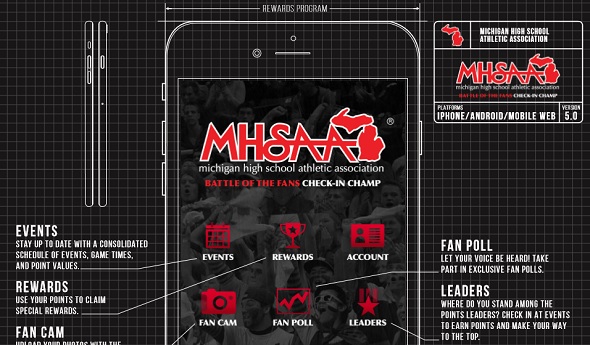
The Michigan High School Athletic Association and SuperFanHigh, a leading fan loyalty and engagement company, have launched a mobile app that will allow students, faculty, alumni, community members and all fans to earn prizes and college scholarships by showing support for high school basketball teams.
To participate, fans simply need to download the “Check-in Champ” app for free from the Apple iTunes or Google Play online stores and then check in at high school girls and boys basketball games they are attending this season. SuperFanHigh will track these check-ins and provide standings of fans who attend the most events statewide beginning Tuesday, Jan. 10. Fans “checking in” accrue points toward prizes including a total of $5,000 in college scholarships sponsored by MI Student Aid.
“The ‘Check-in Champ’ contest provides an exciting opportunity for our schools to promote their regular-season girls and boys basketball games,” MHSAA Executive Director John E. “Jack” Roberts said. “We’re eager to see how this will build more excitement at games, both during the regular season and the MHSAA tournament, and we’re appreciative of MI Student Aid for adding significant incentive for students and their families who support their classmates and communities.”
For the remainder of this Michigan high school boys and girls basketball season, fans who attend games will earn points. When registering on the app, fans must select their favorite school. Schools will be divided by Class: A, B, C and D. A $3,000 scholarship will be awarded to the fan who earns the most points overall across all four classes, and $500 scholarships will be awarded to fans who earn the most points in each class.
Only student fans will be eligible to use the college scholarships; however, fans who are not students may still compete for the scholarships and designate them for specific students should they win the contest. All fans, including those who are not students, will be able to earn app “badges” as they accrue points, and the top 100 point-getters will receive shirts printed to celebrate their accomplishment in the contest.
“We are excited about partnering with the MHSAA to launch this new app,” said Anne Wohlfert, Director of the Student Financial Services Bureau at the Michigan Department of Treasury. “We are pleased to offer $5,000 in scholarship dollars to the students who attend the most games. This joint venture aligns with our goals to provide high school students and their families with student financial resources and information.”
The app provides other information for students and fans including their selected schools’ boys and girls basketball team schedules, MHSAA news and an opportunity to share photos through a ‘fan cam.’ Participants may accrue bonus points by answering MHSAA basketball trivia questions and promoting their “check-ins” on social media.
SuperFanHigh is a division of its parent company, SuperFanU and provides fan experiences for more than 300 high schools and colleges/universities across the country. The company is leading the market in developing innovative platforms that allow the communication and marketing between students/fans and schools to be more engaging and efficient.
“We know that our partnership with MHSAA will yield lots of excitement this year across the state of Michigan,” says Kayla Mount, co-founder and COO of SuperFanU.