


1,000-Point Scoring Pair has Howardsville Christian Eying Postseason Possibilities
By
Scott Hassinger
Special for MHSAA.com
February 5, 2025
MARCELLUS – Despite facing a shorter bench and tougher schedule this winter, Howardsville Christian’s boys basketball team still started this season much slower than head coach Ken Sparks had anticipated.
 But Sparks, now in his fourth season, said the Eagles are highly confident they can achieve big things before the 2024-25 campaign ends.
Two reasons why are the exceptional play of shooting guard Kaden Sparks – Ken's son – and point guard John Paul Rose. The two four-year varsity players and senior starters both recently eclipsed the 1,000-point career scoring mark.
Howardsville Christian has fewer than 80 students, and they were the first pair in school history to achieve that milestone during the same season. A total of 17 players are now on the Eagles’ 1,000-point list, led by Dylan Jergens, the third-leading scorer in MHSAA history with 2,782 career points. All of their names appear on a banner on the wall behind one of the baskets inside the school gymnasium.
Needing just two points to reach his career milestone, Kaden Sparks scored a game-high 27 points in a 57-46 loss by Howardsville Christian to Division 2 Edwardsburg in the Tri-State Holiday Classic on Dec. 14 at Southwestern Michigan College.
Rose achieved the rare feat in the Eagles' 55-44 win over St. Joseph Our Lady of the Lake Catholic on Jan. 7. Rose needed 30 points to reach 1,000 and scored exactly that many.
Making their feats even more impressive is that both Eagles starting guards stand just 5-foot-9.
Out of necessity, Kaden Sparks and Rose both made immediate impacts as freshmen on the Eagles' varsity.
"We knew that Kaden and John Paul were going to be good players from the very start of their careers. Both of them became starters right away because we didn't have lot of impact returners in the way of upperclassmen. That forced them to play at a high level early on, and now it’s really paying off for both of them," said Ken Sparks, a 2000 Howardsville graduate and also a member of the 1,000-point club. "When both Kaden and John Paul are on the court, they find a way to get the ball to the other. Even though they are our main scorers, they are also our top two guys in assists and work hard to get everyone else involved.
“Having two guys in the same class reach 1,000 points is really special. We try to make it a big deal so it inspires our younger kids in the program to work hard and achieve similar success when they reach the high school level."
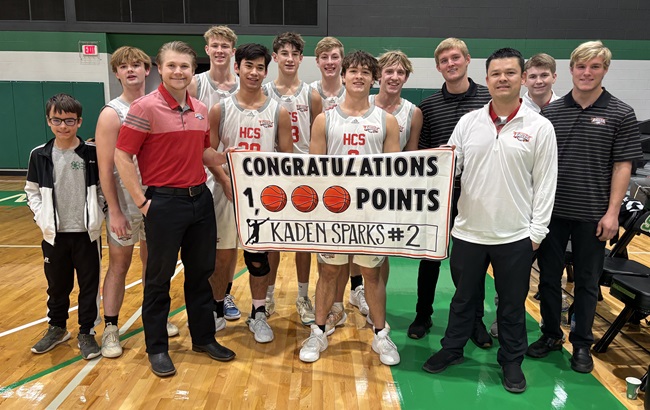 Kaden Sparks’ strength and athleticism is a big reason why he leads the Eagles in every statistical category. Through 16 games, Sparks is averaging 21.4 points, 7.2 rebounds, 3.1 assists and 3.2 steals per game.
"We're confident if Kaden gets the ball inside the post that he can still finish against bigger guys because of his strength. That's a big reason he is able to lead us in rebounding, because he does such a great job of boxing out," Ken Sparks said. "His athleticism and quickness help him anticipate where the ball is going. Defensively, he's led our team in steals the last couple seasons. As a coach, out of nowhere you'll see him intercept the ball and head the other way downcourt. He has more speed than most other players on the floor. Offensively he's always shot one of the higher percentages during his career."
On Jan. 2 in a game against Battle Creek St. Philip, Kaden suffered a bad ankle sprain that sidelined him nearly three weeks. But he's returned to top form.
"Scoring 1,000 points has always a goal of mine, and it’s neat to accomplish the same thing my dad did, but to also have a teammate from my class achieve that too is pretty special as well," Kaden Sparks said. "I don't consider my scoring as my biggest contribution to the team though. I pride myself on defense and try to motivate my teammates to do the same. That's what wins championships."
Rose is currently averaging 19 points, 6.2 rebounds, three assists and 2.1 steals per game. Scoring and rebounding have been his two biggest areas of improvement the past two years.
"John Paul led us in scoring as a junior. He was a great young point guard his freshman and sophomore year and led our team in assists. I've gotten several compliments from opposing coaches about what a great ballhandler he is and his ability to run the point guard position. He's been a good mainstay for us that way," Ken Sparks said. "He has a very solid mid-range jump shot and also has a knack for finishing well under the basket. His quickness allows us to put him on the other team's best offensive player too. From a leadership standpoint, he's very vocal on the court and is a good encourager for our younger players in practice. Like Kaden, he's really put in the time during the offseason to improve."
Rose credits cousins David and Michael Crips, both assistant varsity coaches at Howardsville, as being big influences to him in basketball.
"Those two have helped me a lot in my development and inspired me to work hard. Last year we had six losses and three of those were to Our Lady of the Lake Catholic, so being able to get my 1,000th point this year against them was pretty special," Rose said. "I'm proud that I've become a better ballhandler. I have a good mid-range shot, while Kaden is a better 3-point shooter. But I feel like I've made my most improvement defensively."
Last year Howardsville finished 19-6, losing in the Regional Semifinals 49-43 to Our Lady of the Lake.
"I think we have a good shot to repeat as District champions, but it’s going to be tough with (Kalamazoo) Phoenix and Marcellus is a pretty good team as well," Ken Sparks said.
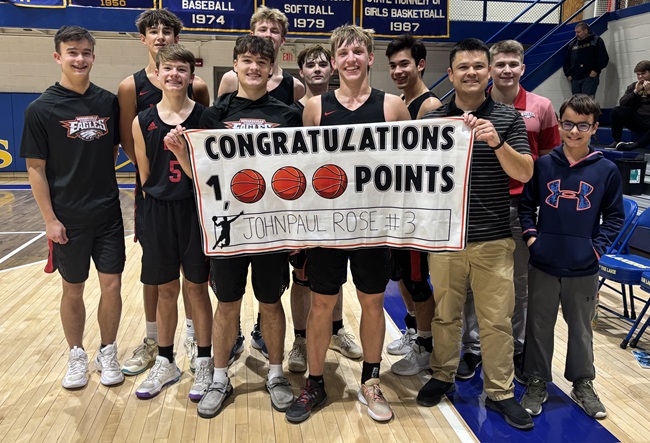 Howardsville's overall record stands at 6-11, including a 4-4 mark good enough to tie for third in the Berrien-Cass-St. Joseph League. Kaden's career point total now stands at 1,168, and Rose had scored 1,092 entering Tuesday's home game with Covert.
One of Howardsville Christian's other losses came Dec. 28 to Jackson Northwest, a Division 1 school, 73-51 in the Spring Arbor University Shot Clock Classic.
The Eagles, with six games remaining, have their sights set on finishing the regular season on a strong note and building momentum for the postseason. Howardsville Christian has won six District titles over the last nine seasons, including a run to the Quarterfinals during Jergens' senior year in 2018.
Howardsville Christian will be one of five teams vying for the District title Feb. 24-28 at Marcellus High School, along with the host school, Phoenix (12-1), Kalamazoo Heritage Christian and Lawrence. Howardsville lost to Phoenix 53-50 on Dec. 20.
"If we could win our remaining regular-season games, that would give us momentum for the postseason. John Paul and I are a big presence and give our team lots of energy when we are on the floor, so that makes us work that much harder to help our team succeed," Kaden Sparks said.
Howardsville's head coach is confident his Eagles can work some postseason magic, especially with five seniors joined by three talented freshmen to make up the current roster.
Other Eagles seniors besides Kaden Sparks and Rose playing key roles are guard Sean Kimble, 6-4 center Isaac Nagel and 5-11 forward Jonah West. Leading a solid freshman class are 5-10 guard Kole Sparks – Kaden's younger brother – 6-3 Keaton Grandlinard at forward/center and 6-2 forward Caden Grant.
"Our No. 1 goal is to repeat as District champions. I know we're about to turn the corner. We wanted to challenge our kids by scheduling some tougher games this season and finish in the top of our conference," Ken Sparks said. "We've really spoke with our other seniors and younger guys about stepping up in scoring, rebounding and defense. Everyone plays a role, and I think it’s set us up for a good run here at the end of the season."
 Scott Hassinger is a contributing sportswriter for Leader Publications and previously served as the sports editor for the Three Rivers Commercial-News from 1994-2022. He can be reached at [email protected] with story ideas for Berrien, Cass, St. Joseph and Branch counties.
PHOTOS (Top) At left, Howardsville Christian’s John Paul Rose (3) brings the ball upcourt this season against Cassopolis. At right, Kaden Sparks drives around a screen set by a teammate against Kalamazoo Phoenix. (Middle) Howardsville Christian teammates and coaches pose for a photo after Sparks surpassed 1,000 points for his career during a loss to Edwardsburg in the Tri-State Holiday Classic at Southwestern Michigan College. (Below) Howardsville teammates and members of the coaching staff celebrate Rose reaching 1,000 career points against St. Joseph Our Lady of the Lake Catholic. (Howardsville/Cassopolis photo by Brooklyn Scheidel. Howardsville/Phoenix photo by David Sparks. Banner photos by Kristen Sparks.)
Breslin Bound: 2021-22 Boys Report Week 8
By
Geoff Kimmerly
MHSAA.com senior editor
January 31, 2022
This week we welcome February, five weeks to go in the boys basketball regular season and 19 teams bringing undefeated records into both.

That’s always impressive, of course, given the state’s 700 varsity teams total and competitiveness throughout one of Michigan’s most-played high school sports. Two of those unbeaten teams play in Division 1, eight play in Division 2, three in Division 3 and six in Division 4 – and we highlight three during this week’s “Breslin Bound” report.
“Breslin Bound” is powered by MI Student Aid and based on results and schedules posted for each school at MHSAA.com. Send corrections or missing scores to [email protected].
Week in Review
The countdown of last week’s five most intriguing results:
1. Detroit Martin Luther King 74, Detroit Renaissance 70 The Crusaders (11-1) enter the final week of the Detroit Public School League Blue schedule in position to clinch thanks in part to this win over the formerly co-leading Phoenix (9-3).
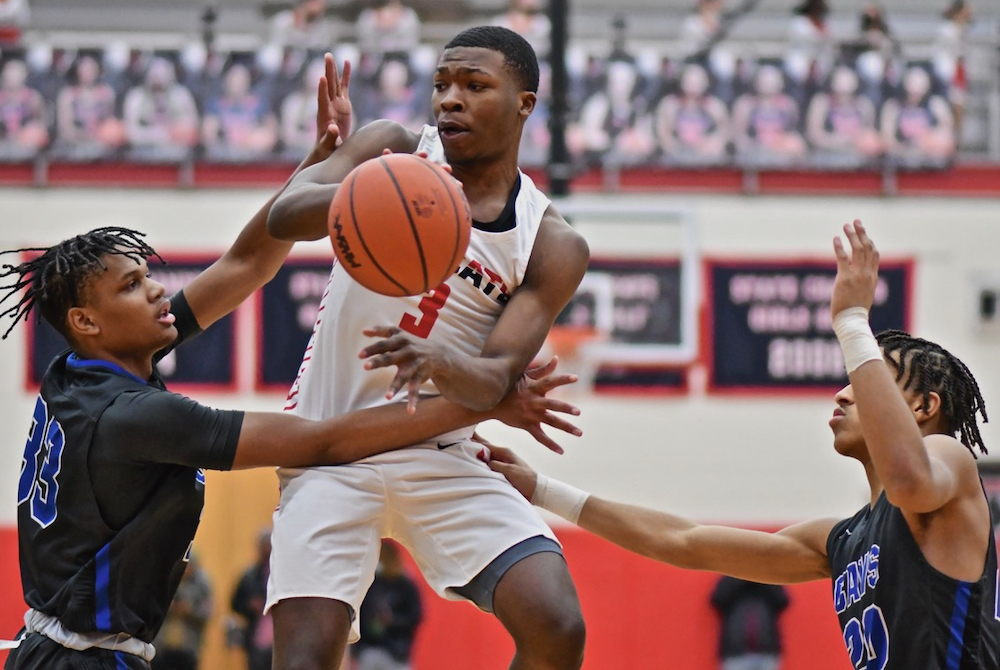
2. Grand Blanc 64, Flint Carman-Ainsworth 63 The Bobcats (6-4) are the last team undefeated in Saginaw Valley League play thanks to this win over the second-place Cavaliers (6-4).
3. Maple City Glen Lake 64, Benzie Central 58 The Lakers (9-3) handed Benzie its first defeat, in the process moving into a tie for first in the Northwest Conference with the Huskies (10-1) and with their rematch scheduled for Feb. 25.
4. Orchard Lake St. Mary’s 47, Warren De La Salle Collegiate 34 The Detroit Catholic League Central continues to reshuffle weekly, now with St. Mary’s (9-2) and Detroit U-D Jesuit tied for first but every team within a game of the lead and the Pilots (9-3) tied for most overall wins among league teams.
5. Detroit University Prep 57, Carrollton 56 The Panthers (4-6) have to be one of the best sub-.500 teams in Michigan, mostly recently handing Carrollton (10-1) its first loss, and after defeats by six or fewer points to Benton Harbor, Detroit Renaissance and Carman-Ainsworth.
Watch List
With an eye toward March, here are two teams in each division making sparks:
Division 1
Bloomfield Hills (10-2) The Black Hawks are undefeated aside from a pair of losses at December’s Motor City Roundball Classic, to Detroit Renaissance and Detroit Catholic Central (8-3), which actually help fill out a strong body of work overall. Six of Bloomfield Hills’ wins are against teams .500 or better, and the Black Hawks also have an early upper hand as they seek to repeat as Oakland Activities Association White champions.
Muskegon (10-0) There are plenty of highlights to rattle off from the Big Reds’ start. After finishing second in the Ottawa-Kent Conference Green last year, Muskegon is two games ahead of the rest atop the league standings. The Big Reds avenged two losses from last season to reigning league champ Zeeland East with Friday’s 58-42 win, and Muskegon also has handed Benton Harbor (11-1) its only defeat, 84-58 on Jan. 8. Only Reeths-Puffer, the second-place team in the Green, has gotten closer than 11 points.
Division 2
Battle Creek Pennfield (9-2) The Panthers’ first run to the MHSAA Finals was one of the feel-good stories of the abbreviated 2020-21 season, and they could be finding their footing again after a couple of mid-January league losses to Battle Creek Harper Creek (9-3) and Coldwater (9-1). Those came immediately after Pennfield handed Marshall (11-1) its only loss. The Panthers will have plenty of opportunities to show what they can do with six games coming up against teams with at least nine wins so far, including rematches with all three of those league foes plus a home game with Benton Harbor.
Hudsonville Unity Christian (12-0) The Crusaders appear on their way to a sixth-straight league title, with a two-game lead in the O-K Blue after the first run through the league schedule. Only one opponent – Grandville Calvin Christian (see below) in a 78-76 Unity win on Dec. 10 – has gotten closer than 10 points. The Crusaders defeated the second and third-place teams in the Blue by 10 and 31 points, respectively, last week.
Division 3
Grand Rapids Covenant Christian (10-2) The Chargers haven’t stopped moving coming off of last season’s Quarterfinal run. Generally playing larger schools, they did avenge a 2021 loss to Wyoming Tri-unity Christian so far with the only losses to Division 2 Unity and Forest Hills Eastern (9-3) in December. Covenant doesn’t play in a league, but did claim a Cornerstone University Holiday Tournament title with wins over Division 2 Allendale and Division 1 Muskegon Mona Shores.
Grandville Calvin Christian (8-3) The Squires continue to put distance between themselves and an 0-3 start that concluded with an overtime loss to Covenant (see above). Calvin defeated former co-leader Grand Rapids NorthPointe Christian 75-62 on Friday to move into first place alone in the O-K Silver. Also bringing context to that winless start – the first two defeats came to Division 2 Holland Christian (7-5) and Unity.
Division 4
Clarkston Everest Collegiate (8-2) The Mountaineers are coming off their second loss, to Genesee Christian (10-2), but defeats have been few lately as Everest is a combined 23-5 over the last two years. The Mountaineers lead the Detroit Catholic League Intersectional #2 as they look to extend their league title streak to three, and they have notable wins over Marine City Cardinal Mooney (9-3) and Ypsilanti Arbor Prep (9-4).
McBain Northern Michigan Christian (10-0) The Comets are only one game into the second half of the Highland Conference schedule but already three games ahead of the field as they pursue what would be a first league title in at least a decade. It’s been an impressive rise for NMC, which broke a seven-season streak of sub-.500 finishes by going 12-3 (and also winning a District title) a year ago.
Can't-Miss Contests
Be on the lookout for results of these games coming up:
Tuesday – East Lansing (10-3) at Williamston (12-0) – The leaders of the Capital Area Activities Conference Blue and Red, respectively, match up with the winner likely considered the Lansing area’s best.
Tuesday – Dearborn (10-1) at Belleville (7-3) – Belleville has a one-game lead on Dearborn in the Kensington Lakes Activities Association East thanks to a 63-43 win on Jan. 4.
Friday – Kalamazoo Central (9-4) at Richland Gull Lake (8-4) – Gull Lake won the first meeting, 78-75 in overtime Dec. 16, and they’re tied atop the Southwestern Michigan Athletic Conference East
Friday – Orchard Lake St. Mary’s (9-2) at Detroit Catholic Central (8-3) – St. Mary’s won the first meeting 75-64 and could begin breaking up the tightly-packed league standings with a big week that starts on the road at De La Salle.
Saturday – Ferndale (8-2) vs. Muskegon (10-0) at Cornerstone University – Contenders in Divisions 2 and 1, respectively, face off at the RedHawk Challenge.
Second Half’s weekly “Breslin Bound” previews and reviews are powered by MI Student Aid, a part of the Office of Postsecondary Financial Planning located within the Michigan Department of Treasury. MI Student Aid encourages students to pursue postsecondary education by providing access to student financial resources and information. MI Student Aid administers the state’s 529 college savings programs (MET/MESP), as well as scholarship and grant programs that help make college Accessible, Affordable and Attainable for you. Connect with MI Student Aid at www.michigan.gov/mistudentaid and find more information on Facebook and Twitter @mistudentaid.
PHOTO A pair of Carman-Ainsworth defenders wall off the passing lanes during last week’s 64-63 loss to Grand Blanc. (Photo by Terry Lyons.)