

28-0 Surge Sends GR Catholic Central to Saturday
By
Dean Holzwarth
Special for MHSAA.com
April 8, 2021
GRAND RAPIDS – At first glance, it might seem that the Grand Rapids Catholic Central boys basketball team had a relatively easy time in Thursday’s first Division 2 Semifinal against Ferndale.
It was anything but, and only came to fruition following a dominating fourth quarter that helped push the Cougars to an 81-55 victory over the Panthers at Van Andel Arena.
Catholic Central improved to a perfect 19-0 and will play either Pennfield or Bridgeport on Saturday at Breslin Center.
An up-tempo and competitive game turned into a lopsided ending as the Cougars scored an astounding 28 consecutive points in a span of seven minutes, six seconds from the end of the third quarter until late in the game.
“I thought our defense initiated a bunch of offense for us in that fourth quarter,” Catholic Central coach TJ Meerman said. “We rebounded a lot better, and coming out of half we knew they were going to make a push because that’s what they do. I’m proud of our guys, and our team defense and the way they shared the ball on offense tonight was a special thing.”
Catholic Central trailed 44-42 with 2:31 remaining in the third quarter, but scored the final six points of the quarter and opened the fourth with a 22-0 run.
Torrid outside shooting aided the spurt as the Cougars knocked down five consecutive 3-pointers at one point, including three from junior Jorden Brooks.
“We just came out and played hard in that fourth quarter on both ends,” said Brooks, who scored 14 of his 20 points in the second and was 6 of 11 from beyond the arc.
“I said to myself just keep shooting, and my teammates were setting me up for those 3-point shots.”
Brooks’ hot shooting helped Catholic Central on Monday in an upset of top-ranked Benton Harbor in the Quarterfinals.
“His play speaks for itself, and he puts in a lot of time in the gym and it’s shown all season,” Meerman said. “He’s been doing this for us all season, and he had a fantastic run on the offensive end, but he made an impact on defense by keeping his guy in front of him.”
Catholic Central, which lost to Benton Harbor in the 2018 Class B Final, held a 35-25 advantage at halftime as sophomore Kaden Brown was the offensive catalyst by scoring 14 of his team-high 23 points.
Ferndale, however, scored the first eight points of the third quarter to cut into the deficit and eventually grabbed the lead.
“This team doesn’t get down on themselves,” said junior Jack Karasinski, who recorded 19 points and had five rebounds.
“We took a timeout, regrouped and we kept pushing forward. This is a dream because as a sophomore we got this opportunity taken away from us, and we’ve had the hardest route so far I believe with the teams we’ve gone through. I think it has built our confidence.”
The Cougars also received stellar overall play from freshman guard Durral Brooks, who stuffed the stat sheet with eight points, seven assists, five rebounds, three blocked shots and two steals.
“That’s what he does,” said Jorden Brooks, his older brother. “He’s a good defender, passer and finisher. He can do anything, and it’s crazy that he has three more years left. We just want to go out and hopefully give him his first state championship as a freshman.”
The fourth-ranked Eagles were making their first appearance in the Semifinals since 1985, and were hoping for a chance to win a championship for the first time since 1966.
Instead, they were unable to stop the offensive onslaught by the Cougars in the fourth quarter as they were outscored 33-11.
Ferndale led 44-42 at the start of Catholic Central’s run, then trailed 70-44 with 3:25 to play.
“I thought we did a poor job offensively, and we didn’t get back on defense,” Ferndale coach Juan Rickman said. “Brooks hit four or five threes, and I saw him do that against Benton Harbor. We didn’t execute in our transition defense and didn’t find him.
“The game just got away from us, and we gave up a lot of points to the three guys we wanted to keep from scoring. You never like to lose, so it’s just tough.”
Junior guard Jason Drake scored a game-high 27 points for the Panthers, but was held scoreless over the final eight minutes of the game.
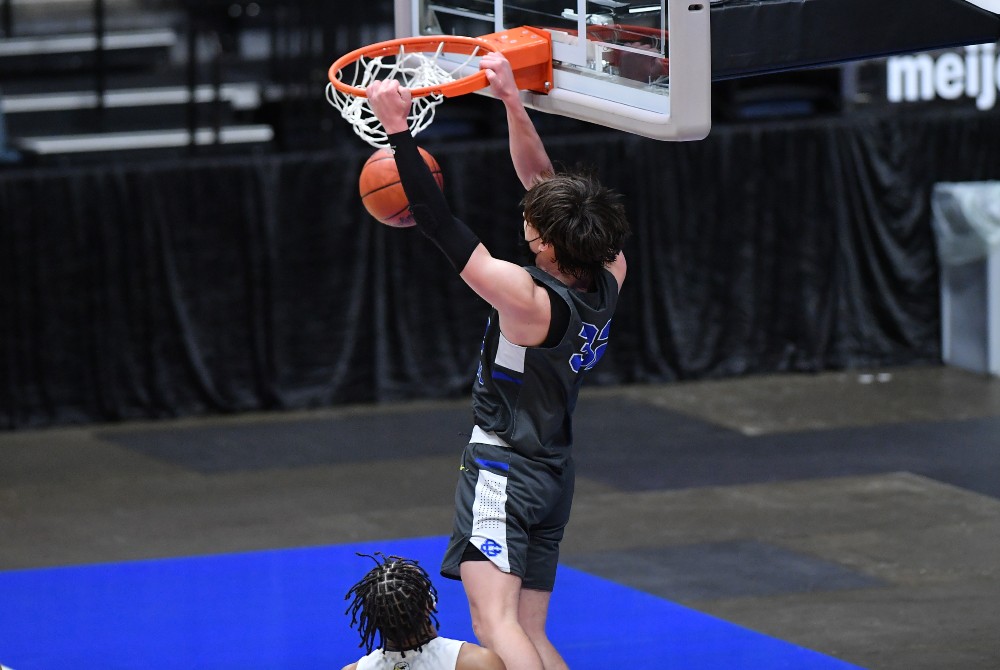
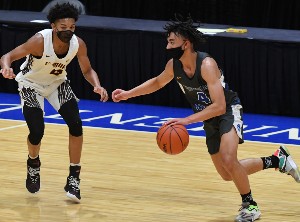
PHOTOS: (Top) Jack Karasinski dunks two of his 19 points for Grand Rapids Catholic Central on Thursday. (Middle) GRCC's Kaden Brown works to get upcourt. (Click for more from Hockey Weekly Action Photos.)
Clarkston Earns 1st Shot at Dream Finish
March 24, 2017
By Geoff Kimmerly
Second Half editor
EAST LANSING – Dan Fife dreamed of playing for an MHSAA basketball championship at Jenison Field House while a student at Clarkston 50 years ago.
Thursday afternoon, the current Wolves made similar dreams come true – and offered their coach that opportunity he never was able to achieve as a player.
Clarkston’s 78-35 win over league rival West Bloomfield in Friday’s first Class A Semifinal earned the program its first appearance in an MHSAA boys basketball championship game.
The Wolves have had piles of success under Fife, the fourth winningest coach in state hoops history with 676 wins since taking over the program before the 1982-83 season. He’s led Clarkston to 30 District and 12 Regional titles, with Friday’s Semifinal the second during his tenure.
“Coach Fife, I don’t think he’ll admit how much it means to him. But it’s everyone’s goal at the beginning of every season; your ultimate goal is to finish out with a win,” Clarkston junior guard Foster Loyer said. “For Coach Fife, and the community of Clarkston, that would just mean the world to all of us, just motivate us to keep working even more.”
Clarkston (26-1), which entered the postseason tied for No. 3 in The Associated Press’ final regular-season Class A poll, will finish this season against Grand Rapids Christian at noon Saturday at the Breslin Center.
The Semifinal was the third ever in Wolves history. And the rare opportunity to advance to Saturday came with an even rarer opportunity to face a familiar opponent in this late round of the tournament.
Clarkston had beaten West Bloomfield (17-9) by 11 and seven during the regular season on the way to winning the Oakland Activities Association Red championship; the Lakers tied for third in the league.
And they knew what to expect from Loyer, a junior already committed to play at Michigan State. But it didn’t help much this time.
 Loyer’s first shot of the game, an attempted layup, sailed over the rim. His second shot, a 3-pointer, touched nothing but net.
Making 10 of 17 shots from the floor and 5 of 8 3-pointers, Loyer finished with 32 points, to go with seven assists. Senior forward Dylan Alderson added 27 points, and sophomore center Taylor Currie had 10 points and 16 rebounds as Clarkston hit 57 percent of its shots from the floor – including an incredible 69 percent during a first quarter that ended with the Wolves carrying a 24-13 lead.
Clarkston took an 18-point advantage into halftime.
Senior guard Kevin McAdoo led the Lakers with 22 points, but as a team they made only 22 percent of their shots from the floor, and had just one steal as Clarkston had only four turnovers but 17 assists.
“It’s a tough one to swallow today, especially with the ride we were on to get here,” said seventh-year West Bloomfield coach Jeremy Denha. “What a fun, fun time to get here with the ups and downs and the way the kids battled. We hadn’t sniffed a District Final, let alone a District title, since I’d been here – we hadn’t won one since 2003. For us to make this magical run, get to Breslin, play Clarkston a third time … yeah, the outcome is disappointing, but it’s about the journey too.”
Fife has been on a lot of these trips. So he'd likely quickly agree with his OAA colleague. And especially with how this journey has a chance to end for the first time.
“I’m not worried about what it means to me. I have an expectation; I’ve always had one no matter what I’m doing. If I’m playing something, I’m going to compete,” Fife said. “The reality is, I dreamed of playing in the state championship when I was in high school. I wanted to get to Jenison. That was always my dream, and I’m just trying to instill in the kids to have the same dream – to play basketball and get to this point. They’ll remember this day the rest of their lives, and tomorrow’s game, regardless of what happens.”
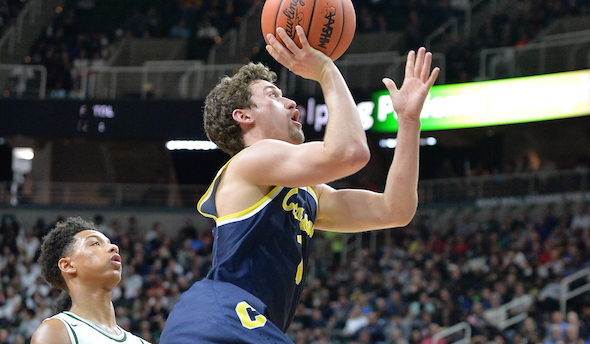
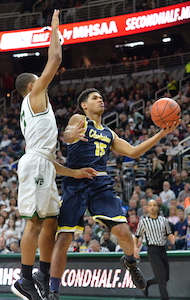
PHOTOS: (Top) Clarkston’s Foster Loyer breaks past West Bloomfield defenders to get a shot up during Friday’s first Class A Semifinal. (Middle) The Wolves’ Tieler Houston (15) gets position on West Bloomfield’s Daniel Wrack.