

After Lead Fades, Concord Stays Together to Stop Reigning Champ Tri-Unity in OT
By
Keith Dunlap
Special for MHSAA.com
March 12, 2026
EAST LANSING — Dethroning a champion is never easy, a fact Concord found out first-hand against Wyoming Tri-unity Christian in a Division 4 Semifinal on Thursday.
Concord jumped out to a big halftime lead and remained ahead by nine points late in the fourth quarter, but were stunned when Tri-unity Christian junior Cody Osbun forced overtime with a buzzer-beating 3-pointer during the final second of regulation at Breslin Center.
But in a credit to its resolve, Concord refocused and ended Tri-unity’s pursuit of a third-straight title, ending the game on an 11-0 run to earn a thrilling 50-40 overtime victory.
Concord (24-4) advanced to meet Detroit Douglass in the Division 4 Final at 10 a.m. Saturday in what will be its first championship game appearance.
“That was one of the hardest games we’ve ever had to play,” Concord head coach Marcus Gill said. “Hats off to them. That is a great team and a great program, perennial power. They are here every year. We just wanted to come out and be us.”
After Concord senior Jett Smith split a pair of free throws with 4.2 seconds left in regulation to give the Yellowjackets a 38-35 lead, Tri-unity (25-2) put the ball in the hands of Osbun, who drained a 3-pointer from the top of the key as time expired to tie the game at 38-38 and force overtime.
“That was actually a botched play,” Osbun said. “We had a different play where I was supposed to get the ball at half (court), which I did, but we were supposed to have someone running down far and I was supposed to pitch it up to him. But they were face-guarding them. So I just turned and subconsciously threw up a shot, and it just happened to go in.”
 Tri-unity Christian then took its first and only lead of the game at 40-39 with 2:29 remaining in overtime on a basket by senior Nolan DeMots.
From there, Concord took over.
Senior Connor Stevens hit a layup with 1:54 remaining to give Concord a 41-40 lead, and then freshman Zack Stevens made two free throws with 1:33 left push the margin to three.
Two more free throws by Connor Stevens with 1:00 remaining made it 45-40 Concord. Following a couple of stops, Concord then took a 48-40 lead with 18 seconds to go on two free throws by Smith.
“I couldn’t be prouder of a group of guys for standing together,” Gill said. “Some guys are not together after having that meltdown in the second half. There’s no way a team that’s not together would have won that overtime. So proud of these guys for staying together and being who we are all year.”
Stevens had 16 points and 10 rebounds and Smith added 13 points for Concord, which came out attacking and aggressive, taking an 18-5 lead after the first quarter and going up 29-13 by halftime.
Concord held a 37-28 lead late in the fourth quarter, but Tri-unity Christian cut its deficit to 37-35 with 48.2 seconds remaining in the game on a 3-pointer by senior Clayton Rowlader, a layup by junior Jake VanKlompenberg and a putback basket by Osbun.
Osbun had 16 points and 11 rebounds to lead Tri-unity.
“Obviously we would have liked to have gotten off to a better start,” said Tri-unity first-year head coach Brent Voorhees, who took over this year after the retirement of longtime coach Mark Keeler. “But the kids you saw in that second half, that’s who we are. That’s Tri-unity basketball. That’s the guys that I coached all year.”
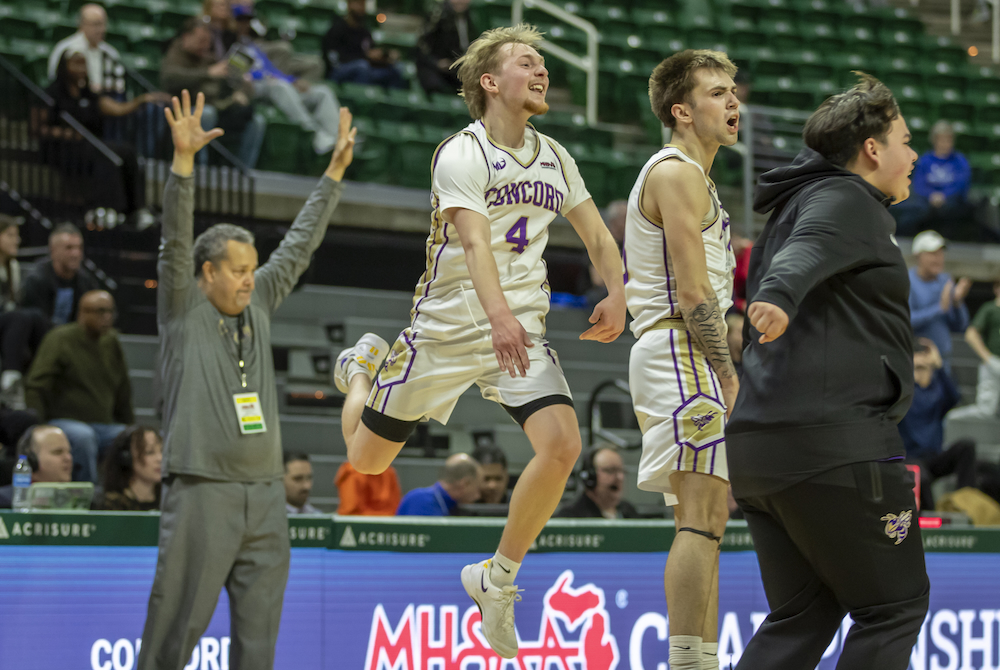
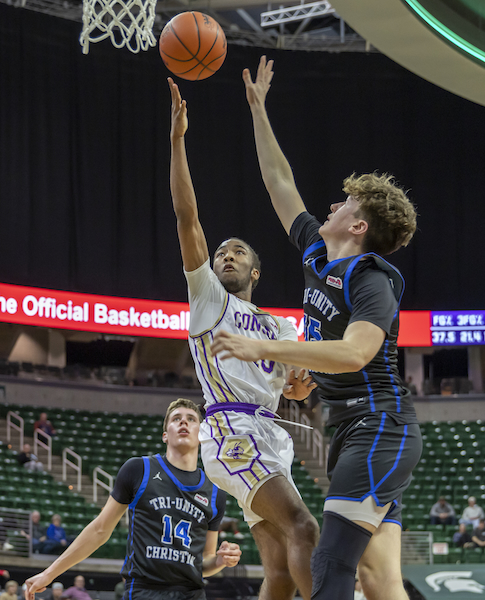
PHOTOS (Top) Concord players including Brady Garrett (4) celebrate during the Yellow Jackets’ Division 4 Semifinal win Thursday. (Middle) Darrell Dean Jr. (10) drives to the basket with Tri-unity’s Andrew Hofmann (24) defending. (Photos by Adam Sheehan/Hockey Weekly Action Photos.)
Breslin Bound: Boys Report Post-Break
January 3, 2017
By Geoff Kimmerly
Second Half editor
This week, Michigan’s high school boys basketball teams will begin focusing most of their energies on winning league championships and doing their best against competition closest to home.
 But before we dive in to that always-intense chapter of each season, our Breslin Bound report – powered by MI Student Aid – reviews the best from two weeks of holiday break, including matchups of some expected MHSAA title contenders in Class A and B.
Week in Review
The countdown of holiday break's five most intriguing results:
1. Detroit U-D Jesuit 69, Macomb Dakota 61 – Dakota was missing a standout and lost another near the end of this one, but regardless this rematch of last season’s Class A Semifinal finished with the Cubs on top while sandwiched between their overtime losses to Flint Beecher and Indianapolis Lawrence North (Ind.).
2. North Farmington 53, Detroit Henry Ford 49 – The Raiders bounced back from three losses to open this season, including a 65-58 defeat to Farmington, to beat Dearborn Divine Child and then the Class B reigning champ at the Motor City Roundball Classic.
3. McBain 73, Boyne City 62 – In a matchup of expected Class C contenders from the northern Lower Peninsula, McBain emerged with a fourth double-digit win in four tries this winter while handing Boyne City its first loss.
4. Wyoming Godwin Heights 69, Wayland 67 – They are in different Districts this season after meeting in the first round a year ago, and both could emerge as Class B contenders after meeting in this Cornerstone Invitational title game.
5. Frankfort 72, Traverse City St. Francis 65 – The Panthers avenged one of only two regular-season losses from last season, when they fell to St. Francis 69-68.
Watch List
With an eye toward March, here are two teams in each class making sparks:
CLASS A
Detroit East English (5-0) – The Bulldogs may have graduated a Mr. Basketball finalist off last season’s 17-win team, but they likely have another and could finish even better this winter with wins so far over Flint Beecher, Macomb Dakota and most recently Wayne Memorial 92-77.
Battle Creek Central (5-1) – That lone loss came early to Kalamazoo Central, and Battle Creek Central has stormed back with the latest a sweep at its holiday tournament, 60-50 over Otsego and 61-46 over Muskegon Heights Academy.
CLASS B
St. Clair (5-0) – The Saints, winners of 12 and 14 games, respectively, over the last two seasons, downed St. Clair Shores Lakeview 54-53 in overtime and then host Clinton Township Chippewa Valley 58-57 at the latter’s holiday tournament to finish off 2016.
Wyoming Lee (5-0) – A 3-17 finisher just last season, Lee is in the midst of a sizable turnaround highlighted over the break by wins over Gobles (in overtime) and host Allegan to win the Tigers’ holiday tournament.
CLASS C
Harbor Springs (3-0) – After also going only 3-17 a year ago, Harbor Springs has equaled that win total while handing the only losses this season to Bellaire (40-37) and Pickford (67-65).
Michigan Center (6-0) – The Cardinals will embark next on at least matching last season’s shared title in the Cascades Conference, and will do so after dominating Williamston’s holiday event with wins over Dansville (66-47) and Class A DeWitt (86-75).
CLASS D
Bark River-Harris (4-0) – Eventually, the Broncos will get to test themselves against Powers North Central (Jan. 27) in the Skyline Central Conference West. So far, they look good to top last season’s 10-11 finish.
Frankfort (3-0) – Expectations are high as always coming off a second straight Northwest Conference title and fourth straight season with 20 or more wins – and so far so good; see note above on avenging last season’s loss to Traverse City St. Francis.
Can't-Miss Contests
Be on the lookout for results of these games coming up:
Tuesday – Clarkston (5-0) at Flint Carman-Ainsworth (6-0) – The Wolves have earned a reputation as Class A contender with another strong start, and Carman-Ainsworth could cement that status as well with a win.
Tuesday – Maple City Glen Lake (3-0) at Elk Rapids (5-0) – In addition to both being undefeated this week, Glen Lake beat Elk Rapids twice last season including in the District.
Friday – Beaverton (4-1) at Clare (3-1) – Although both have a loss, both also are undefeated in early Jack Pine Conference play; Beaverton’s only defeat was in its last game, to Class A Midland Dow by two.
Friday – Detroit U-D Jesuit (4-2) at Romulus (2-1) – Another week, another impressive foe lined up for reigning Class A champion Jesuit; Romulus’ lone loss was by six to Clarkston.
Friday – Holt (3-2) at Okemos (3-1) – This longtime rivalry means something again, as both are seeking to rise in a Capital Area Activities Conference Blue that also features East Lansing, Lansing Everett and Jackson.
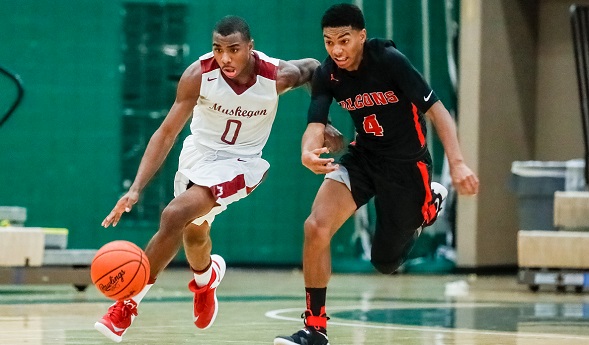
PHOTO: Muskegon pushes the ball upcourt during a 68-45 win over East Kentwood during the Muskegon Hall of Fame Classic on Dec. 28 at Reeths-Puffer High School. (Photo by Tim Reilly.)