

Amid Season of Hurdles, Tri-unity Earns Breslin Return
By
Steve Vedder
Special for MHSAA.com
April 8, 2021
GRAND RAPIDS – It may be a familiar destination for Wyoming Tri-unity Christian's boys basketball team. But there's no arguing the path to get there has been strewn with potholes this season.
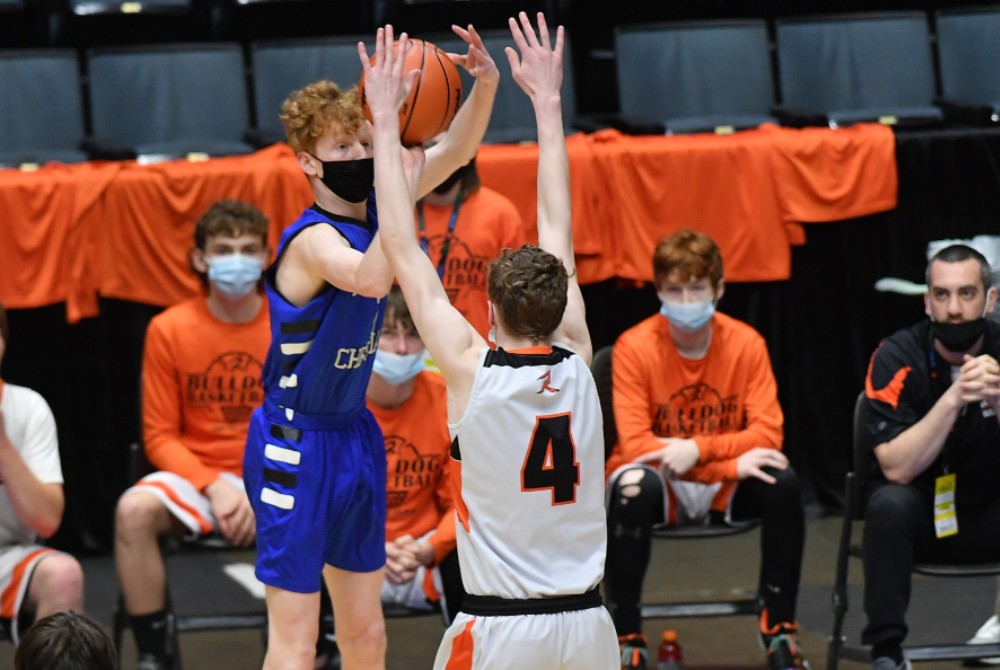
The Defenders will play in their ninth MHSAA Finals championship game since 1996 after racing past Rudyard 61-43 in Thursday's first Division 4 Semifinal at Van Andel Arena.
While playing in a Final is nothing new for Tri-unity, the win overcame another obstacle in what has been a challenging season for the Defenders (14-2), who move along to Saturday's 10 a.m. championship game at Breslin Center. Among the issues Tri-unity has overcome include playing only 10 regular-season games, axing the last two weeks of the schedule due to a COVID shutdown, playing only once in an abbreviated Regional and losing 12 seniors – plus coach Mark Keeler – to quarantine protocol early in the year.
Despite the reduced schedule and missing out on the chance to build early momentum, the Defenders have more than prevailed. The program has won four Finals titles and will make its ninth trip under Keeler, who this winter passed Paul Cook for sixth place on the state's all-time win list (627).
"It's been a very trying year," Keeler said. "I knew we had good potential, and guys have responded so well. We played a tough schedule, the kind of competition you want. We were able to stay humble, which is always something I have believed in. It's been a tough year, but it's been really exciting for the school.
"The guys have played awesome all the way through. We were confident we could make it to the Breslin, and we peaked at the right time. We've got a great senior group, and we really want to finish it out."
The Defenders never trailed Rudyard (18-3) after a 16-2 run snapped a 4-4 tie late in the first quarter. The Bulldogs did cut the lead to 20-16 with 7:13 left in the first half, but Tri-unity scored 16 of the next 19 points for a 36-19 halftime lead. The lead reached 54-34 with four minutes to go in the game.
While Keeler said he believed all along the team was a Finals contender, co-captain Austin Treece, who finished with 11 points and eight rebounds, said there was pressure to meet lofty goals.
"For sure," he said. "There is always pressure, but we just play bigger. We do a great job because I think we're a hungry team."
Co-captain Jaden Ophoff, who had six rebounds, two assists, two steals and four points, said the team has never felt distracted from its goal of playing in East Lansing. Beating Rudyard was just another step, he said.
"We didn't know what to expect from them, coming from the Upper Peninsula," he said. "We were able to adjust to them."
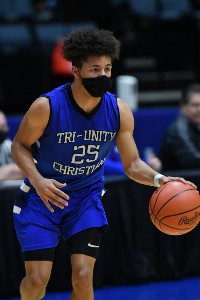
Tri-unity junior guard Brad Titus was virtually unstoppable. He scored 28 points on 11-of-21 shooting while adding four rebounds, six assists and six steals. Titus, who started as a freshman two years ago on a Division 4 semifinalist, said he's heard about playing in a championship game for years.
"This is really big, a blessing. I love it," he said. "We went two years ago, but we were cut short two years ago. It's great to be going."
Rudyard coach Jim Suggitt said Titus, who averages 22 points and four assists per game, was the difference.
"We tried to trade for their point guard, but Mark wouldn't buy it. I told him we'd even throw in the team bus, but he wouldn't go for it," Suggitt said. "He was the best ballplayer on the floor. He could take over whenever he wanted to."
Rudyard's E.J. Suggitt, who finished with 19 points, said the game plan was to keep Titus in check.
"We wanted to stop (him)," Suggitt said. "But even if you stop him, their role players will step up. They are a very tough team; they just played better basketball."
Keeler thinks Titus has played well enough in his career to be at least a two-time all-stater. He's thrilled Titus will have the chance to join his teammates in a championship game.
"The numbers (of past championship game trips) don't matter because this is a whole new group," Keeler said. "It's exciting for them, and it's something they will always remember. They've heard from other players we've had what it's like. It's a thrill."
PHOTOS: (Top) Tri-unity Christian's Aidan DeKlyen pulls up for a shot in front of the Rudyard bench Thursday at Van Andel Arena. (Middle) The Defenders' Brady Titus was the game's high scorer with 28 points. (Click for more from Hockey Weekly Action Photos.)
Tradition-Rich Kingston Adding to Legacy
By
Paul Costanzo
Special for MHSAA.com
January 31, 2018
Camryn MacGuire remembers watching Kingston varsity basketball games and dreaming about the day she could be on the court.
 Evan Neff enjoyed going to games so much as a kid, he kept coming back even after his family moved away for a few years while he was in middle school.
Now both are leading the way for the Cardinals on the court as the Kingston girls and boys basketball teams are inspiring another group of youngsters in their small town.
“I know a lot of little kids come to our games and are huge fans,” said Neff, a sophomore on the boys team. “I know I’ve talked to a couple eighth graders, and they say they can’t wait to play on varsity with me their sophomore year. I think a lot of the littler kids can’t wait to be a part of it.”
Basketball is king in Kingston, and this winter, Cardinals fans have plenty to cheer about. The girls team was 12-0 heading into Wednesday night’s game against Croswell-Lexington, and ranked No. 1 in Class D by the Detroit Free Press and No. 2 by The Associated Press.
The boys started the season on a nine-game winning streak, and are 11-2.
“I think it’s the same thing wherever you’re going to: if you’re winning, if you’re putting a good product out there, you’re going to see a lot of people there,” boys coach Dave Lester said. “In our little town, it seems like everybody is there for the girls games and guys games. We’ve got a great, great student body. Our home games are electric. It’s a fun atmosphere. It’s fun to coach, and it’s gotta be fun to play.
“It’s what high school sports are all about. I think that atmosphere attracts your younger athletes to want to be a part of it. If they’re there and seeing us win, that’s contagious.”
 Lester and girls coach Jay Green have been part of it for the better part of the past three decades, first as players for Kingston and now as coaches.
They played together in the late 1980s, and in Green’s senior year, he helped the boys team reach the MHSAA Quarterfinals.
Green returned to coach the girls team and win four District titles in four years – along with his brother, Dave – during the late 90s. Lester took over the girls program in 2003 and coached the team to the Quarterfinal. The Greens came back to the program in 2011, and Lester took over the boys team midway through the 2013-14 season.
“I think there’s probably a little more passion toward what you do, and what you’re trying to instill into the girls and the boys because you are an alumni,” Jay Green said. “I think both of us could say we were successful alumni in the past. And we both learned under coach Leon Westover when we played, then developed our own ideas, and we have that pride of seeing both the boys and girls doing well.”
Green credits his team’s current success, in part, to the parents in the program, who have taken the time to get their girls to the gym for years and been supportive throughout.
MacGuire agreed.
“My parents, and a bunch of the girls on my team’s parents were always pushing us, and always getting us to play as much as we could,” the point guard said. “They were always telling us that big things were coming. Our starting five is all juniors, and we’ve been playing together since the fourth grade or third grade.”
Kingston’s girls aren’t focused too much on the rankings, or the record, but more on preparing themselves for the postseason. They’ve already scored a win against Class C power Sandusky, and the game against Cros-Lex will provide a test against a strong Class B program. A game against another Class B school, Yale, was postponed because of weather this past Monday.
“I love playing bigger schools,” MacGuire said. “It gives you more competition, and you get to push yourself even more; then it’s even better if you come out with the win. It’s going to benefit us in the tournament.”
Their classmates are providing plenty of support to both teams. MacGuire said there’s been a buzz in the hallways all season, and both she and Neff said their teams make sure to cheer each other on whenever their schedules allow.
 “I never really watched girls basketball until seventh or eighth grade when we moved back to Kingston,” Neff said. “I remember watching those teams, and I was really impressed. My eighth grade year, they had like four or five freshmen on varsity, and I knew they were going to be outstanding. Those girls work really hard, and they’re great athletes.”
“We try to make it to as many (boys) games as we can, even the road games,” MacGuire said. “We support each other both ways. It’s a good atmosphere.”
No Kingston team has ever been beyond the Quarterfinals, but the conference and District championships have piled up through the years. And as dedicated players keep walking into the program, it could just be a matter of time before a group of them breaks through.
“It’s just a tradition here, and our kids know it,” Lester said. “When you walk into our gym, there’s tons and tons of basketball banners. We really talk about tradition and how it would be great to continue that tradition and put up more banners.
“Obviously, we would like to make a long run. At some point, you want to win a state championship, but it’s a process. We’ve got some kids who were playing a lot of basketball, putting a lot of time into it. They want to win, and they want to be a part of that tradition.”
 Paul Costanzo served as a sportswriter at The Port Huron Times Herald from 2006-15, including three years as lead sportswriter, and prior to that as sports editor at the Hillsdale Daily News from 2005-06. He can be reached at [email protected] with story ideas for Genesee, Lapeer, St. Clair, Sanilac, Huron, Tuscola, Saginaw, Bay, Arenac, Midland and Gladwin counties.
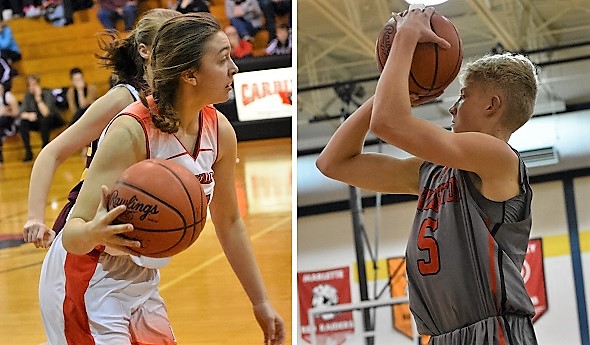
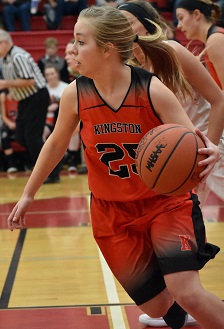
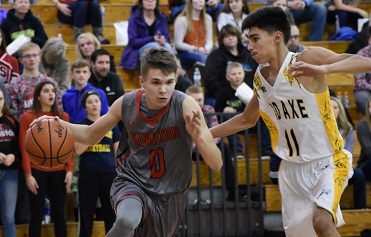
PHOTOS: (Top) Kingston’s Carley Smith, left, pushes the ball upcourt while junior Nathan Cloyd, right, launches a shot. (Middle) Gerilyn Carpenter looks for open teammates during a game this season. (Below) Sophomore Evan Neff works to get around a Bad Axe defender. (Photos by Spot On By Shari.)