Athens' #13 Makes 'Miracle' Comeback

By Pam Shebest
Special for MHSAA.com

October 19, 2015

ATHENS — Damon Knowles talked about baseball and basketball with his cousin, Luke Lamson, one warm Sunday last December.

That’s not unusual for the two young teens, but that day Lamson lay crushed beneath the wheels of a semi trailer loaded with corn and weighing more than 30,000 pounds.
His cousin had crawled beneath the trailer to keep Lamson awake until the ambulance arrived with the Jaws of Life. Both boys were in eighth grade at the time.


Immediately following the accident, “My dad told me to go get the phone so we could call 911,” Knowles, 14, said. “I went under the trailer and was talking to Luke. I just had to keep asking him if he could breathe.”

That accident drastically changed the way Lamson figured his freshman year at Athens High School would play out. Instead of running cross country and playing basketball this year, he is on the sidelines cheering his teammates.

The fact the 14-year-old can actually do that now is a story of amazing recovery and faith.

Knowles, his dad John and Lamson were the only ones at the farm, moving the corn to the silo at the time of the accident. None of them knows exactly how the accident happened, but John Knowles said the ground was soft from rain the day before, which probably kept his nephew from being crushed to death.


Lamson said he was awake the entire time, but doesn’t remember much about the accident. 

“It didn’t kill him because we kept the pressure on him,” an emotional John Knowles said. “I could have drove the truck off him. Had a piece of machinery there, I could have tipped the truck off him. 

“But I kept the pressure on him and he didn’t bleed internally. There was a higher power telling me not to get the trailer off him. He should have never made it out from under the trailer, never made it to the hospital. The first couple days were nerve-wracking.

“By the time I got to the hospital (later that day), half of Athens was there. We had over 90 people in the waiting room that night; probably 25 of them spent the night.”

Said Lamson’s mother, Lucy: “Being the adult and the one driving the vehicle, my brother was a mess. This little guy (Damon) was down there with Luke, underneath the trailer while he was pinned and held his head and made him stay awake and just kept talking with him.

“To me, that was the first miracle. Luke is sitting here right now because of it.”

The family created a Facebook page, Lukey Lamson’s Comeback, to post updates for friends and family.

The first entry explained: “He has a shattered pelvis, a compound fracture in his shoulder, a fracture in his lower back, and numerous open wounds. He currently just got out of surgery and they were able to attach a wound vac to help his wounds heal.

“We are receiving some communication from him such as waves, thumbs up, and hand squeezes when he is off his sedation medication, which is only for a few minutes at a time.”
Lamson, who spent two months in Kalamazoo’s Bronson Methodist Hospital and one in University of Michigan’s C.S. Mott Children’s Hospital, said at the beginning he wasn’t sure he would live.

“There was times in the hospital that Luke wasn’t real fun to be around,” his uncle said. “There was one time I come around the corner and my mother and my sister were crying. I said what’s wrong. They said Luke wants to die.

“So I walked in there. I asked the two nurses to leave. We had a good heart-to-heart talk, and things changed.”

By Dec. 10, three days after the accident, Lamson was taken off the ventilator. And by Christmas, he had survived seven surgeries.

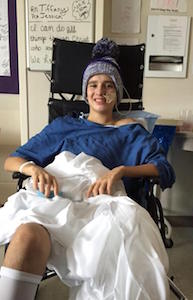
On Dec. 28 he was moved from the intensive care unit to a regular room, and by Jan. 20 he was able to sit in a wheelchair for the first time. He left Bronson for Mott’s on Feb. 3.

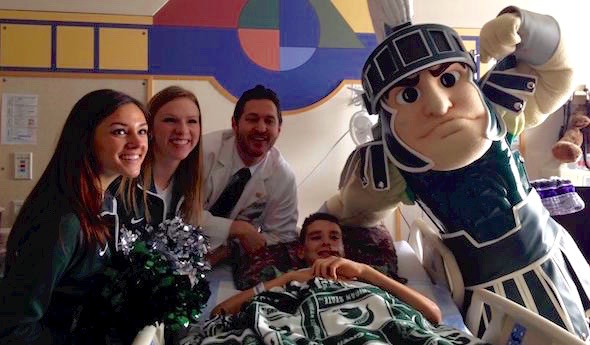
One bright spot in those early days came from Bronson Hospital’s Dr. Michael Leinwand who learned that Lamson is a huge Michigan State fan. He arranged for a visit from two students from the MSU dance team along with mascot Sparty.

Lamson had an attitude adjustment at Mott’s, where he found inspiration after watching an ESPN short called “Miraculous: The Austin Hatch Story,” about the University of Michigan basketball player.

“(Hatch) survived two plane crashes and lost his mother, father, two siblings and a stepmother in those two airplane crashes,” Lucy Lamson said. “He had a crushed pelvis, brain injuries. He worked like there was no tomorrow, and he didn’t have the family to support him.

“After we watched the story, Luke looked at me and said he doesn’t even have his mom and his dad to help him, and I do. That’s when he kicked it in.”

Lamson has had 22 surgeries with another scheduled for later this week, goes for physical therapy three times a week and has actually walked Athens’ home course at Stanton Farms with the cross country team.

He expects to be on the sidelines cheering on the team at its regional Oct. 31 and hopes to be a manager for the basketball team.

Lucy Lamson said it is not just the community who has come together to support the family, but also teams in the Big 8 Conference.

While at Mott’s, the teen wanted a leave to attend an Athens basketball game when his sister, Josie, was on the homecoming court.
He worked hard to meet all the criteria his doctors set and planned the surprise.

“We played our rival, Union City,” Lucy Lamson said. “They did a fundraiser for him, too. My sister was thanking everyone and then Luke rolled in in his wheelchair. and everybody just cried.”

Lamson’s basketball number has always been 13, and that number actually gave the family some comfort.

“After the accident, that number kept showing up everywhere,” his mother said. “The room he was in at one point was 13. Damon’s first gymnastics meet after the accident, he drew 13. They won a basketball game by 13.

“Players had headbands made that had 13 on them. Other teams in our conference that played our team would come in with 13 on their shirts or wristbands. At a dollar store for fundraiser stuff, the amount came to exactly $13. That was our way of knowing that God was with us and Luke would be OK.”

Lamson, Knowles and Riley Howard, all freshmen, figured they would be battling each other on the cross country team this year.

Instead, Knowles and Howard are running with Lamson cheering them on.

Although basketball is his first love, “We talked Luke into running cross country his seventh grade year, so he ran seventh and eighth grade years,” said coach Missy Hamilton, who also teaches science at the middle school.

“He’s just amazed everybody because we didn’t think he’d be back in school last year. He came back after spring break, in a wheelchair. He’s starting to walk a little bit. Now he walks the halls (with a brace on his left leg).

“I’m hoping he’ll be ready to run with us next year, and by the time he’s a junior, full time. As he works through his physical therapy, he becomes stronger and stronger.”

Damon Knowles has dedicated this cross country season to his cousin.

Asked if he thinks of Luke running beside him during meets, Damon replied, laughing and without hesitation: “Maybe behind me.”

Howard said Lamson is an inspiration to the other athletes.

“I’ve known him my whole life,” Howard said. “I was worried that he wasn’t going to make it, but I was really surprised because he’s up and walking.

“It’s inspired me to work harder, actually, because he’s not doing this right now, but he’ll be back. The team likes it when he’s there supporting us.”

John Knowles said the family has become even closer since the accident.

“There’s been a lot of great things that have come from this accident that is bigger than any one person or any one sport,” he said. “You’ve got to have bad days to appreciate the good days. Sports is a great teacher of that.”

Pam Shebest served as a sportswriter at the Kalamazoo Gazette from 1985-2009 after 11 years part-time with the Gazette while teaching French and English at White Pigeon High School. She continues to freelance for MLive.com covering mainly Kalamazoo Wings hockey and can be reached at [email protected] with story ideas for Calhoun, Kalamazoo and Van Buren counties.

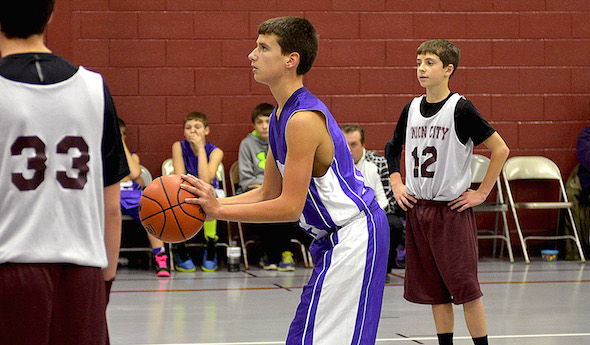
PHOTOS: (Top) Luke Lamson, in bed, is surrounded by his doctor, members of the Michigan State University dance team and Sparty during his stay at Bronson Hospital. (Middle) From left, John Knowles, Damon Knowles, Lucy Lamson. (Middle below) Luke Lamson sits up as his recovery continues. (Below) Lamson played basketball during middle school. (Top and middle photos courtesy of Lamson family; head shots by Pam Shebest, basketball photo by Photography by Char.)
63-Pointer Stirs Memories of UP Legends

February 29, 2020

By Ron Pesch
Special for Second Half

For the first time since 1970 – 50 years ago – and for only the 10th time in Upper Peninsula boys basketball history, a player has scored 60 or more points in a single game.

And that Houghton showing has stoked memories of legendary U.P. scoring showcases going back more than a century.

For the first time, the effort was for naught, at least from a win-loss standpoint, as Houghton dropped a nonconference road contest to Ishpeming 88-83 on Feb. 4. Brad Simonsen hit 23 of 45 field goal attempts, including 7 of 18 from beyond the 3-point arc, as Houghton pushed the play, hoping to narrow what had been a 10-point halftime margin. The 6-foot-6 senior, signed by Michigan Tech, was 10 of 13 from the free throw line and scored 24 points in the fourth quarter, ending the night with 63.

The performance topped Houghton’s school record of 60 points, set by Gary Lange in 1970. The total ranks 14th across the entire state for single game points in a contest, and tied Simonsen for sixth highest above the bridge. There, the mark equaled the top single-game output posted by Stephenson’s Mel Peterson, considered by many the greatest cager ever to come out of the Upper Peninsula.

“Marvelous Mel”

Peterson was the son of a minister and one of 10 children (and eight boys). His older brother, George, broke the U.P. scoring record in 1949 with 44 points in a game for Stephenson High School. The family moved away from the Upper Peninsula following George’s graduation, ultimately landing in southeastern Idaho.

There, Mel emerged as an outstanding athlete for Idaho Falls High School. Standing 6-foot-4½, Peterson’s growth occurred mostly during his freshman year.

“I played quite a bit on the varsity my sophomore year,” recalled Peterson recently. “My junior year I started out very, very slow but ended up very good. (However,) I fractured my ankle with about a minute to go in the semifinals of the (1955) state tournament, which we won.”

Peterson led all scorers with 25 points and dominated the boards that night, but had to be helped from the floor, then didn’t play in the title contest. “We lost the state tournament by three points, (43-40 to Kellogg). I was a cheerleader. … It would have been fun to play in the final game.”

When his father received a call to serve the Mission Covenant Church in Wallace, Michigan, about seven miles south of Stephenson, the family returned to the Upper Peninsula for Peterson’s senior year.

“At that time, it was nothing like it is now, where you can find anything about anybody. Then, that wasn’t the case at all,” Peterson said. “So, when we came back, no one had any idea of where I lived before, if I played or not.”

Indeed, prior to football season, one newspaper report indicated Peterson had transferred in from North Dakota, while another listed him as coming from Illinois. Regardless, Peterson emerged as a solid football player at Stephenson High in the fall of 1955. But it was on the basketball court where his scoring and rebounding prowess quickly loomed. He opened the season with 33 points in a win over Gladstone, despite fouling out early in the fourth quarter.

By January, the media had taken to calling him “Marvelous Mel” as Peterson averaged 32.3 points in his first half-dozen games for the Eagles. He drove Stephenson to a 15-1 regular-season record, posting 11 games over 30 points and scoring more than 40 in six.

On Jan. 21, 1956, he poured in 63 points in an 89-44 win over Manistique, shattering his brother’s school record. Mel nailed 25 of 38 shots from the field and 13 of 16 from the free-throw line. At the time, the scoring total exceeded the previous known best in the U.P. of 60 points, scored by Norbert Purol in February 1952. (Purol, from Ironwood St. Ambrose, would later play two seasons of AAU ball in Chicago before matriculating at Kentucky Wesleyan, earning four letters between 1956 and 1959. Wesleyan ended the 1957 season as runner-up to Wheaton College in the inaugural NCAA Small College Tournament – now known as Division II.)

“I don’t remember a great deal about a lot of it. That was so long ago,” said Peterson, laughing. “I guess the thing I appreciate most about the game was that my coach (Duane “Gus” Lord), let me play the whole game, which didn’t happen real often. Probably the thing I remember most about the whole year is that we played a Catholic school, Lourdes, from Marinette, Wisconsin. The first game we played them we beat them 110 to 44. The second game we lost 68-66.”

Peterson’s regular-season total of 570 points also exceeded Purol’s U.P. record of 556 posted over 19 games in 1952. His regular-season average, which had climbed to 35.6, topped the previous best of 29.6, posted by Pete Kutches in 1952 for Escanaba St. Joseph. Then Peterson pushed the per-game-average even higher in the postseason.

Seeing more playing time in the playoffs, “Marvelous Mel,” notched more than 30 points in all seven postseason games (exceeding 40 in three of the contests and 50 once), leading Stephenson to the MHSAA Class B championship win against Detroit St. Andrews in sudden-death overtime, 73-71. There he scored the game-tying bucket with 17 seconds remaining in the three-minute extra frame, and then sunk the game winner 26 seconds into sudden death, where the first team to gain a two-point advantage was proclaimed the victor. That 1956 season saw three of the four basketball championships awarded to U.P. teams.

Peterson finished with 849 points on the year – at the time the best single-season performance in MHSAA history. He averaged 36.9 points across 23 contests – currently eighth in the MHSAA record book.

Following graduation, Peterson nearly signed to play at the University of Minnesota, but felt a better fit at Wheaton College, outside Chicago. There, he earned three All-American honors. As a freshman in 1957, he led Wheaton to victory in that first NCAA Small College Tournament championship game against Wesleyan, earning Most Outstanding Player honors along the way. Today, he remains Wheaton’s all-time leader in career points, points per game, field goals made and career rebounds, all accomplished “without the benefit of a 3-point line, which had yet to be implemented.”

Peterson, who helped the USA team win gold at the 1963 Pan American Games in Sao Paulo, Brazil, played two games for Baltimore in the National Basketball Association (NBA) before a heart condition sidetracked his career. Once the issue was repaired, he returned to play 134 games over three seasons in the American Basketball Association, earning an ABA league championship with the Oakland Oaks in 1969. In 2019, he was inducted into the Small College Basketball National Hall of Fame.

The High-Scoring Sixties

Roger Roell, a senior at Channing, topped Peterson’s U.P. single game record with a 67-point performance in early January 1960 by dropping 31 field goals and five free throws in a 105-55 win over Michigamme.

Just over seven weeks later, Jim Manning scored 69 for Trout Creek against Amasa in another lopsided affair, 140-47 (then, a U.P. record for highest team score. The team’s 44 points in the fourth quarter was also a U.P. mark at the time. Trout Creek’s coach, Bruce Warren began substituting in the second quarter).

Manning, a junior, finished the 1959-60 season as the first player in U.P. history to exceed 600 points in one regular season, totaling 608 over 18 games. He would later pitch in the Major Leagues. 

Roell finished second with 569 points in 18 regular-season contests. Third on the regular-season scoring list was another junior, Erwin Scholtz of Hermansville, who tallied 505 across 18 games. 

As a senior, the 6-foot-5 Scholtz would post 71 points against Channing, a new benchmark for points in a game in the Upper Peninsula.

Or was it?

The Master’s Thesis

Perhaps because of the media coverage of Scholtz’s accomplishment, in 1962 the Crystal Falls Diamond Drill ran an article detailing the recently unearthed exploits of Ed Burling some 50 years prior. Richard Mettlach, football and baseball coach at Crystal Falls, had uncovered the Burling story.

Mettlach, “in the process of preparing a history of local high school sports which he submitted as a part of the preparation for his master’s degree … discovered that the newspaper records of the early years of high school basketball tell of a match between Iron River and Crystal Falls (played during the 1910-11 season).”

Crystal Falls had downed Iron River, 107-27, according to Mettlach’s research, and Burling had scored all but 10 of Crystal Falls’ points.

“Basketball was different in those days,” said Burling when interviewed by the Diamond Drill in January 1962. Then 68 years old and working as the postmaster in Crystal Falls, he recalled, “when one man was hitting the basket well, the rest of the team fed him the ball and let him shoot. I couldn’t miss that night.”

According to the article, “Burling said as he recalled the game, he made 98 points that night. It appears that 97, however, reportedly verified in two newspaper accounts of the game, will have to be the figure used in the record book.”

Burling recalled that the majority of his shots were from in front of the basket and that rules of the day allowed the top shooter on the team to attempt the free throws.

“The 97 point scoring record would probably have never been uncovered if it had not been for Mettlach’s research,” added the Diamond Drill.

Three more U.P. additions

In 1966, Bob Gale of Trout Creek scored 60 against Mercer, Wisconsin. Gale would later play at Michigan State.

Houghton’s Lange scored his 60 as the Gremlins walloped Painsedale Jeffers, 134-62, on January 23, 1970. One week later, Larry Laitala dropped 65 as Champion crushed Felch, 114-71.

“We had a very good team that year. We had a lot of wings and normally, I wouldn’t play the whole game. My coach was Dominic Jacobetti (who played at Negaunee St. Paul, then Northern Michigan University) and he was a pretty prolific scorer in the U.P. It was one of those nights where the rim was real big,” recalled Laitala, chuckling.

Laitala finished second to Lange in regular-season scoring, 557 to 523, with each athlete playing 17 games.

“Houghton is possibly the best team in any class in the Upper Peninsula,” wrote Hal Schram in the Detroit Free Press, who predicted an MHSAA state title for the team noting that many felt Lange was the top player north of the bridge. The Gremlins, at 17-0, finished as the top-ranked team in Class C in the weekly press polls assembled by the Free Press, The Associated Press and United Press International.

But the season ended earlier than expected for both teams. Houghton fell to St. Ignace in a Regional Semifinal.

“We were beat by our archrival, Republic (61-55) in the first game of the (Class D) Districts, which was kind of an upset,” added Laitala.

Prior to Simonsen’s accomplishment, Lange and Laitala were the most recent players above the Straits of Mackinac to equal or exceed the 60-point minimum established in the MHSAA record book.

The Challenge of Traceability

With modern-day electronic archiving of a number of the state’s newspapers and the accessibility of newspapers on microfilm, an effort has been made to add dates to single-game records, where once only the season of accomplishment was listed. The work continues.

Today, more than 100 years later, the “two newspaper accounts” used back in the 1960s for verification of Burling’s scoring accomplishment have not resurfaced. Hence, neither the date of the game, nor details from period accounts are available for study. That, combined with knowledge that basketball games from the time were usually low-scoring affairs, means doubt is still cast on the mark.

After investigation, the record was accepted by Crystal Falls historian Malcolm McNeil and U.P. sports archivist, Jim Trethewey, a former sports editor of the Marquette Mining Journal who travelled to Crystal Falls to interview Burling. MHSAA historian Dick Kishpaugh ultimately added the performance to the state record book. Questions about the legitimacy of Burling’s total began almost immediately and have resurfaced every 10 years or so. Todd Schulz, a former sports columnist at the Lansing State Journal, wrote extensively on the chase in 2012.

One of the individuals still working to help solve the mystery is Al Anderson of Crystal Falls.

The Diamond Drill was a weekly paper during Burling’s high school days, and newspapers of the time generally didn’t separate prep sporting news into sections. When reported upon, accounts of high school games were usually included in a ‘School Notes’ column.

The season was, without question, a success. “Winning eight out of ten games played, and having three challenges refused, the local basket ball team lay claim to the U.P. championship for the season of 1910-11,” stated the Diamond Drill in the March 25, 1911 edition. 

Still, reports uncovered from the period publication continue to cast doubt on the plausibility of the feat occurring in a high school game. “… More basket ball and less indoor foot ball next time will look better to the audience,” noted the newspaper about a 17-10 victory over Niagara, Wis., in mid-December 1910.

“The basket ball game last night resulted in a dispute near the end of the last half with the score 13 to 12 in favor of Crystal Falls. Iron Mountain disputed a decision by the referee and withdrew from the floor,” was the account in the Feb. 18, 1911 edition of the paper.

“There’s an article that was cut out of the physical copy of the December 10, 1910 Diamond Drill,” reports Anderson, who’s been seeking confirmation in fits and starts for nearly a decade. “It looks like it could be the ‘School Notes.’ portion.  It’s missing on microfiche copies as well. Perhaps that’s it.”

So the chase to verify continues.

2019-20 season brings sudden burst

Sophomore phenom Emoni Bates of Ypsilanti Lincoln is the latest prep player to etch his name in the MHSAA record book for scoring 63 points. He accomplished the feat in a 108-102 double-overtime win against Chelsea two weeks after Simonsen’s accomplishment. Statewide, that means 34 players have now scored 60 or more points in a game – 30 boys (10 in the U.P. and 20 in Lower Michigan) and four girls (one in the U.P and three in the Lower Peninsula).

Will the list be reduced by one? Time and additional research will tell.

Ron Pesch has taken an active role in researching the history of MHSAA events since 1985 and began writing for MHSAA Finals programs in 1986, adding additional features and "flashbacks" in 1992. He inherited the title of MHSAA historian from the late Dick Kishpaugh following the 1993-94 school year, and resides in Muskegon. Contact him at [email protected] with ideas for historical articles.

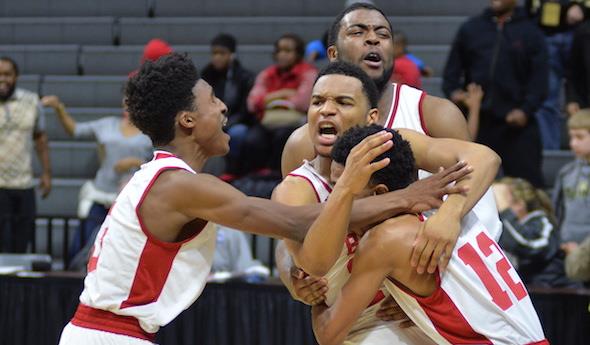
PHOTOS: (Top) Brad Simonsen celebrates becoming Houghton's all-time leading scorer Wednesday. (2) Stephenson's Mel Peterson. (3) Trout Creek's Jim Manning. (4) Houghton's Gary Lange. (5) Trout Creek's Bob Gale. (Top photo courtesy of Houghton Daily Mining Gazette. Peterson photo courtesy of Upper Peninsula Sports Hall of Fame. Houghton and Trout Creek photos courtesy of those schools' yearbook departments.)