

Athens' #13 Makes 'Miracle' Comeback
By
Pam Shebest
Special for MHSAA.com
October 19, 2015
ATHENS — Damon Knowles talked about baseball and basketball with his cousin, Luke Lamson, one warm Sunday last December.
That’s not unusual for the two young teens, but that day Lamson lay crushed beneath the wheels of a semi trailer loaded with corn and weighing more than 30,000 pounds.
 His cousin had crawled beneath the trailer to keep Lamson awake until the ambulance arrived with the Jaws of Life. Both boys were in eighth grade at the time.
Immediately following the accident, “My dad told me to go get the phone so we could call 911,” Knowles, 14, said. “I went under the trailer and was talking to Luke. I just had to keep asking him if he could breathe.”
That accident drastically changed the way Lamson figured his freshman year at Athens High School would play out. Instead of running cross country and playing basketball this year, he is on the sidelines cheering his teammates.
The fact the 14-year-old can actually do that now is a story of amazing recovery and faith.
Knowles, his dad John and Lamson were the only ones at the farm, moving the corn to the silo at the time of the accident. None of them knows exactly how the accident happened, but John Knowles said the ground was soft from rain the day before, which probably kept his nephew from being crushed to death.


 Lamson said he was awake the entire time, but doesn’t remember much about the accident.
“It didn’t kill him because we kept the pressure on him,” an emotional John Knowles said. “I could have drove the truck off him. Had a piece of machinery there, I could have tipped the truck off him.
“But I kept the pressure on him and he didn’t bleed internally. There was a higher power telling me not to get the trailer off him. He should have never made it out from under the trailer, never made it to the hospital. The first couple days were nerve-wracking.
“By the time I got to the hospital (later that day), half of Athens was there. We had over 90 people in the waiting room that night; probably 25 of them spent the night.”
Said Lamson’s mother, Lucy: “Being the adult and the one driving the vehicle, my brother was a mess. This little guy (Damon) was down there with Luke, underneath the trailer while he was pinned and held his head and made him stay awake and just kept talking with him.
“To me, that was the first miracle. Luke is sitting here right now because of it.”
The family created a Facebook page, Lukey Lamson’s Comeback, to post updates for friends and family.
The first entry explained: “He has a shattered pelvis, a compound fracture in his shoulder, a fracture in his lower back, and numerous open wounds. He currently just got out of surgery and they were able to attach a wound vac to help his wounds heal.
“We are receiving some communication from him such as waves, thumbs up, and hand squeezes when he is off his sedation medication, which is only for a few minutes at a time.”
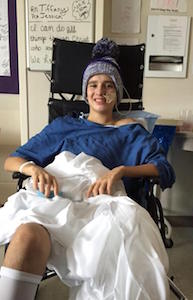 Lamson, who spent two months in Kalamazoo’s Bronson Methodist Hospital and one in University of Michigan’s C.S. Mott Children’s Hospital, said at the beginning he wasn’t sure he would live.
“There was times in the hospital that Luke wasn’t real fun to be around,” his uncle said. “There was one time I come around the corner and my mother and my sister were crying. I said what’s wrong. They said Luke wants to die.
“So I walked in there. I asked the two nurses to leave. We had a good heart-to-heart talk, and things changed.”
By Dec. 10, three days after the accident, Lamson was taken off the ventilator. And by Christmas, he had survived seven surgeries.
On Dec. 28 he was moved from the intensive care unit to a regular room, and by Jan. 20 he was able to sit in a wheelchair for the first time. He left Bronson for Mott’s on Feb. 3.
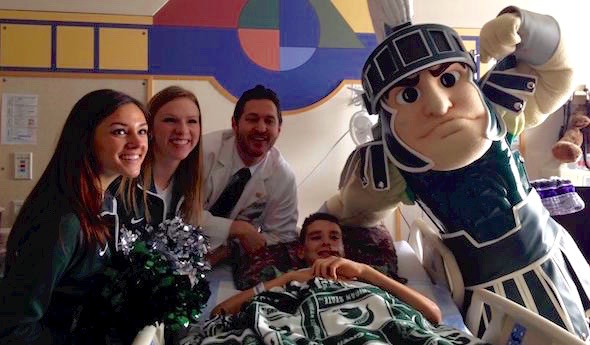
One bright spot in those early days came from Bronson Hospital’s Dr. Michael Leinwand who learned that Lamson is a huge Michigan State fan. He arranged for a visit from two students from the MSU dance team along with mascot Sparty.
Lamson had an attitude adjustment at Mott’s, where he found inspiration after watching an ESPN short called “Miraculous: The Austin Hatch Story,” about the University of Michigan basketball player.
“(Hatch) survived two plane crashes and lost his mother, father, two siblings and a stepmother in those two airplane crashes,” Lucy Lamson said. “He had a crushed pelvis, brain injuries. He worked like there was no tomorrow, and he didn’t have the family to support him.
“After we watched the story, Luke looked at me and said he doesn’t even have his mom and his dad to help him, and I do. That’s when he kicked it in.”
Lamson has had 22 surgeries with another scheduled for later this week, goes for physical therapy three times a week and has actually walked Athens’ home course at Stanton Farms with the cross country team.
He expects to be on the sidelines cheering on the team at its regional Oct. 31 and hopes to be a manager for the basketball team.
Lucy Lamson said it is not just the community who has come together to support the family, but also teams in the Big 8 Conference.
While at Mott’s, the teen wanted a leave to attend an Athens basketball game when his sister, Josie, was on the homecoming court.
 He worked hard to meet all the criteria his doctors set and planned the surprise.
“We played our rival, Union City,” Lucy Lamson said. “They did a fundraiser for him, too. My sister was thanking everyone and then Luke rolled in in his wheelchair. and everybody just cried.”
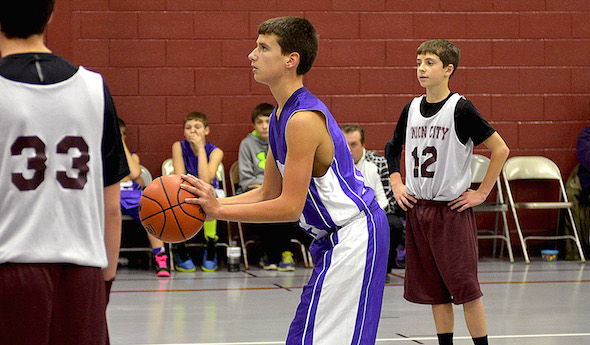
Lamson’s basketball number has always been 13, and that number actually gave the family some comfort.
“After the accident, that number kept showing up everywhere,” his mother said. “The room he was in at one point was 13. Damon’s first gymnastics meet after the accident, he drew 13. They won a basketball game by 13.
“Players had headbands made that had 13 on them. Other teams in our conference that played our team would come in with 13 on their shirts or wristbands. At a dollar store for fundraiser stuff, the amount came to exactly $13. That was our way of knowing that God was with us and Luke would be OK.”
Lamson, Knowles and Riley Howard, all freshmen, figured they would be battling each other on the cross country team this year.
Instead, Knowles and Howard are running with Lamson cheering them on.
Although basketball is his first love, “We talked Luke into running cross country his seventh grade year, so he ran seventh and eighth grade years,” said coach Missy Hamilton, who also teaches science at the middle school.
“He’s just amazed everybody because we didn’t think he’d be back in school last year. He came back after spring break, in a wheelchair. He’s starting to walk a little bit. Now he walks the halls (with a brace on his left leg).
“I’m hoping he’ll be ready to run with us next year, and by the time he’s a junior, full time. As he works through his physical therapy, he becomes stronger and stronger.”
Damon Knowles has dedicated this cross country season to his cousin.
Asked if he thinks of Luke running beside him during meets, Damon replied, laughing and without hesitation: “Maybe behind me.”
Howard said Lamson is an inspiration to the other athletes.
“I’ve known him my whole life,” Howard said. “I was worried that he wasn’t going to make it, but I was really surprised because he’s up and walking.
“It’s inspired me to work harder, actually, because he’s not doing this right now, but he’ll be back. The team likes it when he’s there supporting us.”
John Knowles said the family has become even closer since the accident.
“There’s been a lot of great things that have come from this accident that is bigger than any one person or any one sport,” he said. “You’ve got to have bad days to appreciate the good days. Sports is a great teacher of that.”
 Pam Shebest served as a sportswriter at the Kalamazoo Gazette from 1985-2009 after 11 years part-time with the Gazette while teaching French and English at White Pigeon High School. She continues to freelance for MLive.com covering mainly Kalamazoo Wings hockey and can be reached at [email protected] with story ideas for Calhoun, Kalamazoo and Van Buren counties.
PHOTOS: (Top) Luke Lamson, in bed, is surrounded by his doctor, members of the Michigan State University dance team and Sparty during his stay at Bronson Hospital. (Middle) From left, John Knowles, Damon Knowles, Lucy Lamson. (Middle below) Luke Lamson sits up as his recovery continues. (Below) Lamson played basketball during middle school. (Top and middle photos courtesy of Lamson family; head shots by Pam Shebest, basketball photo by Photography by Char.)
Breslin Bound: Boys Report Week 12
February 19, 2019
By Geoff Kimmerly
Second Half editor
We’re almost there. In fact, by delaying this week’s Breslin Bound report until Tuesday, we’re a day closer to the end of this boys basketball regular season and beginning of District play Monday.
 But a few league championships remain undecided, and there is still plenty to cover before we switch gears to the postseason.
Next week, we’ll preview the most intriguing District brackets in every division. Click here to get an early look at those matchups.
Breslin Bound is powered by MI Student Aid and based on results and schedules posted for each school at MHSAA.com. To offer corrections or fill in scores we’re missing, email me at [email protected].
Week in Review
The countdown of last week’s five most intriguing results:
1. Benton Harbor 72, River Rouge 62 – The Tigers won again in this rematch from last season’s Class B Semifinals – and possible preview of a Division 2 matchup coming next month.
2. New Haven 64, Roseville 55 – The Rockets won the Macomb Area Conference Red/White Tournament title by defeating one Red co-champ in this game after defeating the other Sterling Heights Stevenson in the semifinal.
3. Detroit U-D Jesuit 63, Detroit Catholic Central 54 – The Cubs finished a perfect run through both the Detroit Catholic League Central and then A-B Tournament bracket, with DCC finishing second in both.
4. Detroit Cass Tech 80, Detroit Renaissance 56 – The Technicians have won nine of their last 11 games and with this victory added a Detroit Public School League Tournament title to a shared Midtown championship.
5. Muskegon 66, Kalamazoo Central 59 – The Big Reds claimed this matchup of league leaders to extend their winning streak to 11.
Watch List
With an eye toward March, here are two teams in each division making sparks:
DIVISION 1
• Detroit U-D Jesuit (17-2) – The Cubs have won 11 straight games, with the most notable of the run against DCC twice and Flint Beecher by a point on Jan. 26. The only losses this winter came early, against New Haven on Dec. 1 and then Illinois championship contender Chicago Morgan Park on Jan. 5. Jesuit has reached the MHSAA Quarterfinals five straight seasons and could be on the verge of running that streak to six.
• Ann Arbor Pioneer (17-2) – The Pioneers, 11-10 a season ago, have locked up the Southeastern Conference Red title in a league where four of six teams have winning records. They added an impressive 56-44 win over the weekend against PSL Midtown co-champ Detroit Martin Luther King. The only losses came before the new year, against eventual league winners Canton and Wayne Memorial.
DIVISION 2
• Fremont (16-1) – A 60-59 overtime win over Grant on Friday clinched the Central State Activities Association Gold title, Fremont’s second straight after sharing last season with Big Rapids. This championship is outright, ironically after the Packers opened league play with their only defeat Dec. 7 to Reed City. Next up, Fremont will go for a second straight District title as well.
• Ovid-Elsie (15-1) – The Marauders have clinched a share of the inaugural Mid-Michigan Activities Conference championship, avenging their lone loss of the season Friday with a 69-66 double-overtime victory over second-place (tied) Mount Morris. Ovid-Elsie can clinch outright against the other second-place team, New Lothrop, on Thursday. The Marauders entered the new league coming off last season’s Tri-Valley Conference West title, and they too will play next week for a second straight District trophy.
DIVISION 3
• Iron Mountain (17-0) – The Mountaineers have followed up on last season’s Class C Quarterfinal run with the Western Peninsula Athletic Conference Iron title, plus a repeat championship in the Mid-Peninsula Athletic Conference. Three of Iron Mountain’s first four games this winter were decided by single digits – they haven’t had another closer than 10 since Dec. 7.
• Maple City Glen Lake (16-2) – The Lakers clinched an outright Northwest Conference title with a win over Benzie Central on Saturday and have won six straight since falling to Division 2 Williamston at Saginaw Valley State on Jan. 21. The only other defeat was to another strong Division 2 opponent, Holland Christian, on Dec. 28. Both losses no doubt served as great prep as Glen Lake looks to get back to Breslin after finishing Class C runner-up a year ago.
DIVISION 4
• Dollar Bay (16-3) – After making the Class D Semifinals coming off a perfect regular season in 2018, the Blue Bolts started this one slowly (relatively speaking) at 4-2. But they’ve won nine straight and clinched a share of the Copper Mountain Conference Copper Country championship, with a chance to finish the title outright Friday if they can avenge an earlier loss to Chassell. Dollar Bay also won’t see nemesis Bessemer (the other two defeats) until possibly the Regional if both advance next week.
• Wyoming Tri-unity Christian (15-3) – The Defenders sit second in the Alliance League thanks to a one-point loss Jan. 22 to Division 3 and league leader Potter’s House Christian. But Tri-unity could make another of its usual long postseason runs, especially with Potter’s House in a different division after eliminating the Defenders in the District a year ago. Tri-unity’s only other losses were to Division 3 Pewamo-Westphalia and Grandville Calvin Christian.
Can't-Miss Contests
Be on the lookout for results of these games coming up:
Tuesday – McBain (14-3) at Manton (13-4) – McBain’s 45-42 win on Feb. 5 has the Ramblers still sitting atop the Highland Conference standings, but a Manton win could result in a shared championship when this week is done.
Thursday – Howell (14-5) at Canton (18-1) – The overall Kensington Lakes Activities Association championship game pits the top two teams from the West division.
Friday – DeWitt (16-2) at Okemos (17-1) – The Chiefs own a share of the Capital Area Activities Conference Blue title thanks in part to a 41-35 win over the Panthers on Jan. 18, but DeWitt can grab a share by winning this rematch.
Friday – Grand Rapids Forest Hills Northern (18-0) at Grand Rapids Northview (14-3) – FHN won the first meeting 64-53 on Jan. 25, but a Northview win could mean a shared Ottawa-Kent Conference White title or more if Northern gets upset Tuesday.
Friday – Detroit Cass Tech (14-5) vs. Detroit U-D Jesuit (17-2) at Calihan Hall – The annual Operation Friendship game pits PSL and Catholic League champs and likely Division 1 state contenders as well.
Second Half’s weekly “Breslin Bound” reports are powered by MI Student Aid, a part of the Student Financial Services Bureau located within the Michigan Department of Treasury. MI Student Aid encourages students to pursue postsecondary education by providing access to student financial resources and information, including various student financial assistance programs to help make college more affordable for Michigan students. MI Student Aid administers the state’s 529 savings programs (MET/MESP) and eight additional aid programs within its Student Scholarships and Grants division. Click for more information and connect with MI Student Aid on Facebook and Twitter @mistudentaid.
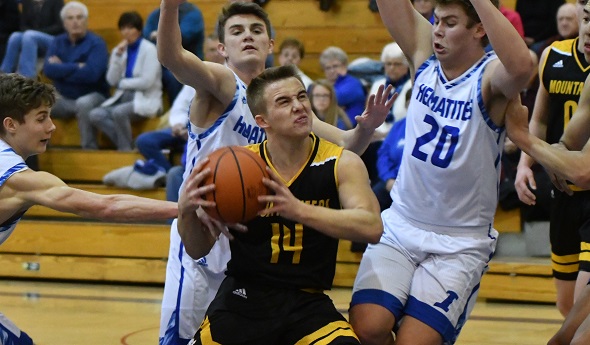
PHOTO: Iron Mountain's Marcus Johnson works to get to the basket during a Feb. 1 win over Ishpeming. Iron Mountain is one of 14 unbeaten teams left statewide. (Photo by Cara Kamps.)