

Baseball Pro Windham Winters at Monroe St. Mary as Dad's Assistant Coach
By
Doug Donnelly
Special for MHSAA.com
December 15, 2022
When Bryce Windham was about 6 years old, he was the ball boy for the Monroe St. Mary Catholic Central basketball team.
 At halftime, rather than go inside the locker room, Bryce would stay on the court and shoot 3-pointers.
“He was the halftime entertainment,” SMCC head boys basketball coach Randy Windham said. “I’d hear some big cheers, and I’d open the door and look out and just shake my head. Bryce would be out there shooting 3s.”
Bryce is now 26 and a minor league baseball player in the Chicago Cubs organization. Being a professional baseball player hasn’t changed who he is or where he is. Only now, Bryce goes into the locker room because he’s an assistant coach for his dad’s SMCC Falcons.
“He’s ready right now,” Randy Windham said. “He could be head coach right now. I tell him, ‘Once you are done messing around with the baseball thing, you can coach this team.’”
Bryce had a dream high school sports career at SMCC.
He was the Falcons’ starting shortstop, point guard on the basketball team, and was quarterback for the football team. He was all-state in all three sports. He quarterbacked SMCC to the 2014 Division 6 championship in football. The Falcons boys basketball team – coached by his dad – reached the 2015 Class C Quarterfinals. He was MVP of the 2015 all-star baseball game at Comerica Park.
“He’s always been a thinker, no matter what sport he’s been in,” Randy Windham said. “He’s always analyzed the game. That helps. He’s so humble. That’s the best thing about him.”
Bryce could have played basketball at the University of Toledo, but took a different turn when Old Dominion University offered him a baseball scholarship.
“I was nowhere’s near as good at baseball as I was at basketball,” he said. “I didn’t think I was very good. I wanted to see how good I could be at baseball.”
The lure of Virginia Beach, Va., helped push him to baseball, too. It was a couple of years into baseball on the east coast that he picked up catching. After graduating, he ended up getting drafted by the Cubs and is now at the Double A level.
Bryce reports back to the Cubs on Feb. 17. He expects to return to the Tennessee Smokies, where he played last season.
 “Double A is where the prospects are. Players are competitive, pushing hard,” he said. “I think they really want me to get some at-bats and get more miles catching on my body.”
For now, in Monroe, he works out daily to stay in shape, hits the batting cages to keep his swing sharp and works at the family business. He will leave for baseball just at the time SMCC begins final preparations for the District tournament, and he’s okay with that.
“By then, the teaching is done,” he said.
It’s no shocker that Bryce is coaching in his spare time. Not only is his dad an ultra-successful boys basketball coach at SMCC, but his mom Kim also has had great success coaching volleyball in Monroe County for years. As soon as Bryce’s high school career was finished, he started to coach.
“I started helping right after I graduated high school,” Bryce said. “In college, I’d come home, and I’d practice with the guys. That allowed me to stay in shape, and I kind of kept the relationship with guys. Once I officially graduated from college, I jumped right into coaching.”
“I always felt like a player-coach when I played,” Bryce continued. “I felt like I knew what was going on, even outside of myself.”
Coaching just came naturally.
“I knew that was something I wanted to do. It’s because of him,” he said, pointing to his dad. “He was my coach from fifth grade all the way up. I knew the game. I tell my pitching coach all the time that if my baseball IQ was as high as my basketball IQ, I’d be in the Major Leagues right now.”
Randy Windham is in his 14th season as the SMCC varsity coach. He took over for longtime coach Ray Lauwers and built on that success and brought the Falcons to new heights, with multiple deep runs in the postseason. He came into this winter with a record of 229-71. A lot of those wins came with Bryce on the court. Another victory during his tenure actually belongs to Bryce as coach.
Randy was ill last year and, for the first time in nearly three decades of coaching, he sat out a game. Bryce took the reins and led SMCC to a Huron League win at Milan.
“I was so nervous,” Bryce said. “I’m glad it was on the road. If it would have been at home with all the home fans, I would have been more nervous.”
Randy said he was comfortable with missing the game because he knew Bryce would be fine.
“I give him a lot of responsibility now,” Randy said. “He’s ready right now to be a head coach. He’s ready for that. Coaches must do more than Xs and Os. A coach must be able to handle problems before they happen. He’s ready for that. I can walk away from practice, and he can handle it.”
“He just knows the game so well. I know for a fact that I could step away, and the success would continue. He’s natural at it.”
Windham said having his son on the bench next to him provides a lot of comfort, and the players like having him there. Bryce rarely talks about being a professional baseball player, but that gets the attention and respect of the players right away.
“He’s helped me come back,” Randy said. “I’ve been around here 25 years (including his time as an assistant to Lauwers). He helps refresh me. In the fall, he comes back and jumps right into the skill work with the kids. That allows me to refresh and have the energy to coach this time of year. I love this time of year.”
For now, Bryce will continue to pursue professional baseball but knows coaching is in his future at some point.
“I’m still an athlete and a coach. Right now, I kind of have that bridge between the players and (my dad). I keep them out of trouble. I catch things before he catches it. I bring a lot of energy to practice every day. Basketball practice is so much fun,” Windham said.
He also has a different perspective now as an assistant coach, but one he relishes. As he said, again referring to his father, “I only know what I know because of him.”
 Doug Donnelly has served as a sports and news reporter and city editor over 25 years, writing for the Daily Chief-Union in Upper Sandusky, Ohio from 1992-1995, the Monroe Evening News from 1995-2012 and the Adrian Daily Telegram since 2013. He's also written a book on high school basketball in Monroe County and compiles record books for various schools in southeast Michigan. E-mail him at [email protected] with story ideas for Jackson, Washtenaw, Hillsdale, Lenawee and Monroe counties.
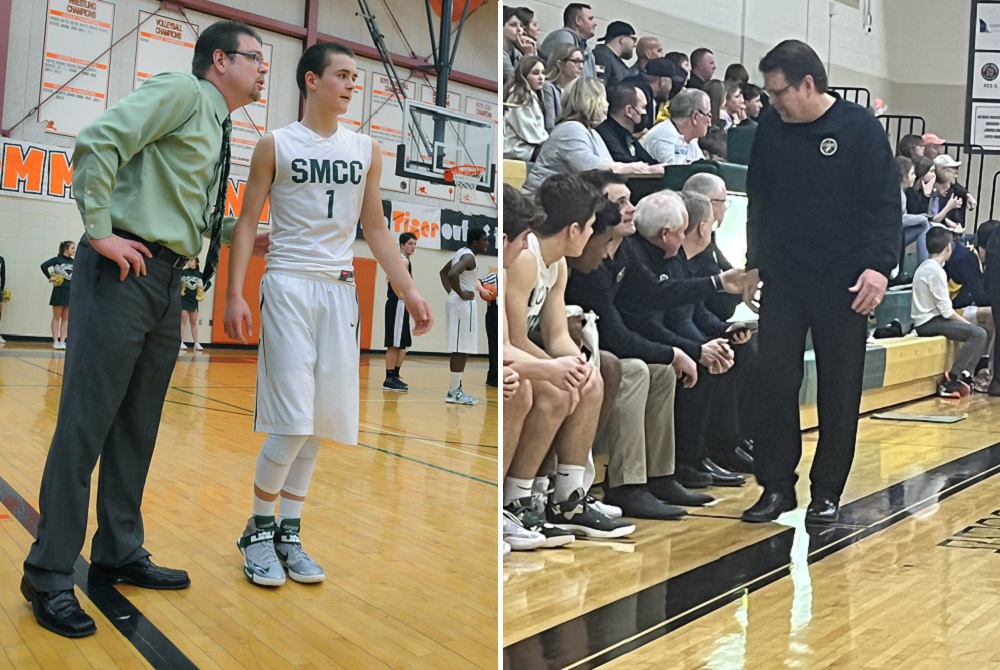
PHOTOS (Top) At left, coach Randy Windham and his son/point guard Bryce Windham confer during Monroe St. Mary’s Regional run in 2014. At right, Randy talks things over this season with Bryce, now his assistant coach. (Middle) Bryce Windham mans the plate this summer for the Tennessee Smokies, a Cubs affiliate. (Top photos by Tom Hawley and Doug Donnelly, respectively. Middle photo by Mike Krebs.)
Breslin Bound: Boys Report Week 7
January 22, 2013
By Geoff Kimmerly
Second Half editor
The fireworks flew in Michigan boys basketball last week, as three Associated Press top-ranked teams fell, albeit against others considered contenders as well.
With boys basketball season now at its midpoint, it's fair to say doors remain open for more potential contenders to step in. See this week's list of high performers for some that could be in the mix.
1. Detroit Cass Tech (10-1) – The two-time reigning football champ has owned the basketball court too since falling in December to Harper Woods Chandler Park.
2. East Kentwood (10-0) – The Falcons won 17 games two years ago and 18 last season, and will make a run next month to improve on those totals again.
3. Detroit Consortium (6-2) – Consortium is looking to be in the Class C mix and looks good to contend after knocking off Class B giant Detroit Country Day last week 68-62.
4. Wyoming Godwin Heights (9-0) – On top of being considered arguably the top team in Class B, Godwin Heights gave Class D power Wyoming Tri-unity Christian its first loss, 60-58 last week.
5. Detroit Pershing (12-0) – Pershing was here last week too, but it’s hard to not include the Doughboys again after they beat Detroit Southeastern 63-54 and handed Flint Beecher its only loss, 56-53.
6. Munising (6-1) – Since opening with a loss to Gwinn, Munising hasn’t fallen and beat 2012 Class D Semifinalist Carney-Nadeau last week 40-37; C-N knocked Munising out in the Regional Final last season.
7. Frankfort (8-0) – Just 11-12 last season, Frankfort is only a few wins from besting that mark and looks good to accomplish much more.
8. Jackson Lumen Christi (8-0) – The Titans often have contended but rarely been favored during their decade in the Capital Area Activities Conference; they are the team to beat in the CAAC Gold this time.
9. Warren Woods-Tower (7-2) – After opening 1-2, the Titans have won six straight including a big win over previously-surging New Haven, 58-54 last week.
10. Beal City (6-3) – The Aggies have won four straight after a little bit of a delayed start due to a Ford Field football run; last week’s 62-61 win over Leroy Pine River was the best win so far.
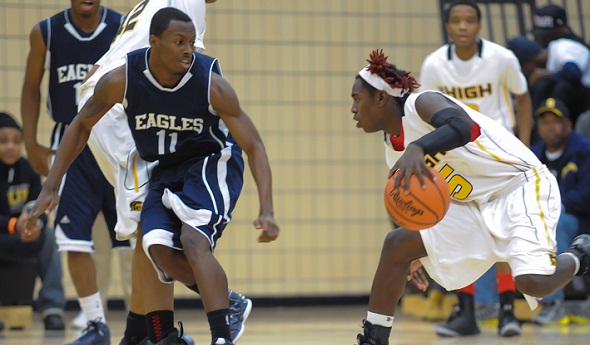
PHOTO: Saginaw (white jerseys) improved to 14-1 on Saturday with an 86-61 win over Harper Woods Chandler Park. (Click to see more at HighSchoolSportsScene.com.)