

Bates, Lincoln Land in 1st Hoops Final
March 15, 2019
By Geoff Kimmerly
Second Half editor
EAST LANSING – Emoni Bates was here to help, he told his teammates before beginning his freshman year at Ypsilanti Lincoln in the fall.
That’s one very understated way to put what the nationally-renowned freshman has meant to the Railsplitters during their most successful season.
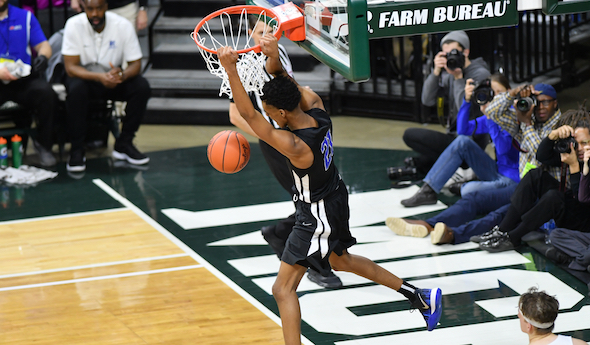
Bates, and Lincoln, played in their first MHSAA Semifinal on Friday, and the 6-foot-10 phenom showed as expected – he flashed skill and poise and brought roars with a pair of dunks, including one from a pass off the backboard.
And Lincoln continued to perform as he expected when he joined an otherwise veteran lineup, making an incredible 57 percent of its shots from the floor in a 72-56 win over Howell to earn a berth in Saturday’s Division 1 championship game.
“My teammates … when I told them I was coming (to Lincoln), I told them I was just helping them, and I told them if we just keep working hard every day we’d be here,” Bates said. “I just knew I trusted them. I trust them, and they trust me, and that’s how we got here.”
Lincoln (22-4) will play for its first championship against Detroit U-D Jesuit at 12:15 p.m. Saturday.
Playing on the Breslin Center floor for the first time, in front of a mostly full lower bowl, has derailed many an MHSAA championship hopeful.
But there might not be a player, and team, in recent memory that has been more prepared for a trip to East Lansing than Bates and Lincoln.
Buzz around the nationally-renowned freshman started high this winter and has only continued to grow as he’s keyed the Railsplitters’ run to its first Regional title, then Semifinals and now championship game.
He had 31 points – on 55 percent shooting – and 14 rebounds against Howell, and his teammates followed suit showing no effects from the big-arena atmosphere by sinking 59 percent of their shots.
“It was just fun. We battled all game, he’s taller than me and was shooting over my head, and I couldn’t really do anything about it,” said Howell senior Josh Palo, an all-state honorable mention last season and one of those charged with defending Bates on Friday. “I was definitely looking forward to guarding him. Our game plan was making him take tough shots. He was knocking them down. We couldn’t do anything about it.”
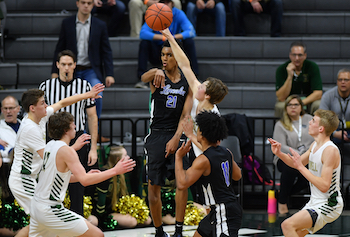 Bates’ first basket was a 3-pointer with 3:52 left in the first quarter that made the score 10-4. The Railsplitters never led by fewer than six points the rest of the way.
Senior forward Amari Frye added 12 points while making half his shots from the floor, and senior guard Tahj Chatman made all four of his shots from the floor for 10 points to go with four assists.
“I’ve been on varsity four years, and the added pressure, I tell him all the time to put the pressure he gets and put it on me,” Chatman said. “I feel we’re here for him. We all embrace him. There’s no jealousy or none of that. We embrace him all the way.”
Lincoln starts four seniors with Bates, and after going 10-11 in coach Jesse Davis’ first season three seasons ago posted back-to-back winning records before breaking through this winter.
“I envisioned everything that we’re doing right now,” Davis said. “We just worked toward it. Of course I need these guys learning it, (buying in) to what I’m saying and what I’m doing and what I’m teaching them. But yes, I envisioned this for the program.”
Howell (20-7) took a similar step with its program this winter, with Friday’s Semifinal the team’s first since 1927. The Highlanders first won their third straight District title and finished with their highest win total of Howell coach Nick Simon’s seven seasons leading the program.
Palo, one of four seniors in the starting lineup, had 16 points in his final high school game. Junior guard Tony Honkala had 12 points off the bench, and senior forward Jake Sargeant had 11 points and six rebounds for the Highlanders.
“Our guys believed in this for a long time,” Simon said. “It’s not just something that’s happened at the end of the year.
“I knew we could do it, and they knew we could do it all year. We went through tough battles, went against tough opponents in the playoffs, and we were used to that tough competition. We respected them, but we were not fearful at all.”
PHOTOS: (Top) Ypsilanti Lincoln’s Emoni Bates throws down one of his two dunks during Friday’s Division 1 Semifinal. (Middle) Howell players work to break up a pass.
Buckley Rides Into Season Finale Again
March 22, 2018
By Geoff Kimmerly
Second Half editor
EAST LANSING – Buckley’s cart may have come before the horse earlier this season.
The horse arrived Thursday night at the Breslin Center.
Bears coach Blair Moss referred to the old saying to describe how his team – returning almost entirely intact from last year’s Class D runner-up run – got rolling a little slowly this winter.
But Buckley has found its stride – and hit it especially right with about seven minutes to play in Thursday’s 65-55 Semifinal win over Hillsdale Academy.
The Bears outscored the Colts 17-6 to pull away after trailing by 12 early in the third quarter.
“Last postseason, when we lost to Powers North (Central), I said we’d be back here,” said Buckley senior Austin Harris, noting the 78-69 defeat against the Jets in the 2017 championship game. “And I believed in my team and I knew. We got in the gym and worked really, really hard. I think our success in this, hard work really paid off. We believe in ourselves.”
Buckley (21-5) will face Southfield Christian in Saturday’s 10 a.m. championship game.
The Bears’ entire starting five returned this season from the team that fell just one win short of a first MHSAA boys basketball championship a year ago.
They started this season 3-3 – although those losses were to Kalamazoo Hackett, McBain and Frankfort, which all ended up winning at least 18 games.
“I think I put the cart before the horse. We knew where our goal was at, but we forgot we had 20 games in between,” Moss said. “I saw flashes of us, and I tried to pinpoint what we were doing and not doing right. So I told them before the tournament started, let’s not worry about records, let’s not worry about who’s scoring, let’s just play for each other.”
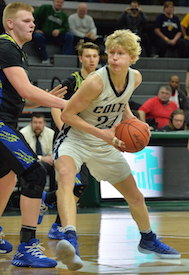 Hillsdale Academy (19-7), making its first trip to the Semifinals after winning its first Regional title last week, got behind by eight points early in the second quarter. But the Colts, following the lead of 6-foot-7 senior Peter Kalthoff, launched a 15-3 run over the final two minutes of the first half and first two of the second to take a 43-31 lead. Kalthoff had six of his team-high 17 points during that stretch.
Buckley’s veteran lineup began chipping away. Harris had eight points including two 3-pointers, and the Bears hit four 3-pointers total over the final six minutes of the third quarter to take back a one-point lead.
Harris started the closing run with another 3-pointer, and senior Joey Weber had seven of his 15 points over the final 4:25 of the game.
Weber also had nine rebounds, four assists and four steals, and senior forwards Denver Cade and Brock Beeman both added 11 points – Cade also dishing four assists.
Kalthoff added 11 rebounds, three steals and two blocked shots to go with his 17 points, and senior guard Michael Craig added 14 points and five assists.
“I’m proud of my guys and the way they battled, not just tonight, but in the other 27-some other games to get to this point,” Hillsdale Academy coach Tim Wells said. “Looking at some of the stats in preparation for tonight, these guys (four-year seniors Kalthoff, Craig and Nolan Sullivan) have won 74 games in four years – that’s fantastic. So by the time we got to now, we started talking about this moment, this is your reward.”
“As much as it stings to lose this game, look where we got to play. I know it’s bigger than that, (but) it was pretty incredible,” Sullivan added. “I knew we could do it. But to actually do it is something that’s absolutely incredible.”
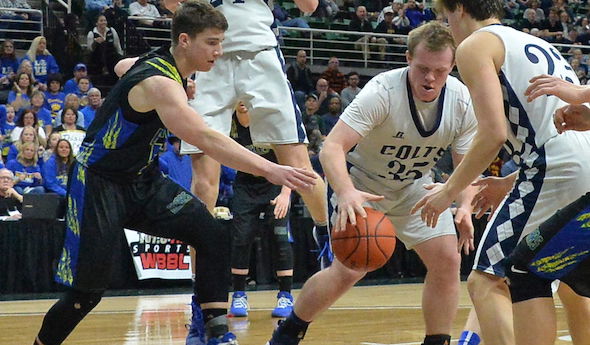
PHOTOS: (Top) Buckley’s Joey Weber (5) and Hillsdale Academy’s Nolan Sullivan work for a loose ball during their teams’ Class D Semifinal. (Middle) Hillsdale Academy’s Peter Kalthoff takes a step toward the basket Thursday.