

Bates, Lincoln Land in 1st Hoops Final
March 15, 2019
By Geoff Kimmerly
Second Half editor
EAST LANSING – Emoni Bates was here to help, he told his teammates before beginning his freshman year at Ypsilanti Lincoln in the fall.
That’s one very understated way to put what the nationally-renowned freshman has meant to the Railsplitters during their most successful season.
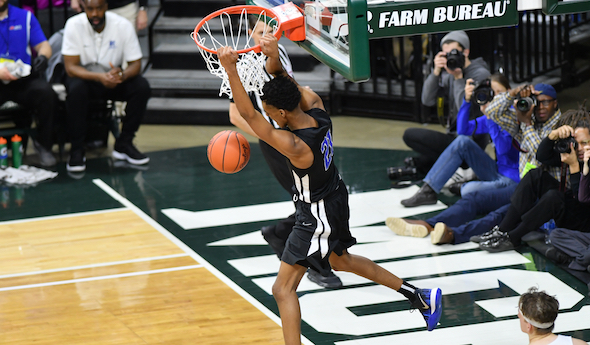
Bates, and Lincoln, played in their first MHSAA Semifinal on Friday, and the 6-foot-10 phenom showed as expected – he flashed skill and poise and brought roars with a pair of dunks, including one from a pass off the backboard.
And Lincoln continued to perform as he expected when he joined an otherwise veteran lineup, making an incredible 57 percent of its shots from the floor in a 72-56 win over Howell to earn a berth in Saturday’s Division 1 championship game.
“My teammates … when I told them I was coming (to Lincoln), I told them I was just helping them, and I told them if we just keep working hard every day we’d be here,” Bates said. “I just knew I trusted them. I trust them, and they trust me, and that’s how we got here.”
Lincoln (22-4) will play for its first championship against Detroit U-D Jesuit at 12:15 p.m. Saturday.
Playing on the Breslin Center floor for the first time, in front of a mostly full lower bowl, has derailed many an MHSAA championship hopeful.
But there might not be a player, and team, in recent memory that has been more prepared for a trip to East Lansing than Bates and Lincoln.
Buzz around the nationally-renowned freshman started high this winter and has only continued to grow as he’s keyed the Railsplitters’ run to its first Regional title, then Semifinals and now championship game.
He had 31 points – on 55 percent shooting – and 14 rebounds against Howell, and his teammates followed suit showing no effects from the big-arena atmosphere by sinking 59 percent of their shots.
“It was just fun. We battled all game, he’s taller than me and was shooting over my head, and I couldn’t really do anything about it,” said Howell senior Josh Palo, an all-state honorable mention last season and one of those charged with defending Bates on Friday. “I was definitely looking forward to guarding him. Our game plan was making him take tough shots. He was knocking them down. We couldn’t do anything about it.”
 Bates’ first basket was a 3-pointer with 3:52 left in the first quarter that made the score 10-4. The Railsplitters never led by fewer than six points the rest of the way.
Senior forward Amari Frye added 12 points while making half his shots from the floor, and senior guard Tahj Chatman made all four of his shots from the floor for 10 points to go with four assists.
“I’ve been on varsity four years, and the added pressure, I tell him all the time to put the pressure he gets and put it on me,” Chatman said. “I feel we’re here for him. We all embrace him. There’s no jealousy or none of that. We embrace him all the way.”
Lincoln starts four seniors with Bates, and after going 10-11 in coach Jesse Davis’ first season three seasons ago posted back-to-back winning records before breaking through this winter.
“I envisioned everything that we’re doing right now,” Davis said. “We just worked toward it. Of course I need these guys learning it, (buying in) to what I’m saying and what I’m doing and what I’m teaching them. But yes, I envisioned this for the program.”
Howell (20-7) took a similar step with its program this winter, with Friday’s Semifinal the team’s first since 1927. The Highlanders first won their third straight District title and finished with their highest win total of Howell coach Nick Simon’s seven seasons leading the program.
Palo, one of four seniors in the starting lineup, had 16 points in his final high school game. Junior guard Tony Honkala had 12 points off the bench, and senior forward Jake Sargeant had 11 points and six rebounds for the Highlanders.
“Our guys believed in this for a long time,” Simon said. “It’s not just something that’s happened at the end of the year.
“I knew we could do it, and they knew we could do it all year. We went through tough battles, went against tough opponents in the playoffs, and we were used to that tough competition. We respected them, but we were not fearful at all.”
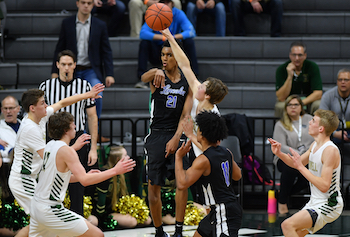
PHOTOS: (Top) Ypsilanti Lincoln’s Emoni Bates throws down one of his two dunks during Friday’s Division 1 Semifinal. (Middle) Howell players work to break up a pass.
Big Reds Come Up Big Time in 4th Quarter
March 21, 2014
By Geoff Kimmerly
Second Half editor
EAST LANSING – One quarter – 8 minutes – remained in Friday’s last Class B Semifinal at the Breslin Center. Time appeared to be running out for Milan as it trailed Detroit Douglass by eight points.
And this was the scenario – almost – that the Big Reds wanted.
Sure, they would’ve liked to be trailing by less. And they probably didn’t want the ball in a freshman’s hands for the program’s most pressure-packed free throw of the last half century.
But aside from that …
“We were down eight and we had eight minutes to win this game,” senior guard Donovan Verges said. “We’re yelling at each other, ‘We’ve gotta come back,’ that we’re not losing today. We want to play in that championship game. So we went out there and fought as hard as we could.”
And they eventually edged Douglass, 51-50, in the most exciting Semifinal of this weekend.
Verges nailed a 3-pointer with 3:38 to play to tie the score for the first time since the start of the third quarter. It remained tied 50-50 with 22 seconds to play as the ball passed through four sets of hands near midcourt before falling into those of Milan freshman Garrett Gardette – who was fouled and made the go-ahead free throw with five seconds to play.
He missed the second free-throw attempt. But Douglass’ outlet pass off the rebound landed comfortably back in Verges’ hands with everyone else on the court then too stunned to do anything more before time expired.
Just like that, Milan (24-3) will be facing Benton Harbor on Saturday with a chance to win its first MHSAA title since claiming Class C in 1948.
“All year we said we wanted to make history here at Milan,” Big Reds senior Latin Davis said. “We wanted to leave a legacy. So that’s what we’re trying to do.”
The 5-foot-9 guard scored 17 points (on 6 of 10 shooting from the floor) with six assists, and 6-7 junior Nick Perkins added 16 points and nine rebounds.
Davis had only three points during the fourth-quarter comeback, but also had two assists. And he played the starring role as Milan’s defense allowed only 12 points in the third quarter and eight during the final period.
“Latin Davis has been underrated for three years. He’s a winner,” Milan coach Josh Tropea said “He’s 64-8 in the last three years, and he’s won more trophies than I care to count. And there’s no question we’re playing (Saturday) because of his leadership and his ability at point guard.”
 Douglass coach Nkwane Young said after that his team had had difficulties all season against zone defenses. Milan switched to a stifling 1-2-2 zone for the fourth quarter after using a 2-3 earlier and watching as the Hurricanes found openings when the Big Reds tried switching to man-to-man.
Douglass senior guard Darrell Davis, a Mr. Basketball candidate, ended up spending most of the game stuck on the perimeter and got off only 11 shots in scoring just nine points, 16 below his average.
Senior point guard Terrell Hales did add 11 points, seven rebounds and five steals, with senior forward Deshawn Sanders leading with 15 points and senior forward Daavi Bradley coming off the bench to also score 11 for the Hurricanes (17-10).
Even then, Douglass’ final undoing fell partially on missing 5 of 9 free-throw attempts during the fourth quarter and making only 10 of 21 for the game.
“I thought the third quarter, we had control of it. And in the fourth quarter, I thought we were still in control,” Young said. “Like I told my team, one play doesn’t (lose) the game. There are some things we could’ve done differently, made some free throws. But otherwise, I’m proud of my team.”
The Semifinal run was the first for Douglass, which previously had reached a Quarterfinal in 2010. Davis was part of teams that finished 68-31 and won four District titles over his four seasons despite playing as a Class B in the Class A-heavy Detroit Public School League. Young called his standout the face of his program, and Davis will go on to play next season at the University of Dayton.
“The first year we took it to the Regional (Semifinal), and I wanted to take it farther than that, to the state championship,” Davis said. “My legacy is a good legacy at Fred D. I hope somebody comes in to replace it. I’ve just got to work harder in college, a stepping stone toward life.
“A lot of people doubted us, didn’t think we’d be making it this far. We came up a little short, but it’s OK. We just wanted to win, that’s all.”
Click for a full box score and video from the press conference.
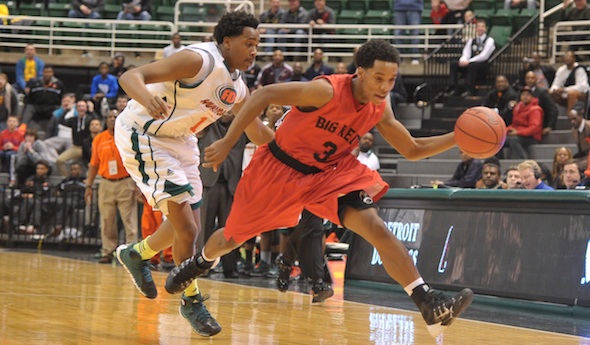
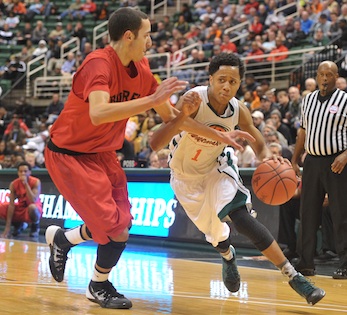
PHOTOS: Milan freshman Garrett Gardette tries to get past Douglass’ Daavi Bradley during Friday’s Class B Semifinal. (Middle) The Hurricanes’ Darrell Davis works to get to the basket.
HIGHLIGHTS: (1) Detroit Douglass ended the first half on an 11-4 run, including this bucket by Darrell Davis on a break with 3 seconds to go. (2) Nick Perkins had a pair of baskets for Milan in the closing moments of its 51-50 Class B Semifinal win. This putback gave the Big Reds the 50-49 lead at the time.