

Bear Lake's Harless Twins Both Eclipse 1,000 Points, Have More Milestones in Mind
By
Tom Spencer
Special for MHSAA.com
January 30, 2026
Grady and Myles Harless will end their high school basketball careers among the highest scorers in Bear Lake history.
 The twin brothers are the latest Lakers to join the 1,000-point club, but scoring is not how either one of them wants to be remembered. Their preferred legacy, as they look to play at the next level, is a strong work ethic.
“You can be athletic as you want, but if someone outworks you they'll be better than you,” Grady Harless said, noting his message is to current and future high school basketball players. “If you're from a small school, hard work will get your name out there.”
Myles Harless has a similar message for those competing on the hard court.
“Even if you come from a small school or a small community, you can be great,” he said. “It doesn't matter what part of the state you're from – if you're good, you're good.”
With the Harless twins leading the way, the Lakers are off to a 13-4 start and share first place in the West Michigan D League at 8-1. Grady Harless is scoring 23 points per game while also averaging six rebounds, 2.5 assists, 2.7 steals. Myles Harless is averaging 20.7 points per game while dominating the boards with almost 18 rebounds per contest.
“Those two have been the definition of what I view Bear Lake basketball is and should be going forward,” said fifth-year Lakers coach Christian Novak. “I've seen some pretty solid twins that have played together and what not, but I've not seen any accomplish the same thing these two have.”
Myles Harless pulled down 25 rebounds and scored 28 points Tuesday night as the Lakers stayed in first place with an 87-49 win over Mesick. Grady Harless added 27 points and six assists.
 Joining the 1,000-point club had been the twins’ goal since they first played for Bear Lake as eighth graders. With an enrollment far fewer than 100, Bear Lake applied for and was granted an MHSAA waiver to permit eighth graders like the Harless boys to compete in junior varsity and varsity play.
The twins played sparingly on the varsity as eighth graders, mostly benefiting from the fifth-quarter rule.
“Myles and Grady are the exact definition of what Bear Lake basketball is — show up, go to work, put in the extra time with grit and all the extra stuff,” Novak said. “I would say from their eighth-grade summer until all the way up till now, they did the work and I doubt they missed more than a handful of training opportunities.”
The Lakers are riding a five-game winning streak and have four league games remaining. They’ll finish the regular season at Baldwin, a team they topped 66-48 at home. Baldwin currently shares the league lead.
Senior Easton Nowak has been on a tear of late for Bear Lake as well. He had 13 points, four steals, two assists and a blocked shot against Mesick and is now averaging almost 10 points per game. Just prior to playing Mesick, Nowak had double-digit games of 20, 16 and 10 points.
“Easton started off slow this year, but he's been picking it up a lot recently,” Novak pointed out. “He is looking to score, and everything has just opened up the twins so much to where it's made everything so much easier for them.”
Mesick was the opponent earlier this season when Myles Harless, who has also topped 1,000 rebounds in his career, joined the 1,000-point club. The milestone point was scored with a slam dunk.
“The coolest part was when Myles was at the point of reaching 1,000, he got a steal and got a dunk,” said Novak, himself a past all-state player for Bear Lake. “That's the perfect way to cap your thousand – go throw it down.”
 Prior to the first meeting with Mesick, the 1,000-point club recognized just one Harless, Grady. The Lakers were prepared to immediately recognize Myles’ accomplishment.
It was an extra special moment for the twins and not just because the pressure of both getting into the club had been lifted. They were both on the court during the second quarter as the game was temporarily halted.
“It was pretty special — they unveiled the banner during the game,” recalled Grady Harless. “Having both of our names on those banners back-to-back, it really shows it’s worth putting in so much time and effort into one thing.”
Myles Harless admitted it was quite a relief the moment he joined his brother in the club. He started the season 91 points shy.
“My goal was to hit it before Christmas break, and thankfully I did,” Myles acknowledged. “I kind of just wanted to not really think about it and just play because if you just play, you'll score and just play hard and do the work. But once I did hit it, all the pressure went away.”
Myles’s Harless was quick to point out there is more to achieve for the Lakers moving forward. And no one knows that more than Novak.
Bear Lake hopes to win the District championship – which has eluded the Lakers since 2008 – in addition to a first conference title since 2018. They had both in their sights as the season tipped off, and they have not wavered despite a tough loss to Marion early that reminded the Lakers they have to show up every night.
“It's been a while for both so it was just kind of let's get a conference title – we're kind of the favorites – and then let's go into Districts, handle business there and try to get that and then move on to Regional,” Novak said. “So it's always been kind of the goal to accomplish as much as we can with all the guys we have and put the work in.”
 Tom Spencer is a longtime MHSAA-registered basketball and soccer official, and former softball and baseball official, and he also has coached in the northern Lower Peninsula area. He previously has written for the Saginaw News, Bay County Sports Page and Midland Daily News. He can be reached at [email protected] with story ideas for Manistee, Wexford, Missaukee, Roscommon, Ogemaw, Iosco, Alcona, Oscoda, Crawford, Kalkaska, Grand Traverse, Benzie, Leelanau, Antrim, Otsego, Montmorency, Alpena, Presque Isle, Cheboygan, Charlevoix and Emmet counties.
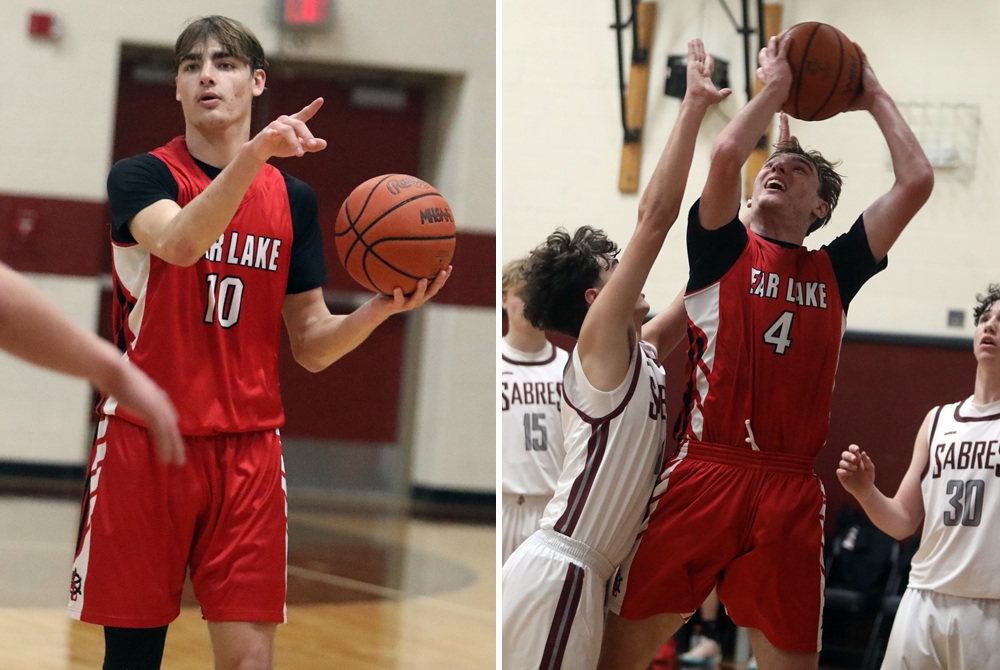
PHOTOS (Top) Grady Harless (10) brings the ball up for Bear Lake against Traverse City Christian, while Myles Harless (4) puts up a shot against the Sabres. (Middle) Grady Harless directs the offense against Mason County Eastern. (Below) Myles Harless elevates for a jumper against Leland. (Traverse City Christian and Leland game photos courtesy of the Traverse City Record-Eagle. Mason County Eastern game photo courtesy of Miles Joseph/milesflics.)
Nieto Closes Magnificent Madison Career as Team's All-Time Leading Scorer
By
Doug Donnelly
Special for MHSAA.com
April 2, 2025
Antonio Nieto has never met Pete Bagrow, but he’s closely following in the footsteps of a fellow Adrian Madison basketball player.
 Last month, Nieto passed Bagrow to become the all-time leading scorer in Madison boys basketball history. Nieto was the first player in school history to break the 1,000-point barrier and will play college basketball at Siena Heights University, just like Bagrow.
“Tell him I said congratulations,” said Bagrow, a 1984 Madison graduate and now general manager of sales at a car dealership in Texas. “But, kid him a little that he had the 3-point shot and played in more games.”
In an age where it seems more and more players are surpassing 1,000 points and piling up large scoring totals, Nieto was a steady, consistent player during his four years at Madison. He reached 30 points just twice in his career – with his career high 31. He made a career-high 28 3-pointers this season – a figure surpassed by 20 players in Lenawee County alone.
“I think it is interesting that in my 20 years at Madison, and all of the good players we have had, none scored 1,000 points,” said Madison coach Erik Thompson. “Antonio made it a goal his freshman year and got it. He’s a basketball-only kid. He loves the game.”
Nieto benefited from the MHSAA’s five-quarter rule as a freshman, where he could play four quarters of junior varsity and stick around for another quarter as a varsity player. He practiced with both teams – one before school and one after.
“The other guys accepted me, so it was good,” he said. “It took a little bit of adjusting to get used to varsity, but not too much.”
By his sophomore year he was averaging in double figures. His junior year he averaged 18.1 points a game, and it started to dawn on him that 1,000 points was within reach.
“I’d see his name on the (record) board,” Nieto said about Bagrow. “After my sophomore year, I started thinking about 1,000 points. Last year, I would sort of keep an eye on where I was. I knew I could get it this year.”
The mission was accomplished during a 12-game Madison win streak this season that included a 43-37 win over previously-unbeaten Onsted, which was ranked among the top five teams in the state in Division 2 at the time. That win helped Madison clinch its first league championship in a decade.
 “That was big,” Nieto said. “We knew we could beat them. The first time we played them, we watched film and we were confident, then the game came and they beat us by 25. Even in the locker room after that game, we knew that the next time we played we could get them.”
Nieto’s 15 points in that game helped Madison secure the upset, and it was during that victory that he reached 1,000. Before that, Madison was the only team in Lenawee County history without a 1,000-point scorer.
Nieto said his game evolved over his four years, especially thanks to hitting the weight room.
“I got a lot stronger,” he said. “I put up a lot of shots in the gym, too.”
Madison went through some changes during Nieto’s varsity career as well. The school was in the Tri-County Conference his freshman and sophomore seasons but moved to the Lenawee County Athletic Association last year. His freshman season was also the first time Madison played in Division 2.
This season the Trojans shared the LCAA title with Onsted, the first trophy won during Nieto’s four seasons.
“We had a good season. I’m satisfied,” Nieto said. “I wish we would have won more. I think we won 55 games in my four years. That’s pretty good.”
Nieto chose to stay close for college, selecting Siena Heights, which is just a few miles from his home. Among reasons is his close-knit family.
“My sister always comes to my games, my mom and dad and my uncles,” he said. “They all sit in the same spot and sit together. I know they are there.
“Sometimes my mom will get after me about playing defense. It helps me having them there.”
His basketball family is close-knit, too.
“Not that we weren’t a family last year, but I think this year we really became a close family, all the players and coaches,” he said. “I think that is what helped us get over the top.”
Madison’s 18 wins this season were the most for the Trojans since 2015-16.
The school celebrated Nieto becoming the all-time leading scorer, something Bagrow doesn’t recall happening when he was in school.
“I think they painted the number 974 (his career point total) on a piece of plywood and hung it in the school. I think the guy I passed had the record for only two or three years,” he said. “I can’t believe the record has held this long. That’s 40 years.”
 Doug Donnelly has served as a news and sports reporter at the Adrian Daily Telegram and the Monroe News for 30 years, including 10 years as city editor in Monroe. He's written a book on high school basketball in Monroe County and compiles record books for various schools in southeast Michigan. He is now publisher and editor of The Blissfield Advance, a weekly newspaper. E-mail him at [email protected] with story ideas for Jackson, Washtenaw, Hillsdale, Lenawee and Monroe counties.
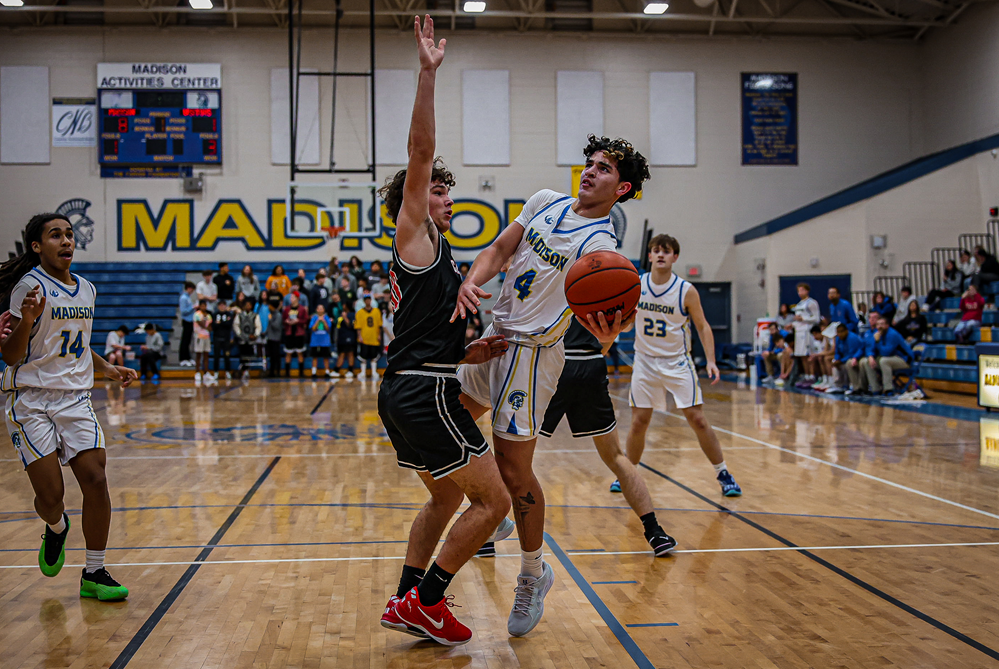
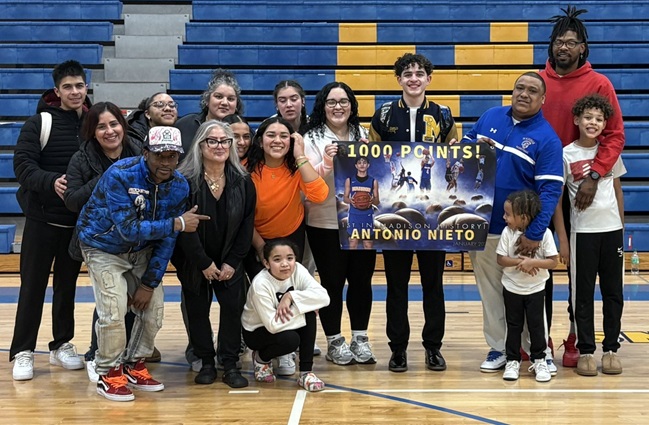
PHOTOS (Top) Adrian Madison’s Antonio Nieto (4) puts up a shot during a game this season. (Middle) Nieto, holding a banner, celebrates his 1,000th career point surrounded by family. (Top photo by Tyler George.)