

Breslin Bound: 2021-22 Boys Report Week 10
By
Geoff Kimmerly
MHSAA.com senior editor
February 14, 2022
The boys basketball tournament picture is getting a little clearer as we draw closer to the end of the regular season, allowing coaches to forecast a bit more (and scout) who their teams might face when Districts begin in three weeks.

It's also the right time for us to begin envisioning how some of our headlining regular-season games might become rematches next month – and we'll be digging into some of those possibilities over the next few weeks, including a couple we note below.
“Breslin Bound” is powered by MI Student Aid and based on results and schedules posted for each school at MHSAA.com. Send corrections or missing scores to [email protected].
Week in Review
The countdown of last week’s five most intriguing results:
1. Detroit U-D Jesuit 65, Detroit Catholic Central 43 The Detroit Catholic League Central has been the setting for one of the most contested league races in recent memory, and the Cubs (10-4) clinched the title after having defeated the Shamrocks (8-7) by only two points in their first meeting.
2. Port Huron Northern 49, St. Clair Shores Lake Shore 47 The Huskies (12-4) faced former co-leader Lake Shore (13-3) twice over seven days and won both to clinch the Macomb Area Conference Blue title outright.
3. Vandercook Lake 65, Napoleon 59 The Jayhawks (13-1) moved into a half-game lead over Michigan Center and one full game ahead of Napoleon (12-2) in the Cascades Conference.
4. Goodrich 43, Flushing 42 The Martians (14-1) won a second one-point game in a row, this one over the Raiders (12-2) in a matchup of teams leading their respective Flint Metro League divisions.
5. Benton Harbor 79, Battle Creek Pennfield 74 The Tigers (13-2) bounced back from their second loss with their best win in terms of MPR against the Panthers (11-3).
Watch List
With an eye toward March, here are two teams in each division making sparks:
Division 1
Detroit Martin Luther King (15-1) The Crusaders haven’t lost since the season opener against Detroit U-D Jesuit (see below) and are up to No. 2 in Division 1 MPR after going undefeated in a Detroit Public School League Blue that included Cass Tech (14-2), Renaissance and Southeastern (both 11-4). King also has wins over Beecher (13-1), Ann Arbor Huron (11-3), Saginaw (10-6), Kalamazoo Central (10-6) and Grand Blanc (11-4) among others – and if the Crusaders meet Jesuit again, it will be in the Division 1 Final.
Detroit U-D Jesuit (10-4) As noted above, Jesuit clinched the Catholic League Central, a major accomplishment. Additionally, only two of the Cubs’ opponents this season have fewer than 10 wins entering this week, providing another boost behind Jesuit’s No. 1 MPR ranking. The Cubs opened with a 51-42 win over King and can also count nonleague victories over Waterford Mott (11-3) and Macomb Dakota (10-5) along with the impressive run through the conference.
Division 2
Croswell-Lexington (14-0) This is familiar territory for the Pioneers, who are up to a combined 53-3 over the last three seasons. They have a two-game lead over Richmond in the Blue Water Area Conference, having handed the Blue Devils (12-2) a 57-38 defeat Jan. 25 and with the rematch coming up. Wins over Brown City (9-5) and Reese (12-2) have provided further MPR boost as the team sits No. 4 in Division 2 coming off last year’s run to the Quarterfinals.
Escanaba (10-4) After reaching the Quarterfinals last season, the Eskymos loaded their schedule again with many of the Upper Peninsula’s best, and it’s paid off with the No. 1 MPR ranking in Division 2. Escanaba is second in the Great Northern Conference with two losses to Menominee (14-1) and will play the Maroons again Tuesday, but those defeats have provided a boost along with two wins over Kingsford (10-4) and others against Ishpeming Westwood (12-3) and Negaunee (11-5). The two other losses came to teams from Wisconsin.
Division 3
Detroit Loyola (11-4) The Bulldogs have won eight straight to clinch the Detroit Catholic League AA championship and move up to Nov. 5 in Division 3 MPR. Wins over Pontiac Notre Dame Prep and Warren Lincoln (both 12-4) also have provided a boost, and all four losses were to larger schools with at least 11 wins – Hamtramck (11-3), Bloomfield Hills (11-3), Oak Park (11-3) and North Farmington (12-3). Loyola gets another good test in Detroit Country Day (10-3) this week as it looks to build on last season’s Quarterfinal run.
Elk Rapids (9-4) With only one game left against leader Traverse City St. Francis, on Tuesday, and two league losses, Elk Rapids may have to settle for second in the Lake Michigan Conference for the second-straight season. But another big opportunity awaits the Elks, No. 9 in Division 3 MPR. Their District includes St. Francis and the top two teams in the Northwest Conference and second-place team in the Ski Valley Conference – and at the time of this writing, Elk Rapids would be seeded second thanks to wins like the sweep of Boyne City (10-4).
Division 4
Genesee Christian (11-4) The Soldiers have taken a few steps up from last year’s 9-8 finish despite a strong schedule. The Genesee Area Conference Red has four teams 8-4 or better and three with at least 10 wins, and Genesee Christian is up to No. 8 in Division 4 MPR with six victories over teams with eight wins or more. The Soldiers get some benefit from losses to Beecher (13-1) and Flint Hamady (8-4) and have defeated among others Hamady, Lake Fenton (9-5), Clarkston Everest Collegiate (11-3), Webberville (11-4) and Burton Bendle (10-4). They see Bendle again next week.
Lake Leelanau St. Mary (12-3) The No. 7 Eagles have piled up 14 wins two seasons in a row and made the Regional Finals a year ago, and they’re surging toward March again with a 10-game winning streak. St. Mary handed Ellsworth (14-1) its only defeat and also earned solid boosts from victories over Traverse City Christian (12-2) and Flat Rock (13-3) – with the losses to Maple City Glen Lake (13-3), Rudyard (14-0) and Monroe St. Mary Catholic Central (8-6).
Can't-Miss Contests
Be on the lookout for results of these games coming up:
Tuesday – Ferndale (12-3) at Bloomfield Hills Brother Rice (11-4) – Ferndale is No. 7 in Division 2 MPR and Brother Rice is No. 3 in Division 1
Tuesday – Grand Haven (14-1) at Rockford (15-1) – The Rams won the first meeting and have a one-game lead on the Bucs in the Ottawa-Kent Conference Red.
Tuesday – Battle Creek Pennfield (11-3) at Marshall (14-1) – Marshall has a one-game lead in the Interstate 8 Athletic Conference despite falling to co-second place Pennfield 48-44 on Jan. 11.
Friday – Frankenmuth (11-2) at Freeland (14-0) – The Falcons can clinch a share of the Tri-Valley Conference 8 title, or the Eagles can pull within a half game of the lead if they hand Freeland a first league defeat.
Saturday – Grand Blanc (11-4) at Muskegon (13-1) – The reigning Division 1 champion could bring a 10-game winning streak on the road to face another contender for this season’s title.
Second Half’s weekly “Breslin Bound” previews and reviews are powered by MI Student Aid, a part of the Office of Postsecondary Financial Planning located within the Michigan Department of Treasury. MI Student Aid encourages students to pursue postsecondary education by providing access to student financial resources and information. MI Student Aid administers the state’s 529 college savings programs (MET/MESP), as well as scholarship and grant programs that help make college Accessible, Affordable and Attainable for you. Connect with MI Student Aid at www.michigan.gov/mistudentaid and find more information on Facebook and Twitter @mistudentaid.
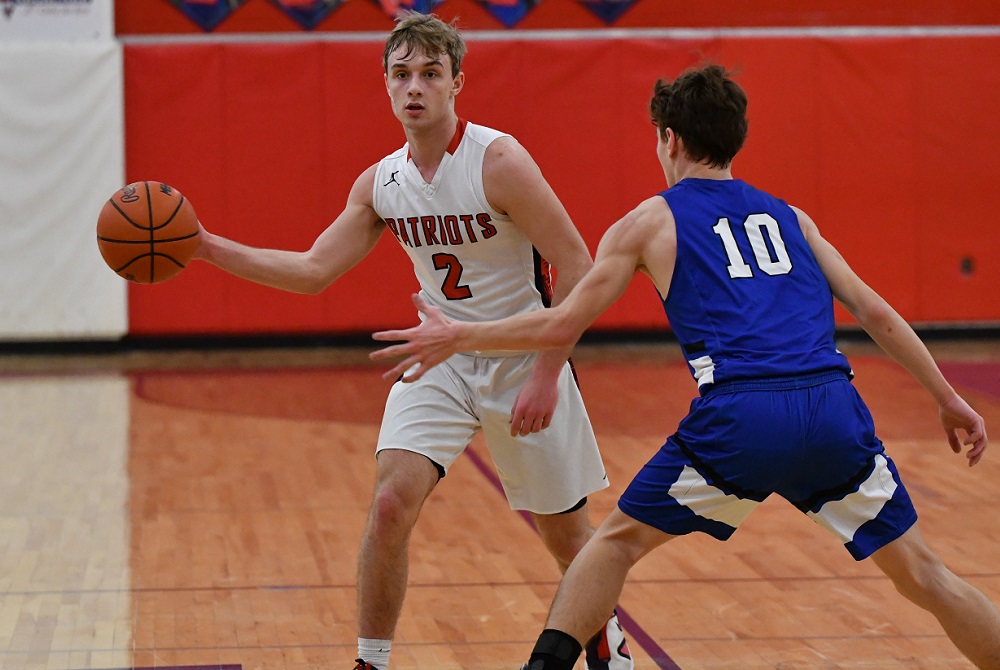
PHOTO Westwood’s Zach Carlson threads a pass while being defended last week by Ishpeming’s Parker Gauthier. (Photo by Cara Kamps.)
Breslin Bound: 2025-26 Boys Quarterfinal Preview
By
Geoff Kimmerly
MHSAA.com senior editor
March 10, 2026
One. More. Win.
That’s all that’s needed as 32 boys basketball teams take the floor tonight for Quarterfinals across the state and with a trip to East Lansing and Breslin Center on the line.
Below are quick glances at all 16 matchups. Games tip off at 7 p.m. unless noted. Details on tickets, brackets and more can be found on the Boys Basketball page. To watch all 16 games online, visit the NFHS Network.
“Breslin Bound” is powered by MI Student Aid and based on results and schedules posted for each school at MHSAA.com. (Abbreviations below denote ppg - points per game, rpg - rebounds per game and apg - assists per game.)
Week in Review
The countdown of last week’s five most intriguing results:
1. Grand Rapids Northview 52, East Kentwood 50 Cam Ryans drilled a buzzer-beating 3-pointer to send Grand Rapids Northview (22-4) past East Kentwood (22-3) in a Division 1 Regional Final.
2. Harbor Beach 64, International Academy of Flint 62 (2 OT) Harbor Beach (23-3) won its first Regional title, edging IAF (19-5) in Division 4.
3. Colon 49, Battle Creek St. Philip 40 The Magi (22-4) also clinched their first Regional title, in Division 4, by adding to two regular-season wins over St. Philip (16-9).
4. Onsted 42, Ecorse 40 Onsted (24-2) clinched its first Regional title since 1983, advancing in Division 3 with a close win over Ecorse (19-6).
5. Onekama 46, Traverse City Christian 40 Onekama (17-10) handed Traverse City Christian (25-1) its only loss in a Division 4 Regional Final.
Quarterfinals at a Glance
DIVISION 1
Rockford (22-3) vs. Grand Rapids Northview (22-4) at Hudsonville
These two met Jan. 31 at the 2K26 Showcase, with Rockford winning 48-45. Senior 6-foot-6 forward Jake Bascom is a tough matchup averaging 17.7 points and 7.1 rebounds per game. But so is Northview senior guard Cam Ryans, a Mr. Basketball Award finalist averaging 24.2 points, 7.6 rebounds and 3.3 assists per contest.
Auburn Hills Avondale (25-1) vs. Roseville (19-6) at Detroit Mercy
Avondale is coming off its first Regional title since 2002 with senior forward Jakobe Liford (15.2 ppg, 7.5 rpg) leading three players averaging double-digit scoring. Roseville last won a Regional in 2019 and returns to the season’s final week with junior guard Terrell Owens (17.3 ppg, 3.5 apg, 3.9 spg) setting the pace.
East Lansing (25-1) vs. Ann Arbor Pioneer (21-4) at Lansing Eastern’s Don Johnson Fieldhouse
Reigning Division 1 champion East Lansing celebrated senior guard KJ Torbert winning the Mr. Basketball Award on Monday, and he’s an especially impressive shooter making 52 percent of his shots from the floor – including 39 percent of his 3-point tries – on the way to averaging 25 points per game. Pioneer is back at the Quarterfinals for the first time since 2007, with senior guard Jordan Harrison a potent scorer (18.1 ppg) and distributor (3.9 apg).
Wayne Memorial (23-3) vs. Bloomfield Hills Brother Rice (21-5) at Detroit Mercy, 5:30 p.m.
The Zebras are also playing for a return trip to Breslin after finishing Division 1 runner-up a year ago, and they’re also led by a Mr. Basketball Award finalist in senior guard Jaylohn Allen (23.3 ppg, 6.0 apg). Brother Rice won its second Regional title over the last three seasons, keyed by a high-powered backcourt of senior Greg Grays (14.9 ppg) and freshman Jordan McDaniel (19.3 ppg).
DIVISION 2
Ludington (24-2) vs. Freeland (23-3) at Mount Pleasant
Junior guard Taj Williams (18.8 ppg) and senior forward Cameron Gunsell (18.2 ppg) have led Ludington to the Quarterfinals for the first time since 2017, as the Orioles advanced with a Regional Final win over 2025 semifinalist Kingsford. Freeland has won nine straight games to reach the Quarterfinals for the second consecutive year. Senior guard Wilson Huckeby is making almost 39 percent of his 3-pointers, drilling 81 this season while averaging 18.9 points per game.
Chelsea (20-5) vs. Romulus Summit Academy North (25-1) at Ypsilanti Lincoln, 5:30 p.m.
Summit is one win away from returning to Breslin after finishing Division 2 runner-up a year ago, its only loss to an Ohio opponent and with three players averaging double-digit points per game led by senior guard Jordan Fuller at 15.4. Chelsea has won nine of its last 10 games, with a big one over Lansing Sexton (23-3) in a Regional Final. Freshman Drew Cabana is averaging 21.8 points per game and senior Buck Allen adds 17.4 – and both have made at least 50 3-pointers.
Detroit University Prep (16-9) vs. Detroit Country Day (19-7) at Detroit Renaissance
University Prep has won nine of its last 10 games and edged reigning champion Warren Lincoln by two points in their Regional Final to reach this week. Senior guards Chris Byrd and Maurice Jackson are a 6-5 tandem averaging 19.6 and 14.6 ppg, respectively. Country Day has made a jump from 11-12 a year ago, winning nine of its last 10 games with junior guard Christian Cast (20.9 ppg) and 6-6 junior forward Isaiah Moreno (16.5) setting the pace.
Grand Rapids Catholic Central (20-6) vs. Hudsonville Unity Christian (23-3) at Hamilton
Grand Rapids Catholic Central is playing in its third-straight Quarterfinal and reached the Semifinals a year ago, and can turn to senior guards BB Watkins (14.4 ppg) and Jordan McCoy (15.5 ppg) for scoring punch. Unity Christian has won 19 of its last 20 games, its only defeat during that time against Freeland, and has five players averaging between 7-12 ppg topped by senior guard Brogan Sherd (12.2), who also has made 61 3-pointers.
DIVISION 3
Arts & Technology Academy of Pontiac (17-3) vs. Harbor Beach (23-3) at St. Clair County Community College
ATAP is a game away from a Breslin return as well after finishing Division 3 runner-up last season, and the Lions will take on a first-time Regional champ in Harbor Beach. Sophomore point guard Lewis Lovejoy paced last year’s ATAP run and leads again at 26.5 points and 7.6 assists per game. Senior guard Benson Harper leads three Harbor Beach players scoring in double digits at 17.3 ppg, and he and senior forward Skiler Krus (13.2 ppg) were also among stars on the Pirates’ Division 8 football championship team.
Menominee (22-4) vs. Beal City (24-2) at Boyne City
After a year away, Menominee is playing in its second Quarterfinal in three seasons and third over the last five – in part thanks to avenging a regular-season loss to 2025 semifinalist Ishpeming Westwood in their Regional Semifinal. Senior forward Tanner Theuerkauf quarterbacked the Division 7 football championship team and leads at 17.8 ppg, with senior guard Darren Butler at 15.2. Beal City is playing in its first Quarterfinal since 2013 and has reached 20 wins three straight seasons. Junior guard Cuyler Smith (15 ppg) leads three players averaging at least 11 points per game.
Flint New Standard Academy (20-4) vs. Onsted (24-2) at Ypsilanti Lincoln
New Standard is playing in its second-straight Quarterfinal and with its only losses this season to teams that all reached Regional Finals. Sophomore guard AJ Smith (12.4 ppg) and senior guard Jeffery Turner (12.0) lead four players averaging at least 10 ppg. As noted above, Onsted is back in the season’s final week for the first time in more than four decades, and after just missing with some very strong teams over the last 10 years. Mason Chesser (13.9 ppg) leads four averaging at least nine points per game who have helped the Wildcats push through.
Pewamo-Westphalia (24-2) vs. Schoolcraft (16-10) at Kalamazoo Loy Norrix
These two have met two other times in Quarterfinals this decade, with P-W advancing last season with a 50-45 victory. The Pirates have been regulars at this stage with this their fourth Quarterfinal over the last five seasons. Grady Eklund sets the pace for P-W at 20.7 points and 3.5 assists per game. Senior 6-10 forward Jimmy Miller leads three Schoolcraft players scoring at least 15 ppg with 19.3, plus nine rebounds per contest, and junior guard Kodee Bienz (15.1 ppg) has drilled 68 3-pointers.
DIVISION 4
Dollar Bay (23-2) vs. Pickford (25-0) at Gladstone
These two guarantee at least one Upper Peninsula team will be heading downstate, with Pickford making the attempt after losing a Quarterfinal last year by two points and Dollar Bay seeking its first Breslin trip since 2018. Gunner Bennin averages 19.1 points, 7.4 rebounds, 3.7 steals and 3.5 assists per game for the Panthers. Senior forward Liam Tourtillott (20.2 ppg, 73 3-pointers) and junior guard Baron Colbert (16.9 ppg) are strong perimeter options for Dollar Bay.
Detroit Douglass (19-7) vs. Waterford Our Lady of the Lakes (19-6) at West Bloomfield, 6 p.m.
Douglass has made its run after tying for second in a Detroit Public School League Blue filled at the top with Division 1 teams, and defeated 2025 semifinalist Allen Park Inter-City Baptist in a Regional Semifinal last week. Freshman guard Damani Oliver averages 22.5 ppg and senior guard Jeremiah Thurman adds 16.1. Our Lady started this season 2-4 but has surged since the start of January, with senior center Jack Miller (12.4 ppg, 7.2 rpg) and senior forward Latane Ware (11.3 ppg) pacing a balanced attack.
Colon (22-4) vs. Concord (22-4) at Portage Northern
As noted above, Colon is coming off its first Regional title, and the Magi also defeated league rival Mendon (22-2) in a District Final. Seniors forwards Dalton Williams (22.1 ppg) and Quincy Blair (17.7) lead four players averaging double-digit scoring. Concord is coming off its first Regional title since 1990 and has celebrated senior guard Jett Smith and senior forward Connor Stevens both reaching 1,000 career points this winter.
Onekama (17-10) vs. Wyoming Tri-unity Christian (24-1) at Big Rapids
Onekama stunned previously-undefeated Traverse City Christian with a 46-40 Regional Final win to advance to the season’s final week for the first time since 1997, and the Portagers now get to take on the reigning Division 4 champion Defenders. Center Luke Bradford sets the pace at 15 ppg and is one of three senior starters. Tri-unity has replaced four starters from last season’s title winner, with the lone returner junior center Cody Osbun leading at 12.4 points, 7.8 rebounds and 3.2 assists per game.
MHSAA.com's weekly “Breslin Bound” reports are powered by MI Student Aid, a division within the Department of Lifelong Education, Advancement, and Potential (MiLEAP). MI Student Aid encourages students to pursue postsecondary education by providing access to student financial resources and information. MI Student Aid administers the state’s scholarship and grant programs that help make college Accessible, Affordable and Attainable for you. Click to connect with MI Student Aid and find more information on Facebook and X @mistudentaid.
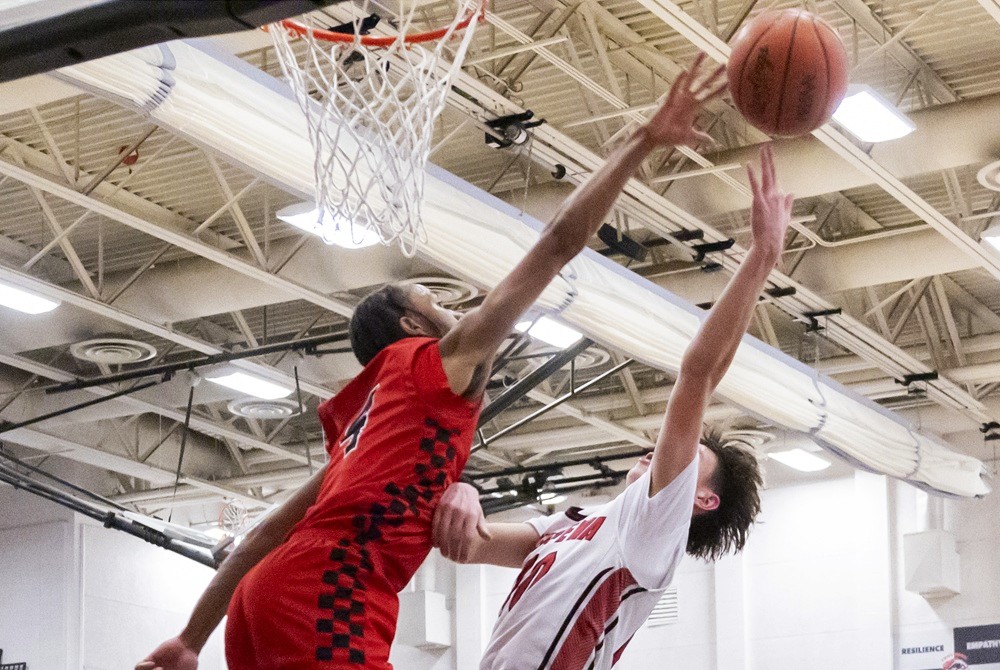
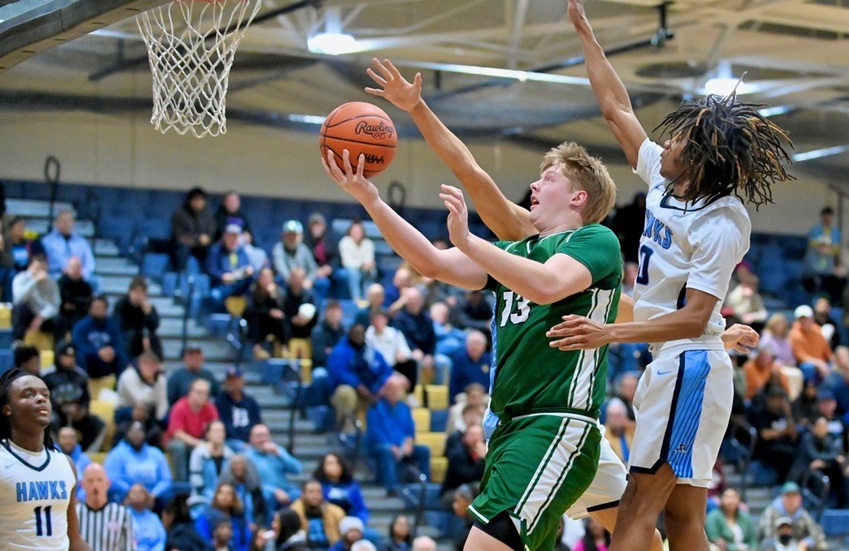
PHOTOS (Top) Roseville’s Terrell Owens (4) blocks a shot during his team’s 71-68 overtime win over Clinton Township Chippewa Valley in last week’s Regional Semifinal. (Middle) Freeland’s Tristan Comer (13) scoops a shot during the Falcons’ Regional Final win over Flint Hamady. (Roseville/Chippewa Valley photo by Adam Sheehan. Freeland/Hamady photo by Terry Lyons.)