

Breslin Bound: 2022-23 Boys Report Week 11
By
Geoff Kimmerly
MHSAA.com senior editor
February 20, 2023
We’re less than a week from taking thousands of results from this season and crunching the numbers to seed the top two teams in 128 MHSAA Boys Basketball Districts. Those will be published Sunday.

But if you think everything is wrapped up for the regular season, just check out our list of “Can’t-Miss Contests” below.
Those five games top what might end up one of the most exciting weeks of boys hoops this entire winter, and that’s without including Friday’s Detroit Catholic League Cardinal championship game as the top four placers from one of the state’s most competitive leagues will contend over two rounds this week.
“Breslin Bound” is powered by MI Student Aid and based on results and schedules posted for each school at MHSAA.com.
Week in Review
The countdown of last week’s five most intriguing results:
1. Detroit Cass Tech 74, Detroit Martin Luther King 70 (OT) The Technicians (21-0) followed up a 57-55 win over King (10-7) on Jan. 20 to clinch the Detroit Public School League Tournament title.
2. Grand Blanc 70, Muskegon 62 (OT) Grand Blanc (17-2) is No. 3 in Division 1 MPR and Muskegon (17-2) is No. 4, and it wouldn’t be shocking to see them meet again with much more on the line next month.
3. Flint Beecher 48, Flint Hamady 43 The Bucs (15-3) clinched the Genesee Area Conference Red title outright, finishing a regular-season sweep of the rival Hawks (16-4).
4. Escanaba 72, Painesdale Jeffers 68 (OT) After falling to Painesdale Jeffers in their Jan. 20 meeting 74-71, the Eskymos (10-6) handed the Jets (17-1) their only defeat.
5. Redford Union 57, Romulus 55 The Panthers (14-5) added this to an overtime win over Romulus (14-5) from Jan. 20 to clinch the Western Wayne Athletic Conference title.
Watch List
With an eye toward March, here are two teams in each division making sparks:
DIVISION 1
Lansing Waverly (14-5) The Warriors may have just enjoyed their best week of what’s guaranteed to be their winningest season since 2013-14. They took a one-game lead in the Capital Area Activities Conference Blue by avenging a Jan. 23 loss to Okemos with a 72-53 win Feb. 13, then outlasted Grand Ledge 68-64 in overtime and edged Benton Harbor 76-71 on Saturday. Of 14 victories, 11 have come against teams with winning records – with the losses to Okemos (14-3) and East Lansing (9-8) in league and Detroit Renaissance (12-7), River Rouge (14-5) and Davison (14-6) nonconference.
Oak Park (10-5) In an Oakland Activities Association Red where all five teams have double-digit wins led North Farmington (17-1) and Ferndale (10-6) at the top, Oak Park might not be getting the attention it would otherwise. But the Knights are No. 9 in statewide Division 1 MPR, with four of those losses coming to North Farmington (twice), Ferndale or Clarkston – and with the Clarkston and Ferndale rematches next week. Oak Park would be the second seed in a similarly-strong District if brackets were drawn today.
DIVISION 2
Croswell-Lexington (15-3) The Pioneers took a major step toward retaining a share of the Blue Water Area Conference title with a 54-45 win Thursday over Richmond (15-2) after falling to the Blue Devils on Jan. 19. Croswell-Lexington and Richmond both have one league loss (to each other), but the Pioneers have one more win and their final three games against the bottom three teams in the BWAC standings. Elkton-Pigeon-Bay Port Laker (13-3) tonight should provide another solid test.
Grand Rapids Catholic Central (14-5) The reigning Division 2 runner-up Cougars have bounced back from an 0-3 start with 14 wins over their last 16 games as they’ve moved to the top of the O-K Gold. They can clinch the championship outright Tuesday against second-place Grand Rapids South Christian (16-3), which GRCC defeated 71-67 on Jan. 24. Nine of those 14 wins have come against teams with records .500 or better, paying off in the Cougars also topping their District in MPR.
DIVISION 3
Brown City (18-1) The Green Devils can clinch the Greater Thumb Conference East title outright Tuesday against second-place Sandusky (12-6), which they defeated 42-37 in their first matchup Jan. 25. Brown City’s only loss came to Laker, 64-61 in its second game this season, and the Green Devils are coming off finishing a regular-season sweep of Ubly after placing second to the Bearcats in the league standings a year ago.
Cass City (16-1) As noted here, more than one-third of Cass City’s wins have come with go-ahead points during the final seconds – and the halfcourt shot to down Elkton-Pigeon-Bay Port 43-42 on Jan. 27 has Cass City sitting a game ahead of Laker in the GTC West standings with the rematch set for Friday. Cass City’s only loss was 50-41 to Bad Axe on Jan. 6, avenged with a 46-45 win Feb. 1. The Red Hawks presently also sit atop a District bracket that includes both Bad Axe and Laker.
DIVISION 4
Eau Claire (15-4) The Fighting Beavers have clinched a share of the Berrien-Cass-St. Joseph Conference championship after finishing second last season and winning only five games total during the abbreviated 2020-21. They are 11-1 since the start of the calendar year, losing only to Benton Harbor Countryside Academy and avenging that loss Friday to gain the league title share. An 84-68 win over Galesburg-Augusta (15-4) jumps out – and they play again Wednesday – but so too does Eau Claire’s nine games scoring at least 80 points.
Kingston (15-3) After finishing 10-11 and fifth in the North Central Thumb Conference Stars a year ago, Kingston has changed lanes and clinched the championship outright with a 47-39 win over Peck on Friday. A 61-60 double-overtime victory over second-place Dryden three days earlier was more key, and the Cardinals sit No. 10 in statewide Division 4 MPR with all three losses to Division 2 or 3 teams, including Brown City (see above).
Can’t-Miss Contests
Be on the lookout for results of these games coming up:
Tuesday – Jackson (15-4) at Chelsea (16-2) – This will decide if Chelsea wins the Southeastern Conference White title outright or shares with the Vikings, who won the Jan. 31 matchup 76-69.
Tuesday – Ovid-Elsie (15-2) at Chesaning (15-3) – They enter tied for first in the Mid-Michigan Activities Conference and will both have one league game remaining. Ovid-Elsie won the Jan. 16 meeting 55-51 in overtime.
Tuesday – Boyne City (17-2) at Traverse City St. Francis (15-3) – The Ramblers have a one-game lead on St. Francis in the Lake Michigan Conference with two games to play, and after winning their first meeting 50-44 on Jan. 24.
Friday – Hudsonville (14-5) at East Kentwood (14-5) – These two have risen to the top of a tightly-packed O-K Red race and could decide the championship outright if they both also win Tuesday. Hudsonville won 54-45 when they met Jan. 27.
Friday – Ferndale (10-6) at North Farmington (17-1) – North Farmington is No. 1 in Division 1 MPR, Ferndale is No. 1 in Division 2, and the Raiders lead the Eagles by a game in the OAA Red. North Farmington won 50-48 on Jan. 31.
MHSAA.com's weekly “Breslin Bound” previews and reviews are powered by MI Student Aid, a part of the Office of Postsecondary Financial Planning located within the Michigan Department of Treasury. MI Student Aid encourages students to pursue postsecondary education by providing access to student financial resources and information. MI Student Aid administers the state’s 529 college savings programs (MET/MESP), as well as scholarship and grant programs that help make college Accessible, Affordable and Attainable for you. Connect with MI Student Aid at www.michigan.gov/mistudentaid and find more information on Facebook and Twitter @mistudentaid.
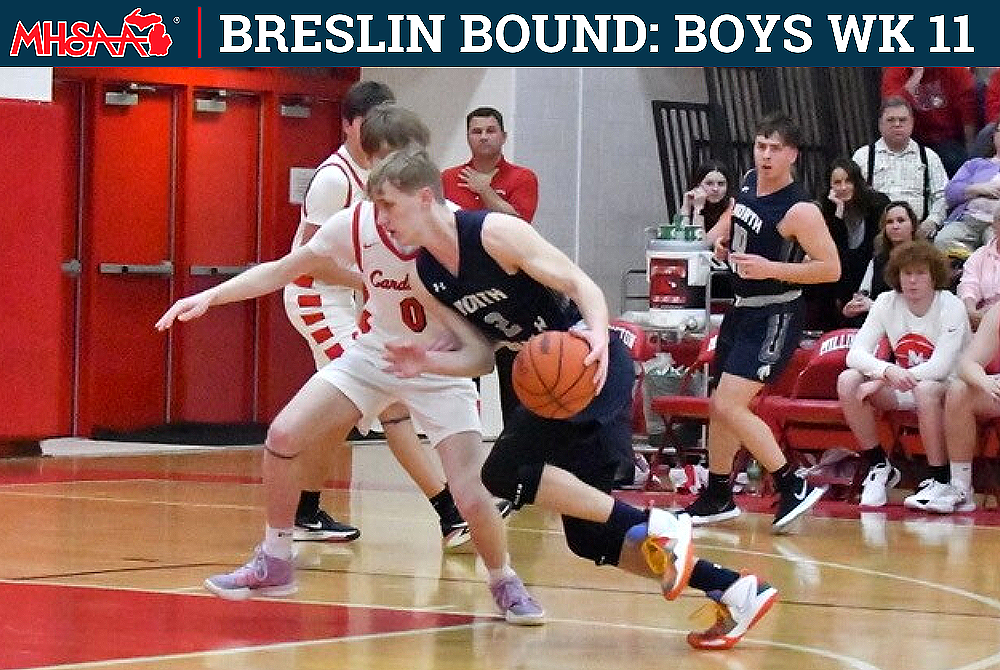
PHOTO North Branch earned its best win this season Tuesday, 65-63 over Millington. (Photo by Terry Lyons.)
Breslin Bound: Boys Report Post-Break
January 3, 2017
By Geoff Kimmerly
Second Half editor
This week, Michigan’s high school boys basketball teams will begin focusing most of their energies on winning league championships and doing their best against competition closest to home.
 But before we dive in to that always-intense chapter of each season, our Breslin Bound report – powered by MI Student Aid – reviews the best from two weeks of holiday break, including matchups of some expected MHSAA title contenders in Class A and B.
Week in Review
The countdown of holiday break's five most intriguing results:
1. Detroit U-D Jesuit 69, Macomb Dakota 61 – Dakota was missing a standout and lost another near the end of this one, but regardless this rematch of last season’s Class A Semifinal finished with the Cubs on top while sandwiched between their overtime losses to Flint Beecher and Indianapolis Lawrence North (Ind.).
2. North Farmington 53, Detroit Henry Ford 49 – The Raiders bounced back from three losses to open this season, including a 65-58 defeat to Farmington, to beat Dearborn Divine Child and then the Class B reigning champ at the Motor City Roundball Classic.
3. McBain 73, Boyne City 62 – In a matchup of expected Class C contenders from the northern Lower Peninsula, McBain emerged with a fourth double-digit win in four tries this winter while handing Boyne City its first loss.
4. Wyoming Godwin Heights 69, Wayland 67 – They are in different Districts this season after meeting in the first round a year ago, and both could emerge as Class B contenders after meeting in this Cornerstone Invitational title game.
5. Frankfort 72, Traverse City St. Francis 65 – The Panthers avenged one of only two regular-season losses from last season, when they fell to St. Francis 69-68.
Watch List
With an eye toward March, here are two teams in each class making sparks:
CLASS A
Detroit East English (5-0) – The Bulldogs may have graduated a Mr. Basketball finalist off last season’s 17-win team, but they likely have another and could finish even better this winter with wins so far over Flint Beecher, Macomb Dakota and most recently Wayne Memorial 92-77.
Battle Creek Central (5-1) – That lone loss came early to Kalamazoo Central, and Battle Creek Central has stormed back with the latest a sweep at its holiday tournament, 60-50 over Otsego and 61-46 over Muskegon Heights Academy.
CLASS B
St. Clair (5-0) – The Saints, winners of 12 and 14 games, respectively, over the last two seasons, downed St. Clair Shores Lakeview 54-53 in overtime and then host Clinton Township Chippewa Valley 58-57 at the latter’s holiday tournament to finish off 2016.
Wyoming Lee (5-0) – A 3-17 finisher just last season, Lee is in the midst of a sizable turnaround highlighted over the break by wins over Gobles (in overtime) and host Allegan to win the Tigers’ holiday tournament.
CLASS C
Harbor Springs (3-0) – After also going only 3-17 a year ago, Harbor Springs has equaled that win total while handing the only losses this season to Bellaire (40-37) and Pickford (67-65).
Michigan Center (6-0) – The Cardinals will embark next on at least matching last season’s shared title in the Cascades Conference, and will do so after dominating Williamston’s holiday event with wins over Dansville (66-47) and Class A DeWitt (86-75).
CLASS D
Bark River-Harris (4-0) – Eventually, the Broncos will get to test themselves against Powers North Central (Jan. 27) in the Skyline Central Conference West. So far, they look good to top last season’s 10-11 finish.
Frankfort (3-0) – Expectations are high as always coming off a second straight Northwest Conference title and fourth straight season with 20 or more wins – and so far so good; see note above on avenging last season’s loss to Traverse City St. Francis.
Can't-Miss Contests
Be on the lookout for results of these games coming up:
Tuesday – Clarkston (5-0) at Flint Carman-Ainsworth (6-0) – The Wolves have earned a reputation as Class A contender with another strong start, and Carman-Ainsworth could cement that status as well with a win.
Tuesday – Maple City Glen Lake (3-0) at Elk Rapids (5-0) – In addition to both being undefeated this week, Glen Lake beat Elk Rapids twice last season including in the District.
Friday – Beaverton (4-1) at Clare (3-1) – Although both have a loss, both also are undefeated in early Jack Pine Conference play; Beaverton’s only defeat was in its last game, to Class A Midland Dow by two.
Friday – Detroit U-D Jesuit (4-2) at Romulus (2-1) – Another week, another impressive foe lined up for reigning Class A champion Jesuit; Romulus’ lone loss was by six to Clarkston.
Friday – Holt (3-2) at Okemos (3-1) – This longtime rivalry means something again, as both are seeking to rise in a Capital Area Activities Conference Blue that also features East Lansing, Lansing Everett and Jackson.
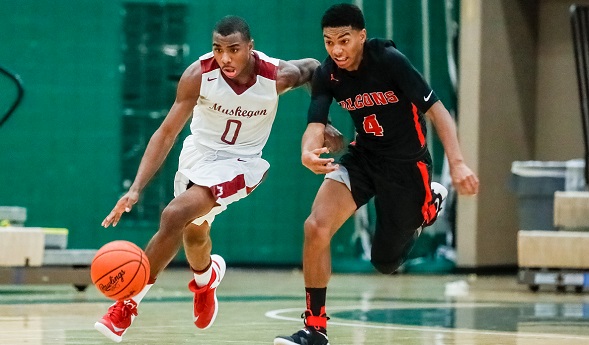
PHOTO: Muskegon pushes the ball upcourt during a 68-45 win over East Kentwood during the Muskegon Hall of Fame Classic on Dec. 28 at Reeths-Puffer High School. (Photo by Tim Reilly.)