

Breslin Bound: Boys Quarterfinal Preview
March 12, 2019
By Geoff Kimmerly
Second Half editor
After nearly four months, we’ll know by the end of tonight which 16 Michigan boys basketball teams will be “Breslin Bound” this weekend to play for this season’s championships.
 We’re already guaranteed at least two new title winners when Saturday’s Finals are done, and there are plenty of storylines as a number of teams reached tonight’s Quarterfinals for the first time in a long time – or first time in their program’s histories.
Our final “Breslin Bound” report of 2018-19 – powered by MI Student Aid – takes a glance at all 16 Quarterfinals, which tip off at 7 p.m. unless noted. All Quarterfinals will be broadcast and viewable with subscription on MHSAA.tv. Come back Wednesday night for a more in-depth look at our 16 finalists as they head into this weekend.
DIVISION 1
Saginaw (22-3) vs. Howell (19-6) at Grand Blanc
After a rare down season a year ago, Saginaw is back at the Quarterfinals for the fourth time in eight seasons under coach Julian Taylor. Howell, coming off its first Regional title since 2014, follows talented senior guard Josh Palo (17.7 points, 4.8 rebounds, 3.7 assists per game).
Ypsilanti Lincoln (20-4) vs. Detroit Martin Luther King (20-4) at University of Detroit Mercy, 5:30 p.m.
Lincoln freshman Emoni Bates has been perhaps even more exciting than anticipated, with game-winning shots in both of last week’s Regional wins just the latest highlights as he’s led the team to its first Regional title. King rebounded from two losses to end the regular season to win a District title for the second straight season and first Regional title since 2000.
Detroit U-D Jesuit (23-2) vs. Roseville (20-4) at University of Detroit Mercy, 7:30 p.m.
Jesuit will play in a Quarterfinal for the sixth straight season, this team with senior forward Daniel Friday (16.9) leading an attack with four scorers averaging at least 9.6 ppg. Roseville also lost its final two games of the regular season, but has won all five of its postseason matchups by at least 11 points on the way to its first Regional title since 1952.
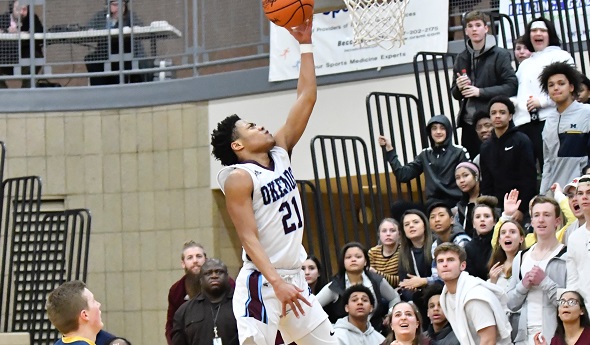
East Kentwood (16-9) vs. Okemos (22-2) at Caledonia
Led by junior guard Ja’moni Jones (17.6 ppg), East Kentwood has bounced back from four straight losses to end the regular season and defeated a pair of league champions last week in Muskegon and Hudsonville to reach the Quarterfinals for the first time since 1998. Okemos held off DeWitt for the third time this season in their Regional Final to advance to the final week for the first time since 2012. Senior Evan Thomas (17.3 ppg) is the lead scorer.
DIVISION 2
Ludington (13-10) vs. Alma (19-3) at Mount Pleasant
Alma stunned previously-undefeated Bridgeport in a Regional Semifinal last week and will play its first Quarterfinal since 1999. Senior guard Camden Sutherland (11.1 ppg) is the high scorer for a balanced attack. Ludington, the Class B runner-up two seasons ago, lost five of its last six regular-season games but rebounded by winning a third straight District title. Senior Joshua Laman (15.8 ppg) leads in most statistical categories.
Grand Rapids South Christian (22-3) vs. Hudsonville Unity Christian (23-2) at Calvin College
The Sailors are coming off their first Regional title since winning the Class B championship in 2005, thanks to a two-point win over Grand Rapids Catholic Central on Thursday. The Sailors have their share of 3-point aces, and senior guards Luke Schrotenboer and Peyton Vis both score between 13-14 ppg. South Christian won its Dec. 21 meeting with Unity Christian 63-61, but the Crusaders are riding high after downing 2018 Class B champ Benton Harbor to win their second Regional title in four seasons. Senior TJ VanKoevering (13.8 ppg) is the leading scorer and rebounder.
Haslett (20-5) vs. River Rouge (21-2) at Chelsea
Haslett, in its first Quarterfinal since 2006, beat league champions Williamston and Parma Western on the way to the final week. Senior guard Ty Andrades (14.1 ppg, 65 3-pointers) leads four players averaging double-digit scoring. River Rouge, a Class B semifinalist last season, has wins over Ypsilanti Lincoln and Flint Beecher among others. Senior guard Nigel Colvin (13 ppg) leads three scorers averaging in double figures.
Harper Woods Chandler Park (20-0) vs. New Haven (24-1) at Ortonville Brandon
Newly-awarded Mr. Basketball Romeo Weems (27.9 ppg, 11.3 rpg, 4.1 apg, 4.2 spg) is looking to lead New Haven to its third straight Semifinal and second title in three seasons as the Rockets won Class B in 2017. Senior guard Ronald Jeffery III (21.9) also is a major contributor. Chandler Park can claim impressive wins over Detroit Edison, Macomb Dakota, Detroit Henry Ford and Ferndale as it moves from its first Regional title into the final week.
DIVISION 3
Iron Mountain (25-0) vs. Sanford Meridian (23-1) at Petoskey, 6 p.m.
Iron Mountain won a Regional title for the second straight season and is now a combined 48-2 over the last two. Junior guard Marcus Johnson and sophomore guard Foster Wonders are both scoring just above 23 points per game. Meridian is also playing in a Quarterfinal for the second straight season, entering tonight a combined 44-5 over the last two winters after handing previously-unbeaten Oscoda a 21-point defeat in the Regional Final.
Detroit Edison (18-7) vs. Flint Beecher (23-2) at St. Clair County Community College
This Quarterfinal pits the Class C champions of the last two seasons, both with similar success this season. Reigning champ Edison has wins over Benton Harbor and Canton and is led by senior forward Brian Taylor (16.6 ppg). Beecher has beaten Detroit Renaissance, Grand Blanc and Flint Carman-Ainsworth among others, keyed by junior guard Jalen Terry, and is seeking its fourth MHSAA title in five seasons.
Hanover-Horton (23-1) vs. Erie-Mason (22-2) at Tecumseh
Hanover-Horton will play in its third Quarterfinal over the last five seasons and first since 2016, with its only defeat this winter to Ohio’s Toledo St. Francis de Sales. Junior Luc Laketa scores 14 ppg to lead five averaging at least 9.3. Erie Mason won its first Regional title since 1973 and has wins over league champs Detroit Loyola and Petersburg Summerfield over the last two weeks. Junior guard Joe Liedel pours in 28 points with 5.1 assists per game.
Pewamo-Westphalia (25-0) vs. Cassopolis (23-1) at Richland Gull Lake
P-W has emerged from winning a league that produced three District champs and then defeated league champions Morley Stanwood and Carson City-Crystal during these playoffs. Senior Andre Smith has helped the Pirates reach the final week for the first time since 2014 by averaging a team-high 14.1 ppg. After going 24-1 a season ago but falling in the Regional Final, Cassopolis has broken through to make its first Quarterfinal since 1989. Senior guard Tyrese Hunt-Thompson scores 22 points per game, and sophomore forward Brayden Saxton adds 18 ppg.
DIVISION 4
Dollar Bay (20-4) vs. Pellston (23-2) at Escanaba
Dollar Bay finished second in its league but has won 13 of its last 14 games and defeated that league champion, Chassell, on the way to reaching the Quarterfinals again after making the Semifinals in 2018. Junior forward Ashton Janke (16.4) leads three scorers at 12 ppg or higher. Pellston won its first Regional title since 2012, downing previously-unbeaten Brimley in last week’s Regional Semifinal. Senior guard Tanner Byard scores 25.9 ppg and junior guard Blake Cassidy adds 23.
Southfield Christian (18-6) vs. Burton Genesee Christian (18-7) at West Bloomfield, 6 p.m.
Southfield Christian is the reigning Class D champion and has won 16 of its last 17 games. Senior guard Jon Sanders and junior guard Da’Jion Humphrey both average 16.5 points per game. Genesee Christian is coming off its first Regional title since 2005 and is 17-3 after a slow start in December.
Frankfort (19-5) vs. Big Rapids Crossroads (23-1) at Cadillac
Frankfort fell in its regular-season finale and then won its District opener by just two points in overtime, but has surged ahead to claim its first Regional title since 2015. Senior guard Will Newbold and sophomore guard Jack Stefanski both average 14 points per game. Crossroads won its first Regional title last week, with its only defeat of the season all the way back on Dec. 5 to Manistee Catholic Central. Senior guard Britton Angell leads at 26 ppg.
Wyoming Tri-unity Christian (21-3) vs. Bellevue (24-1) at Charlotte
In its third straight season with at least 22 wins, Bellevue has reached the final week for the first time after claiming its first Regional title. Senior guard Wyatt Waterbury scored 16.4 ppg to lead the way. Tri-unity is a regular at this stage but also back after missing out on the Quarterfinals last season after three straight appearances. Senior forward Bennett Sinner and freshman guard Brady Titus both score 12 ppg to lead a balanced effort.
Second Half’s weekly “Breslin Bound” reports are powered by MI Student Aid, a part of the Student Financial Services Bureau located within the Michigan Department of Treasury. MI Student Aid encourages students to pursue postsecondary education by providing access to student financial resources and information, including various student financial assistance programs to help make college more affordable for Michigan students. MI Student Aid administers the state’s 529 savings programs (MET/MESP) and eight additional aid programs within its Student Scholarships and Grants division. Click for more information and connect with MI Student Aid on Facebook and Twitter @mistudentaid.
PHOTO: Okemos junior Noah Pruitt gets to the basket during the Chiefs’ Regional Final win over DeWitt last week at Holt. (Photo by Terry Lyons.)
'Scott Hancock Court' Celebrates JV Coach's 50 Years Building Up Cheboygan Hoops
By
Tom Spencer
Special for MHSAA.com
December 19, 2025
It’s been a remarkable season so far for the Cheboygan boys basketball players and coaches.
 The undefeated varsity Chiefs are looking ahead to the new calendar year and their next opponent, Northern Shores Conference rival Elk Rapids. They also have the District tournament they’ll be hosting in February in their sights.
But Scott Hancock is already looking ahead to the classes of 2035, 2036, 2037 and 2038. And nobody can blame him.
Hancock, a 1976 graduate of Cheboygan, has no intentions of ending his coaching career soon. He’d like to make it long enough to coach his youngest grandson Lincoln Hancock, who is already playing youth basketball in Cheboygan.
And while the Chiefs are finding success this year with the foundation Hancock helped build, the veteran coach can’t help but dream about his youngest grandson playing at Cheboygan High School.
“As a kindergartner he’s in Saturday basketball, and he loves the game,” Hancock said. “God willing, I plan to be there for him.”
Hancock is his 50th season in Cheboygan program. He enjoyed the opportunity to coach his two sons Nick and Brian, both school record holders. He’s also enjoyed coaching his grandson, Landon Gahn, the Chiefs’ junior point guard. Gahn played junior varsity for Hancock his freshman year and moved up to the varsity his sophomore season.
All but two of Hancock’s season were spent as the JV coach. He took the varsity job on an interim basis when current Cheboygan varsity coach, Jason Friday, was playing for the Chiefs in the late 1990s.
On Dec. 9, the Chiefs officially named their home court the Scott Hancock Court. His family was on hand as well as current and former Northern Michigan coaches.
Hancock’s JV team lost that night to Alpena in overtime. The score was 50-50 when the fourth quarter buzzer sounded.
“Looking back, we should have just called the game at the end of regulation,” Hancock admitted. “I got a bunch of great kids this year. and it was a tough loss because it was an overtime loss.”
 It was the only loss the Chiefs’ JV team has encountered so far this year. But wins and losses are not the focus of Hancock’s level of the program.
“I don't get too carried away with the wins and losses — I know what I'm there for,” Hancock explained. “I'm there to teach the kids to get them ready for the varsity.”
Hancock is considered by many to be the best coach in Cheboygan history. No counter argument can be found among the current varsity players and their head coach.
“He's the best coach that I've ever had — no bias because he's my grandfather,” acknowledged Gahn, who was found cheering from the bench as the Chiefs secured the victory earlier this week at Kingsley. “He teaches everything about basketball, but he doesn't really preach as much as he demonstrates being a good person. Just looking at him and what he does every day, you can just tell he's the guy that's doing everything right, even though nobody's watching.”
Senior Carson Kiefer helped lead the way for Cheboygan's varsity at Kingsley. He scored 12 points, with two 3-pointers. Kiefer credits Hancock for helping him improve his confidence on the court.
“I think he cares more about the person individually outside of sports,” said Kiefer, who is averaging 16 points per game. “It's fitting that he's a JV basketball coach, helping build players’ skills and confidence.”
Kiefer’s twin brother, Andrew, singled out Hancock’s commitment to the school.
“He's not just a school figure,” said Andrew Kiefer, who is averaging just under 12 points per game. “He is not just the coach. He is a community guy all-around.”
The Chiefs varsity is getting strong contributions from their juniors this season. Nolan Schley is averaging 12 points per game, and he’s second on the team in rebounding. And Gavin Smith is leading the team in rebounds and assists, collecting almost 10 boards and four dishes per game.
The Kiefers, Smith and Schley are part of the reason Friday is not surprised by the 6-0 start and seeking a District title for the first time since 2015. The last time Cheboygan won a conference championship was 2020, playing in the Straits Area Conference during Friday’s first season as boys head coach after previously coaching the girls varsity.
 “We knew that our junior and senior classes had some talent in there,” Friday noted. “The boys really want to win a District championship, as well as a conference championship. The boys put a ton of time in the offseason to do everything they can to get over that hump and get both a conference and District championship.”
Cheboygan will host a Division 2 District tournament this season after falling 50-48 in last year’s Division 3 District Final – also at home. The Chiefs face a field including league foes Grayling, Kalkaska and Kingsley as well as Ogemaw Heights and Sault Ste. Marie. Cheboygan topped the Sault 67-43 earlier this year and will play a home-and-home series with Grayling in January.
For now, though, the Chiefs are thinking only about Elk Rapids. Cheboygan started 7-0 last year before falling to the Elks to start the new year.
“We're approaching 7-0 again, so having them coming up here on the schedule, we’re definitely going to be practicing a little harder and watching maybe a little more film and just preparing for the game more seriously,” Gahn said. “Coach Friday was saying last year that he can't remember the last time the team started off 8-0, and it was our eighth game that we lost to Elks. So we're hoping to beat them next time we play.”
The court naming did not come as a surprise to Hancock. He was informed in a meeting with Marty Mix, Cheboygan principal. He thought he had some papers to sign and was surprised his family was waiting in the office.
“He was completely shocked, and Coach Hancock doesn't like attention,” said Friday, who is also the school’s athletic director and was in the notification meeting. “Scott always likes to be in the background, and he handled it quite well.”
And while his signature was placed on the court opening day this year, he points out the Hancock legacy started way before him.
“I'm more proud of the Hancock name on there more than the Scott part of it,” said Hancock, who also serves as the city’s as the parks and recreation director. “Believe me, my dad was a Chief through and through. He passed in 2006. I know he was there in spirit with us looking down.”
 Tom Spencer is a longtime MHSAA-registered basketball and soccer official, and former softball and baseball official, and he also has coached in the northern Lower Peninsula area. He previously has written for the Saginaw News, Bay County Sports Page and Midland Daily News. He can be reached at [email protected] with story ideas for Manistee, Wexford, Missaukee, Roscommon, Ogemaw, Iosco, Alcona, Oscoda, Crawford, Kalkaska, Grand Traverse, Benzie, Leelanau, Antrim, Otsego, Montmorency, Alpena, Presque Isle, Cheboygan, Charlevoix and Emmet counties.
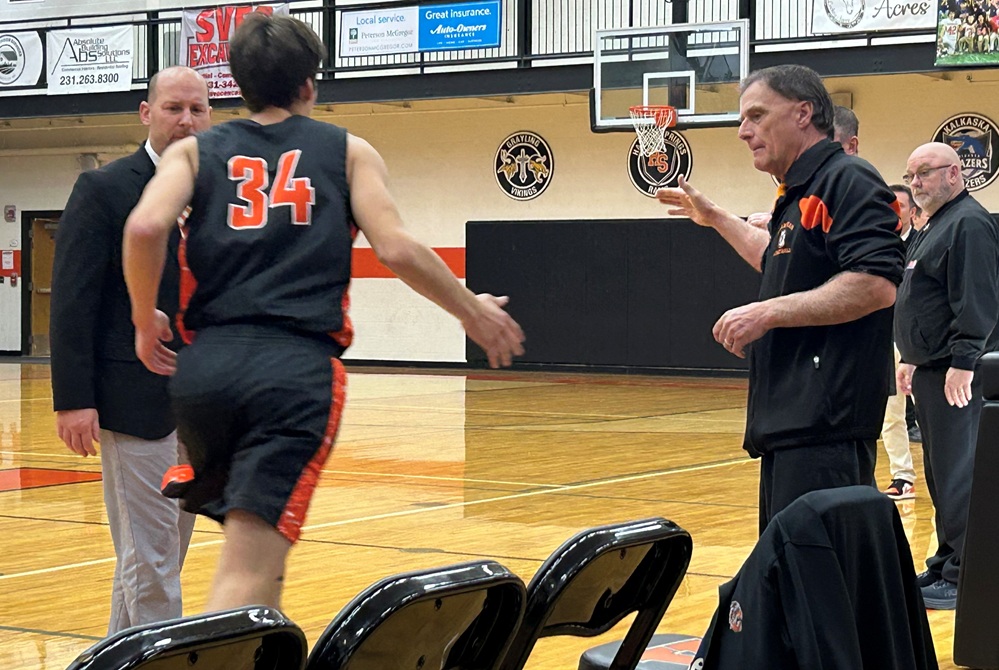
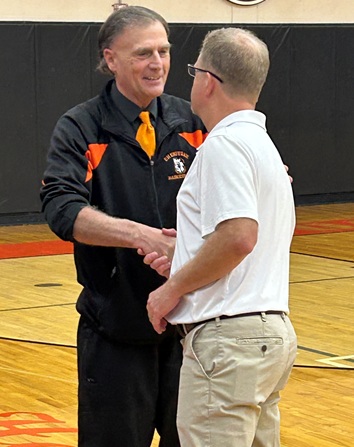
PHOTOS (Top) Longtime Cheboygan boys basketball JV coach Scott Hancock sends Andrew Kiefer (34) onto the floor during introductions before a game against Kingsley. (Middle) The Hancock family takes a photo with Scott’s newly-added signature on the floor. From left: Landon Gahn, Brian Hancock, Olwyn Hancock, Scott Hancock, Marjean Hancock, Lincoln Hancock and Nick Hancock. (Below) Scott Hancock shakes hands with Kingsley assistant coach Steve Acre. (Family photo courtesy of Chris Murdick. Other photos by Tom Spencer.)