

Breslin Bound: Boys Regional Preview
March 14, 2016
By Geoff Kimmerly
Second Half editor
The MHSAA Boys Basketball Tournament finished up its first week Friday with many of the expected contenders moving on – but quite a few surprises as well.
See below for four teams from each class that jumped out from Districts, with Regionals tipping off tonight. Click for brackets for all 32 and stay with Score Center tonight for scores and updated matchups.
Class A
Belleville (19-4) – The Tigers have won eight games straight and improved seven wins from a year ago, and had an eventful District week. In the Semifinal, Belleville beat Romulus, the team with which it shared the Western Wayne Athletic Conference Blue title, and then downed Westland John Glenn in overtime in the Final.
Detroit Western International (17-3) – The reigning Class A champion has had a solid season, finishing second in the Detroit Public School League West Division 1. But the biggest highlights came last week with a 77-76 overtime win over PSL Tournament champion Detroit East English, followed by a 15-point District Final win over 14-win Martin Luther King.
Lowell (18-5) – Since winning three games in 2010-11, the Red Arrows have improved their win total every season of the last five and are four victories better than a season ago. Lowell added a couple top teams from the east side of the state to the schedule this winter and lost locally only to Grand Rapids Christian twice and Wyoming Godwin Heights.
Roseville (17-5) – The Panthers improved to five wins better than a season ago, adding a District title to a runner-up finish in the Macomb Area Conference White. They've won 10 of their last 12 games.
Class B
Ann Arbor Gabriel Richard (12-11) – The Fighting Irish entered the tournament two games below .500 but emerged on the plus side thanks in part to a 43-41 upset of Chelsea in the District Final. Chelsea finished 16-6.
Detroit Osborn (13-10) – The Knights again proved the tough competition in the Public School League is a good primer for the postseason, winning their second straight District title despite finishing fifth in the PSL East Division 1 standings and going 2-7 in January.
Flint Northwestern (12-11) – The Wildcats finished only fifth in the Saginaw Valley League South but have won five straight and avenged last season’s District loss, downing Frankenmuth 57-52 in this year’s Final. Frankenmuth finished 20-3.
Stockbridge (17-5) – The Panthers split with Leslie during the regular season but still finished a game behind the Blackhawks and second in the final Greater Lansing Activities Conference standings. But Stockbridge beat Leslie (20-3) in the District Final.
Class C
Beaverton (19-1) – Bad weather kept Beaverton from getting in its full 20 regular-season games, but the Beavers did manage to extend their Jack Pine Conference winning streak to 34 with a second straight league title. They beat two league foes to win the District as well.
Constantine (14-9) – The Falcons dropped their final two regular-season games and finished only fourth in the Southwestern Athletic Conference Valley. But they beat third-place Schoolcraft on the way to a second-straight District title and after losing to the Eagles only four days before.
Grandville Calvin Christian (17-4) – The Squires took a couple of late losses prepping for the postseason with a final run that included reigning Class C runner-up NorthPointe Christian, reigning Class B champion Godwin Heights, plus 17-win Allendale and 15-win Covenant Christian. But those challenges paid off as Calvin Christian downed Covenant Christian 64-50 to start last week and then NorthPointe 52-45 in the District Final.
Ishpeming Westwood (10-12) – The final two weeks of the regular season included four losses over its final five games, but Westwood was a different team once the District began. The Patriots started with a win over Manistique – which they had lost to Feb. 17 – and finished with a 51-47 win over rival Ishpeming after falling to the 16-win Hematites twice in league play.
Class D
AuGres-Sims (11-9) – The Wolverines were another team that entered the postseason on a bit of a stumble, having lost four of six after locking down second place in the North Star League Little Dipper division. But they beat champion Fairview by 12 to open last week and then Mio 62-59 in the Final.
Fulton (16-6) – A five-point loss to Class C Lakeview in the regular-season finale is the only blemish for the Pirates over their last eight games. They clinched the District title with a 55-42 win over league rival and 13-win Fowler.
Novi Franklin Road Christian (16-6) – Annual contender Southfield Christian is the team most pay attention to from the Michigan Independent Athletic Conference, either division. But Blue runner-up Franklin Road Christian has won eight of nine to continue a seven-win improvement from a season ago.
Rock Mid-Peninsula (13-9) – The Wolverines won only three games each of the last two seasons, but added a District title to this winter of improvement to go with the Skyline Central Conference East championship.
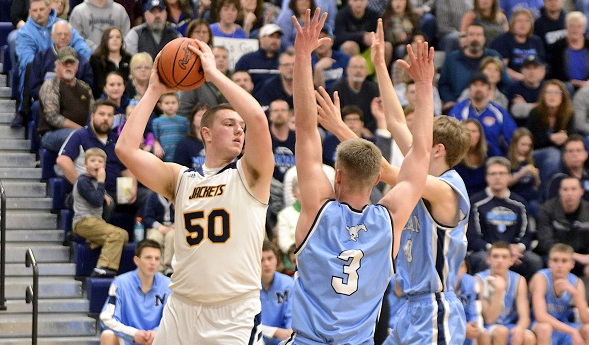
PHOTO: Ithaca repeated as a District champion last week, downing Sanford Meridian in a Class C Final. (Click to see more at HighSchoolSportsScene.com.)
Breslin Bound: Boys Report Post-Break
January 3, 2017
By Geoff Kimmerly
Second Half editor
This week, Michigan’s high school boys basketball teams will begin focusing most of their energies on winning league championships and doing their best against competition closest to home.
 But before we dive in to that always-intense chapter of each season, our Breslin Bound report – powered by MI Student Aid – reviews the best from two weeks of holiday break, including matchups of some expected MHSAA title contenders in Class A and B.
Week in Review
The countdown of holiday break's five most intriguing results:
1. Detroit U-D Jesuit 69, Macomb Dakota 61 – Dakota was missing a standout and lost another near the end of this one, but regardless this rematch of last season’s Class A Semifinal finished with the Cubs on top while sandwiched between their overtime losses to Flint Beecher and Indianapolis Lawrence North (Ind.).
2. North Farmington 53, Detroit Henry Ford 49 – The Raiders bounced back from three losses to open this season, including a 65-58 defeat to Farmington, to beat Dearborn Divine Child and then the Class B reigning champ at the Motor City Roundball Classic.
3. McBain 73, Boyne City 62 – In a matchup of expected Class C contenders from the northern Lower Peninsula, McBain emerged with a fourth double-digit win in four tries this winter while handing Boyne City its first loss.
4. Wyoming Godwin Heights 69, Wayland 67 – They are in different Districts this season after meeting in the first round a year ago, and both could emerge as Class B contenders after meeting in this Cornerstone Invitational title game.
5. Frankfort 72, Traverse City St. Francis 65 – The Panthers avenged one of only two regular-season losses from last season, when they fell to St. Francis 69-68.
Watch List
With an eye toward March, here are two teams in each class making sparks:
CLASS A
Detroit East English (5-0) – The Bulldogs may have graduated a Mr. Basketball finalist off last season’s 17-win team, but they likely have another and could finish even better this winter with wins so far over Flint Beecher, Macomb Dakota and most recently Wayne Memorial 92-77.
Battle Creek Central (5-1) – That lone loss came early to Kalamazoo Central, and Battle Creek Central has stormed back with the latest a sweep at its holiday tournament, 60-50 over Otsego and 61-46 over Muskegon Heights Academy.
CLASS B
St. Clair (5-0) – The Saints, winners of 12 and 14 games, respectively, over the last two seasons, downed St. Clair Shores Lakeview 54-53 in overtime and then host Clinton Township Chippewa Valley 58-57 at the latter’s holiday tournament to finish off 2016.
Wyoming Lee (5-0) – A 3-17 finisher just last season, Lee is in the midst of a sizable turnaround highlighted over the break by wins over Gobles (in overtime) and host Allegan to win the Tigers’ holiday tournament.
CLASS C
Harbor Springs (3-0) – After also going only 3-17 a year ago, Harbor Springs has equaled that win total while handing the only losses this season to Bellaire (40-37) and Pickford (67-65).
Michigan Center (6-0) – The Cardinals will embark next on at least matching last season’s shared title in the Cascades Conference, and will do so after dominating Williamston’s holiday event with wins over Dansville (66-47) and Class A DeWitt (86-75).
CLASS D
Bark River-Harris (4-0) – Eventually, the Broncos will get to test themselves against Powers North Central (Jan. 27) in the Skyline Central Conference West. So far, they look good to top last season’s 10-11 finish.
Frankfort (3-0) – Expectations are high as always coming off a second straight Northwest Conference title and fourth straight season with 20 or more wins – and so far so good; see note above on avenging last season’s loss to Traverse City St. Francis.
Can't-Miss Contests
Be on the lookout for results of these games coming up:
Tuesday – Clarkston (5-0) at Flint Carman-Ainsworth (6-0) – The Wolves have earned a reputation as Class A contender with another strong start, and Carman-Ainsworth could cement that status as well with a win.
Tuesday – Maple City Glen Lake (3-0) at Elk Rapids (5-0) – In addition to both being undefeated this week, Glen Lake beat Elk Rapids twice last season including in the District.
Friday – Beaverton (4-1) at Clare (3-1) – Although both have a loss, both also are undefeated in early Jack Pine Conference play; Beaverton’s only defeat was in its last game, to Class A Midland Dow by two.
Friday – Detroit U-D Jesuit (4-2) at Romulus (2-1) – Another week, another impressive foe lined up for reigning Class A champion Jesuit; Romulus’ lone loss was by six to Clarkston.
Friday – Holt (3-2) at Okemos (3-1) – This longtime rivalry means something again, as both are seeking to rise in a Capital Area Activities Conference Blue that also features East Lansing, Lansing Everett and Jackson.
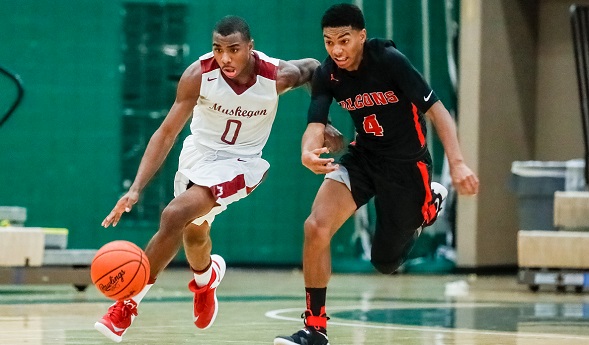
PHOTO: Muskegon pushes the ball upcourt during a 68-45 win over East Kentwood during the Muskegon Hall of Fame Classic on Dec. 28 at Reeths-Puffer High School. (Photo by Tim Reilly.)