

Before the Bridge: Class E & the UP
By
Ron Pesch
MHSAA historian
July 31, 2017
This is the final part in a series on MHSAA tournament classification, past and present, that has been published over the last two weeks and originally ran in this spring's edition of MHSAA benchmarks.
The stories are worthy of the silver screen.
Long lost legends of lore, forgotten by most in the Lower Peninsula of the state of Michigan.
Absurd anecdotes of basketball played behind glass, and out-of-bounds lines painted on walls.
Tales of overlooked places like Trenary and Champion and Doelle and Watersmeet.
This is the story of MHSAA Class E basketball.
From 1932 to 1947, Michigan's Upper Peninsula did not compete in the state-sponsored basketball tournament. Instead, the U.P. held a separate basketball tournament, crowning champions in Classes B, C and D. In 1941, the state added a fifth classification – Class E, comprised of schools with a student body numbering 75 or fewer. A fourth bracket was added to the U.P. tourney.
Following the 1948 season, the Upper Peninsula returned to the state tournament. Winners of the traditional U.P. tourney were pronounced regional champions, and advanced to the state quarterfinals in Classes B, C and D. However, since there were no Class E schools with basketball teams in the Lower Peninsula, the winner of the U.P. tournament crown was proclaimed Class E state champion. This arrangement continued through the spring of the 1960 season.
Since they were the state's smallest high schools, the gymnasiums came in all shapes and sizes. Some sported a center circle that intersected with the top of the key. Basketball courts that doubled as a stage required netting to keep the kids and the ball on the court and away from the audience seated below.
Fred Boddy, a former coach at Champion, recalled his first visit to Doelle. Located in copper country near Houghton, the hosts were the proud owners of “the smallest” gym in U.P.
“I couldn't believe my eyes. ... Here on the second floor were windows and bleachers all around filled with fans. The gym, of course, was located on the first floor, but to get into the gym one had to go around to the back of the school to enter through the boiler room to the locker rooms, which opened onto the gym floor much like a dugout on a baseball field. The players sat on a bench under the wall and could look out and see the game in this manner. The free throw lines intersected and there were no out of bounds lines... the wall itself was ‘out of bounds.’ On the floor during the game were 10 players and two referees. There were no sounds as all the fans were up on the second floor, glassed in.
The cheerleaders tried valiantly to fire up the fans up on the second floor, but the teams couldn't hear in the quiet below. The score clock and statistician personnel were placed in a corner box high over the floor in one corner of the gym. They attained this lofty perch by a ladder that was removed from the trap door after all three were in position and the game could thus commence. The timer then tied a rope around his ankle. To send a sub into the game the coach would send the player along the wall heading for this rope. He would pull the rope causing the timer to look down through the trap door and at next opportunity would ring the buzzer and admit this substitute”
Regardless of the challenges presented by these cracker-box gyms, the fans loved their basketball. “The enthusiasm was just the same, if not bigger, than schools twice and 10 times their size,” noted longtime U.P. historian, Jay Soderberg.
Coach Joseph Miheve's 1941 Palmer squad captured the state's first Class E title with a 39-28 win over Hulbert at Ironwood. A graduate of Wakefield High School, Miheve had never played high school basketball, serving as the team's manager.
The 1942 tournament, scheduled for March 19-21, was postponed one week because the city of Marquette was more or less taken over “by nearly 1,000 selective service registrants from every county in the Upper Peninsula” who had another and more serious battle in mind – World War II.
Palmer, this time coached by Elvin Niemi, repeated in Class E with a 37-31 victory over Bergland. It was Palmer's 32nd consecutive victory.
No tournament was held in 1943 due to the involvement of the United States in the war. In the 1944 championship game, Cedarville jumped out to a 19-14 first quarter lead but was held to 24 points in the remaining periods and fell to Amasa, 51-43 at Ishpeming.
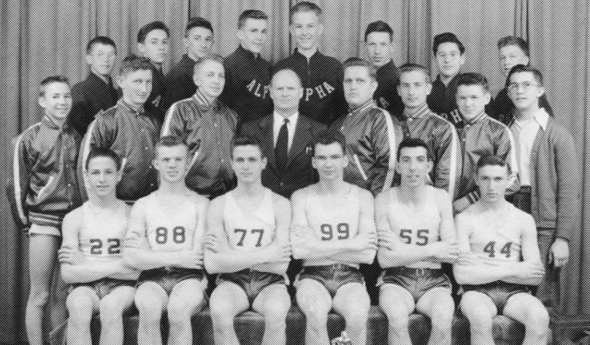
Trenary made its lone Class E finals appearance in 1945, losing to Bergland 49-39 at Ishpeming, while the Alpha Mastodons won their first U.P. title since 1934 with a 48-28 win over Champion in 1946. It was the second of five Class E titles for Alpha coach Gerhardt “Gary” Gollakner, one of the finest coaches to come out of the U.P. Gollakner had coached at Amasa two years earlier, and his Mastodons would earn three additional titles during the 19-year run of the Class E championships.
Bergland became the tourney's second two-time winner in 1947, with a 40-37 win over the Perkins Yellowjackets. Perkins made four trips to the Class E finals over the years, including an appearance in the final year of the tournament, but came away empty-handed each time.
The Nahma Arrows made their first appearance in the championship in 1951, losing to Michigamme. Led by coach Harold “Babe” Anderson, a cage star at Northern Michigan College during the early 1940s, the Arrows returned to the finals in 1952. Nahma finished the year with a 21-0 mark and a 64-44 win over Marenisco for the crown.
 The two teams met again in a finals rematch the following year. The scored was tied six times, while the lead changed hands seven times in this barnburner. With 15 seconds to play, Nahma led 64-60. Marenisco's Robert Prosser hit a jump shot, then teammate Bill Blodgett stole a pass and scored to knot the game at 64. With two seconds remaining, Nahma's Bernard Newhouse was fouled. Newhouse hit the first free throw, but missed on the second. Teammate Wendell Roddy tipped in the rebound, and the Arrows had their second title.
Alpha returned to the championship circle in 1954 with a 52-48 win over Perkins.
The 1955 title game matched a pair of the finest teams in Class E history. Trout Creek, making its first championship appearance, downed Alpha 84-83 in another Class E thriller. Don Mackey led the winners with 39 points. Tony Hoholek paced Alpha with 31, while junior John Kocinski added 21-points for the Mastodons.
Kocinski, a four-year starter at Alpha, scored 1,782 points during his career, then an all-time U.P. record. He once scored 51 points against Amasa, and could have scored more according to teammate Walter “Slip” Ball. “He refused to shoot in the fourth quarter, and passed up one shot after another,” Ball said.
Without question, Trout Creek was one of the powerhouse squads during the final years of the tourney. The Anglers, coached by Bruce “Pinky” Warren, a former captain of Purdue's football team, made four trips to the finals during the last six years of the Class E tourney. The defending champions downed Alpha in the semifinals of the 1956 tournament, then knocked off Hermansville 86-68 in the finals to repeat. It was a year of celebration for fans of U.P. basketball, as four of the state's five champions – Stephenson (B), Crystal Falls (C), Chassell (D) and Trout Creek (E) – came from Michigan's northern peninsula.
Hermansville returned to the finals in the spring of 1957 and earned its second Class E title with a 77-51 win over Michigamme at Escanaba. Trout Creek downed Perkins 61-41 for their third crown in 1958.
The 1959 championship, hosted at Northern Michigan College's fieldhouse, was a showdown of the U.P.’s only undefeated squads, Trout Creek and Nahma. Trout Creek was riding a 24-game winning streak that dated back to the 1958 season. A scoring machine, Warren's Anglers averaged 81.7 points per contest. Nahma, 19-0 on the season, boasted the U.P.'s strongest defense. Still coached by “Babe” Anderson, the Arrows had allowed an average of 38.2 points per game. Led by senior Warren Groleau, Nahma had been last defeated by Trout Creek in the semifinals of the 1958 tourney.
Leading 25-15 at the intermission, Nahma matched Trout Creek point for point in the second half for a 55-45 victory.
Hermansville, behind Richard Polazzo's 29 points and Irwin Scholtz's 27, downed surprise finalist Perkins 72-50 in the 1960 finale, to end this chapter in MHSAA history.
Today, most of the former Class E high schools are long gone. Many have closed their doors and consolidated with other area schools. Amasa and Alpha merged with Crystal Falls to form Forest Park. Palmer is now part of the Negaunee school system. Bergland and Trout Creek joined forces with Class D Ewen to form Ewen-Trout Creek. Hermansville combined with Powers to form North Central, to name but a few. A few remain: Dollar Bay, Marenisco (now Wakefield-Marenisco) and Watersmeet, and their enrollments are much the same as in the glory days of the state's fifth classification.
Author’s note: Special thanks to Jay Soderberg and Roger Finlan, who assisted in gathering statistics and quotes used in this article. Thanks also to Dick Kishpaugh, Bob Whitens, Walter “Slip” Ball, Dennis Grall, Fred Boddy, Bruce Warren, Gene Maki, Harold “Babe” Anderson and the various personnel at U.P. high schools for their contributions to this story.
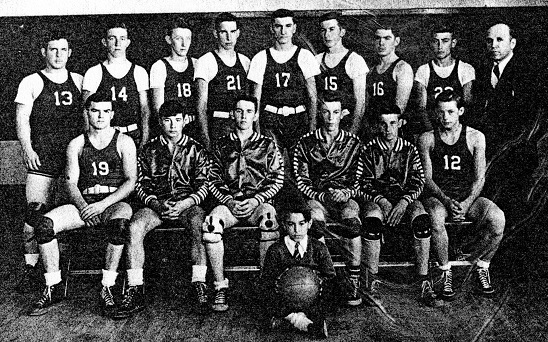
PHOTOS: (Top) The Alpha boys basketball team won the 1950 Class E title by nearly doubling up Michigamme, 52-28. (Middle) Hermansville claimed the 1948 title with a 58-38 win over Rockland.
Breslin Bound: 2025-26 Boys District Preview
By
Geoff Kimmerly
MHSAA.com senior editor
February 23, 2026
The march to Breslin Center ramps up significantly this week as more than 700 boys basketball teams across Michigan begin a journey they hope will end in East Lansing.

We always switch up our “Breslin Bound” format once the MHSAA Tournament starts, as last week’s most intriguing results below are followed this time by glances at three District brackets of note in each division. Host sites are bolded, and teams playing in those brackets are listed by seed as determined by Michigan Power Ratings (MPR).
Everything you could want to know this week about tickets, brackets and more can be found on the Boys Basketball page. To watch any of several games online, visit the NFHS Network.
“Breslin Bound” is powered by MI Student Aid and based on results and schedules posted for each school at MHSAA.com.
Week in Review
The countdown of last week’s five most intriguing results:
1. Saginaw Heritage 73, Grand Blanc 60 The Hawks (18-4) avenged a 28-point loss to Grand Blanc (17-4) from December in this matchup of Saginaw Valley League division champions.
2. Detroit Catholic Central 64, Detroit Martin Luther King 54 The Shamrocks (15-6) won the annual Operation Friendship championship game matching the winners from the Catholic High School League and Detroit Public School League, and adding to a 54-46 overtime win over King (17-5) from December.
3. Gladwin 49, Beaverton 46 Gladwin (21-1) claimed the overall Jack Pine Conference championship with its second win this month over Beaverton (17-5).
4. Flushing 52, Goodrich 51 Flushing (18-4) held on for a second close win over Goodrich, this time in the Flint Metro League championship game, after winning their Jan. 27 meeting by four.
5. Wayne Memorial 61, Hartland 48 The Zebras (19-3) capped off their regular season by defeating the Eagles (18-4) in the Kensington Lakes Activities Association title game.
Districts at a Glance
These could be among our most competitive brackets. Host sites are in bold, and teams are listed by seed:
DIVISION 1
Detroit Cass Tech
1. Detroit Martin Luther King (17-5), 2. Detroit Cass Tech (16-6), 3. Detroit Western (19-2), 4. Grosse Pointe South (11-11), 5. Grosse Pointe North (10-12).
King and Cass Tech have met twice this season – King won the Jan. 21 matchup 60-53 that helped decide the PSL Blue title, and then 68-63 in the PSL Tournament city championship game Feb. 15. King also defeated Western, 56-36, in a league tournament semifinal, while Cass Tech and Western didn’t face each other during this regular season. Grosse Pointe North has won seven of its last nine games and defeated Cass Tech by a point in their District matchup last season, and South owns a big early win over North.
Flushing
1. Saginaw Heritage (18-4), 2. Flushing (18-4), 3. Saginaw United (13-8), 4. Flint Carman-Ainsworth (8-14), 5. Swartz Creek (11-11).
As noted by the results above, Heritage and Flushing emerged at the end of last week as the top teams from the Saginaw Valley League and Flint Metro League, respectively. Saginaw United finished second in the SVL South and split with SVL North runner-up Mount Pleasant this season, and despite losing to Heritage early should also be considered a contender. Flushing has only one loss this calendar year, to Pontiac Notre Dame Prep in overtime, and Heritage has lost only twice since Jan. 1 and defeated Mount Pleasant twice by 20 or more points to win the SVL North.
Muskegon
1. Rockford (18-3), 2. Muskegon (19-2), 3. Greenville (20-2), 4. Muskegon Mona Shores (10-10), 5. Muskegon Reeths-Puffer (6-16), 6. Cedar Springs (7-15).
Rockford and Muskegon are the anticipated matchup to decide this bracket, and they met in last season’s District Final with the Rams winning 64-62. Rockford has victories over Bloomfield Hills Brother Rice and East Kentwood but finished second to the latter in the O-K Red. Muskegon has downed Wayne Memorial and Lansing Waverly and won the O-K Green. And definitely don’t count out River Cities Alliance champion Greenville, which has two losses by a combined six points and introduced itself loudly with a December win over Grand Rapids Northview.
DIVISION 2
Comstock Park
1. Grand Rapids Catholic Central (16-6), 2. Grand Rapids Christian (16-5), 3. Grand Rapids NorthPointe Christian (17-5), 4. Wyoming Kelloggsville (14-7), 5. Comstock Park (5-17), 6. Ada Forest Hills Eastern (2-20).
Grand Rapids Christian claimed the O-K White title outright last week in part thanks to a 51-43 win over Grand Rapids Catholic Central, and they split their regular-season series as the Cougars won their Jan. 20 meeting by five. NorthPointe was second in the O-K Silver and Kelloggsville fourth, and on opposite sides of this bracket certainly could provide obstacles as the Cougars and Eagles pursue a third round.
Ludington
1. Ludington (20-2), 2. Hart (19-3), 3. Reed City (10-12), 4. Manistee (12-10), 5. Big Rapids (9-13).
Ludington finished undefeated in the West Michigan Conference Lakes and has reached Regional Finals the last two seasons. Hart was second in the WMC Rivers and is seeking a first District title since 2019. They have key mutual opponents; both lost to North Muskegon this winter, and Hart also took a loss from Fremont while Ludington swept the Packers. Manistee and Ludington played Thursday – Ludington winning 68-55 – and they could meet again in a District Semifinal if Manistee gets past Big Rapids tonight.
Yale
1. Yale (20-2), 2. Croswell-Lexington (17-5), 3. Imlay City (16-6), 4. Almont (10-10), 5. North Branch (7-15).
All five of these teams are from the Blue Water Area Conference and finished among the top six, with Yale and Croswell-Lexington sharing the championship and splitting their matchups – the Pioneers won Jan. 20 in overtime, 64-57, while Yale won the rematch Friday 60-41. Imlay City finished third in the BWAC and despite losing both games against both champs took Croswell-Lexington to overtime the second time they played.
DIVISION 3
Kent City
1. Blanchard Montabella (15-7), 2. Kent City (14-8), 3. Morley Stanwood (13-9), 4. Ravenna (13-9), 5. Lakeview (7-15), 6. White Cloud (3-19).
The top four seeds all finished second or third in their respective leagues and will look to add a trophy winning what could be one of the most tightly-contested brackets in any division. Montabella tied for second in the Mid-State Activities Conference West and has won six of its last seven games since falling to Ravenna 43-39 on Jan. 28. Ravenna, which tied for third in the WMC Rivers, has bounced back from a late rough stretch and opened this season with a win over Morley Stanwood – which finished second in the Central State Activities Association White while splitting with third-place Kent City, which won their Friday matchup by 20.
Mancelona
1. Mancelona (20-2), 2. East Jordan (20-2), 3. Indian River Inland Lakes (14-8), 4. Harbor Springs (11-11), 5. Boyne City (9-12), 6. Charlevoix (6-15).
By the numbers, Mancelona and East Jordan has been so close at the top of this District that East Jordan actually passed Mancelona in MPR during the week after seeding. East Jordan also won the Ski Valley Conference by game over Mancelona, claiming their matchups 48-38 and 45-36. Inland Lakes finished third in the Ski Valley, losing to both league title contenders twice, and Harbor Springs is coming over after finishing third in the Northern Shores Conference and losing to East Jordan by only six points, 45-39, on Thursday.
Unionville-Sebewaing
1. Harbor Beach (19-3), 2. Elkton-Pigeon-Bay Port Laker (18-3), 3. Cass City (16-6), 4. Unionville-Sebewaing (11-11), 5. Bad Axe (6-15).
There is a great deal of familiarity in this bracket as well, as Harbor Beach won the Big Thumb Conference Black and Laker and Cass City were first and second, respectively, in the BTC White. Harbor Beach saw both during the first half of the regular season, defeating Cass City by seven and Laker by three. Laker defeated Cass City by seven and nine to win their league. USA tied for fifth in the BTC White – with an eight-point win over Cass City and a four-point loss to Laker in February rematches.
DIVISION 4
Lake Linden-Hubbell
1. Dollar Bay (19-2), 2. L’Anse (15-6), 3. Baraga (15-6), 4. Lake-Linden-Hubbell (7-15), 5. Chassell (5-16).
Dollar Bay won the Copper Mountain Conference championship and L’Anse and Baraga both finished among the upper half among a strong group – in fact, Baraga defeated Dollar Bay by 11 just 10 days ago. Dollar Bay did defeat Baraga in last season’s District Final, and the Blue Bolts’ only other loss this season was to Division 1 Marquette. L’Anse is enjoying its first winning season since 2018-19 and swept Baraga during the regular season.
Rogers City
1. Hillman (19-2), 2. Posen (15-5), 3. Gaylord St. Mary (13-9), 4. Rogers City (12-9), 5. Onaway (5-17), 6. Atlanta (4-13).
Hillman and Posen shared the North Star League Little Dipper championship, splitting the regular-season series with Posen and winning their most recent matchup 57-50 on Jan. 27. They may meet again, but Hillman also took a loss from potential Wednesday opponent Rogers City before winning their rematch by 20. Rogers City also defeated Posen twice. Gaylord St. Mary is intriguing after finishing fourth in the Ski Valley Conference but, as noted above, defeating that league’s champion East Jordan earlier this month.
Three Oaks River Valley
1. St. Joseph Michigan Lutheran (17-4), 2. St. Joseph Our Lady of the Lake Catholic (13-7), 3. New Buffalo (14-8), 4. Eau Claire (11-11), 5. Three Oaks River Valley (3-17).
Michigan Lutheran finished first, Our Lady and New Buffalo tied for second, and Eau Claire finished fourth in the Berrien-Cass-St. Joseph League. New Buffalo handed Michigan Lutheran its only conference defeat in their second of two games – winning by a point – and New Buffalo and Our Lady split their two games, decided by five and two points. Michigan Lutheran also defeated New Buffalo to clinch a District championship a year ago.
MHSAA.com's weekly “Breslin Bound” reports are powered by MI Student Aid, a division within the Department of Lifelong Education, Advancement, and Potential (MiLEAP). MI Student Aid encourages students to pursue postsecondary education by providing access to student financial resources and information. MI Student Aid administers the state’s scholarship and grant programs that help make college Accessible, Affordable and Attainable for you. Click to connect with MI Student Aid and find more information on Facebook and X @mistudentaid.
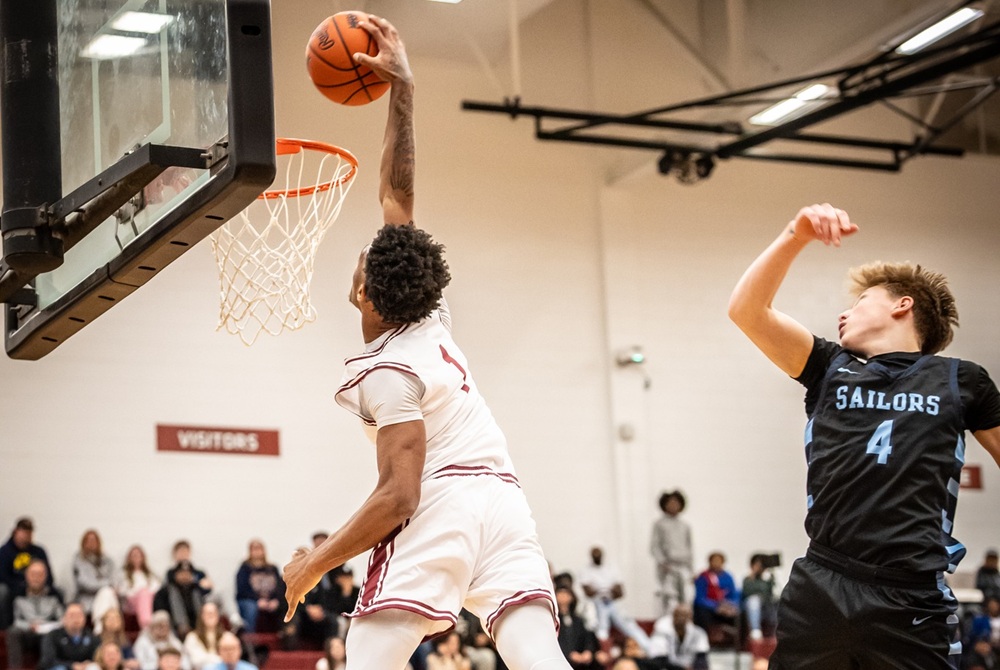
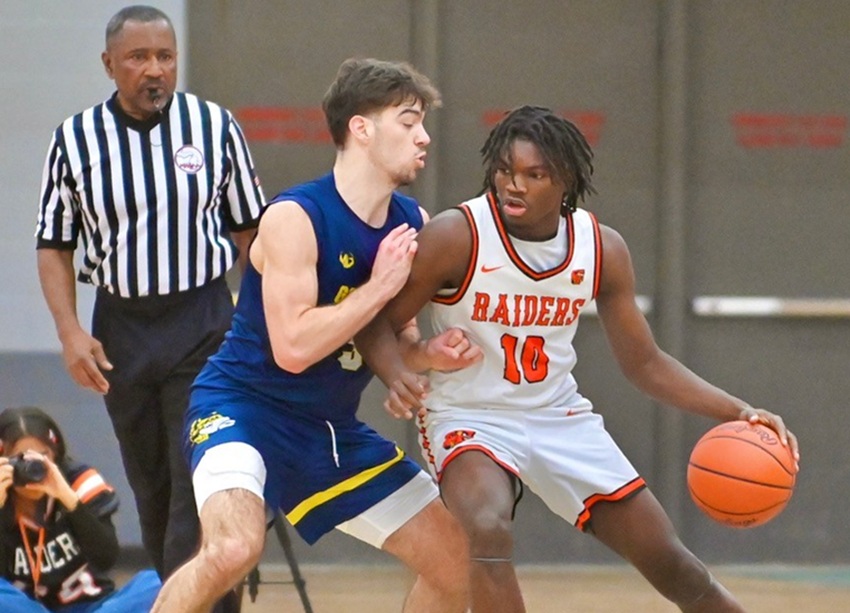
PHOTOS (Top) Muskegon’s James Martin throws down a dunk against Muskegon Mona Shores during a Jan. 30 win. (Middle) Flushing’s Raymond Neither (10) works for post position against Goodrich’s Jensen LePla during the Raiders’ 52-51 Metro League title clincher. (Muskegon/Mona Shores photo by Tim Reilly. Flushing/Goodrich photo by Terry Lyons.)