

Before the Bridge: Class E & the UP
By
Ron Pesch
MHSAA historian
July 31, 2017
This is the final part in a series on MHSAA tournament classification, past and present, that has been published over the last two weeks and originally ran in this spring's edition of MHSAA benchmarks.
The stories are worthy of the silver screen.
Long lost legends of lore, forgotten by most in the Lower Peninsula of the state of Michigan.
Absurd anecdotes of basketball played behind glass, and out-of-bounds lines painted on walls.
Tales of overlooked places like Trenary and Champion and Doelle and Watersmeet.
This is the story of MHSAA Class E basketball.
From 1932 to 1947, Michigan's Upper Peninsula did not compete in the state-sponsored basketball tournament. Instead, the U.P. held a separate basketball tournament, crowning champions in Classes B, C and D. In 1941, the state added a fifth classification – Class E, comprised of schools with a student body numbering 75 or fewer. A fourth bracket was added to the U.P. tourney.
Following the 1948 season, the Upper Peninsula returned to the state tournament. Winners of the traditional U.P. tourney were pronounced regional champions, and advanced to the state quarterfinals in Classes B, C and D. However, since there were no Class E schools with basketball teams in the Lower Peninsula, the winner of the U.P. tournament crown was proclaimed Class E state champion. This arrangement continued through the spring of the 1960 season.
Since they were the state's smallest high schools, the gymnasiums came in all shapes and sizes. Some sported a center circle that intersected with the top of the key. Basketball courts that doubled as a stage required netting to keep the kids and the ball on the court and away from the audience seated below.
Fred Boddy, a former coach at Champion, recalled his first visit to Doelle. Located in copper country near Houghton, the hosts were the proud owners of “the smallest” gym in U.P.
“I couldn't believe my eyes. ... Here on the second floor were windows and bleachers all around filled with fans. The gym, of course, was located on the first floor, but to get into the gym one had to go around to the back of the school to enter through the boiler room to the locker rooms, which opened onto the gym floor much like a dugout on a baseball field. The players sat on a bench under the wall and could look out and see the game in this manner. The free throw lines intersected and there were no out of bounds lines... the wall itself was ‘out of bounds.’ On the floor during the game were 10 players and two referees. There were no sounds as all the fans were up on the second floor, glassed in.
The cheerleaders tried valiantly to fire up the fans up on the second floor, but the teams couldn't hear in the quiet below. The score clock and statistician personnel were placed in a corner box high over the floor in one corner of the gym. They attained this lofty perch by a ladder that was removed from the trap door after all three were in position and the game could thus commence. The timer then tied a rope around his ankle. To send a sub into the game the coach would send the player along the wall heading for this rope. He would pull the rope causing the timer to look down through the trap door and at next opportunity would ring the buzzer and admit this substitute”
Regardless of the challenges presented by these cracker-box gyms, the fans loved their basketball. “The enthusiasm was just the same, if not bigger, than schools twice and 10 times their size,” noted longtime U.P. historian, Jay Soderberg.
Coach Joseph Miheve's 1941 Palmer squad captured the state's first Class E title with a 39-28 win over Hulbert at Ironwood. A graduate of Wakefield High School, Miheve had never played high school basketball, serving as the team's manager.
The 1942 tournament, scheduled for March 19-21, was postponed one week because the city of Marquette was more or less taken over “by nearly 1,000 selective service registrants from every county in the Upper Peninsula” who had another and more serious battle in mind – World War II.
Palmer, this time coached by Elvin Niemi, repeated in Class E with a 37-31 victory over Bergland. It was Palmer's 32nd consecutive victory.
No tournament was held in 1943 due to the involvement of the United States in the war. In the 1944 championship game, Cedarville jumped out to a 19-14 first quarter lead but was held to 24 points in the remaining periods and fell to Amasa, 51-43 at Ishpeming.
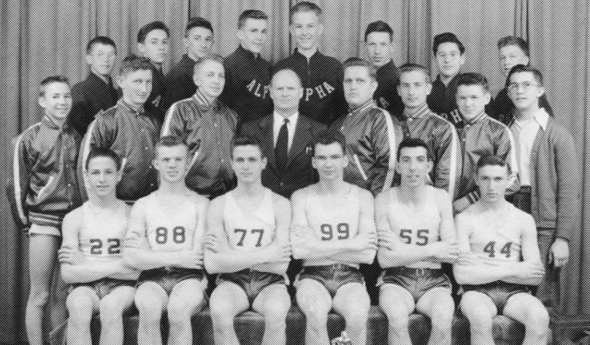
Trenary made its lone Class E finals appearance in 1945, losing to Bergland 49-39 at Ishpeming, while the Alpha Mastodons won their first U.P. title since 1934 with a 48-28 win over Champion in 1946. It was the second of five Class E titles for Alpha coach Gerhardt “Gary” Gollakner, one of the finest coaches to come out of the U.P. Gollakner had coached at Amasa two years earlier, and his Mastodons would earn three additional titles during the 19-year run of the Class E championships.
Bergland became the tourney's second two-time winner in 1947, with a 40-37 win over the Perkins Yellowjackets. Perkins made four trips to the Class E finals over the years, including an appearance in the final year of the tournament, but came away empty-handed each time.
The Nahma Arrows made their first appearance in the championship in 1951, losing to Michigamme. Led by coach Harold “Babe” Anderson, a cage star at Northern Michigan College during the early 1940s, the Arrows returned to the finals in 1952. Nahma finished the year with a 21-0 mark and a 64-44 win over Marenisco for the crown.
 The two teams met again in a finals rematch the following year. The scored was tied six times, while the lead changed hands seven times in this barnburner. With 15 seconds to play, Nahma led 64-60. Marenisco's Robert Prosser hit a jump shot, then teammate Bill Blodgett stole a pass and scored to knot the game at 64. With two seconds remaining, Nahma's Bernard Newhouse was fouled. Newhouse hit the first free throw, but missed on the second. Teammate Wendell Roddy tipped in the rebound, and the Arrows had their second title.
Alpha returned to the championship circle in 1954 with a 52-48 win over Perkins.
The 1955 title game matched a pair of the finest teams in Class E history. Trout Creek, making its first championship appearance, downed Alpha 84-83 in another Class E thriller. Don Mackey led the winners with 39 points. Tony Hoholek paced Alpha with 31, while junior John Kocinski added 21-points for the Mastodons.
Kocinski, a four-year starter at Alpha, scored 1,782 points during his career, then an all-time U.P. record. He once scored 51 points against Amasa, and could have scored more according to teammate Walter “Slip” Ball. “He refused to shoot in the fourth quarter, and passed up one shot after another,” Ball said.
Without question, Trout Creek was one of the powerhouse squads during the final years of the tourney. The Anglers, coached by Bruce “Pinky” Warren, a former captain of Purdue's football team, made four trips to the finals during the last six years of the Class E tourney. The defending champions downed Alpha in the semifinals of the 1956 tournament, then knocked off Hermansville 86-68 in the finals to repeat. It was a year of celebration for fans of U.P. basketball, as four of the state's five champions – Stephenson (B), Crystal Falls (C), Chassell (D) and Trout Creek (E) – came from Michigan's northern peninsula.
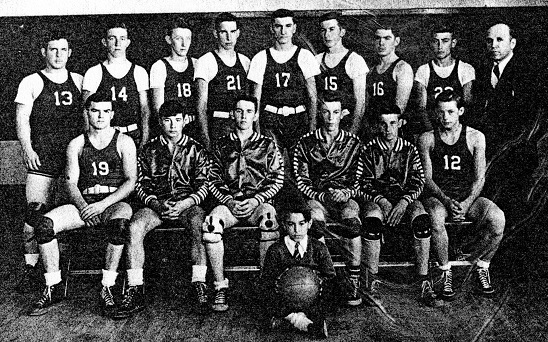
Hermansville returned to the finals in the spring of 1957 and earned its second Class E title with a 77-51 win over Michigamme at Escanaba. Trout Creek downed Perkins 61-41 for their third crown in 1958.
The 1959 championship, hosted at Northern Michigan College's fieldhouse, was a showdown of the U.P.’s only undefeated squads, Trout Creek and Nahma. Trout Creek was riding a 24-game winning streak that dated back to the 1958 season. A scoring machine, Warren's Anglers averaged 81.7 points per contest. Nahma, 19-0 on the season, boasted the U.P.'s strongest defense. Still coached by “Babe” Anderson, the Arrows had allowed an average of 38.2 points per game. Led by senior Warren Groleau, Nahma had been last defeated by Trout Creek in the semifinals of the 1958 tourney.
Leading 25-15 at the intermission, Nahma matched Trout Creek point for point in the second half for a 55-45 victory.
Hermansville, behind Richard Polazzo's 29 points and Irwin Scholtz's 27, downed surprise finalist Perkins 72-50 in the 1960 finale, to end this chapter in MHSAA history.
Today, most of the former Class E high schools are long gone. Many have closed their doors and consolidated with other area schools. Amasa and Alpha merged with Crystal Falls to form Forest Park. Palmer is now part of the Negaunee school system. Bergland and Trout Creek joined forces with Class D Ewen to form Ewen-Trout Creek. Hermansville combined with Powers to form North Central, to name but a few. A few remain: Dollar Bay, Marenisco (now Wakefield-Marenisco) and Watersmeet, and their enrollments are much the same as in the glory days of the state's fifth classification.
Author’s note: Special thanks to Jay Soderberg and Roger Finlan, who assisted in gathering statistics and quotes used in this article. Thanks also to Dick Kishpaugh, Bob Whitens, Walter “Slip” Ball, Dennis Grall, Fred Boddy, Bruce Warren, Gene Maki, Harold “Babe” Anderson and the various personnel at U.P. high schools for their contributions to this story.
PHOTOS: (Top) The Alpha boys basketball team won the 1950 Class E title by nearly doubling up Michigamme, 52-28. (Middle) Hermansville claimed the 1948 title with a 58-38 win over Rockland.
Chelsea Coach Back 'To See This Through'
October 26, 2018
By Doug Donnelly
Special for Second Half
CHELSEA – Is anyone more excited about the start of prep basketball season than Josh Tropea?
With the calendar turning to November soon, we are only days away from the first boys basketball practice of the 2018-19 season. One of the biggest hardwood stories in southeast Michigan is that Tropea is back at Chelsea High School for his second stint as the head varsity coach there.
 He wasn’t gone long – he stepped away for just two years to coach at Spring Arbor University – but Tropea has brought his high energy and passion for basketball, and his whole family, back to the high school ranks.
“I’m thrilled to be back,” Tropea said. “I love being in a packed gymnasium on a Friday night. I’m so looking forward to battles with Dexter and playing Ypsilanti and going on the road for games. I love it.”
Tropea said he stepped away from the college job for several reasons – including the time he was spending away from his family on the weekends and because the timing was right to come back. Mark Moundros resigned after two years when he moved from the area. Tropea said he wanted to ensure the program continued its upward path.
“I have two sons at Chelsea,” he said. “If Mark had stayed I would not be here. But, when Mark left, and they didn’t have a viable candidate at the time, I felt like I didn’t want to let my two years here, the two years I had invested before leaving, to fall apart. Mark did a great job. I’d love it if he stayed, but I felt like I owed it to the kids to come back and see this through.”
The college experience has changed his approach to the game.
“I loved my college experience – loved it. Absolutely no regrets,” Tropea said. “But, I tell you, they have a much better version of me now. My temperament is better. I think I see the bigger picture better. Spring Arbor is all about being the best person you can be. I think I’m better now, not just in the Xs and Os, but as a person, as a coach.”
Tropea was already pretty good.
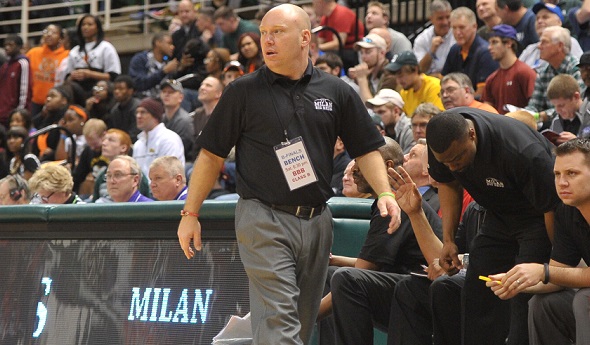
A South Lyon native, he’s been a basketball junkie for years. He got his first high school coaching job at Walled Lake Western while still in college. He made stops at Whitmore Lake and Howell while looking for a permanent teaching job, then landed at Milan in what turned out to be a made-for-each-other job. In short time, he rejuvenated the Milan Big Reds program from two wins the season before he took over the varsity to a surprise run to the Class B championship in 2013-14.
It wasn’t so much of a surprise that the Big Reds won the title that season, but how quickly Tropea built them into a powerhouse. During the summer before the title run, Tropea had his troops playing games all over the state, lining up scrimmages and playing in shootouts and tournaments that exposed the Milan players to some of the other elite.
“We had a lot of kids come from struggling homes or from tough situations,” Tropea said of his time at Milan. “Those kids were not entitled kids. As a family, we were able to make an impact in so many ways. Team dinners were a big deal. That’s what made leaving Milan so hard.
“It was maybe the best five years of my life for my wife and I,” he added. “It was such an exciting time, and we were just so embraced by the community.”
During his time there, the Big Reds went 92-27 and won three Huron League titles. The Class B title run was led by future college players Nick Perkins and Latin Davis. The Big Reds’ state championship was the first in boys basketball in the Monroe County Region in more than 60 years.
Tropea left Milan, he said, because of the teaching and coaching opportunity in Chelsea. Frankly, he said, the job paid more, and, for a young family, that was a big deal.
“It was a very difficult decision, but it was right for my family,” he said. “I was on a pay freeze for five straight years at Milan. Plus, we loved the Chelsea community. My wife wanted to come here.”
Although he was there just two seasons, Chelsea’s basketball program also came a long way in a short time.
The Bulldogs improved from 3-18 the year before he was there to 9-13 in 2014-15 and 16-6 in 2015-16, tying for second place in the Southeastern Conference White his second season. More importantly, Tropea laid the groundwork for the future. He started by getting into the lower levels of the school and teaching basketball to the younger students – and trying to let his passion for the game pass on to them.
“It’s rolling now,” he said. “The first year I had a summer camp, we had 17 kids. This past summer, we had 121. Everybody knows you have to have a youth program.
“We won 16 games my last year here, we won a District title two years ago and the team went 12-8 last year,” he said. “The program is in great shape.”
Tropea never has been afraid to adapt his game or the way he interacts with his players. He draws on his experiences working with other coaches every chance he gets.
“The game is constantly changing, and so are the kids,” he said. “You have to. You have to change.”
In today’s world that means using social media, such as Twitter, to set the tone of the program.
The @ChelseaBoysHoop Twitter feed, for example, regularly includes messages about workouts, inspirational quotes from some of game’s great players and encouragement to other Bulldogs athletes.
Great turnout at the meeting this morning! #BringtheJuice #GreaterThan #WePlayForMarch pic.twitter.com/ePCMjmAJdU
— ChelseaBoysHoop (@ChelseaBoysHoop) October 23, 2018
“I feel it can be a great tool if it is done right and positive,” he said of Twitter.
His wife, Alicia, is an integral part of the program, as are his children, Luke and Zack.
“This is definitely a family deal,” he said. “We are all in. I know no matter what, my wife will be in the third row and she’s so supportive. She’s all-in all the time. She supports me and my passion. You have to have that.”
Years from now, he said he might get back into the college game. But for now, being back at the high school level fits more his love of teaching the game.
“I’m a teacher at heart,” he said. “I love teaching the game. I love the four-player workouts and teaching the kids footwork and the importance of passing the ball with the seam. That’s what it’s all about – making an impact on the kids’ lives.”
The SEC can be a brutally tough league, and this year it’s only going to be stronger with the addition of Jackson to the division. With boys basketball season starting a week earlier this year and Chelsea’s football team alive in the MHSAA Playoffs, Tropea is employing somewhat of a different strategy than normal. The emphasis on the season, he said, will be to get his team ready for the Class B tournament come late February. He doesn’t want the players to peak too soon.
“We have one game before December 15,” he said. “We back-loaded the heck out of our schedule. I don’t care how good we are in November and December. I want to be playing our best basketball in March. We’re playing for March.”
Chelsea will have seven or eight seniors and five or six juniors on this year’s squad, Tropea said. Many of those seniors were part of a group that went 20-0 as freshmen and won 16 games as sophomores.
“We have some experience, and not just athletes but basketball players,” he said. “They are leaders. I’m so excited for this season. I’m happy to be back.”
 Doug Donnelly has served as a sports and news reporter and city editor over 25 years, writing for the Daily Chief-Union in Upper Sandusky, Ohio from 1992-1995, the Monroe Evening News from 1995-2012 and the Adrian Daily Telegram since 2013. He's also written a book on high school basketball in Monroe County and compiles record books for various schools in southeast Michigan. E-mail him at [email protected] with story ideas for Jackson, Washtenaw, Hillsdale, Lenawee and Monroe counties.
PHOTO: Returning Chelsea boys basketball coach leads his Milan team to the Class B championship in 2014 at Breslin Center.