

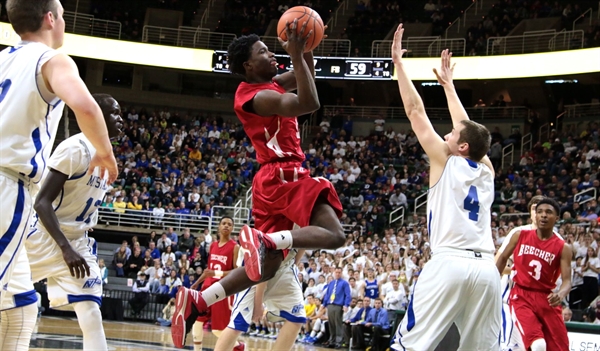
Bucs Take Place Among Beecher Greats
March 28, 2015
By Bill Khan
Special for Second Half
EAST LANSING — Flint Beecher's basketball players warmed up Saturday wearing red and white T-shirts proclaiming the 2015 Buccaneers as Genesee Area Conference Red Division champions.
It was certainly an understated look for a team with much loftier goals than league titles.
The expectation for young basketball players growing up in the Beecher community the past 40 years has been MHSAA Finals championships — and nothing less.
This year's players added their names to the list of greats who have gone before them by beating Grand Rapids NorthPointe Christian, 78-52, in the MHSAA Class C title game at the Breslin Center.
It was Beecher's third championship in the last four years and sixth overall. The Buccaneers have played in 10 Finals and 16 Semifinals over the last 40 years.
There were some down years as well. But all any of the current players can remember are Beecher teams that have been legitimate threats to win it all.
"We don't think about losing," Beecher coach Mike Williams said. "We prepare to win. We don't prepare to lose. We set a standard that we want to win championships. It's important that the kids learn how to set goals and how to work toward them. That's one thing they get from me is that discipline, that structure that in life there's going to be competition, no matter what you do or where you go. You need to learn how to prepare.
“The other thing is you have to have an edge and you have to have a chip on your shoulder. We don't want to be just an average team; we want to be the best."
There was no doubt Beecher was the best team in Class C this season.
The Buccaneers (26-1) won their eight postseason games by an average margin of 31.4 points, with the closest game an 18-point decision over Southfield Christian in the Regional Final.
Not even a team good enough to play on the final day of the season could pose a serious threat to this Buccaneers squad. Beecher scored the first eight points of the game and led by 23 early in the second quarter.
"You know, they're a great team," NorthPointe coach Jared Redell said. "They've been the gold standard of Class C basketball for a long time. ... Obviously, Flint Beecher's been here a ton. They know what to expect. All those kids growing up, when they're in middle school watching the high school kids win state championships and coming to the Breslin Center all the time, that has a big part in terms of the culture of the school."
This would have been Beecher's sixth straight trip to the Breslin Center if not for a devastating loss to Pewamo-Westphalia in last year's Quarterfinals. The Buccaneers led by four points with less than 15 seconds to go, but lost 42-41.
It was a painful memory that drove the Buccaneers all season.
"Last year we learned we can't take anything for granted," said senior Samuel Toins, who was 5 for 10 from 3-point range while scoring 17 points. "Every day in practice, we went hard and didn't goof around. I just wanted to lead my team and leave my legacy with this program."
Junior Aquavius Burks is the only Buccaneer who played in the nail-biter championship game Beecher won 40-39 against Laingsburg two years ago, scoring nine points in 21 minutes in that game. Backup Mike Herd was on the varsity that season.
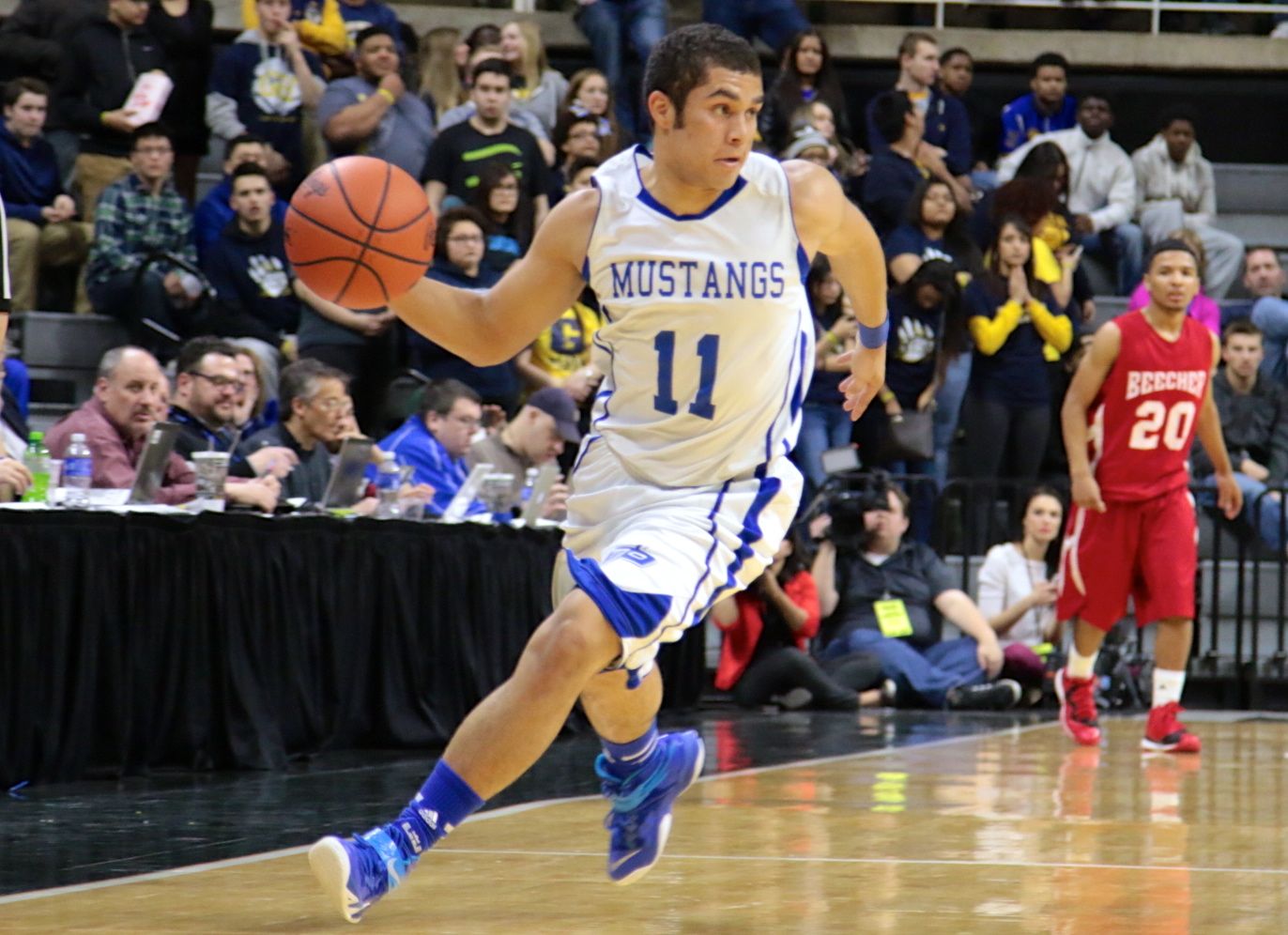 Burks was one of four Buccaneers in double figures on Saturday, scoring 15 points to go with 11 rebounds, five assists, three steals and two blocks.
"I feel relieved it's over with and we won," Burks said.
Other than Burks, it was an entirely different cast. The 2012 and 2013 championship teams were led by Monte Morris, the 2013 Mr. Basketball who is having a successful career at Iowa State. Morris, whose Cyclones were upset in the first round of the NCAA tournament, was in the stands cheering on his alma mater Saturday.
"That's like their big brother," Williams said. "We knew he was coming home. He was at practice yesterday. Monte was calling, keeping up with us the whole way."
There would be no repeat of 2013, when Beecher had to hold on for dear life to turn aside an upset bid by Laingsburg.
The Buccaneers were up 8-0 with 5:52 left in the first quarter and build leads of 25-5 and 28-8 during that opening period. A 3-pointer by Malik Ellison with 6:48 left in the second quarter made it 33-10 before the Mustangs (21-6) were able to settle down and play on relatively even terms the rest of the game.
"I felt like if we got out to a good start that we could play with them, and it was the start that killed us," Redell said. "We were down 20 at the end of the first quarter. Part of it was, obviously, them and their pressure. The other part was we're not beating them shooting 30 percent from the floor. We had to come out and make shots in order to be right there with them."
Beecher's trademark pressure defense led to an 18-6 advantage in points off of turnovers for the Buccaneers.
"We wanted to throw the first punch," Williams said. "We wanted to get out and pressure them."
NorthPointe got within 33-17 midway through the second quarter, but Beecher responded with a 12-2 run. Beecher shot 52.9 percent in the first half on its way to a 45-21 lead at the break.
The lead reached 52-26 with 5:04 left in the third quarter. The closest NorthPointe got after that was 18 points.
All-stater Cedric Moten shot 11 for 13 from the floor while scoring a game-high 24 points.
"I just came out and tried to do my best to help my team win," Moten said. "That's basically it. Whatever it took to get the win was what I was going to do. The shots were going in."
Ellison, a sophomore who took over for Morris last year as the starting point guard, had 10 points. Levane Blake grabbed 10 rebounds.
Kual Nhial had 16 points and 10 rebounds (eight offensive), Tyler Baker 14 points and Preston Huckaby 10 points for NorthPointe.
Click for the full box score and video from the postgame press conference.
PHOTOS: (Top) Beecher's Mike Herd drives for a shot during Saturday's Class C Final. (Middle) NorthPointe's Preston Huckaby looks for an opening.
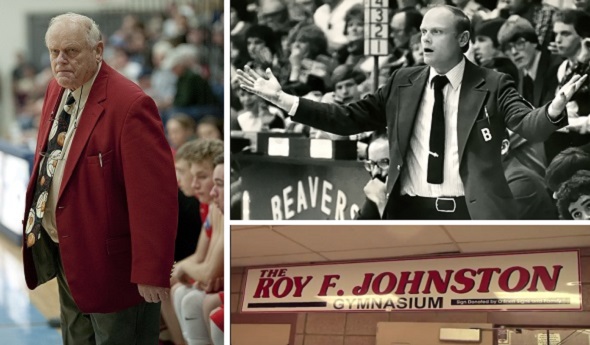
Beaverton Legend Nearing Wins Record
By
Paul Costanzo
Special for MHSAA.com
January 18, 2017
 Roy Johnston is three wins from tying and four from breaking the all-time wins record for boys basketball in Michigan.
But the longtime Beaverton coach isn’t interested in reflecting, at least not yet. That’s just not his style.
“During the season, you just concentrate on – at least I do – the games you’ve got coming up for the week,” Johnston said. “When you start reflecting on things, you’re not doing justice to what’s on hand.”
Johnston, who took over the Beaverton program in 1974 after short stints in Yale and Howell, has a career record of 725-301. Longtime River Rouge coach Lofton Greene holds the record for wins in the state at 728.
“There’s so much pride in our community,” said Shad Woodruff, Beaverton’s junior varsity boys coach and a former player of Johnston’s. “Beaverton basketball brings our community together. Beaverton basketball and Roy’s program brings our small-town community together. It’s a big feather in our cap, and we’re proud to have Roy and what he means – we understand that not every place has something like that.
“To really validate it with the all-time wins record, and be able to say our school has that – you can’t beat that.”
Building a program
Johnston graduated from Croswell-Lexington High School. He attended Adrian College for a semester, playing on the basketball team, before transferring to Eastern Michigan University. While there, he got his nose wet in coaching by helping in Ypsilanti.
He earned his first coaching win during the 1966-67 season at Yale. He was 13-24 with a District title in his two years at the St. Clair County school before he moved to Howell, going 5-28 in two seasons there.
After meeting with the Beaverton High School principal at a deer hunting cabin, he was on the move again – this time to the place he would make his home.
Johnston – who had been teaching high school classes – took a job as a fifth-grade teacher and JV coach in the fall of 1970. He took over the varsity program in 1974 and started winning immediately, going 16-8, 23-2, 18-3 and 22-2 in his first four seasons with three District titles, three conference titles and a Regional title during that stretch.
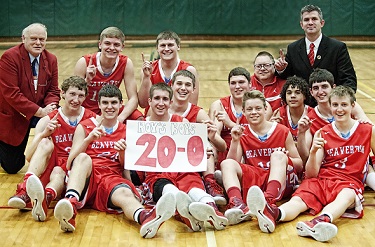 “Most of it was just discipline,” Johnston said. “I had to make sure the ballplayers got on the same page and that everybody had one common goal. So it was just a matter of making sure kids were disciplined, played with each other and did what you practiced.”
Eventually, players who entered the program knew what to expect and what was expected of them before they stepped foot on Johnston’s court.
“That takes a long time to create that environment,” Woodruff said. “He’s been there for 45 years, so it doesn’t happen overnight. But it does start to coach itself. When kids walk through the door knowing, ‘I have to bust my tail,’ part of that job is already accomplished for you. That’s what a program is. It’s no different than Alabama football.”
In his 42 seasons at Beaverton, the Beavers have won 20 conference titles, 15 District titles and five Regional titles. The team made a run to the Class C Semifinals in 1984.
More impressive, however, is the consistency. In his 42 seasons at Beaverton, Johnston has had just five losing seasons, and one of those still featured 10 wins.
“It has been stable,” longtime Beaverton public address announcer Scott Govitz said. “He is just a guy that is very disciplined in what he does and his coaching. It’s all about doing things right and repetitiveness. He doesn’t run dozens of offenses. He’s a stickler for defense. He just instills in every player that they’re going to have to work hard.”
Community gatherings
Don’t mistake discipline for not having fun, however. Beaverton basketball games are an event.
“(Games are) a community gathering, especially on Fridays,” Govitz said. “You can see as many as 10 kids clamoring to be water boy, hear the pep band with a director that’s been around 30 years and after each game, the floor fills with community members having conversations while dozens of kids race to one end to shoot baskets before the call comes to put the balls away. It’s just a real tradition.”
Beaverton’s student section, the Bleacher Creatures, won the MHSAA’s Battle of the Fans contest in 2014.
The team gets into it, as well, as pregame introductions include the Beaver Shuffle and the Beaver Slide (see video below). The final player introduced makes a run through the student section and slides from about halfcourt into his teammates waiting near the bench.
Even Johnston has his own very visible tradition, wearing a red blazer for every game.
The fun offers a bit of a window into who the coach really is.
“Roy is a disciplinarian, and he’s demanding,” Woodruff said. “But I’ve said this for years, if you think you know Roy Johnston by sitting across the gym and watching him coach, you might have a different perception. If that’s all you know Roy from, you don’t know Roy.
“He loves his kids. He expects a lot of us, but he loves his kids and he loves his community.”
Beaverton may not be Johnston’s hometown, but it certainly has become his home.
“I think that we have been very fortunate in Beaverton,” Johnston said. “We have had great teachers, we’ve had great administrators, and for the most part, we have had very good board members. I look at other places that go through a lot of turmoil, and we’ve been very fortunate.”
Johnston’s family has also been part of the tradition, including his wife Judy, who has served as his statistician. Two of his sons, and his three grandsons who grew up the district, have played for him. His daughter Jennifer (Northern Michigan) and son Jeff (Michigan Tech) each went on to play college basketball.
“I’ve had three grandsons live in the district, and I’ve had all three of them,” Johnston said. “Not too many guys have had that pleasure that I’ve had. It’s always been special, all along. I’m very lucky and very fortunate to have had the opportunity to coach those three.”
Spanning generations
The youngest of the grandsons, Carter, is at the center of this year’s squad which is 7-1 and sure to push Grandpa over the all-time wins mark.
It’s this latest group, which has included grandsons Carter, Spencer and Grant, that has accelerated Johnston’s chase for the record.
Since the 2012-13 season, Beaverton is 94-10, giving Johnston his winningest stretch near the end of his storied career.
“He has had multiple generations that he’s coached, and he does a lot of the same things with the kids,” Beaverton athletic director Ryan Roberts said. “He’s really good with the kids, getting them involved. I have an 8-year-old boy who sits at the end of the bench, along with about a half dozen others.
“All of the kids and most of the people in the town here have the utmost respect for him, know what he’s doing and how he is.”
For Johnston, reaching out to multiple generations of high school athletes isn’t as complicated as some make it seem.
“They are different, but high school kids and kids at that age are going through the same things we all went through at that age,” Johnston said. “Yeah, they’ve got cell phones that we never had, but they’re still going through the transition of being a little kid and becoming an adult. It’s something that we’ve all gone through.
“If you were out of coaching and came back, I think you would see a difference. Whereas I haven’t been, so you kind of grow with it. Kids are kids, always have been.”
Whenever the record is broken, several generations of Beaverton players and fans will be on hand to watch it. The Beavers play their next three games on the road before settling in for four straight home games Feb. 1 through Feb. 10.
Johnston is trying not to focus on it, but even he admits breaking the record will be special.
“You have to be concerned about your players and how to get them ready for the next game,” Johnston said. “My JV coach is the one who worries about most of this stuff, more than I do. It’s just another step.
“It’s more than that, let’s face it. But it’s another step.”
Others have no problem admitting that it’s much more than that. Woodruff became emotional thinking about the moment and all that Johnston has meant to him throughout the years.
Govitz said the community is already starting to fill with anticipation of the milestone victory.
“We’re a small community, and in small communities you have to rally around whatever successes you have,” Govitz said. “In this community, there’s a huge love for our school system, and this is something that really shines a positive light on our school system. It’s a point of pride.
“I’m already seeing more people in the stands. There’s a buzz in the community. There’s a buzz in the other communities that surround us. There’s a lot of communities that can point to state championships on their signs. This is one of those markers for us that will be around a long time.”
 Paul Costanzo served as a sportswriter at The Port Huron Times Herald from 2006-15, including three years as lead sportswriter, and prior to that as sports editor at the Hillsdale Daily News from 2005-06. He can be reached at [email protected] with story ideas for Genesee, Lapeer, St. Clair, Sanilac, Huron, Tuscola, Saginaw, Bay, Arenac, Midland and Gladwin counties.
PHOTOS: (Top) Beaverton coach Roy Johnston, at right in 1984 and left more recently. The gymnasium at his schools bears his name. (Middle) Johnston, far left, celebrates an undefeated regular season with his 2014-15 team. (Photos courtesy of Stephanie Johnston.)