

Calvin Christian Follows Hot Hand in C
March 24, 2016
By Geoff Kimmerly
Second Half editor
EAST LANSING – Grandville Calvin Christian’s success is built on team basketball, feeding the hottest hands at opportune times.
 Smoke might have been rising off Tony DeWitte’s fingers during the first half of Thursday’s Class C Semifinal against McBain at the Breslin Center.
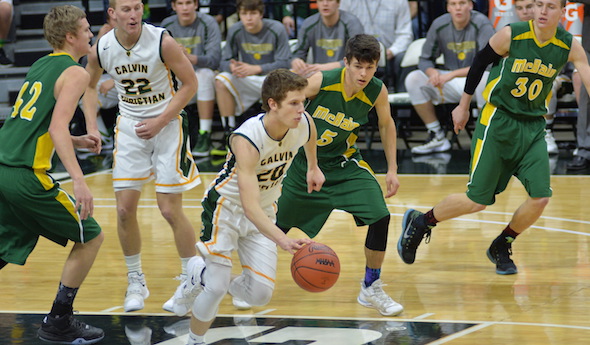
The 6-foot-2 senior guard made 10 of 11 shots during the first half for 26 points, and Calvin Christian opened up a lead that stayed in double digits for good over the final 20 minutes to advance to Saturday’s championship game with a 65-42 win.
DeWitte finished with 31 points on 12 of 15 shooting, grabbed eight rebounds, and had both of his assists late as the game crept out of reach for the previously-undefeated Ramblers.
“I came out shooting with confidence. The ball was going in, and my teammates found me, got me open,” DeWitte said. “The rim feels two times bigger like that. The ball keeps going in, and it’s great.”
Allow Calvin Christian coach Ryan Stevens to elaborate.
“When he gets hot like that, his teammates know that,” Stevens added. “We have a lot of kids who can do that. They find each other when they are hot, and the thing about Tony is he can score so many different ways. You’ll see him score inside, outside, off the dribble, off the pass, off a screen, off a back cut. He’s just a very good scorer all-around, very hard to defend.”
Calvin Christian (21-4), unranked at the start of the postseason, will face reigning champion Flint Beecher at 4:30 p.m. Saturday. The Squires will be playing for their first championship since 1994 after reaching the Semifinals for the first time since that season.
DeWitte entered this week as his team’s leading scorer at 18.2 points per game, and Stevens said his standout shooter’s Thursday performance wasn’t rare – he and DeWitte’s teammates have been witness to that kind of scoring outburst going back to when his seniors were finishing up elementary school.
But it certainly seemed to knock McBain a bit off its game, as the No. 3 Ramblers never warmed up offensively and gave up more than 60 points for the first time since giving up that exact number in the season opener.
 “We tried some different things. They hit everything,” McBain coach Bruce Koopman said. “They executed extremely well, and that gave them excellent opportunities to get back and play defense on us. I thought there was a time when (the deficit) was 10, and we got three or four stops in a row. But we didn’t capitalize. Maybe if we’d gotten a few of those to close the gap, it would’ve been different.”
Senior guard Braden Stevens added 10 points and seven assists for Calvin Christian, which made an incredible 60 percent of its shots from the floor after opening with a blistering 70-percent success rate during the first half.
Junior guard Logan Eling had 18 points to lead McBain (26-1), while junior center Craig Sterk had nine points and eight rebounds and senior guard Cole Powell added nine points and six rebounds.
Calvin Christian (21-4) was prepared for elite competition after facing a league schedule that included two matchups with reigning Class B champion Wyoming Godwin Heights and two more against last season’s Class C runner-up, Grand Rapids NorthPointe Christian. The Squires lost all four of those games, but came back to beat NorthPointe in the District Final.
“We always talk about ladders, and at the beginning of the season it felt like we were midway up the ladder,” Stevens said. “A lot of teams get there when the tournament starts, but it felt like we were already up there midway through the season.
“We had a couple of losses to Godwin and NorthPointe, and we weren’t satisfied with our record. (So) we wanted to work toward the end of the season.”
The Boys Basketball Finals are presented by Sparrow Health System.
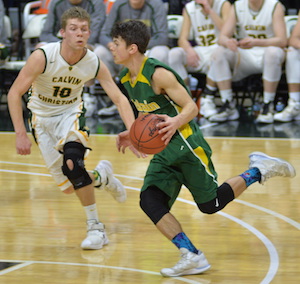
PHOTOS: Calvin Christian’s Tony DeWitte (20) pushes the ball upcourt during Thursday’s first Class C Semifinal. (Middle) The Squires’ Braden Stevens (10) works to stay in front of McBain’s Logan Eling.
Breslin Bound: Boys Report Week 1
December 16, 2019
By Geoff Kimmerly
Second Half editor
This boys basketball season needed just a few hours of opening night to satisfy the anticipation that’s been building since last season’s MHSAA Finals finished a little more than eight months ago.
 We’ll bank on that first week as an indication of what’s to come.
Below is our first “Breslin Bound” report of the boys season, powered by MI Student Aid and based on results and schedules posted for each school at MHSAA.com. Those results have become much more vital this winter – for the first time, there will be limited seeding of the top two teams at the District level based on their Michigan Power Rating (MPR). Check out how every team in the state ranks, and send corrections or missing scores to [email protected].
Week in Review
The countdown of last week’s five most intriguing results:
1. River Rouge 63, Ypsilanti Lincoln 53 – This high-profile matchup started the week and season, as reigning Division 2 runner-up Rouge handed reigning Division 1 champion Lincoln an opening defeat at Eastern Michigan University’s Convocation Center.
2. Grand Blanc 80, Detroit Douglass 77 – This Horatio Williams Showcase headliner featured one of the state’s best sophomores and juniors and two teams that should be making pushes in March in Divisions 1 and 2, respectively.
3. Saginaw 88, Saginaw Arthur Hill 76 – After scoring 101 points in its opener, Saginaw put up another big number in its first matchup of the season with the rival Lumberjacks.
4. Ferndale 66, Flint Beecher 55 – The Eagles also posted an impressive win at the Horatio Williams event, getting past a Beecher team looking toward contending in Division 3 again after making the Quarterfinals last season.
5. Ypsilanti Arbor Prep 48, Detroit U-D Jesuit 47 – Division 3 Arbor Prep started its season with a one-point win over the reigning Division 1 runner-up.
Watch List
With an eye toward March, here are two teams in each division making sparks:
DIVISION 1
Ann Arbor Huron (2-0) Last season’s 13-8 record was a bit deceptive; two losses were one-pointers and its District defeat came in overtime. The River Rats are starting out on the positive end of those close games this winter, with their first win 53-50 over returning Division 3 semifinalist Detroit Edison.
Marquette (2-0) For the second straight season, Marquette opened with wins over Brighton and Petoskey – this time by eight and three points, respectively. Last season, that start turned into a 19-4 finish with league and District championships.
DIVISION 2
Detroit Communication Media Arts (2-0) CMA improved five wins from 2017-18 last winter to get to 11-10, and may be on its way toward taking another step. The Pharaohs opened with a 74-48 win over Pershing to avenge last season’s one-point loss to the Doughboys, then got past Farmington in overtime 70-68 after Farmington had opened with an impressive win over Wayne Memorial.
Imlay City (3-0) The Spartans are coming off two straight sub-.500 seasons but did improve two wins last winter to 10-12. The Harry Moore Tournament at Capac gave them an opportunity for three wins during the first week, and Imlay City capitalized by defeating Deckerville in the championship game.
DIVISION 3
Burton Bendle (2-0) The Tigers are halfway to equaling last season’s 4-17 success thanks to double-digit wins over Flint Southwestern and Flint New Standard Academy. The 84-74 win over Southwestern avenged last season’s one and 11-point losses to the Jaguars.
Farwell (2-0) The Eagles haven’t won more than five games in a season since 2013-14, and tied that high of five last winter. But they are 2-0 for the first time in at least a decade, opening with a 65-64 win over Remus Chippewa Hills after losing to the Warriors by 17 a year ago.
DIVISION 4
Mayville (2-0) The Wildcats over the last six seasons have gradually climbed, progressing to an 8-14 finish a year ago. Last week gave them their best start in at least a decade, as Mayville stacked double-digit wins over Akron-Fairgrove and Caseville.
Three Oaks River Valley (3-0) The Mustangs doubled their success last season from 2017-18, going from 6-15 to 13-9 and despite a 1-3 start. River Valley opened last week with double-digit wins over Decatur and White Pigeon and then avenged a pair of losses from last season to Marcellus Howardsville Christian.
Can't-Miss Contests
Be on the lookout for results of these games coming up:
Tuesday – Sanford Meridian (1-1) at Beaverton (2-0) – Three wins over Beaverton last season played significant parts in Meridian winning the Jack Pine Conference title and reaching the Division 3 Quarterfinals.
Tuesday – Grand Rapids Catholic Central (1-0) at Grand Rapids Christian (2-0) – GRCC won the regular-season and District matchups between these two last season, the latter on the way to a Division 2 Regional Final.
Thursday – Pittsford (1-1) at Bellevue (1-0) – These two both won divisions of the Southern Central Athletic Association last season; Bellevue won their regular-season meeting and the rematch in the Division 4 Regional Final.
Friday – Kalamazoo Central (1-0) at Benton Harbor (2-0) – These annual southwestern powers are meeting for the first time since the 2014-15 season.
Saturday – Detroit U-D Jesuit (1-1) at Detroit Edison (1-1) – As noted above, both ended last season at Breslin Center, Jesuit in the Division 1 Final and Edison in the Division 3 Semifinals.
Second Half’s weekly “Breslin Bound” reports are powered by MI Student Aid, a part of the Office of Postsecondary Financial Planning located within the Michigan Department of Treasury. MI Student Aid encourages students to pursue postsecondary education by providing access to student financial resources and information. MI Student Aid administers the state’s 529 college savings programs (MET/MESP), as well as scholarship and grant programs that help make college Accessible, Affordable and Attainable for you. Connect with MI Student Aid at www.michigan.gov/mistudentaid and find more information on Facebook and Twitter @mistudentaid.
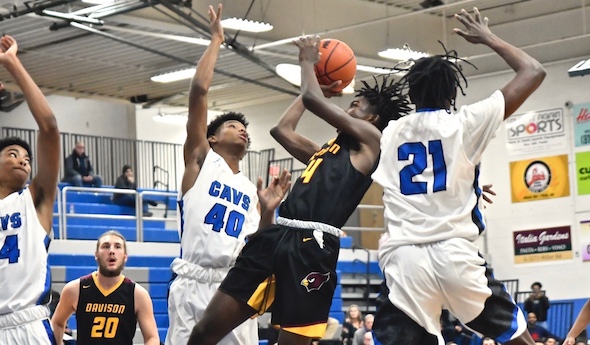
PHOTO: Flint Carman-Ainsworth opened the season last week with an 81-45 win over Davison. (Photo by Terry Lyons.)