

Calvin Christian Follows Hot Hand in C
March 24, 2016
By Geoff Kimmerly
Second Half editor
EAST LANSING – Grandville Calvin Christian’s success is built on team basketball, feeding the hottest hands at opportune times.
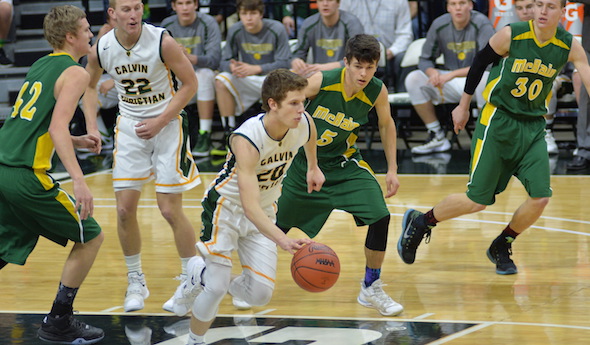
 Smoke might have been rising off Tony DeWitte’s fingers during the first half of Thursday’s Class C Semifinal against McBain at the Breslin Center.
The 6-foot-2 senior guard made 10 of 11 shots during the first half for 26 points, and Calvin Christian opened up a lead that stayed in double digits for good over the final 20 minutes to advance to Saturday’s championship game with a 65-42 win.
DeWitte finished with 31 points on 12 of 15 shooting, grabbed eight rebounds, and had both of his assists late as the game crept out of reach for the previously-undefeated Ramblers.
“I came out shooting with confidence. The ball was going in, and my teammates found me, got me open,” DeWitte said. “The rim feels two times bigger like that. The ball keeps going in, and it’s great.”
Allow Calvin Christian coach Ryan Stevens to elaborate.
“When he gets hot like that, his teammates know that,” Stevens added. “We have a lot of kids who can do that. They find each other when they are hot, and the thing about Tony is he can score so many different ways. You’ll see him score inside, outside, off the dribble, off the pass, off a screen, off a back cut. He’s just a very good scorer all-around, very hard to defend.”
Calvin Christian (21-4), unranked at the start of the postseason, will face reigning champion Flint Beecher at 4:30 p.m. Saturday. The Squires will be playing for their first championship since 1994 after reaching the Semifinals for the first time since that season.
DeWitte entered this week as his team’s leading scorer at 18.2 points per game, and Stevens said his standout shooter’s Thursday performance wasn’t rare – he and DeWitte’s teammates have been witness to that kind of scoring outburst going back to when his seniors were finishing up elementary school.
But it certainly seemed to knock McBain a bit off its game, as the No. 3 Ramblers never warmed up offensively and gave up more than 60 points for the first time since giving up that exact number in the season opener.
 “We tried some different things. They hit everything,” McBain coach Bruce Koopman said. “They executed extremely well, and that gave them excellent opportunities to get back and play defense on us. I thought there was a time when (the deficit) was 10, and we got three or four stops in a row. But we didn’t capitalize. Maybe if we’d gotten a few of those to close the gap, it would’ve been different.”
Senior guard Braden Stevens added 10 points and seven assists for Calvin Christian, which made an incredible 60 percent of its shots from the floor after opening with a blistering 70-percent success rate during the first half.
Junior guard Logan Eling had 18 points to lead McBain (26-1), while junior center Craig Sterk had nine points and eight rebounds and senior guard Cole Powell added nine points and six rebounds.
Calvin Christian (21-4) was prepared for elite competition after facing a league schedule that included two matchups with reigning Class B champion Wyoming Godwin Heights and two more against last season’s Class C runner-up, Grand Rapids NorthPointe Christian. The Squires lost all four of those games, but came back to beat NorthPointe in the District Final.
“We always talk about ladders, and at the beginning of the season it felt like we were midway up the ladder,” Stevens said. “A lot of teams get there when the tournament starts, but it felt like we were already up there midway through the season.
“We had a couple of losses to Godwin and NorthPointe, and we weren’t satisfied with our record. (So) we wanted to work toward the end of the season.”
The Boys Basketball Finals are presented by Sparrow Health System.
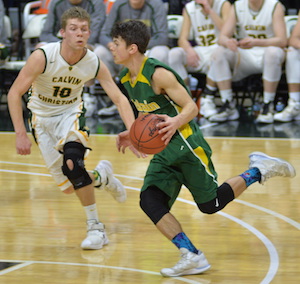
PHOTOS: Calvin Christian’s Tony DeWitte (20) pushes the ball upcourt during Thursday’s first Class C Semifinal. (Middle) The Squires’ Braden Stevens (10) works to stay in front of McBain’s Logan Eling.
Breslin Bound: Boys Report Week 8
January 28, 2013
By Geoff Kimmerly
Second Half editor
Eight weeks of success is enough to expect that any team still undefeated – like our top team among last week's high performers – should keep making noise over the month and a half to come.
But there's something to be said about starting anew on Jan. 1. And we've got a few on this week's list as well that have surged since the calendar year got a new start.
Remember, results and overall records below are those listed in our MHSAA Score Center. Are either incorrect? Please help us out after filling in this brief registration.
1. Big Rapids (11-0) – The Cardinals have won 20 straight regular-season games dating back to the mid-point of last winter and lead the Central State Activities Association.
2. Rochester Adams (10-1) – The Highlanders’ lone loss came against Oxford all the way back on Dec. 14; they’ve won four straight by double figures and are just two wins from equaling last season’s total.
3. Zeeland East (10-2) – The Chix are in first place by a win over two others in the O-K Black and have won four straight including beating league favorite Muskegon 67-61 on Friday.
4. Allen Park Inter-City Baptist (10-2) – Before Saturday’s 14-point loss to Detroit Country Day, the Chargers had won three straight and earlier this month edged reigning Class D champion Southfield Christian by a point.
5. Lansing Waverly (9-2) – The Warriors opened this season with losses to Holt and Jackson Lumen Christi by a combined five points, but since have won nine straight including avenging that loss to the Titans on Friday.
6. Bessemer (10-1) – The Speedboys are undefeated in-state, with their only loss to Washburn, Wis., after winning 10 games total last season.
7. Crystal Falls Forest Park (6-3) – The Trojans opened this winter with two losses, but are on a roll and edged 2012 Class D Semifinalist Carney-Nadeau on Friday, 70-67.
8. Pittsford (9-2) – The Wildcats hit a rough patch from Jan. 11-15, when they lost two games; otherwise, they’re undefeated this season.
9. Temperance Bedford (8-1) – Despite losing to Sylvania Southview of Ohio on Saturday, the Kicking Mules opened with eight straight wins and beat Ann Arbor Pioneer 56-54 the night before.
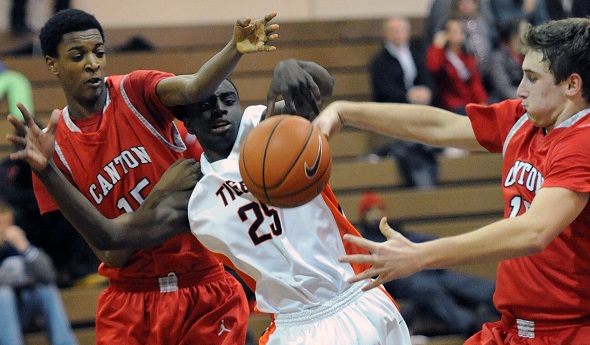
10. Canton (7-5) – The Chiefs also are running well in January with five straight wins including Friday’s 55-50 victory over Westland John Glenn which avenged their last lost before the run, 53-48 to John Glenn on Jan. 4.
PHOTO: Canton players (in red) try to gather a loose ball during a game against Cincinnati Withrow on Dec. 28 at Detroit County Day. (Click to see more at HighSchoolSportsScene.com.)