

Changing of the Capital Guard
August 16, 2012
By Geoff Kimmerly
Second Half editor
Who would I pick to coach a Lansing area boys basketball Dream Team? Sportswriters get a lot of questions like that, from radio hosts or fans, or roommates who grew up nearby.
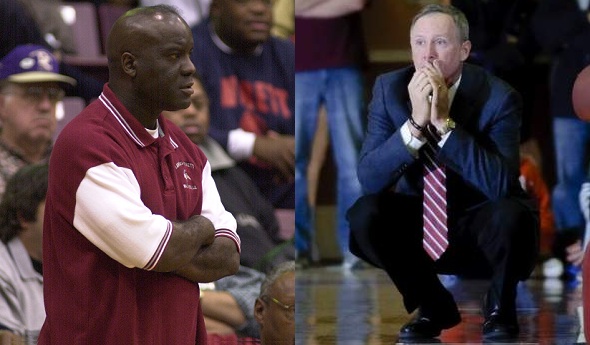
To not offend the other coaching friends I’d made in my decade-plus in Lansing, I kept that answer within the roommate circle for a long time – until I decided Okemos' Dan Stolz and Lansing Everett's Johnny Jones were so incredible their colleagues would understand my choice.
 I could’ve never picked between them. Their styles different, the results were the same. Both had stars over their decades, but I also saw both do more with less and in ways that regularly went unmatched during the 13 years I was a twice-weekly watcher of high school hoops for the Lansing State Journal.
It’s only a coincidence that both decided to retire from coaching during this same summer. But it’s certainly a double loss for mid-Michigan specifically and the statewide basketball community as a whole.
So why were these guys my Dream Team combo?
- Of course, they won a lot.
According to a report from local HOMTV, Stolz finished with a record of 428-99 at Williamston and then Okemos, where he took over for his father Stan in 1994-95. That win total is only eight more than Dad's, giving the family 828 wins over roughly four decades.
Tracking down Jones’ record wasn’t as easy. But based on the paper trail I’ve been running since I got my start in Lansing, he had 334 wins after the 2003-04 season, which likely means he too finished right around 400 – with a few hundred more leading the Vikings girls.
And they were the kind of standout high school players too whose stories had become legend – Jones for Battle Creek Central once taking down a top-ranked team by himself, while it was said Stolz could still dunk into his 40s after playing for his dad and the Chieftains back in his day.
- They won at the highest levels.
Jones is one of only a handful who has won MHSAA championships with both girls and boys teams – his girls teams won Class A in 2000 and 2001 and his boys won Class A in 2004. Everett’s girls program, by the way, was near-winless just a few years before Jones took over and led it to its first run to a Final in 1999.
Stolz never got his MHSAA title, his Chieftains falling to Saginaw Arthur Hill 85-84 in the 2006 Class A Final – the only MHSAA boys title game ever to go two extra periods. But against what many locals considered long odds, Stolz led Okemos from the cozy Class B-dominated Capital Circuit into the highest division of the Capital Area Activities Conference, where the Chieftains continued to win against the likes of Everett, Lansing Sexton, Lansing Eastern, Holt, Grand Ledge, East Lansing and Jackson in what is arguably the toughest league in the state.
Another interesting “by the way:” Stolz did lead Okemos’ softball (1999) and girls tennis teams (1993) to MHSAA championships.
- They won by doing the things others weren’t.
Jones’ girls teams were loaded with talent – a number of players went on to major college programs – but they were unstoppable because of a fullcourt press that handcuffed opponents and set a trend that others like Lansing Waverly and East Lansing also used to win Class A titles. Jones' best boys teams had an all-state post combo of Derick Nelson and Goran Suton, but still had to contend with Grand Ledge’s Al Horford (now of the Atlanta Hawks) two and three times a season.
And, it must be noted that Jones was one of fewer than 20 coaches who continued coaching both the boys and girls teams even after the girls season was moved from fall to winter for 2007-08.
Stolz similarly had his share of good players – Johnathon Jones maybe the best of all. But again, playing in a league with a number of other similarly-talented players (and in the postseason against Orchard Lake St. Mary’s Kalin Lucas and others), Stolz was unmatched in Greater Lansing when it came to gameday strategy. His teams always had a plan, and frequently made it work when the odds seemed stacked against -- which made apparent upsets hardly surprises at all.
Stolz has been replaced by Jeff Wonch, who led Bath to the MHSAA Class C title in 2007. He most recently coached at Potterville. Jones' replacement is former Everett star Desmond Ferguson, who played briefly in the NBA with the Portland Trail Blazers and was a volunteer assistant for the Vikings last season.

Edison Hangs On, Moves On to 1st Final
March 22, 2018
By Geoff Kimmerly
Second Half editor
EAST LANSING – Detroit Edison saw its 16-point lead disappear by the middle of the fourth quarter of Thursday’s Class C Semifinal against Grand Rapids Covenant Christian.
The Pioneers weren’t worried.
“I wasn’t really concerned at all,” Edison senior guard Pierre Mitchell, Jr., said. “We’ve been through this the whole season. We play in the PSL. It’s a whole bunch of tough battles every Tuesday and Friday.
In fact, the Pioneers won the Detroit Public School League tournament this season. And that experience no doubt helped them earn the chance to play for their first MHSAA boys basketball championship.
Edison broke away over the final four minutes Thursday for a 55-43 win, launching a 14-1 game-ending run after the Chargers had come all the way back from the earlier double-digit deficit.
“I have seniors here, and these guys do a pretty good job of keeping guys focused on what we need to do and when we need to do it,” Edison coach Brandon Neely said. “I had confidence these guys were going to rise to the occasion.
“We were going to just maintain composure. We’ve been in a lot of tough battles this year, but we’re battle-tested. We’ve had teams come back on us before. We’ve lost some games that way. We’ve lost a game just about any way you could imagine. … (but) we always competed.”
Edison (16-10) will face Maple City Glen Lake in Saturday’s 4:30 p.m. championship game.
The Pioneers have won 10 of their last 11 games, which means they started 6-9 – and they finished fourth in their PSL division, which also included two Class A, a Class B and another Class C school.
But lessons learned from those defeats helped Edison weather Covenant Christian’s comeback and the momentum shift that could’ve come with it.
 The Pioneers moved on with senior center Deante Johnson playing only 20 minutes because of foul trouble. They held on despite hitting only 35 percent of their shots for the game.
Instead of folding during Covenant’s comeback, Edison got help in the post from senior guard Gary Solomon, who finished with team highs of 15 points and 10 rebounds. And they climbed out of their cold shooting to make 5 of 11 tries from the perimeter during the fourth quarter, including 4 of 5 during the run to close out the game. Johnson came back to score the first five points of that final stretch.
“I work on (shooting) every day, and I had to come up big for my team,” Johnson said. “I was in foul trouble all throughout the game. I wasn’t the presence in the middle that I’d usually be. So I had to make it up somehow, some way in the fourth quarter for my team.”
As a team, Covenant Christian (22-5) shot a nearly identical 35 percent to the Pioneers, but made 9 of 13 attempts to knock down the 16-point deficit over the first 12 minutes of the second half.
But as the Pioneers closed on a roll, the Chargers finished making just 1 of 6 shots and turning the ball over twice.
“We knew we had to shoot it well today, and we didn’t in the first half and I thought that cost us,” Covenant Christian coach Tyler Schimmel said. “In the second half, we started playing Charger basketball.
“We changed a few things defensively (at halftime), but not many. For some reason, we were timid early on. We thought we were just as good as Edison, and they’re a good team. The shots just didn’t fall for us.”
Senior forward Carson Meulenberg led Covenant Christian with 12 points and 12 rebounds, and senior forward Trenton Koole also scored 12 points.
Mitchell added 13 points for Edison, and senior guard Keith Johnson was key off the bench with 10 points on 4 of 8 shooting over 14 minutes.
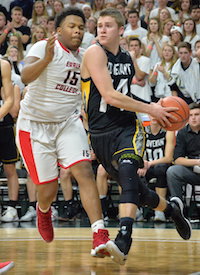
PHOTOS: (Top) Detroit Edison’s Keith Johnson puts up a jumper during Thursday’s Class C Semifinal against Grand Rapids Covenant Christian. (Middle) The Chargers’ Nathan Minderhoud drives the baseline with Johnson defending.