

Changing of the Capital Guard
August 16, 2012
By Geoff Kimmerly
Second Half editor
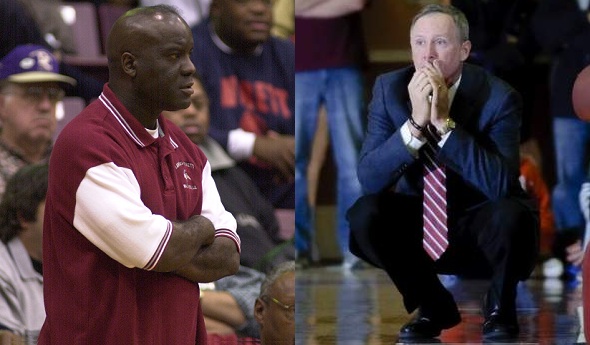
Who would I pick to coach a Lansing area boys basketball Dream Team? Sportswriters get a lot of questions like that, from radio hosts or fans, or roommates who grew up nearby.
To not offend the other coaching friends I’d made in my decade-plus in Lansing, I kept that answer within the roommate circle for a long time – until I decided Okemos' Dan Stolz and Lansing Everett's Johnny Jones were so incredible their colleagues would understand my choice.
 I could’ve never picked between them. Their styles different, the results were the same. Both had stars over their decades, but I also saw both do more with less and in ways that regularly went unmatched during the 13 years I was a twice-weekly watcher of high school hoops for the Lansing State Journal.
It’s only a coincidence that both decided to retire from coaching during this same summer. But it’s certainly a double loss for mid-Michigan specifically and the statewide basketball community as a whole.
So why were these guys my Dream Team combo?
- Of course, they won a lot.
According to a report from local HOMTV, Stolz finished with a record of 428-99 at Williamston and then Okemos, where he took over for his father Stan in 1994-95. That win total is only eight more than Dad's, giving the family 828 wins over roughly four decades.
Tracking down Jones’ record wasn’t as easy. But based on the paper trail I’ve been running since I got my start in Lansing, he had 334 wins after the 2003-04 season, which likely means he too finished right around 400 – with a few hundred more leading the Vikings girls.
And they were the kind of standout high school players too whose stories had become legend – Jones for Battle Creek Central once taking down a top-ranked team by himself, while it was said Stolz could still dunk into his 40s after playing for his dad and the Chieftains back in his day.
- They won at the highest levels.
Jones is one of only a handful who has won MHSAA championships with both girls and boys teams – his girls teams won Class A in 2000 and 2001 and his boys won Class A in 2004. Everett’s girls program, by the way, was near-winless just a few years before Jones took over and led it to its first run to a Final in 1999.
Stolz never got his MHSAA title, his Chieftains falling to Saginaw Arthur Hill 85-84 in the 2006 Class A Final – the only MHSAA boys title game ever to go two extra periods. But against what many locals considered long odds, Stolz led Okemos from the cozy Class B-dominated Capital Circuit into the highest division of the Capital Area Activities Conference, where the Chieftains continued to win against the likes of Everett, Lansing Sexton, Lansing Eastern, Holt, Grand Ledge, East Lansing and Jackson in what is arguably the toughest league in the state.
Another interesting “by the way:” Stolz did lead Okemos’ softball (1999) and girls tennis teams (1993) to MHSAA championships.
- They won by doing the things others weren’t.
Jones’ girls teams were loaded with talent – a number of players went on to major college programs – but they were unstoppable because of a fullcourt press that handcuffed opponents and set a trend that others like Lansing Waverly and East Lansing also used to win Class A titles. Jones' best boys teams had an all-state post combo of Derick Nelson and Goran Suton, but still had to contend with Grand Ledge’s Al Horford (now of the Atlanta Hawks) two and three times a season.
And, it must be noted that Jones was one of fewer than 20 coaches who continued coaching both the boys and girls teams even after the girls season was moved from fall to winter for 2007-08.
Stolz similarly had his share of good players – Johnathon Jones maybe the best of all. But again, playing in a league with a number of other similarly-talented players (and in the postseason against Orchard Lake St. Mary’s Kalin Lucas and others), Stolz was unmatched in Greater Lansing when it came to gameday strategy. His teams always had a plan, and frequently made it work when the odds seemed stacked against -- which made apparent upsets hardly surprises at all.
Stolz has been replaced by Jeff Wonch, who led Bath to the MHSAA Class C title in 2007. He most recently coached at Potterville. Jones' replacement is former Everett star Desmond Ferguson, who played briefly in the NBA with the Portland Trail Blazers and was a volunteer assistant for the Vikings last season.
Hoopfest Returns This Weekend to Jenison
March 21, 2017
By Geoff Kimmerly
Second Half editor
March Magic Hoopfest will return to Jenison Field House for this weekend’s Michigan High School Athletic Association Boys Basketball Finals, marking the eighth championship weekend the event has run concurrent with the games being played at Michigan State University’s Breslin Center.
A number of favorite attractions will return including slam dunk (on lowered rims), 3-point shootout and half-court shot areas where fans can come at any time and participate, and the festivities also will include a court for timed “Around the World” shooting games and another court featuring the Michigan Army National Guard skills challenge. Also returning is the Walk of History, showcasing championship games, life-size photos and display boards from throughout the MHSAA Finals’ near century-long run.
Two Hoopfest center courts will host a number of games throughout the event, including the “JumpBall Jamboree” made up of teams of boys and girls in grades 3-8, and a series of games between Special Olympics Project UNIFY high school teams.
Admission to the March Magic Hoopfest is $2 per person, and fans attending the MHSAA Boys Basketball Semifinals and Finals will be admitted free with their game tickets. Hours on March 23 and 24 will be 2 p.m. to 7 p.m.; the event is open from 10 a.m. to 6 p.m. on March 25. Jenison Field House, site of Hoopfest, also was the site of the MHSAA Boys Basketball Finals for 31 years. To find out more general information about the event, visit the March Magic Hoopfest Website.
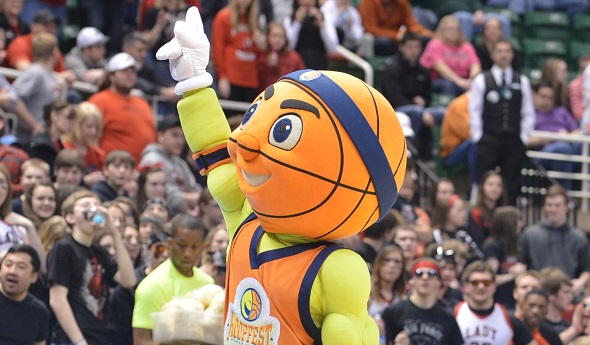
Hoopfest also will be home to Hoopie, the event’s mascot who made his first public appearances during the 2014 MHSAA Finals.
The March Magic Hoopfest is being conducted in partnership between the Greater Lansing Sports Authority (GLSA), a division of the Greater Lansing Convention and Visitors Bureau, and the MHSAA, with vital support coming from the Department of Intercollegiate Athletics at Michigan State University.
“For more than 90 years, basketball teams have ended their seasons at the MHSAA Tournament, and Hoopfest allows fans to share first-hand in the atmosphere that has made this such a historic event,” MHSAA Director of Brand Management Andy Frushour said. “It’s a great stop-over for our fans coming to or leaving the Breslin Center, and it’s also a great place to bring the family for some fun even for those who won’t be attending this weekend’s Finals.”
The Greater Lansing Sports Authority’s mission is to be the leading voice of sports tourism in the Greater Lansing area and to promote economic growth by attracting a diverse range of sporting events to the region. The GLSA strives to enhance the quality of life for area residents through the development of local sports and fitness programs for all ages and supports the continued development and maintenance of safe, high-quality athletic facilities.
“The March Magic Hoopfest sets off a great weekend of MHSAA tournament games and helps create a multi-day event which will involve the Lansing area and thousands of visitors from across the state,” said Mike Price, Executive Director of the Greater Lansing Sports Authority. “If you’re coming to the championships, Hoopfest is a destination to visit before and after the games; and if you’re not coming to the games, Hoopfest is a fun, wholesome, inexpensive, family activity.”
PHOTO: Hoopie entertains the crowd during the 2014 MHSAA Finals.