

Class D: Follow the Blue and Yellow Road
March 22, 2012
EAST LANSING – The blue and yellow brick road was paved with character and hard work.
So read T-shirts worn by Climax-Scotts basketball players making their first appearance at the MHSAA Semifinals on Thursday.
How excited is the school much better known for its nine straight football playoff appearances? The rest of those shirts sold out to the student body in less than a day.
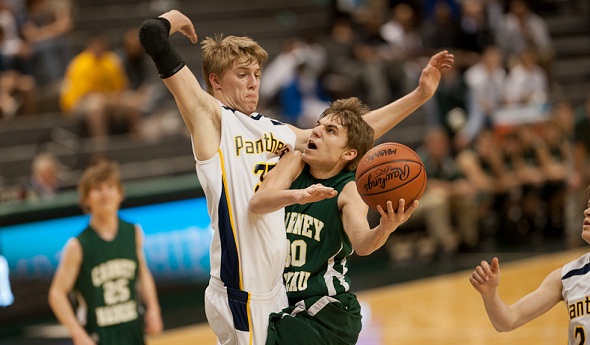
And that yellow haze swallowed up the Panthers as they celebrated a 52-44 win over Carney-Nadeau that earned Climax-Scotts its first berth in an MHSAA hoops championship game.
“It means the world to do something nobody in the history of our school has done before. The feeling’s pretty much indescribable,” Climax-Scotts senior guard Brandon Eshuis said. “Our student body probably wanted this just as bad as we did. … We had a huge crowd and a huge support group, and it really helped us.”
The No. 5 Panthers (26-1) will face No. 7 Southfield Christian in the Final at 10 a.m. Saturday.
They advanced by taking advantage of a few big ones.
Carney-Nadeau’s tallest player was just 6-foot-1, good news for Climax-Scotts’ 6-7 junior Aaron Cook (12 points, 14 rebounds) and 6-7 all-state senior Malachi Satterlee (12 points, nine rebounds). Total, the Panthers outscored Carney-Nadeau 28-6 in the paint.
The Wolves also have relied almost solely on five players for the last two weeks and never subbed in the Semifinal. Climax-Scotts looked a little worn at the end Thursday night – but went on a 9-3 run over two minutes to turn a three-point lead into a 49-40 advantage with 1:08 to play.
What Carney-Nadeau (23-3) does best is shoot from outside, and "3-pointer" became the buzzward among the Panthers over the two days leading up to the game. Climax-Scotts’ second stringers were given green lights to shoot from NBA 3-point range at practice Wednesday in an attempt to imitate what the team would see.
“We had anticipated shooters, and they were just amazing when we got here,” Panthers coach Steve Critchlow said.
Wolves junior Wade Schetter scored 15 points, with three 3-pointers, while senior Keenan Lampinen added 12 points and senior Lucas Moreau scored 13. All three took at least 15 shots from the floor. But as a whole, the team made only 29 percent.
“This has been a long two weeks for us, with tough games night in and night out,” Carney-Nadeau coach Jason Polfus said. “Maybe the kids were worn out a little bit. But they stuck it out today. They kept fighting today, and I can’t say enough about that.”
Click for box score or to watch the game and press conferences at MHSAA.tv.
PHOTO: Climax-Scott's Aaron Cook attempts to block a shot by Carney-Nadeau's Lucas Moreau on Thursday. Cook blocked two shots in the game. (Photo courtesy of Terry McNamara Photography.)

'Reaching Higher' Showcase Returns
July 12, 2018
By Geoff Kimmerly
Second Half editor
After a one-year hiatus in 2017, the annual Reaching Higher showcases of Michigan’s top high school basketball players will return for their ninth year July 17 at Milford High School in Highland Township.
More than 200 athletes with aspirations to play at the college level will train and scrimmage under the tutelage of high school coaches from across the state and in front of college coaches expected to represent a number of NCAA, NAIA and junior college programs.
An educational effort by the Michigan High School Athletic Association and the Basketball Coaches Association of Michigan, the Reaching Higher experience includes classroom sessions for student-athletes and their parents as well as on-court drills and scrimmaging. The events aim to give athletes a vision of what it takes to become a college basketball player and also succeed in college life.
Participants in the program were selected by a committee of BCAM members based on nominations by its member coaches. Click for complete lists of expected attendees.
The boys event begins at 11 a.m. on July 17, with scrimmages running from 1-3:30 p.m. The girls event begins at 3 p.m., with scrimmages from 5-7:30 p.m. Speakers for the boys session include Travis Bader, a standout at Okemos High School and Oakland University who played professionally this past season in Greece. Girls session speakers include Crystal Bradford, who starred for Inkster High and Central Michigan University and was selected in the first round of the 2015 WNBA Draft by the Los Angeles Sparks; she played professionally this past season in Israel.
Longtime coach Dave Ginsberg will speak with athletes about social media and the recruiting process during both sessions; he coached at a number of Michigan high schools and also was an assistant men’s basketball coach at Central Michigan University for 16 years, and he currently serves as the secretary/treasurer of the National High School Basketball Coaches Association. Longtime high school and college coach Marc Comstock – currently the boys basketball coach at Hudson High School – and recently retired Saginaw Valley State University athletic director Mike Watson will conduct sessions with parents during players’ drill and practice sessions.