

Class A Final: Trojans ring up a title
March 24, 2012
EAST LANSING – Every time Draymond Green visited a Saginaw basketball practice this season, he reminded the current Trojans of the same thing:
The Michigan State and former Saginaw star has two Class A championship rings. They had none.
And he brought that up one more time when he went to dinner with the team Friday night.
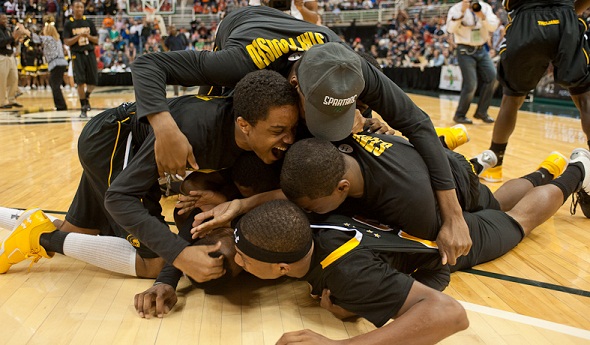
He can’t tease them anymore. Saginaw – top-ranked entering the tournament – ended it that way with a 54-42 win over Rockford in Saturday’s Class A Final.
“Now I don’t gotta hear Draymond Green’s mouth saying we don’t have a ring. Now I can take my ring to his face and say, ‘Yes, now we do,’” Saginaw senior Davario Gaines said. “He said (Friday), ‘You’re happy just to be here,’ since we won yesterday. We said, ‘No, we’re not happy to be here.’ We hadn’t won anything yet.
“So now we won.”
The championship is Saginaw’s sixth, and first since 2008, when Green led the Trojans to their second straight. But this title-winner had a different look from those that won under previous Saginaw coaches Lou Dawkins and Marshall Thomas.
Those two sat behind the Trojans’ bench Saturday as first-year coach Julian Taylor guided a team that didn’t have a Green-esque star, but a number of contributors who didn’t get down during the streakiest play of the weekend.
 Saginaw jumped out to a 7-0 lead. Rockford countered with 18 straight points. The Trojans came back from that with an 18-6 run to lead 25-24 at halftime.
The score was knotted 40-40 with 5:01 to play. But Saginaw finished on a 14-2 run, scoring the final 11 points of the game.
“You try to control runs and limit them,” Rockford coach Nick Allen said. “Saginaw is a very good team, and obviously we didn’t do a very good job of it.”
The Rams did hit 10 3-pointers, tying for fourth-most in MHSAA boys basketball championship game history. They made 55 percent of their first-half tries from beyond the arc.
But the Trojans turned up the pressure to full-court, and limited mistakes at a level rarely seen. Saginaw had just five turnovers and only nine fouls – and Rockford didn’t get to shoot a free throw.
Senior guard Travontis Richardson led the Trojans with 13 points and junior Julian Henderson had 12. But seven players scored at least four points and six grabbed at least six rebounds.
“We don’t have to have a big player. As long as we have parts to the team, they balance out the floor,” Gaines said. “We played D that they haven’t seen before, probably. We fought hard.”
So did Rockford, just to reach Breslin. Allen also was in his first season coaching after taking over for longtime coach Steve Majerle, who is battling Parkinson’s disease. The Rams entered the postseason unranked, but won seven games to finish 22-6.
Junior Chase Fairchild scored 14 points off the bench Saturday to lead the team for the second straight game. He’s one of seven juniors who won’t be nearly as big a surprise if they make a run again in 2013.
“No one expected us to go all the way to the state championship game,” Rockford junior guard Chad Carlson said. “We got here and played together as a team. It was a great season for us. We just couldn’t get it done.”
Click for box score or to watch the game and press conferences at MHSAA.tv.
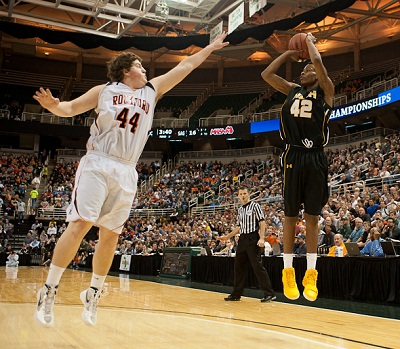
PHOTOS: (Top) Saginaw players embrace each other at midcourt after clinching the 2011-12 Class A championship. (Middle) Saginaw sophomore Joseph Williams-Powell (42) sends up a shot above the reach of Rockford senior Ivy Johnson. (See more at Terry McNamara Photography.)
Breslin Bound: Boys Report Post-Break
January 3, 2017
By Geoff Kimmerly
Second Half editor
This week, Michigan’s high school boys basketball teams will begin focusing most of their energies on winning league championships and doing their best against competition closest to home.
 But before we dive in to that always-intense chapter of each season, our Breslin Bound report – powered by MI Student Aid – reviews the best from two weeks of holiday break, including matchups of some expected MHSAA title contenders in Class A and B.
Week in Review
The countdown of holiday break's five most intriguing results:
1. Detroit U-D Jesuit 69, Macomb Dakota 61 – Dakota was missing a standout and lost another near the end of this one, but regardless this rematch of last season’s Class A Semifinal finished with the Cubs on top while sandwiched between their overtime losses to Flint Beecher and Indianapolis Lawrence North (Ind.).
2. North Farmington 53, Detroit Henry Ford 49 – The Raiders bounced back from three losses to open this season, including a 65-58 defeat to Farmington, to beat Dearborn Divine Child and then the Class B reigning champ at the Motor City Roundball Classic.
3. McBain 73, Boyne City 62 – In a matchup of expected Class C contenders from the northern Lower Peninsula, McBain emerged with a fourth double-digit win in four tries this winter while handing Boyne City its first loss.
4. Wyoming Godwin Heights 69, Wayland 67 – They are in different Districts this season after meeting in the first round a year ago, and both could emerge as Class B contenders after meeting in this Cornerstone Invitational title game.
5. Frankfort 72, Traverse City St. Francis 65 – The Panthers avenged one of only two regular-season losses from last season, when they fell to St. Francis 69-68.
Watch List
With an eye toward March, here are two teams in each class making sparks:
CLASS A
Detroit East English (5-0) – The Bulldogs may have graduated a Mr. Basketball finalist off last season’s 17-win team, but they likely have another and could finish even better this winter with wins so far over Flint Beecher, Macomb Dakota and most recently Wayne Memorial 92-77.
Battle Creek Central (5-1) – That lone loss came early to Kalamazoo Central, and Battle Creek Central has stormed back with the latest a sweep at its holiday tournament, 60-50 over Otsego and 61-46 over Muskegon Heights Academy.
CLASS B
St. Clair (5-0) – The Saints, winners of 12 and 14 games, respectively, over the last two seasons, downed St. Clair Shores Lakeview 54-53 in overtime and then host Clinton Township Chippewa Valley 58-57 at the latter’s holiday tournament to finish off 2016.
Wyoming Lee (5-0) – A 3-17 finisher just last season, Lee is in the midst of a sizable turnaround highlighted over the break by wins over Gobles (in overtime) and host Allegan to win the Tigers’ holiday tournament.
CLASS C
Harbor Springs (3-0) – After also going only 3-17 a year ago, Harbor Springs has equaled that win total while handing the only losses this season to Bellaire (40-37) and Pickford (67-65).
Michigan Center (6-0) – The Cardinals will embark next on at least matching last season’s shared title in the Cascades Conference, and will do so after dominating Williamston’s holiday event with wins over Dansville (66-47) and Class A DeWitt (86-75).
CLASS D
Bark River-Harris (4-0) – Eventually, the Broncos will get to test themselves against Powers North Central (Jan. 27) in the Skyline Central Conference West. So far, they look good to top last season’s 10-11 finish.
Frankfort (3-0) – Expectations are high as always coming off a second straight Northwest Conference title and fourth straight season with 20 or more wins – and so far so good; see note above on avenging last season’s loss to Traverse City St. Francis.
Can't-Miss Contests
Be on the lookout for results of these games coming up:
Tuesday – Clarkston (5-0) at Flint Carman-Ainsworth (6-0) – The Wolves have earned a reputation as Class A contender with another strong start, and Carman-Ainsworth could cement that status as well with a win.
Tuesday – Maple City Glen Lake (3-0) at Elk Rapids (5-0) – In addition to both being undefeated this week, Glen Lake beat Elk Rapids twice last season including in the District.
Friday – Beaverton (4-1) at Clare (3-1) – Although both have a loss, both also are undefeated in early Jack Pine Conference play; Beaverton’s only defeat was in its last game, to Class A Midland Dow by two.
Friday – Detroit U-D Jesuit (4-2) at Romulus (2-1) – Another week, another impressive foe lined up for reigning Class A champion Jesuit; Romulus’ lone loss was by six to Clarkston.
Friday – Holt (3-2) at Okemos (3-1) – This longtime rivalry means something again, as both are seeking to rise in a Capital Area Activities Conference Blue that also features East Lansing, Lansing Everett and Jackson.
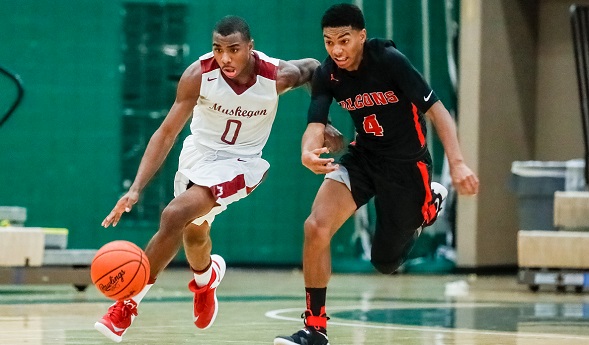
PHOTO: Muskegon pushes the ball upcourt during a 68-45 win over East Kentwood during the Muskegon Hall of Fame Classic on Dec. 28 at Reeths-Puffer High School. (Photo by Tim Reilly.)