

Coaches Return With College Knowledge
By
Tom Markowski
Special for Second Half
February 24, 2016
North Farmington boys basketball coach Todd Negoshian is not so vain to believe he’s at the top of his profession.
 After all, he’s nearing just his fifth season running what is considered one of the top programs in the Oakland Activities Association.
What Negoshian is certain of is that he is a better coach now than he was during the early 2000s when he entered the profession as an assistant at North Farmington under his father, Tom Negoshian.
In addition to Todd Negoshian’s years as a high school coach, he spent three seasons (2004-07) as an assistant coach at Oakland University under coach Greg Kampe. Having worked at the college level has not only added to his knowledge as a coach but also given him an opportunity to work with different people under different circumstances but with similar goals.
“I learned a lot from Kampe,” Negoshian said. “I learned a lot about relationships. He has the uncanny ability to (scold) a kid and then 30 seconds later have your arms around him. It’s about building relationships.
“It’s his approach to coaching. There’s so many things you learned outside of coaching.”
This brief stint at the collegiate level gave Negoshian, 35, a whole new perspective on how to coach and how to be a coach. Building relationships takes time, and to those committed to being a coach who cares about his or her players, it’s paramount to allow for that time.
Some coaches, like John Beilein at University of Michigan, start out coaching at the high school level, move on to college and remain there. A number of others statewide have taken paths similar to that of Negoshian.
LaMonta Stone at River Rouge and Steve Hall at Detroit Cass Tech started coaching at the high school level and have recently returned to their roots after each spent several years as a college coach.
Stone played for the legendary Lofton Greene at River Rouge and then coached the Panthers to a Class B title in 1999. Stone ambitiously sought a position at the next level and was quite successful. He spent two seasons at Eastern Michigan, two at Ohio State and 10 at Bowling Green before returning to River Rouge last season as head coach.
And he has no regrets.
“At that point, I had goals,” Stone said of making the jump to college. “There were things I wanted to do. I still have goals. People ask me, would I go back to college? I don’t know. If the situation was right, I might.”
Stone, 49, returned for two reasons: family and community. Last season he was able to coach his oldest son, LaMonta, Jr., his senior year. Stone also has two other sons, ages 6 and 9.
 Basketball is king in River Rouge. Greene won a record 12 MHSAA titles and the program has won two more since his departure. But the Panthers relinquished their claim as a state power soon after Stone left and haven’t been much of a factor in the tournament since. Stone intends on changing that.
“It’s a situation where, I’d been (coaching in college) for 14 years,” he said. “I’d reached all my goals. The only one I didn’t was to become a head coach. But you’re an assistant in the Big Ten. You can’t get much higher than that.
“The opportunity to come back to that community, I just couldn’t pass up. I get to be more of a part of my sons’ lives.”
In addition to the high school season, Stone said he enjoys coaching during the summer, in camps and individually.
“I can, within the (Michigan High School Athletic Association) rules, work with kids outside of Rouge,” he said. “I get calls all the time saying can you work with my son. I work with them but they can’t come to Rouge. I like it that way. There’s no pressure on me or them.”
Hall, 45, was one of the state’s top players when he graduated from Cass Tech in 1988. He played four years in college (Washington, Virginia Tech) before playing professionally overseas. In 1996 he became the head coach at Detroit Rogers, an all-boys school in the Detroit Public School League. Hall spent nine seasons there and won three MHSAA titles before the school closed.
Hall went to Detroit Northwestern in 2005 and spent three seasons there, winning one PSL title, before accepting a position as an assistant coach at Duquesne University in Pittsburgh. He spent four seasons there before becoming an assistant coach at Youngstown State. On Aug. 25, Hall officially came back to Detroit as athletic director and boys basketball coach at Cass Tech.
Like Stone, Hall was looking for a more stable lifestyle. Family came first, and the opportunity to coach his alma mater was too good to pass up.
“A lot had to do with my life at this stage,” he said. “I have two young boys (ages 7 and 4) and to be more a part of their lives is important. If I wanted to spend time with them, we’d go to a game where I was recruiting a kid and that would be our time together on that given day.
“And I have a passion for this school. This whole year has been learning on the fly. At Rogers there was a lack of numbers. Here football is huge. We didn’t have a football team at Rogers. And here I have a surplus of numbers. It’s a different dynamic. Rogers was the smallest school in the PSL by enrollment. Cass is the biggest.”
Hall said he doesn’t miss the hours of travelling on the road, going into countless gymnasiums recruiting players and trying to convince them and their coaches that his university was the right one. It’s not that his responsibilities as athletic director and coach are less demanding. But being able to go home every night and see his children and sleep in his bed has its rewards.
Hall said he had more than a few conversations with Stone on returning home.
All three coaches agree that experience has its benefits. It’s not that coaching is any easier at this time. The challenges are still there and in many ways demand different approaches.
“Every stop makes you better,” Negoshian said. “Anytime you coach kids, the more you are around them, it helps.
“The game has changed. Society changed. Kids don’t want to fight through tough times. That’s why you see so many transfers. Everybody wants to be the hero. They want the focus on them. And it’s just not them. It’s the family. I’m not sure all of the parents are committed. They don’t want to go to A, B and C to get to D.”
Hall said the expectations for incoming freshmen and their parents are so different than it was when he was in high school. Then students went to a certain school, whether it was a power like Detroit Southwestern or a neighborhood school like Detroit Mumford, to be a part of an established program.
“It’s a trickle down from college,” Hall said. “It’s not, ‘I want to send my kid to a great program.’ There’s the attitude that if my son isn’t a part of it as a freshman, I’ll go somewhere else instead of being part of the process.”
 Tom Markowski is a columnist and directs website coverage for the State Champs! Sports Network. He previously covered primarily high school sports for the The Detroit News from 1984-2014, focusing on the Detroit area and contributing to statewide coverage of football and basketball. Contact him at [email protected] with story ideas for Oakland, Macomb and Wayne counties.
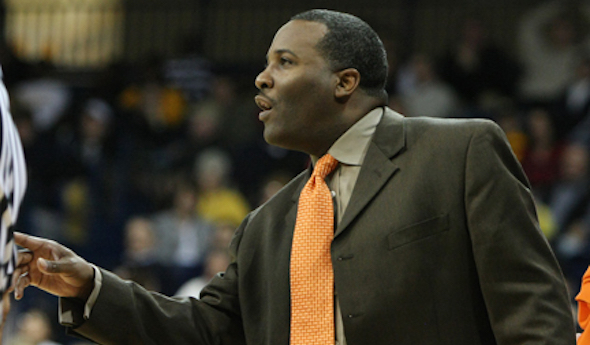
PHOTOS: (Top) Current River Rouge boys basketball coach LaMonta Stone returned to his alma mater after serving as a college assistant including at Bowling Green. (Middle) Todd Negoshian, LaMonta Stone, Steve Hall. (Top photo courtesy of LaMonta Stone.)
Vicksburg's Offord Jr. Beginning 50th, Final Season Coaching Teams to Net Gains
By
Pam Shebest
Special for MHSAA.com
March 26, 2025
VICKSBURG — Warner Offord Jr.’s was hardly impressed the first time he played tennis.
 That was 55 years ago, when he was heading into his sophomore year at Paw Paw High School.
Still, he continued to play with neighbor boys all that summer, and figured it would end there – until the following spring sports season, when he joined the tennis team.
“I go, it’s not a bad sport after all,” he laughed.
Offord ended up at No. 1 singles his final three years at Paw Paw, graduating in 1973.
Now, at age 70, he is ready to retire at the end of the upcoming Vicksburg’s girls season after 50 years of coaching tennis.
After graduating from Paw Paw, Offord stayed in the area, helping the basketball team and coaching boys and girls tennis there. He coached at his alma mater 28 years, first as an assistant before taking over the tennis programs.
When he heard about a basketball coaching opening at Vicksburg 22 years ago, he applied for the job.
He did not get the head hoops gig, but athletic director Mike Roy offered him a job coaching the girls tennis team.
“I said I’ve got to talk to my wife (Linda Connor-Offord),” Offord said. “I don’t do nothing without talking to my wife, or I’ll be in the doghouse.”
Two days later, the boys tennis coach resigned and Roy offered Offord that job as well.
 Once again he consulted his wife, who he gave him the thumbs up.
Offord soon discovered there is a bit of a difference between coaching boys and girls.
“Girls are feisty,” he said. “Girls listen to you. Boys, sometimes they want to do their own thing. When they do that, I say ‘end zone to end zone’ and then they get back to, ‘OK, we’re going to listen to our coach now.’”
He also has rules on the court.
“I believe in discipline. If you curse on the court, it’s an automatic two miles,” he said. “If you throw your racket, it’s an automatic two miles.
“No matter what, we’re going to run. I try to get the kids in shape for the third set.”
With the girls season just underway, Offord has some definite goals.
“We’re going to try to win (Wolverine) conference for the first time in school history,” he said. “The boys did it last year for the first time.
“Before I leave, I’d like to bring home that Regional trophy for the girls. It would be nice to bring home that trophy my last year.”
He is also challenging the girls not only to get back to the MHSAA Finals, but to improve on last year’s finish.
“Two years ago we finished 18th (in Lower Peninsula Division 3). Last year, I told the girls, let’s get up to 15th of 24 teams, and we got 14th.
“This year, if we go to state again, I’m going to tell then, let’s get down to 10.”
Game changer
Offord said today’s high school players are faster and stronger than when he picked up tennis because they use the weight room and do conditioning.
The equipment also has evolved.
“If I had the racket they have now and I could take that back in the ’70s, the racket is so big,” he said. “I had an Arthur Ashe (wooden) racket, I had a Wilson T3000 racket, I had a Kramer and I had a Davis.
“The technology now is unbelievable.”
Offord, who is affectionately called “Doctor O” or the abbreviated “Doc O” by the Vicksburg community, has changed with the times.
 “Dr. O’s unwavering passion and exceptional dedication have transformed the program,” Roy said. “His deep understanding of the game, paired with his ability to teach strategy at an elite level, sets him apart.
“Beyond his technical expertise, Dr. O instills a culture of excellence by holding athletes to high standards while maintaining fairness, consistency, and approachability – earning the trust and respect of his team.”
Roy noted that Offord has support around him.
“Since taking the reins, Dr. O has cultivated a winning culture, building on the foundation laid by coach Scott Wills, who continues to lead our summer youth programs,” Roy said.
“Recognizing the importance of strong leadership, Dr. O brought in Nick Foley, a former standout at Sturgis, as his assistant. Together these three men have ignited a culture shift, elevating the team to compete at an exceptional level. Their collective vision, tireless work ethic and commitment to growth has positioned the program for sustained success.”
Offord said he learned from the coaches he had growing up, who instilled not only a competitive spirit but confidence in playing and acceptable conduct on the court.
He mentioned retired Allegan tennis coach Gary Ellis as a mentor.
“Anytime I needed to know anything about tennis, I’d call him and he always had the answer,” Offord said. “I thought the world of him and what he did for that program. I’m trying to do the same thing at Vicksburg.”
Ellis said that Offord “definitely got the kids excited about playing tennis for Vicksburg and enjoying the sport. His kids get better and better during the season.”
The players at Vicksburg and Paw Paw are not the only ones who blossomed under Offord’s coaching.
His son, Warner Offord III, is an assistant to Matt Boven at Mattawan and has been a certified tennis pro for 20 years.
One final run
Offord Jr.’s decision to retire after half a century came at a perfect time, said senior Scarlett Hosner, the Bulldogs’ No. 1 singles player.
 “I feel it’s a good ending point because he coached my sister (Josephine, a 2016 grad), too, and he saw me growing up playing tennis,” Hosner said. “It’s like a full-circle moment because it’s my last year and his last year.
“He brings really positive energy. He’s such a nice, fun guy. He makes us enjoy the game, but he can also be serious at times. When we’re not doing what we’re supposed to be doing, he’s like getting on us.”
In retirement, Offord and his wife plan to do some traveling because “we want to enjoy life while we’re young,” he said.
“It’s been a wonderful 50 years coaching tennis, and it’s going to be sad. It hasn’t hit me yet for the boys, and once the girls season is over, then it will probably really hit me.
“I take great pride in seeing my players excel professionally, academically and as an athlete. I feel good knowing I played a part in that person’s success.”
 Pam Shebest served as a sportswriter at the Kalamazoo Gazette from 1985-2009 after 11 years part-time with the Gazette while teaching French and English at White Pigeon High School. She can be reached at [email protected] with story ideas for Calhoun, Kalamazoo and Van Buren counties.
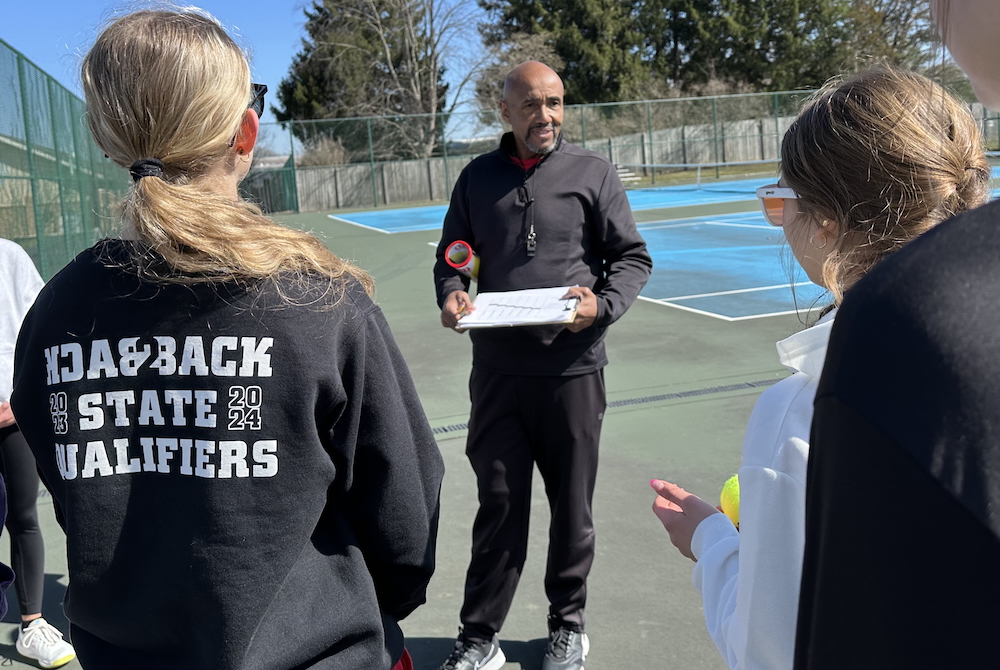
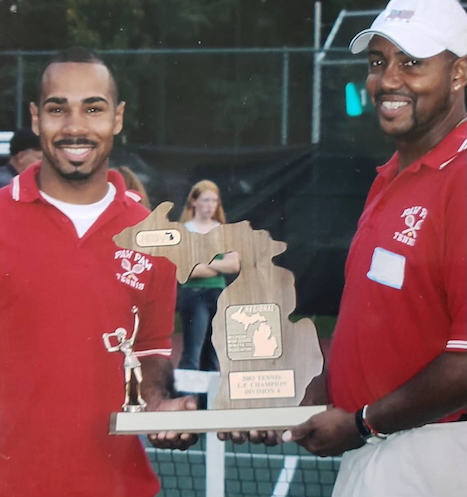
PHOTOS (Top) Vicksburg girls tennis coach Warner Offord Jr. talks with his team at the start of this spring season. (2) Offord and son Warner Offord III hold up their Regional championship trophy won for Paw Paw in 2003. (3) Offord hits with his players during practice. (4) Scarlett Hosner headshot. (Current photos by Pam Shebest; 2003 photo courtesy of Warner Offord Jr.)