

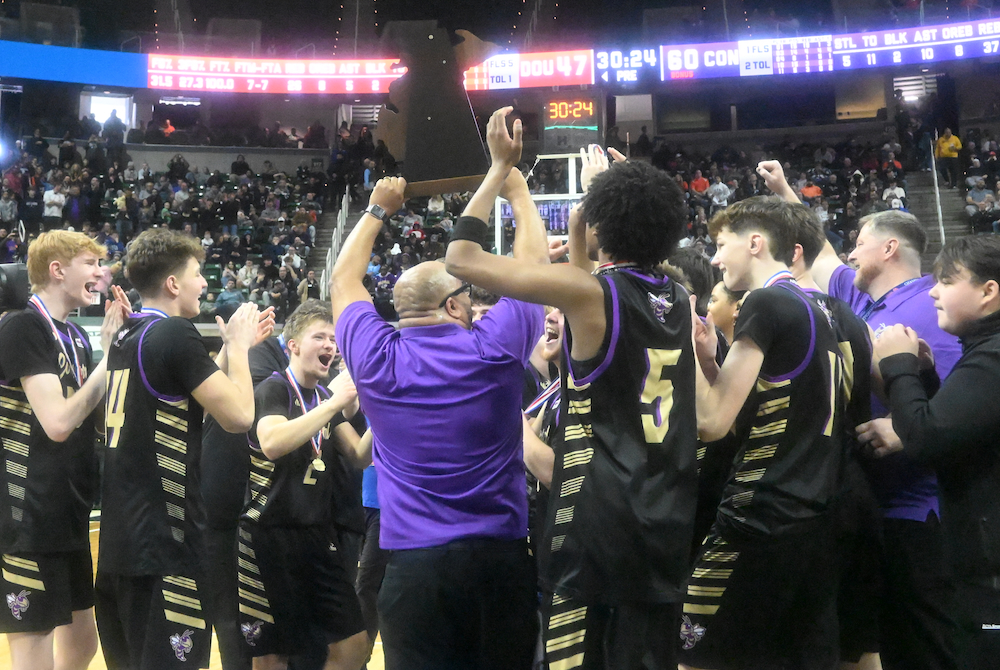
Concord Finishes Strong to End Longest Playoff Run in 40 Years as 1st-Time Champ
By
Paul Costanzo
Special for MHSAA.com
March 14, 2026
EAST LANSING – As his teammate Connor Stevens strode to the free throw line to put the finishing touches on Concord’s 60-47 win over Detroit Douglass in the Division 4 Boys Basketball Final on Saturday, Brady Garrett pulled his jersey over his face.
The Yellowjackets senior shook his head, almost in disbelief before looking up to the massive Concord crowd assembled at the Breslin Center and screaming, “Let’s go!”
“First of all, I love basketball and I love the group of guys that I’m with,” Garrett said. “As time was winding down, it was hitting me. I’m a senior, this is it. This was everything I played for my whole life. To capture it with a state championship, it meant so much to me. I wouldn’t ask for a better group of guys to do it with.”
Garrett and his teammates brought Concord its first Finals title in boys basketball, finishing off the school’s first “final four” appearance since 1986.
“They’ve been waiting on it,” Stevens said. “All season they’ve been riding with us, and there’s no other way I’d want to go out than this. We all looked at each other and knew that’s what we had to do.”
Concord did it for its city and fans, as well as for Fred Garland, who had passed away in a car crash after leaving a Concord practice in December of 2024. Garland was a standout college basketball player who played for Concord coach Marcus Gill Sr. at Albion and was a former club coach of Stevens.
“We did this for Fred Garland,” Gill said. “(His death) rocked our heart and soul, and he wanted this bad. We did this for Fred.”
The Yellowjackets were able to channel all that emotion into an incredible fourth quarter, which broke open a game that was tied after three.
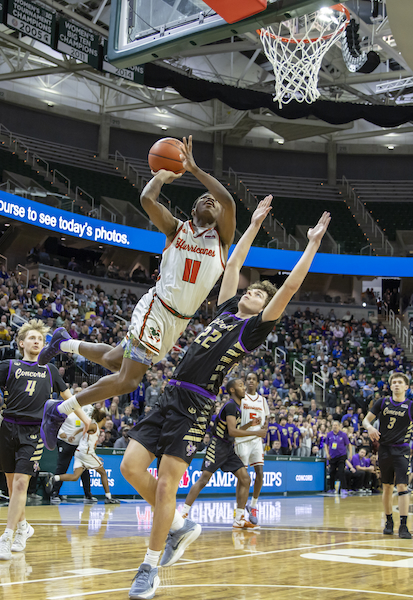 They outscored Douglass 19-6 in the fourth, holding the Hurricanes to 2-of-16 (12.5 percent) shooting from the field, while hitting 60 percent of their shots and not committing a turnover.
Much of that success hinged on a switch during the quarter to a zone defense, which caught Douglass off guard.
“We are primarily a man-to-man team, but we have our (3-2 zone) in,” Gill said. “We knew we wanted to save it a little bit for the second half today, because they’re a really good driving team, and we knew (Douglass guard Damani Oliver) can really shoot it, so we wanted to wait for the right time to try and get them out of their rhythm. We got into it, it was working and we were making stops, so we just stayed in it.”
Douglass coach Pierre Brooks Sr. credited that zone for slowing his team, but thought it was Concord’s senior-led roster that made the difference down the stretch.
“I think Concord’s experience kind of got the best of us in the second half,” Brooks said. “They’ve got seniors that were pretty hungry, and we just didn’t convert.”
The late push from Concord came despite not having star guard Jett Smith on the court for half of the fourth quarter, as he picked up his fourth foul during the final seconds of the third.
With him out, though, the Yellowjackets jumped ahead, leading by five when he re-entered the game with 4 minutes, 26 seconds to play.
“It was huge, but that’s why we’re a championship team, because we’ve got other guys,” Gill said. “Just like (in the Semifinal against Wyoming Tri-Unity Christian), they did a good job of taking (Smith) out of the game, but we’ve got a lot of good ball handlers. Yesterday it was Darrell (Dean) with the ball in his hands, today it was Brady Garrett. I thought he ran our team unbelievably.”
Smith still finished with 14 points, despite the foul trouble and hounding defense from Douglass junior Jacodi Nathan. Stevens led the Yellowjackets with 15 points and 19 rebounds, while Dean had 15 points. Garrett added six points, five assists and two steals.
Oliver led Douglass (21-8) with 15 points, while Nathan had 12, including a five-point stretch over the final seconds of the first half during which he hit a 3-pointer, stole the inbounds pass and laid the ball in, giving his team a 26-22 lead going into halftime.
“Today, we didn’t finish the first 16 minutes great, but we came out and battled and played Concord basketball the last 16 minutes,” Gill said. “And this is the outcome right here. Can’t be more proud of these guys.”
PHOTOS (Top) Concord boys basketball coach Marcus Gill Sr. holds up his team’s newly-won championship trophy Saturday at Breslin Center. (Middle) Douglass’ Jacodi Nathan (11) drives hard to the hoop with Concord’s Tyler Rundle working to wall him off. (Photos by Hockey Weekly Action Photos.)
Bingham's Game Grows with Size, Skills
December 20, 2017
By Dean Holzwarth
Special for Second Half
GRAND RAPIDS – Standing 6-foot-10, Grand Rapids Catholic Central’s Marcus Bingham, Jr., has a rare combination of size, length and skill.
 However, another asset in his overall game has come to the surface during the early weeks of this season.
“He’s leading our team in 3-point percentage,” Catholic Central coach TJ Meerman said.
For Bingham, who has averaged 27 points and 16 rebounds during the Cougars’ 3-0 start, the improved range has come through his time in the gym.
“It all ties in with the work I’ve put in on my shot,” Bingham said. “And I’m just going to keep getting better and better, so why not? I can shoot, so why not use it, and Coach likes it when I shoot it.”
Meerman has no qualms about Bingham hoisting up 3-pointers, especially when he makes the commitment away from practice.
“He loves to be in the gym, and on our days off he’s still in the gym working on his handles, working on his shot,” Meerman said. “You don’t get to shoot it that well without putting in a lot of time outside of practice time, and he does that. It’s exciting for me, and it’s exciting I’m sure for Coach (Tom) Izzo and the Michigan State staff as well.”
Bingham, who recently signed with the Spartans, also possesses abilities that sets him apart from other high school players.
“He handles it well, he passes well and then he has a seven-foot reach to go with that height,” Meerman said. “With his skill and length, he’s capable of doing things that not a lot of people can do in basketball.”
It’s been an incredible rise. Bingham didn’t play high school basketball at all as a freshman. He played only half a season last year after transferring to Catholic Central, but averaged 16 points and 10 rebounds per game. That was followed by a successful AAU season, and the Division I college offers began rolling in.
A growth spurt didn’t hurt either. He sprouted up eight inches over the past two years.
 “I’ve grown, but I’ve also gotten a lot stronger and bigger,” Bingham said. “I’ve just been working, and being bigger I can do things easier. It has been a blessing.”
Meerman has seen a big difference in Bingham from a year ago, and admitted that the end of a frenzied recruiting process also has helped.
“I think he’s more comfortable playing structured basketball,” Meerman said. “He hadn’t played a lot of basketball in his life outside of his sophomore year, and the distraction with the mass recruiting wave that came his way toward the end of the season is gone. It has been a nice relief for him to just focus on school and ball.”
Bingham also added 12 pounds of muscle to his frame.
“He has a ways to go with that, but you can see the difference in his play and with his pace of play,” Meerman said. “He’s understanding the system and the way we want to play, and becoming a senior he understands he has to play at a higher level that he did last year.”
The Cougars claimed conference and District titles a year ago, but are striving for more with a talented nucleus surrounding Bingham.
Senior Jacob Polakovich, along with junior guards Austin Braun and Darrell Belcher, and sophomore guard Devon Boyd are main contributors, too.
“We have a great group of guys, and they like to share the ball,” Meerman said. “I like how dynamic we are, and we have good guard play and very good bigs.”
Catholic Central recorded 25 assists in its season-opening win over Detroit Country Day – a positive early sign.
“We’ve been playing good and sharing the ball more than we did last year,” Bingham said. “We’re just working hard as a team to do what we have to do to get wins.”
Meerman scheduled an early-season gauntlet of the top teams to help measure where the Cougars stand.
Three of their first five games included or will include teams that competed in last year’s MHSAA Finals, and the first two were on the road. Catholic Central downed reigning Class A runner-up Grand Rapids Christian 73-49 on Dec. 12, reigning Class C runner-up Grand Rapids Covenant Christian 62-58 on Friday, and hosts reigning Class B runner-up Ludington on Dec. 29 as part of its invitational.
“We wanted to find out right away who we are and what we need to work on,” Meerman said. “That’s what we’re working on right now, and we have our last early test on the road against one of the best teams in the state.”
Catholic Central will travel to Wyoming Godwin Heights tonight for a highly-anticipated showdown between elite teams.
The undefeated Wolverines feature Division I recruits Lamar Norman and Markeese Hastings.
Tickets sold out Monday afternoon.
“It’s going to be exciting to be a part of that, and gyms don’t sell out like that unless players have put in a lot of time in the gym,” Meerman said. “It’s an opportunity for us to compete against the best and see where we’re at, and it’s going to be fun. It will be a game and crowd they will remember their whole lives.”
Bingham is looking forward to matching skills against Hastings, who has committed to Butler, and Norman, who recently reopened his recruitment after previously committing to Texas-El Paso.
“I’m really excited just knowing that everyone is going to be there to see Catholic Central and Godwin play,” he said. “Godwin is a good team, and we’re just going to go out and fight and do what we have to do to win.”
 Dean Holzwarth covered primarily high school sports for the Grand Rapids Press and MLive for 16 years and more recently served as sports editor of the Ionia Sentinel and as a sports photojournalist for WZZM. Contact him at [email protected] with story ideas for Allegan, Kent and Ottawa counties.
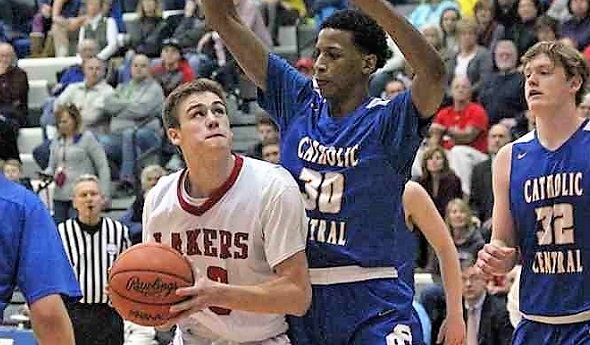
PHOTOS: (Top) Grand Rapids Catholic Central's Marcus Bingham (30) defends in the post against Spring Lake last season. (Top photo courtesy of the Grand Haven Tribune; middle photo courtesy of the Grand Rapids Catholic Central boys basketball program.)