

D2 Preview: Formidable Foursome Expected to Make for Memorable Matchups
By
Geoff Kimmerly
MHSAA.com senior editor
March 23, 2022
This weekend’s final four contenders for the Division 2 boys basketball championship make up a high-echelon group, to say the least.
On one side of the bracket, reigning champion Grand Rapids Catholic Central and Ferndale will meet in a Semifinal rematch after both played many of the state’s best on the way to East Lansing. On the other side? Just the only two undefeated teams playing at Breslin Center this weekend.
Additionally, Ferndale's Treyvon Lewis (Loyola of Chicago signee) and Grand Rapids Catholic Central's Jack Karasinski (William & Mary) were two of four finalists for the Mr. Basketball Award this week.
DIVISION 2 Semifinals – Thursday
Grand Rapids Catholic Central (24-1) vs. Ferndale (21-3), 5:30 p.m.
Williamston (25-0) vs. Freeland (25-0), 7:30 p.m.
FINAL – Saturday – 6:45 p.m.
Tickets for this weekend’s games are $12 for both Semifinals and Finals and are available via the Breslin Center ticket office. All Semifinals will be broadcast and viewable with subscription to MHSAA.tv, and all four Finals will air live Saturday on Bally Sports Detroit, with the Division 4 and 1 games on BSD EXTRA and the Division 3 and 2 games on BSD’s primary channel. All four will be broadcast live as well as on the BSD website and app. Audio broadcasts of all Semifinals and Finals will be available free of charge from the MHSAA Network.
Here’s a look at the four Division 2 semifinals (with rankings by MPR at the end of the regular season, and statistics through Regional Finals):
FERNDALE
Record/rank: 21-3, No. 4
League finish: First in Oakland Activities Association Red
Coach: Juan Rickman, fourth season (62-26)
Championship history: Class A champion 1966 and 1963.
Best wins: 68-55 over No. 12 Pontiac Notre Dame Prep in Quarterfinal, 60-55 over No. 18 Detroit Country Day in District Final, 57-46 over Division 1 No. 9 Muskegon, 63-52 over Division 1 No. 5 Bloomfield Hills Brother Rice, 56-49 over Division 1 No. 13 North Farmington, 63-52 and 58-47 over Division 1 No. 14 Oak Park.
Players to watch: Jason Drake Jr., 6-2 sr. G (16.8 ppg, 6.7 apg); Treyvon Lewis, 6-5 sr. F (22.4 ppg, 10.5 rpg, 4.3 apg, 2.1 bpg); Chris Williams, 6-5 jr. F (10.2 ppg, 9.8 ppg).
Outlook: After making the Semifinals last season for the first time since 1985, Ferndale is making the trip for the second season in a row after navigating one of the strongest schedules in the state. Four of five starters are back from the team that lost 81-55 to Grand Rapids Catholic Central last year at Breslin, with junior guard Cameron Reed (9.1 ppg, 4.9 apg, 2.9 spg) joining Drake, Lewis and Williams. Drake made the all-state second team last season, and Lewis earned an honorable mention. The Eagles’ losses this season were all to Division 1 teams that won Regional titles – Grand Blanc, Warren De La Salle Collegiate and Orchard Lake St. Mary’s.
FREELAND
Record/rank: 25-0, No. 14
League finish: First in Tri-Valley Conference 10
Coach: John Fattal, third season (49-15)
Championship history: Has never played in an MHSAA Final.
Best wins: 67-47 over Cadillac in Quarterfinal, 55-52 (OT – Regional Semifinal), 68-47 and 69-57 over Alma, 82-59 over Flint Hamady in Regional Final, 63-57 over Division 3 No. 17 Pewamo-Westphalia.
Players to watch: Josh Elliott, 6-3 sr. F (18.5 ppg, 70 3-pointers); Bryson Huckeby, 6-4 sr. F (14.7 ppg, 8.8 rpg, 6.4 apg); Alex Duley, 6-4 sr. C (13.6 ppg, 7.3 rpg, 3.4 apg).
Outlook: After winning its first Regional title since 1971, Freeland will make its first trip to the Semifinals and after playing only three single-digit games during this season’s undefeated run. Huckeby earned an all-state honorable mention last season and guides a high-scoring offense that’s gone over 80 points in three of five postseason games. In addition to the three double-digit scorers, junior Cullum LeBaron added 8.3 points per game and had 63 3-pointers entering the week. Both he and Elliott connect on 44 percent or better of their attempts from beyond the arc, with Elliott nearing 50 percent.
GRAND RAPIDS CATHOLIC CENTRAL
Record/rank: 24-1, No. 6
League finish: First in Ottawa-Kent Conference Gold
Coach: TJ Meerman, ninth season (141-64)
Championship history: Division 2 champion 2021, Class B runner-up 2018.
Best wins: 86-60 over No. 9 Benton Harbor in Quarterfinal, 69-44 (Regional Final) and 48-45 over Grand Rapids Christian, 68-48 over No. 2 Hudsonville Unity Christian in District Final, 64-59 over Division 1 No. 8 Grand Blanc, 80-66 over Division 1 No. 1 Detroit U-D Jesuit.
Players to watch: Jack Karasinski, 6-6 sr. F (16.2 ppg, 6.7 rpg, 1.1 ppg); Kaden Brown, 6-0 jr. G (21 ppg, 65 3-pointers, 4.2 apg); Durral Brooks, 6-2 soph. G (14.6 ppg, 6.5 rpg, 4.5 apg).
Outlook: The reigning Division 2 champion has lost just one game over the last two seasons – to 2021 Division 3 champion Flint Beecher, 75-69 on Jan. 8. Otherwise it’s been all wins despite a loaded schedule, but with four starters back from last season’s undefeated title earner. Karasinski made the all-state first team last season, while Brown made the second and Brooks earned honorable mention, and senior Jorden Brooks (11 ppg, 59 3-pointers) joins them as a returning starter. No opponent, including previously-undefeated Unity Christian, has come closer than 11 points since the Beecher loss.
WILLIAMSTON
Record/rank: 25-0, No. 7
League finish: First in Capital Area Activities Conference White
Coach: Tom Lewis, sixth season (record N/A)
Championship history: Lower Peninsula Class C champion 1940.
Best wins: 70-54 over No. 20 Detroit Edison in Quarterfinal, 57-38 over No. 3 Onsted in Regional Semifinal, 66-29 over Chelsea in District Final, 66-37 over Division 1 No. 7 East Lansing, 49-32 over Division 1 No. 13 North Farmington.
Players to watch: Jacob Wallace, 6-4 sr. G (13.1 ppg, 5.3 rpg); Mason Docks, 6-0 sr. G (16.2 ppg, 4.8 apg, 3.8 spg); Max Burton, 6-10 sr. F (13.4 ppg, 8.4 rpg).
Outlook: Williamston will be playing in its first Semifinal since 2016, led by a pair of 1,000-point career scorers in Wallace and Docks. The Hornets have had one single-digit game all season, against Lansing Everett, and they’ve won their five postseason games by an average of 27.2 points per. Wallace made the all-state second team last season, and with Docks and Burton is part of a group of 10 seniors.
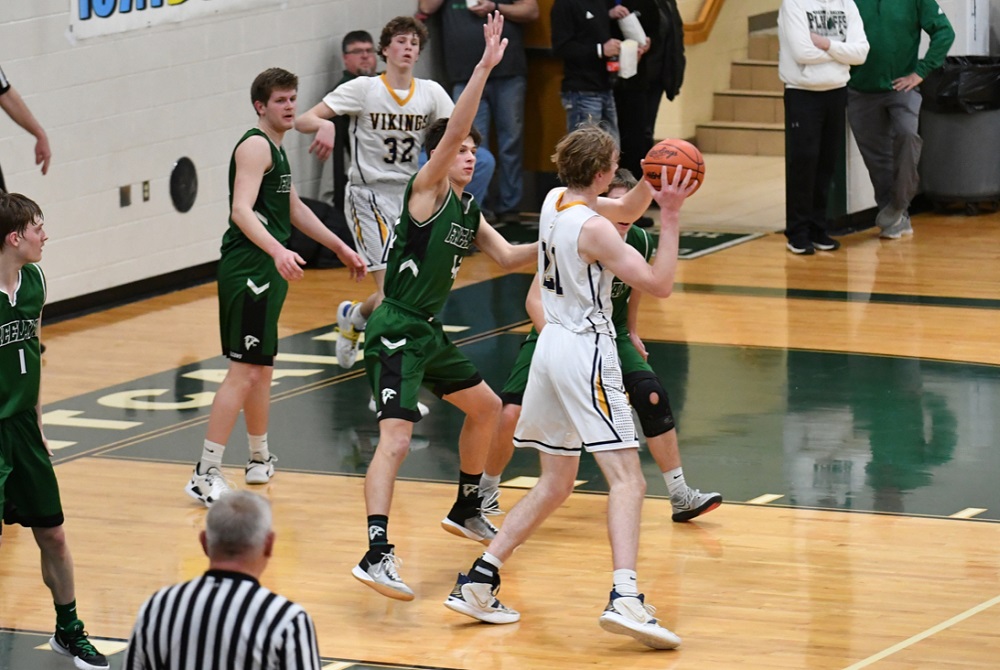
PHOTO Freeland, including Alex Duley (42), defends the lane during Tuesday’s Quarterfinal win over Cadillac. (Photo courtesy of the Freeland athletic department.)
Breslin Bound: Boys Report Week 8
January 28, 2013
By Geoff Kimmerly
Second Half editor
Eight weeks of success is enough to expect that any team still undefeated – like our top team among last week's high performers – should keep making noise over the month and a half to come.
But there's something to be said about starting anew on Jan. 1. And we've got a few on this week's list as well that have surged since the calendar year got a new start.
Remember, results and overall records below are those listed in our MHSAA Score Center. Are either incorrect? Please help us out after filling in this brief registration.
1. Big Rapids (11-0) – The Cardinals have won 20 straight regular-season games dating back to the mid-point of last winter and lead the Central State Activities Association.
2. Rochester Adams (10-1) – The Highlanders’ lone loss came against Oxford all the way back on Dec. 14; they’ve won four straight by double figures and are just two wins from equaling last season’s total.
3. Zeeland East (10-2) – The Chix are in first place by a win over two others in the O-K Black and have won four straight including beating league favorite Muskegon 67-61 on Friday.
4. Allen Park Inter-City Baptist (10-2) – Before Saturday’s 14-point loss to Detroit Country Day, the Chargers had won three straight and earlier this month edged reigning Class D champion Southfield Christian by a point.
5. Lansing Waverly (9-2) – The Warriors opened this season with losses to Holt and Jackson Lumen Christi by a combined five points, but since have won nine straight including avenging that loss to the Titans on Friday.
6. Bessemer (10-1) – The Speedboys are undefeated in-state, with their only loss to Washburn, Wis., after winning 10 games total last season.
7. Crystal Falls Forest Park (6-3) – The Trojans opened this winter with two losses, but are on a roll and edged 2012 Class D Semifinalist Carney-Nadeau on Friday, 70-67.
8. Pittsford (9-2) – The Wildcats hit a rough patch from Jan. 11-15, when they lost two games; otherwise, they’re undefeated this season.
9. Temperance Bedford (8-1) – Despite losing to Sylvania Southview of Ohio on Saturday, the Kicking Mules opened with eight straight wins and beat Ann Arbor Pioneer 56-54 the night before.
10. Canton (7-5) – The Chiefs also are running well in January with five straight wins including Friday’s 55-50 victory over Westland John Glenn which avenged their last lost before the run, 53-48 to John Glenn on Jan. 4.
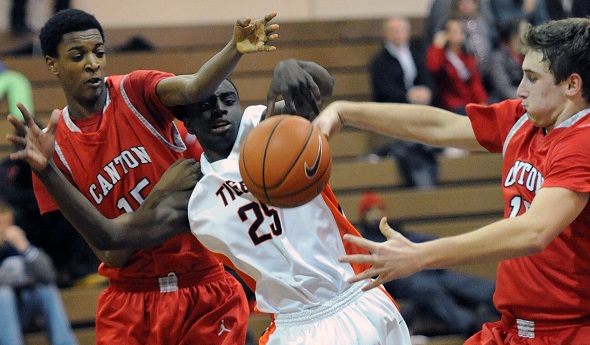
PHOTO: Canton players (in red) try to gather a loose ball during a game against Cincinnati Withrow on Dec. 28 at Detroit County Day. (Click to see more at HighSchoolSportsScene.com.)