

Detroit 'Longtime' Boys Coaches Down to Few
By
Tom Markowski
Special for Second Half
December 14, 2016
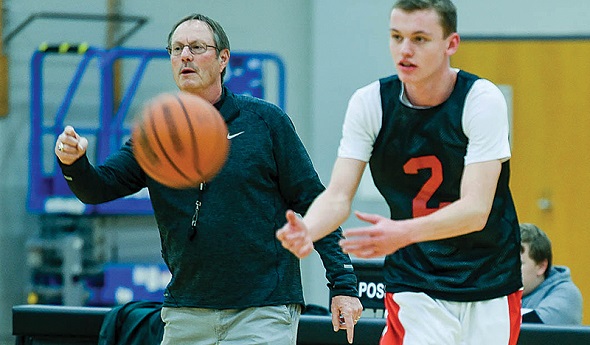
Gary Fralick considers himself one of the fortunate ones.
 Fralick, 66, is in his 32nd season as a head boys basketball coach. He retired from his teaching position in 2013. He started coaching at Redford Thurston in 1979, went to Royal Oak Kimball in 1984 and is in 23rd season as the head coach at Troy.
Fralick might be lucky, but he is unquestionably rare. Fralick is believed to be one of three coaches in the Macomb/Oakland/Wayne area who has coached for more than 30 seasons.
There’s Dan Fife at Clarkston and Kevin Voss of Clinton Township Chippewa Valley, both of whom in their 35th seasons, all at the same school.
Another, Greg Esler at Warren DeLaSalle, is in his 30th season. He was the head coach at St. Clair Shores Lake Shore for seven seasons before going to DeLaSalle in 1994.
“We’re part of a dying breed,” Voss said.
It certainly appears so. Coaching longevity has taken on a different meaning recently. Twenty seems like a lot in these times, and in reality it is a long time. Twenty years or so ago, 20 years was normal. There’s a new normal, and 20 or 25 years isn’t it.
Many factors have contributed to this change. A person’s personal and family life often don’t coincide with the demands of coaching basketball. The responsibilities that come with coaching have increased. Some coaches say that to be an effective coach, it can be a 10- or 11-month job.
Two factors are at the forefront, and they are both financial. Coaches used to be educators as well as coaches. Yes, coaching can be viewed as teaching on the court, but at one time teaching in a classroom and coaching used to go hand in hand.
 Then there’s the subsidy coaches receive. It varies from school district to school district. Some make $4,000 a season, others can make $7,000. And it also costs money to run a program; unless the coach receives financial help from a booster club or parents, the money he or she receives begins to dwindle.
But the most important factor is time.
“A tremendous amount of time is devoted to watching DVD or tapes,” Fralick said. “I know I’m dating myself with saying that. The point is, you’re watching a lot. There’s more scouting. And you don’t get paid much. Why don’t they stay as long as they used to? They get burned out. They want to spend more time with their families.
“You don’t see as many of the young coaches stay. Coaches don’t have the ambition to coach a long time. It’s not a profitable job. I don’t know what other coaches make. We used to compare what we made. Not anymore.
“Thirty years or more? I don’t see it happening. There’s the dual job thing. Things have changed. To me, it’s been a great job.”
To compensate for being away from home, Fralick brought his family with him. Sort of. He coached his son Gary, Jr., and Tim. Gary, a 1996 Troy graduate, played for his father his junior and senior seasons and Tim, a 1999 graduate, played four seasons on varsity. Fralick said he was even more fortunate to coach both on the same team (during the 1995-96 season).
Then there’s his wife, Sharon, who remains the scorekeeper.
“I’ve always had a passion for coaching and teaching,” Fralick said. “I love the game of basketball. I love the kids. There’s never a dull moment. It’s been a great ride.”
Vito Jordan has been around basketball all of his life. His father, Venias Jordan, was the boys head varsity coach at Detroit Mackenzie and Detroit Mumford before stepping down as a head coach only to return to the bench assisting his son the last six seasons.
Vito Jordan, 31, became a head coach at Detroit Osborn when he was 24. He started his coaching career the year before as an assistant to Henry Washington at Macomb College. Jordan went to Detroit Community after one season at Osborn and guided Community to its only MHSAA Finals appearance (Class B, 2013). He’s now in his fourth season as the head coach at Detroit Renaissance.
“I followed my father all of my life,” Jordan said. “I knew what I wanted to do when I was in college (Alma College). This is what I want to do the rest of my life.”
It’s different in Detroit. Schools close. Job titles change. Jordan, for instance, teaches at the Academy of Warren, a middle school in Detroit. It’s a charter school, not within the Detroit Public School system, therefore he receives his pay from two separate school systems (Renaissance is in the DPS).
There is a distinction. In some school systems coaches will receive a percentage – let’s say for argument sake, 10 percent – of their teaching salary to coach. Let’s say a person makes $60,000 a year to teach. He or she would then receive $6,000 to coach. If you coach two sports, that’s $12,000.
 Jordan is not privy to such a contract. Each job is separate. Jordan loves to coach, and he understands he must be a teacher to earn a decent living, and he’s content to continue on the path he is following. But he also knows that to make a good salary just coaching one must move on to the collegiate level like others have done.
“When there were coaches like my dad, Perry Watson (Detroit Southwestern), Johnny Goston (Detroit Pershing) and others, they all worked in the (Detroit Public) school system. Everyone was teaching. That was your career. None of them had aspirations of being a college coach. Not even Watson. Now everyone isn’t in the teaching profession. Maybe they do have a degree and maybe they don’t. The point is, most aren’t teachers. I can count on one hand those (in Detroit) who have their teaching certificate and coach.”
Jordan noted such successful PSL coaches like Derrick McDowell, Steve Hall and Robert Murphy who left high school to pursue a coaching career in college. Murphy guided Detroit Crockett to the Class B title in 2001 and is now the head coach at Eastern Michigan. McDowell has had two stints as a collegiate assistant coach, most recently at EMU. He’s since returned to coach at Detroit Western. Hall coached Detroit Rogers to three consecutive Class D titles (2003-05) before going to Duquesne University and Youngstown State as an assistant coach. Hall returned to Detroit last season and is in his second season as head coach at Detroit Cass Tech.
Jordan said they left high school to challenge themselves professionally, among other considerations. Voss said there are variables that influence how long a person lasts, in one school district or in coaching in general, that didn’t exist 20 years ago.
“Athletics have become pervasive in high school,” he said. “The whole booster situation you find in college is here. You can be winning but not winning enough. It’s a trickle down affect.
“Coaches complain about parents. Parents complain about playing time. High school sports is not as pure as it once was. Winning is way more important now. Now a coach comes in with a three-year window. You can have one or two down years, and the third you’d better win.
“Then there’s the pressure on your family. I’ve been lucky. My wife and I have had the players over for team dinners. We create a family atmosphere. It’s a change of society. I don’t envy the young coaches coming in.”
Community involvement has always been a priority for Voss. To keep a hand on the pulse, Voss heads the elementary basketball program within the Chippewa Valley school district. Games are held on Saturdays, and approximately 750 students take part.
“You have to have the right fit,” he said. “I’m in the right spot. You coach for different reasons when you get older. I’m enjoying the game. There’s a different level of satisfaction.”
 Tom Markowski is a columnist and directs website coverage for the State Champs! Sports Network. He previously covered primarily high school sports for the The Detroit News from 1984-2014, focusing on the Detroit area and contributing to statewide coverage of football and basketball. Contact him at [email protected] with story ideas for Oakland, Macomb and Wayne counties.
PHOTOS: (Top) Troy boys basketball coach Gary Fralick, left, is in his 32nd season coaching. (Middle) Detroit Renaissance boys coach Vito Jordan is following in the coaching footsteps of his father, Venias. (Below) Chippewa Valley boys coach Kevin Voss, left, is in his 35th season at his school. (Top and below photos courtesy of C&G Newspapers; middle photo courtesy of Detroit Public School League.)
Breslin Bound: Boys Quarterfinal Preview
March 21, 2016
By Geoff Kimmerly
Second Half editor
The final week of the 2015-16 boys basketball season finds five undefeated teams among the 32 set to play Quarterfinals on Tuesday.
And they're joined by a number of others playing in this final week for the first time, or at least the first time in a long time.
See below for a glance at all 16 Quarterfinals and come back to Second Half all week for team-by-team previews of the semifinalists and coverage of all 12 games plus video highlights from the Breslin Center this weekend.
All games Tuesday tip off at 7 p.m. unless noted.
Class A
Ypsilanti Community (22-1) vs. Detroit U-D Jesuit (25-0) at University of Detroit Mercy (5 p.m.)
This might be the spotlight game statewide on this night with a pair of elite seniors facing off – recently-crowned Mr. Basketball Cassius Winston of U-D Jesuit and award finalist Corey Allen of Ypsilanti Community. Allen is averaging just above 23 points per game, while Winston leads the Cubs with 21.2 and 7.2 assists per game.
Macomb Dakota (25-0) vs. Midland (17-6) at Grand Blanc
Both programs will take significant strides just by stepping on the floor. Dakota, long seen as a Class A contender this winter, will play in its first Quarterfinal, while surprise Midland will make its first appearance since 1979. Junior Jermaine Jackson paces the Cougars at 21 points per game, while senior Payton DeWildt scores 16.7 to lead the Chemics.
North Farmington (22-2) vs. Sterling Heights Stevenson (20-3) at University of Detroit Mercy
North Farmington also is making its first Quarterfinal appearance, also led by a standout guard, senior Billy Thomas at 21 points per game. Stevenson is back in the final week for the first time since 1983, led by a trio of seniors averaging between 11-13 ppg: Mylon Weathers, Vince Ramaci and Luke Lamoreaux.
Lansing Everett (15-10) vs. Hudsonville (19-5) at Lansing Eastern
This Quarterfinal pits two of the biggest upset producers of the Regional Finals – Lansing Everett, which downed undefeated East Lansing after falling to the Trojans twice during the regular season, and Hudsonville, which upended annual power Muskegon. Both are anchored by senior guards, the Eagles by 6-foot-5 Riley Costen (17 ppg) and the Vikings by 6-3 Jamyrin Jackson (16.8 ppg).
Class B
Detroit Henry Ford (17-6) vs. New Haven (22-2) at St. Clair Shores Lake Shore
Last season’s Class B runner-up, Ford has won 12 of its last 14 games with senior guard James Towns leading the way at 23 points and 5.7 assists per game. New Haven lost to Ford 61-55 in a Quarterfinal a year ago but has a difficult trio to stop in 6-11 senior Innocent Nwoko (10.6 ppg, 10 rpg), 6-4 junior Eric Williams, Jr. (17.5 ppg), and 6-6 freshman Romeo Weems (15.5 ppg, 10.8 ppg, 4.6 apg).
Williamston (20-3) vs. River Rouge (22-3) at Charlotte
Williamston is playing with one of the state’s leading scorers in senior guard Riley Lewis (28.6 ppg) and some added inspiration after coach Jason Bauer left the team recently to undergo cancer treatments. River Rouge has one of the most storied programs in MHSAA history and is seeking to return to the Semifinals for the first time since 1999 and follow up the football team’s runner-up finish in the fall.
Essexville Garber (17-8) vs. Big Rapids (22-2) at Bay City Central
Garber has won Regional titles both seasons under second-year coach Chris Watz, who took over after two seasons as an assistant at Olivet College. Junior forward Demetri Martin (19.5 ppg, 8.8 rpg) leads a Big Rapids team that has won Regional titles three of the last four seasons.
Stevensville Lakeshore (18-7) vs. Hudsonville Unity Christian (16-8) at Vicksburg
Lakeshore is back in its first Quarterfinal since 2013 led by 6-11 senior center Braden Burke, who averages 15.9 points and 10.8 rebounds per game. Unity Christian is playing in its first Quarterfinal since 2008, also keyed by a post player, 6-4 senior forward Mitchel Takens (15.7 ppg, 5.7 rpg).
Class C
Kalamazoo Hackett (24-0) vs. Grandville Calvin Christian (19-4) at Bangor
Hackett has rarely been tested with only two games in single digits on the way to its first Quarterfinal since 1969. Senior guard Dane Preston leads a solid group of scorers at 18.6 ppg. Calvin Christian is making its deepest run since 2010 and can top 20 wins for the fourth time in eight seasons if senior Tony DeWitte (18.2) and teammates can lock up one more.
McBain (25-0) vs. Ishpeming Westwood (12-12) at Petoskey
McBain has had a number of fantastic runs under 22-year coach Bruce Koopman, but none that’s seen the Ramblers undefeated this late. Craig Sterk, Cole Powell and Logan Eling all score between 14-15 points per game. Westwood’s surprise run has it playing its first Quarterfinal since 2003 while riding the hot hands of an all-senior lineup.
Flint Beecher (22-2) vs. Ithaca (23-2) at Troy Athens
Reigning Class C champion Flint Beecher is playing for its fourth championship in five seasons and riding a 16-game winning streak. Ithaca, meanwhile, is playing in its first Quarterfinal since 1956 – but won’t be intimidated led in part by three starters who played prominent roles on the Division 6 championship football team.
Hanover-Horton (23-2) vs. Detroit Loyola (20-5) at Tecumseh
Hanover-Horton has won 15 straight District titles and returned to the Quarterfinals last season, advancing all the way to a Semifinal against Beecher. Loyola is known much more for football as a regular finalist at Ford Field, but will make its first Quarterfinal appearance in hoops after downing 18-win Detroit Allen Academy and Riverview Gabriel Richard and 21-win Monroe St. Mary Catholic Central along the way.
Class D
Wyoming Tri-unity Christian (19-5) vs. Adrian Lenawee Christian (17-7) at Coldwater
Wyoming Tri-unity Christian has been a near-regular during the final week, but is seeking to advance to the Semifinals for the first time since 2013. Senior guard Willie Otole leads at 15.1 ppg. After finishing Class D runner-up in 2014, Lenawee Christian fell to .500 last winter, but is back in contention led by sophomore 3-point ace Trey Helinski (14 ppg).
Waterford Our Lady (20-4) vs. Marine City Cardinal Mooney (17-7) at West Bloomfield
Our Lady brings back three starters this week from the team that missed the Class D Final a year ago by a point – including senior guard Andrew Kline (18.5 ppg). Cardinal Mooney will make its second Quarterfinal appearance and first since 2010, led by sophomore guard Daniel Everhart at 17.2 ppg.
Fulton (18-6) vs. Bellaire (24-1) at Traverse City West, 6 p.m.
The Pirates will play in their second straight Quarterfinal and are led by senior guard Colton Antes, who is set the graduate as one of the top 3-point shooters in MHSAA history. Bellaire’s only loss this season was to eventual 20-win Class C East Jordan. The Eagles start four seniors and rely on three more off the bench.
Onaway (21-4) vs. Powers North Central (25-0) at Sault Ste. Marie
Onaway has put together an impressive rise, adding to its win total the last five seasons under coach Eddy Szymoniak after the team went 1-20 in 2011 in his debut. The Cardinals could add their biggest highlight yet by taking down reigning champion North Central, which hasn’t lost since 2015.
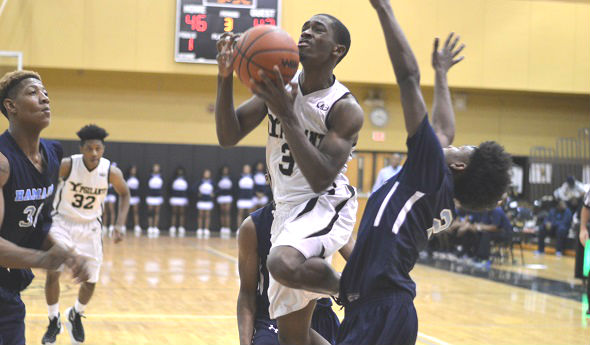
PHOTO: Ypsilanti Community takes on Macomb Dakota in one of the state's most anticipated Quarterfinals on Tuesday. (Photo by Betsy Howell.)