

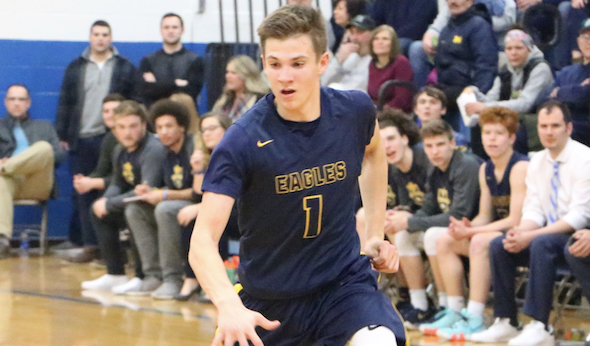
Erie Mason Climbs to Championship Level
February 15, 2019
By Doug Donnelly
Special for Second Half
ERIE – When Kevin Skaggs was named the boys varsity basketball coach at Erie Mason, he immediately got on the phone and started asking questions.
 After more than two decades coaching basketball, Skaggs was about to embark on something new – high school basketball.
“All of my 22 years was in college coaching,” he said. “I reached out to a lot of different high school coaches, coaches that I had known over the years. … It’s mind-boggling how you have to fit all of the pieces together to build a program.”
Whatever those coaches told Skaggs, he should box it up and sell it.
Skaggs took over an Erie Mason program that occasionally had success but was often the team on the schedule other schools wanted to face. Those days are just a memory now. In his eighth season, Skaggs has become the school’s all-time winningest coach, recently leading the team to its first-ever outright Lenawee County Athletic Association championship. His team also is in the midst of a 13-game winning streak, the longest in school history.
What’s more is the success doesn’t appear to be a blip on the screen. Mason has had five consecutive winning seasons for the first time in school history and its top scorer – the top scorer in Monroe County – is just a junior.
“I think we are starting to make (other schools) believe,” Skaggs said. “We want to be one of those opponents that when we walk into the gym, other teams say, ‘oh, no,’ instead of ‘oh, boy.’”
Those days are here. Earlier this week, Mason knocked off Petersburg-Summerfield, 64-44, in a non-league game. The Bulldogs came into Erie with a 15-0 record and a top 10 ranking in the Associated Press poll but were handled by the Eagles.
Mason followed that win with an 89-50 victory Thursday over Hudson to clinch the outright LCAA championship, the first since they joined the LCAA in 1988.
Erie Mason has a Saturday date this week with LCAA rival Dundee with a chance to improve to 15-2 on the season. Mason hasn’t won 15 games in a season since 2003-04 and has done so only three times since the school debuted in 1961-62.
All of the wins, high-powered offenses (Mason averages 67 points a game and has made 126 3-pointers as a team) can be traced back to when Skaggs first got to Mason and, on the advice of coaching friends, started a youth basketball program, the Junior Eagles. Those first-year kids eight years ago are now the ones Skaggs sees in the huddle during timeouts.
“They are from that first group of our youth program, and you can get a sense of that,” he said. “They love basketball. That was a big step for us.”
Skaggs, 63, brought together others in the community to put together the youth program for boys and girls. While Mason has had success in other sports – the football team won the Class C championship in 1987 – basketball had lagged behind. Now, he said, that culture has changed. It happened, he said, because student-athletes started loving the game of basketball.
“What you want to teach is to teach them to have fun with the game,” he said. “If you get the kids to fall in love with the sport, they will pursue it. You want to be able to keep kids interested and with a ball in their hands.”
The program aims at teaching the game, making sure kids have fun and, then, around the fifth- and sixth-grade level, increase the competitiveness. By middle school, the basketball players are able to compete with other teams on the Mason schedule. By high school, they are used to success and hungry for more.
“Our eight-grade team had a tremendous year, and our seventh-grade team was pretty good,” Skaggs said. “It’s starting to cycle through, which is wonderful to watch.”
Skaggs also said he’s noticed that athletes aren’t leaving the district to go play for other schools like was once the case.
“We’re keeping our players in our school,” he said.
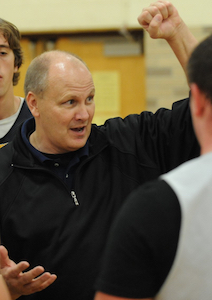 Skaggs earned his master’s degree in sports administration and bachelor’s degree in social work at Western Michigan University, where he met coach Dick Shilts. He was directing Christian-based basketball camps in Michigan and Ohio before becoming an assistant coach at Kalamazoo Valley Community College under Shilts and enjoying monumental success. After six years there, he became head coach at Alma College from 1995 to 2001, going 53-98. His second Alma team went 14-12 and won a Michigan Intercollegiate Athletic Association tournament game for the first time in school history. After moving to Erie, Skaggs got an assistant coaching job at Owens Community College in northwest Ohio. He was an assistant five years with the Express, including three years as a volunteer coach, before becoming the head coach.
In 2011, he was named the head coach at Erie Mason, a school just north of the Ohio border that had just a handful of winning seasons in its history.
“Mason was a no-brainer. I was 55 and getting a little tired of getting on a bus and going three to four hours away for a game,” he said. “Plus, my son was playing and I was missing watching him.”
His family has been a major part of his run at Mason. Sons Isaac and Jacob have both either played or coached with him his entire time at Mason.
“What’s a better place to start than with your family?” he said.
He also found community members Tom Banachowski and Brad Liedel to serve as assistant coaches. He delegates what he calls “meaningful responsibility” to his assistants to help the workload and to build continuity in the program. One thing he doesn’t delegate is the Eagles’ offense.
“I’m greedy when it comes to offense,” he said. “That’s mine. There’s nothing like watching an offense that moves the ball and goes. It’s exciting and fun to watch.”
For the past couple of seasons, the Eagle most fun to watch has been Joe Liedel. The 5-foot-11 junior recently moved into second place on the school’s all-time scoring list. With 1,229 points through 16 games this season, he’s well within reach of the school’s career leader, J.P. Horne (1,455 points).
“If Joe Liedel was 6-foot-3, every Division I school would be calling on him,” Skaggs said. “He’s one of the most complete kids I’ve coached in 35 years – and I don’t say that easily.”
Liedel has been sensational this season. He’s the top scorer in the LCAA, and has had games of 41, 37, 37, 34 and 31 while shooting 51.4 percent from the floor, 86.9 percent from the free throw line and leading the team in assists and steals.
“He’s really a complete player, offense and defense,” Skaggs said. “When he thinks there is a weakness in his game, he identifies it and works on it. He’s always been good at shooting, but now he can get to the basket. It adds to his game.”
Liedel isn’t a one-man show, however. Senior Jake Trainor averages 13.6 points a game, while senior brothers Bryan Sweeney (10.6 points a game) and John Sweeney (8.3 points, 6.3 rebounds a game) have played major roles as well.
When they get to the postseason, Erie Mason will be trying to win its first District championship in 46 years. The 1972-73 team won District and Regional championships. It won’t be easy as the Division 3 District at Blissfield is loaded with talented teams, including Summerfield (15-1), perennial power Monroe St. Mary Catholic Central (11-3) and Clinton, which just knocked off 10th-ranked Quincy.
Skaggs is drawing on his college coaching days to keep his players focused on next-level goals.
“Our first goal was to win the LCAA, and we’ve done that,” he said. “Next, it’s the District. Every game we play in now is a test to get ready for the state tournament. You have to keep the focus on one game at a time. We’ve been able to do that. We’re still having fun.”
 Doug Donnelly has served as a sports and news reporter and city editor over 25 years, writing for the Daily Chief-Union in Upper Sandusky, Ohio from 1992-1995, the Monroe Evening News from 1995-2012 and the Adrian Daily Telegram since 2013. He's also written a book on high school basketball in Monroe County and compiles record books for various schools in southeast Michigan. E-mail him at [email protected] with story ideas for Jackson, Washtenaw, Hillsdale, Lenawee and Monroe counties.
PHOTOS: (Top) Joe Liedel moved into second place on the Erie Mason all-time scoring list this season. (Middle) Coach Kevin Skaggs has led the Eagles to rare success including an outright league title this season. (Top photo by Vanessa Ray.)
Breslin Bound: 2025-26 Boys Quarterfinal Preview
By
Geoff Kimmerly
MHSAA.com senior editor
March 10, 2026
One. More. Win.
That’s all that’s needed as 32 boys basketball teams take the floor tonight for Quarterfinals across the state and with a trip to East Lansing and Breslin Center on the line.

Below are quick glances at all 16 matchups. Games tip off at 7 p.m. unless noted. Details on tickets, brackets and more can be found on the Boys Basketball page. To watch all 16 games online, visit the NFHS Network.
“Breslin Bound” is powered by MI Student Aid and based on results and schedules posted for each school at MHSAA.com. (Abbreviations below denote ppg - points per game, rpg - rebounds per game and apg - assists per game.)
Week in Review
The countdown of last week’s five most intriguing results:
1. Grand Rapids Northview 52, East Kentwood 50 Cam Ryans drilled a buzzer-beating 3-pointer to send Grand Rapids Northview (22-4) past East Kentwood (22-3) in a Division 1 Regional Final.
2. Harbor Beach 64, International Academy of Flint 62 (2 OT) Harbor Beach (23-3) won its first Regional title, edging IAF (19-5) in Division 4.
3. Colon 49, Battle Creek St. Philip 40 The Magi (22-4) also clinched their first Regional title, in Division 4, by adding to two regular-season wins over St. Philip (16-9).
4. Onsted 42, Ecorse 40 Onsted (24-2) clinched its first Regional title since 1983, advancing in Division 3 with a close win over Ecorse (19-6).
5. Onekama 46, Traverse City Christian 40 Onekama (17-10) handed Traverse City Christian (25-1) its only loss in a Division 4 Regional Final.
Quarterfinals at a Glance
DIVISION 1
Rockford (22-3) vs. Grand Rapids Northview (22-4) at Hudsonville
These two met Jan. 31 at the 2K26 Showcase, with Rockford winning 48-45. Senior 6-foot-6 forward Jake Bascom is a tough matchup averaging 17.7 points and 7.1 rebounds per game. But so is Northview senior guard Cam Ryans, a Mr. Basketball Award finalist averaging 24.2 points, 7.6 rebounds and 3.3 assists per contest.
Auburn Hills Avondale (25-1) vs. Roseville (19-6) at Detroit Mercy
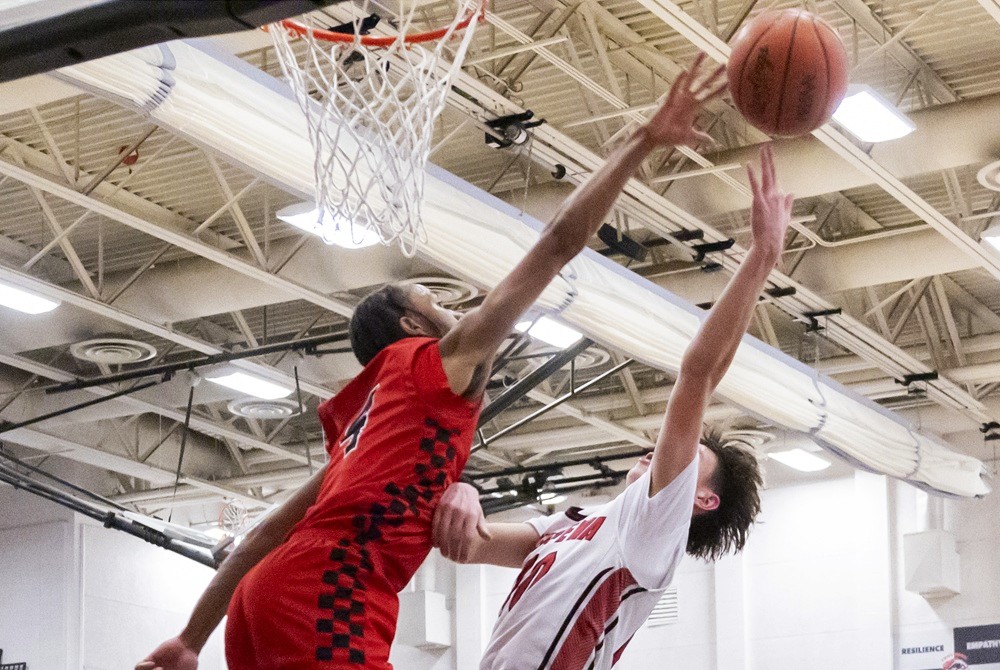
Avondale is coming off its first Regional title since 2002 with senior forward Jakobe Liford (15.2 ppg, 7.5 rpg) leading three players averaging double-digit scoring. Roseville last won a Regional in 2019 and returns to the season’s final week with junior guard Terrell Owens (17.3 ppg, 3.5 apg, 3.9 spg) setting the pace.
East Lansing (25-1) vs. Ann Arbor Pioneer (21-4) at Lansing Eastern’s Don Johnson Fieldhouse
Reigning Division 1 champion East Lansing celebrated senior guard KJ Torbert winning the Mr. Basketball Award on Monday, and he’s an especially impressive shooter making 52 percent of his shots from the floor – including 39 percent of his 3-point tries – on the way to averaging 25 points per game. Pioneer is back at the Quarterfinals for the first time since 2007, with senior guard Jordan Harrison a potent scorer (18.1 ppg) and distributor (3.9 apg).
Wayne Memorial (23-3) vs. Bloomfield Hills Brother Rice (21-5) at Detroit Mercy, 5:30 p.m.
The Zebras are also playing for a return trip to Breslin after finishing Division 1 runner-up a year ago, and they’re also led by a Mr. Basketball Award finalist in senior guard Jaylohn Allen (23.3 ppg, 6.0 apg). Brother Rice won its second Regional title over the last three seasons, keyed by a high-powered backcourt of senior Greg Grays (14.9 ppg) and freshman Jordan McDaniel (19.3 ppg).
DIVISION 2
Ludington (24-2) vs. Freeland (23-3) at Mount Pleasant
Junior guard Taj Williams (18.8 ppg) and senior forward Cameron Gunsell (18.2 ppg) have led Ludington to the Quarterfinals for the first time since 2017, as the Orioles advanced with a Regional Final win over 2025 semifinalist Kingsford. Freeland has won nine straight games to reach the Quarterfinals for the second consecutive year. Senior guard Wilson Huckeby is making almost 39 percent of his 3-pointers, drilling 81 this season while averaging 18.9 points per game.
Chelsea (20-5) vs. Romulus Summit Academy North (25-1) at Ypsilanti Lincoln, 5:30 p.m.
Summit is one win away from returning to Breslin after finishing Division 2 runner-up a year ago, its only loss to an Ohio opponent and with three players averaging double-digit points per game led by senior guard Jordan Fuller at 15.4. Chelsea has won nine of its last 10 games, with a big one over Lansing Sexton (23-3) in a Regional Final. Freshman Drew Cabana is averaging 21.8 points per game and senior Buck Allen adds 17.4 – and both have made at least 50 3-pointers.
Detroit University Prep (16-9) vs. Detroit Country Day (19-7) at Detroit Renaissance
University Prep has won nine of its last 10 games and edged reigning champion Warren Lincoln by two points in their Regional Final to reach this week. Senior guards Chris Byrd and Maurice Jackson are a 6-5 tandem averaging 19.6 and 14.6 ppg, respectively. Country Day has made a jump from 11-12 a year ago, winning nine of its last 10 games with junior guard Christian Cast (20.9 ppg) and 6-6 junior forward Isaiah Moreno (16.5) setting the pace.
Grand Rapids Catholic Central (20-6) vs. Hudsonville Unity Christian (23-3) at Hamilton
Grand Rapids Catholic Central is playing in its third-straight Quarterfinal and reached the Semifinals a year ago, and can turn to senior guards BB Watkins (14.4 ppg) and Jordan McCoy (15.5 ppg) for scoring punch. Unity Christian has won 19 of its last 20 games, its only defeat during that time against Freeland, and has five players averaging between 7-12 ppg topped by senior guard Brogan Sherd (12.2), who also has made 61 3-pointers.
DIVISION 3
Arts & Technology Academy of Pontiac (17-3) vs. Harbor Beach (23-3) at St. Clair County Community College
ATAP is a game away from a Breslin return as well after finishing Division 3 runner-up last season, and the Lions will take on a first-time Regional champ in Harbor Beach. Sophomore point guard Lewis Lovejoy paced last year’s ATAP run and leads again at 26.5 points and 7.6 assists per game. Senior guard Benson Harper leads three Harbor Beach players scoring in double digits at 17.3 ppg, and he and senior forward Skiler Krus (13.2 ppg) were also among stars on the Pirates’ Division 8 football championship team.
Menominee (22-4) vs. Beal City (24-2) at Boyne City
After a year away, Menominee is playing in its second Quarterfinal in three seasons and third over the last five – in part thanks to avenging a regular-season loss to 2025 semifinalist Ishpeming Westwood in their Regional Semifinal. Senior forward Tanner Theuerkauf quarterbacked the Division 7 football championship team and leads at 17.8 ppg, with senior guard Darren Butler at 15.2. Beal City is playing in its first Quarterfinal since 2013 and has reached 20 wins three straight seasons. Junior guard Cuyler Smith (15 ppg) leads three players averaging at least 11 points per game.
Flint New Standard Academy (20-4) vs. Onsted (24-2) at Ypsilanti Lincoln
New Standard is playing in its second-straight Quarterfinal and with its only losses this season to teams that all reached Regional Finals. Sophomore guard AJ Smith (12.4 ppg) and senior guard Jeffery Turner (12.0) lead four players averaging at least 10 ppg. As noted above, Onsted is back in the season’s final week for the first time in more than four decades, and after just missing with some very strong teams over the last 10 years. Mason Chesser (13.9 ppg) leads four averaging at least nine points per game who have helped the Wildcats push through.
Pewamo-Westphalia (24-2) vs. Schoolcraft (16-10) at Kalamazoo Loy Norrix
These two have met two other times in Quarterfinals this decade, with P-W advancing last season with a 50-45 victory. The Pirates have been regulars at this stage with this their fourth Quarterfinal over the last five seasons. Grady Eklund sets the pace for P-W at 20.7 points and 3.5 assists per game. Senior 6-10 forward Jimmy Miller leads three Schoolcraft players scoring at least 15 ppg with 19.3, plus nine rebounds per contest, and junior guard Kodee Bienz (15.1 ppg) has drilled 68 3-pointers.
DIVISION 4
Dollar Bay (23-2) vs. Pickford (25-0) at Gladstone
These two guarantee at least one Upper Peninsula team will be heading downstate, with Pickford making the attempt after losing a Quarterfinal last year by two points and Dollar Bay seeking its first Breslin trip since 2018. Gunner Bennin averages 19.1 points, 7.4 rebounds, 3.7 steals and 3.5 assists per game for the Panthers. Senior forward Liam Tourtillott (20.2 ppg, 73 3-pointers) and junior guard Baron Colbert (16.9 ppg) are strong perimeter options for Dollar Bay.
Detroit Douglass (19-7) vs. Waterford Our Lady of the Lakes (19-6) at West Bloomfield, 6 p.m.
Douglass has made its run after tying for second in a Detroit Public School League Blue filled at the top with Division 1 teams, and defeated 2025 semifinalist Allen Park Inter-City Baptist in a Regional Semifinal last week. Freshman guard Damani Oliver averages 22.5 ppg and senior guard Jeremiah Thurman adds 16.1. Our Lady started this season 2-4 but has surged since the start of January, with senior center Jack Miller (12.4 ppg, 7.2 rpg) and senior forward Latane Ware (11.3 ppg) pacing a balanced attack.
Colon (22-4) vs. Concord (22-4) at Portage Northern
As noted above, Colon is coming off its first Regional title, and the Magi also defeated league rival Mendon (22-2) in a District Final. Seniors forwards Dalton Williams (22.1 ppg) and Quincy Blair (17.7) lead four players averaging double-digit scoring. Concord is coming off its first Regional title since 1990 and has celebrated senior guard Jett Smith and senior forward Connor Stevens both reaching 1,000 career points this winter.
Onekama (17-10) vs. Wyoming Tri-unity Christian (24-1) at Big Rapids
Onekama stunned previously-undefeated Traverse City Christian with a 46-40 Regional Final win to advance to the season’s final week for the first time since 1997, and the Portagers now get to take on the reigning Division 4 champion Defenders. Center Luke Bradford sets the pace at 15 ppg and is one of three senior starters. Tri-unity has replaced four starters from last season’s title winner, with the lone returner junior center Cody Osbun leading at 12.4 points, 7.8 rebounds and 3.2 assists per game.
MHSAA.com's weekly “Breslin Bound” reports are powered by MI Student Aid, a division within the Department of Lifelong Education, Advancement, and Potential (MiLEAP). MI Student Aid encourages students to pursue postsecondary education by providing access to student financial resources and information. MI Student Aid administers the state’s scholarship and grant programs that help make college Accessible, Affordable and Attainable for you. Click to connect with MI Student Aid and find more information on Facebook and X @mistudentaid.
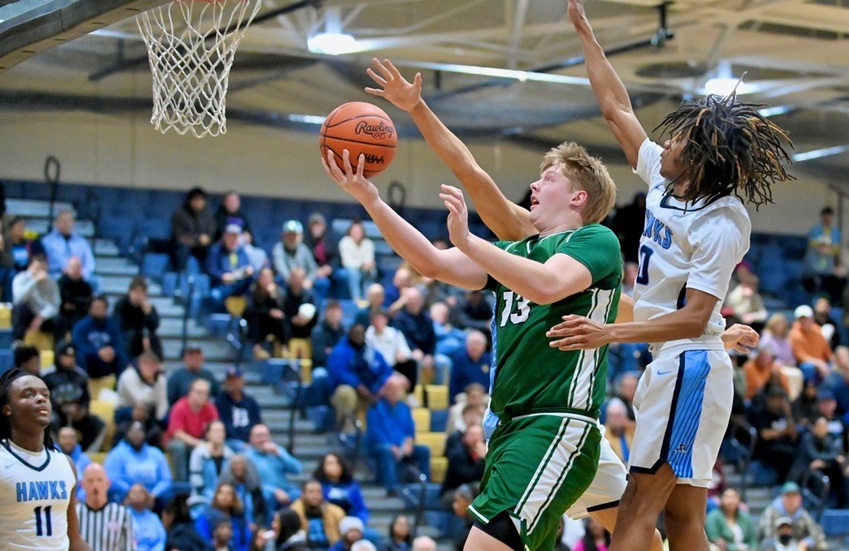
PHOTOS (Top) Roseville’s Terrell Owens (4) blocks a shot during his team’s 71-68 overtime win over Clinton Township Chippewa Valley in last week’s Regional Semifinal. (Middle) Freeland’s Tristan Comer (13) scoops a shot during the Falcons’ Regional Final win over Flint Hamady. (Roseville/Chippewa Valley photo by Adam Sheehan. Freeland/Hamady photo by Terry Lyons.)