

Erik O, Legend on the Microphone
By
Geoff Kimmerly
MHSAA.com senior editor
March 21, 2013
One of Erik O. Furseth’s favorite moments every March – perhaps the one he looks forward to most – comes during the hour before each MHSAA Basketball Semifinal.
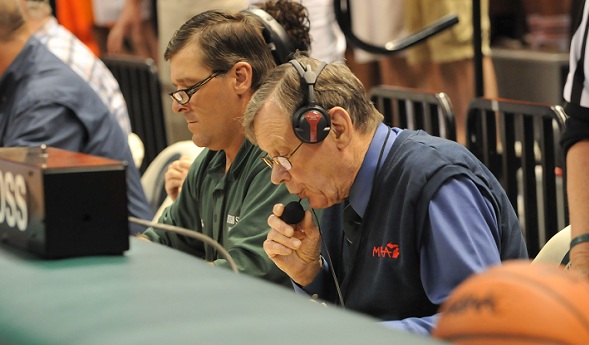
From his familiar seat on press row, Furseth has called hundreds of Michigan State University and MHSAA Finals basketball games.
But the opportunity for high school teams to play at Breslin Center is not lost on him, especially as he watches players and fans enter the arena for the first time.
“(It’s) the kind of awe that overtakes people when they come there,” Furseth explained earlier this month. “The enthusiasm reflected on the kids there and so on.
“What a thrill for those kids to come and play a ballgame there.”
Now imagine Furseth saying this with the voice that’s become legendary to generations of basketball fans across this state.
Furseth, 82, has been a member of the MSU basketball family for more than 60 years. A player first, he since served as the homecourt voice of MSU basketball from 1968-02 and MSU football from 1971-98, and this weekend is continuing a run of calling MHSAA Boys Basketball Finals that began more than four decades ago while those games still were played at Jenison Field House.
Some of his phrases are on ready recall for those who have sat in his audience.
“The clock is correct and official.”
“Yesssss … on the basket!”
“Heeeee gets the bonus.”
Last weekend, Furseth also called his sixth MHSAA Girls Basketball Finals, and he’s announced MHSAA football championship games since their days at the Pontiac Silverdome and Baseball Finals for a decade. Furseth also just finished his third season as voice of Traverse City St. Francis football and girls and boys basketball.
“Erik is able to make that job not just a game, but an event,” St. Francis athletic director Tom Hardy said. “To have somebody of his caliber, with his recognition, in a small gym in Traverse City … whether there are 100 people or it's standing room only, it’s so great to know the professionalism of that is taken care of. He just understands kids.”
Furseth moved from East Lansing to Traverse City 18 years ago. That he would find his way to the microphone in his new hometown makes sense. But that it became the tool of his trade the last half-century certainly would be considered a detour from his original plan when Furseth turned down a chance to play football for Woody Hayes so he could study forestry in East Lansing.
Life-changing moments
“Erik O. on the radio” was the voice of Lansing rock-n-roll radio during the 1950s and 60s.
“He was the number one disc jockey in this area before they were called disc jockeys,” said Lansing WILX sports director Tim Staudt, who grew up in East Lansing and has worked in mid-Michigan television for four decades and as a daily radio host for 20 years.
“He has the all-time greatest voice, and obviously it's held up to this day.”
Furseth grew up in Cleveland Heights, Ohio, and got to know Hayes while the soon-to-be-legendary coach was finishing his tenure at Denison University. Hayes hoped Furseth, a high school football standout, would become part of the coach’s first recruiting class after taking the job at Miami (Ohio) before the 1949 season.
But Furseth, who had vacationed in Michigan growing up, was drawn to MSU’s forestry program. So he made a trip to campus – picked up by then-assistant Duffy Daugherty for a visit with head coach Biggie Munn – and was sold on coming to East Lansing instead.
It didn’t take long for his future to turn in an unplanned direction.
Furseth was injured his first fall with the Spartans, and he never played a down of college football. But at that time, MSU sent all freshmen who had played high school basketball a card encouraging them to try out for the Spartans’ freshman hoops team. Furseth, also a 6-foot-3 post player in high school, not only made that MSU team but played three seasons on the varsity under another future coaching legend – Pete Newell, who would go on to lead teams to NCAA and Olympic championships. Furseth played in MSU’s first Big Ten game, against Northwestern in 1951.
 It was during sophomore year that Furseth’s academic future also changed lanes. Forestry students were required to take a soil science class offered only during the winter and from 3-5 p.m. – a conflict with Furseth’s basketball commitments. He dropped the class, dropped the major, and as a junior switched course of study to communications.
MSU basketball’s announcer at that time, Larry Friedmeyer, was among a few who took note of Furseth’s deep and authoritative tone, and suggested he audition for the campus’ WKAR radio station. Furseth was hired at 75 cents an hour to host a few nights each week of “The Concert Call,” a classical music program, and later that year joined local station WILS to read the evening news. After serving in the Air Force, Furseth returned to WILS – and a star was born.
Furseth was a DJ for WILS for 14 years. On Saturdays for a decade, he hosted dances at the Lansing Civic Center that drew 1,000 teenagers a night – and one evening, included a surprise drum performance by a famous student at the local Michigan School for the Blind, known then as Little Stevie Wonder.
Furseth later managed WILS from 1956-68. “Being the manager made it no fun anymore,” Furseth noted.
He left for a job outside of radio. But the fun returned when his announcing career began.
Erik O on the microphone
The “O,” by the way, stands for Olaf. Furseth’s parents are from Norway. “Erik O” was a smooth radio name early in his career when he was filling in for mentor Dave Froh – “Erik O for Dave Froh” – so it stuck.
In his role at a basketball game, Erik O admittedly doesn’t see much of it – at least, as a fan might. He can say his top three MSU players during his time as announcer were Scott Skiles, Magic Johnson and Johnny Green. But for the most part, Furseth focuses on the factual information he must supply with every substitution, foul and break.
He found that winning formula long ago.
“He’s just a nice guy – and nice guys don’t usually last on the air as long,” said Lansing sports radio personality Earle Robinson, who recently retired after 39 years at WKAR. “He’s always had good relationships and such a pleasant personality.”
“You’d never know he was a basketball player or anything. He’s very free of any ego, very helpful to people and generous of his time,” said longtime MSU men’s basketball broadcaster Gus Ganakas, who formerly coached the Spartans from 1969-76 and was an assistant on Furseth’s freshman team.
“And particularly in basketball, he knew what he was doing. He’s a former player and has a background as an athlete, and he has a pleasing voice. I’ve always admired him because of his devotion to what he’s doing.”
High school sports are high on that list.
Furseth enjoys announcing the seventh and eighth grade football teams that play at Traverse City’s Thurlby Field – “They think they’re big time,” he said – and finds it incredible how much the high school teams can improve over the course of a season.
He relishes the camaraderie he sees at Class C St. Francis, and wishes he’d attended a similarly-small school himself. To a player who was wearing his former number, he said, “You’re wearing my number. Do it right.” And the St. Francis boys basketball team felt at home at Breslin Center in 2012, when it finished runner-up to Flint Beecher while a familiar voice called the action.
Furseth recalled earlier this month. “Really, for me, high school (sports) exemplifies the development of our kids athletically and in many other ways. You learn a lot of things in athletics.”
“When I think about my life, to think something I started led to doing this; I’m thrilled that it happened,” Furseth said of returning to another Finals. “It’s always been a great thrill for me to do it.”
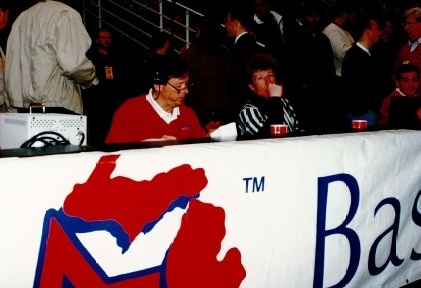
PHOTOS: (Top) Erik O. Furseth calls the Saginaw/Rockford Class A Boys Basketball Final last season at Breslin Center. (Middle) Furseth prepares to call another game during the 1999 Boys Finals weekend at Breslin.
1st-Year Coach Brings Winning Experiences
January 18, 2018
By Dennis Chase
Special to Second Half
TRAVERSE CITY – Like dramatic finishes?
 Travis Schuba has experienced his share.
As a junior in high school, Schuba dropped a buzzer-beating shot from the corner, as he was falling out of bounds, to give Kalkaska a stunning 48-47 Class C District basketball win over second-ranked Traverse City St. Francis in March of 2009. The Gladiators were 19-1 at the time.
That shot is one of the most memorable in Kalkaska history.
During the winter of 2011, as a sophomore at Madonna University, Schuba drained another fadeaway from the corner as time expired to upset NAIA-ranked Indiana Tech on the road.
That shot is one of the most pivotal in school history as it helped turn the struggling program’s fortunes around, leading to 63 wins over three years.
And then there was last Friday night.
That’s when Traverse City Central electrified its fan base as sophomore Henry Goldkuhle scored twice in the final 10 seconds to lift the Trojans to a wild 62-61 win over crosstown rival Traverse City West, giving the 26-year-old Schuba his first signature win as Central’s head coach.
“All (three) are memories I’ll never forget,” the first-year coach said. “But with this one (win over West) being in the present, it’s a little sweeter.”
What made it sweeter is that the Trojans showed resolve in battling back from a 13-point deficit.
“All the credit goes to the kids for not giving up and believing in what we do,” Schuba said. “I’ve been preaching all year to play for each other, to play within yourself, and if you do that good things will happen.”
The game was reminiscent of last year’s contest at Central when West opened a double-digit lead, only to see the Trojans whittle away at it. Central’s rally fell short a year ago, but not Friday.
“That’s the way it is in these types of emotional games,” said junior guard Tobin Schwannecke, who led all scorers with 27 points. “There’s always going to be ups and downs. There’s going to be crazy endings. We stayed with it. Coach stresses that, (battling) through tough times. We believed we were going to win. That’s what got it done for us.”
Just two months earlier, Schwannecke was experiencing similar feelings. The junior quarterback dashed 37 yards for a touchdown with under two minutes to play to boost Central to a 17-14 win over West in a Division 2 District football championship game.
Friday’s victory raised Central’s record to 7-3 at the halfway point of the regular season. A year ago, a young Trojans’ squad was 1-9 at this juncture before finishing strong to end 8-13.
The 7-3 mark includes a one-point loss to Gaylord and a two-point loss to Marquette, a game in which Central did not score in the first quarter.
“I know 7-3 sounds OK,” Schwannecke said. “But we know we should have a few more (wins). At the same time, maybe every team needs losses like that early in the year to motivate them and stress to not let it happen again, especially as we get late into the season when it really matters. So, 7-3, we’ll take it. But I’d much rather be 10-0 or 9-1, which I think we should be.”
Schuba would like a couple of those games back, too, but he’s pleased with how his players bounced back, especially after the 50-49 setback to Gaylord two weeks ago. Since, the Trojans have topped Rockford and West to put their season back on track.
The win over West came right before exam week and left the Trojans in an upbeat mood.
“It was an insane win,” senior Jordan Vicent said. “It should give us momentum for the rest of the season.”
It’s a season that’s been “a blur” thus far for Schuba, who accepted the job in August, replacing Jeff Turner, who moved downstate. Schuba has been going non-stop since.
“Once I took over, I was trying to get everything in line, get the boys in the gym, meet everybody, and then we had a great football season and (four) of my players were still playing football,” he said. “I didn’t see them until tryouts. Then a couple players, who would have played big minutes, quit. It was a whirlwind start.”
Actually, it was a whirlwind spring and summer, too.
After returning to Madonna last year to finish his degree in business administration, Schuba set out to land a head coaching job. He was a finalist at Gaylord. The Blue Devils ultimately promoted Justin Johnson, but athletic director Christian Wilson contacted Kingsley officials to put a good word in for Schuba about their open position.
One day after his June interview in Kingsley, Schuba was offered the job. He accepted and then withdrew his name for the Traverse City St. Francis vacancy.
This was it, the head coaching break the then 25-year-old was seeking. He began to implement his system in the summer.
“I had a summer with the team – just not the one I’m coaching now,” Schuba said. “A couple months later, I sit where I am now. It was a crazy turn of events.”
When the Central job opened, it was too inviting for Schuba to pass up.
“He told me it was his dream job,” Central athletic director Mark Mattson said.
Plus, it’s a job that does not come open often. Schuba was aware of that.
“Jeff was there 10 years,” he said. “I didn’t feel like this was an opportunity that would come about any time soon if I didn’t jump on it.”
 But would the fact that he was 25 and had limited coaching experience hinder his candidacy?
Schuba said he used his background as a positive. In addition to starring at Kalkaska and Madonna (first-team all-Wolverine-Hoosier Athletic Conference selection for two years), he played professionally, including two seasons with the Washington Generals, the team that traveled the world playing the Harlem Globetrotters.
“I have a background of playing, being around the game,” he said. “I let them know, ‘Yes I’m 25, but I’ve played more and seen more than most people.’ And at my age, nowadays, kids tend to relate better to people of a younger nature. So instead of saying I lack head coaching experience, I use (age) to relate to the boys and get them to buy in and trust me on a personal level to be able to get them to do what we need to do to be successful on the court. I think we have a great relationship. We joke off the court, but once we get to practice they know I mean business. I hope they’re having as much fun as I am. These relationships we’re building now will last a lifetime.”
Mattson said Schuba’s personality and drive won him over.
“I put my feelers out because I didn’t know him,” Mattson said. “I had heard positive things about him, that he was an up-and-coming coach, had been there as a player and had that experience coaching (as a student assistant last year) at Madonna.
“When we interviewed him, he had a confidence and maturity about him that we really liked. We liked what he had to offer, what he was about. We knew hiring a 25-year-old with no head coaching experience might be rolling the dice and taking a chance, but that’s what we did.”
And Central has not looked back.
“Besides the fact that he has the guys competing and we’re having success under his leadership, I’ve been really impressed with the way he’s set his standards for the program,” Mattson said. “He doesn’t waver from those. For a 26-year-old now, he gets it. He does a great job interacting with people. He’s focused. He’s driven. When he wants something done, needs something done, he gets after it.”
Mattson said he’s also been impressed with Schuba’s relationships with game officials.
“We’ve received compliments on the way he’s handled himself,” Mattson said. “He holds his staff and himself to high standards. That stuff can be teachable, but when he comes in with it and gets it right away that absolutely reflects positively on the kids, the program and the parents.”
Schuba was on the links, playing a round at the Grandview Golf Club in Kalkaska, when he received word from the district’s human resources office that he had been picked for the job.
“I actually missed the call and had to call back,” he said. “I was teeing off, so as soon as I got back to the cart I gave them a call. It made the rest of the round a little sweeter. I was able to play with more freedom. I wasn’t nervous thinking about it (anymore).”
Still, it was difficult to leave a job he had just accepted.
“I can’t say enough good things about Kingsley for the opportunity they gave me as a young coach without any head coaching experience, other than AAU, to trust me to run that program,” he said.
The Central players applauded the hire.
Vicent played AAU ball for Schuba last summer.
“We’ve been building off that relationship and it’s been going well,” he said. “I feel close to him, and I hope he feels close to me.”
Schwannecke did not play AAU ball with Schuba, but he knew about him.
“Obviously, he’s a pretty big name up here,” he said. “We loved Coach Turner, but after he left Coach Schuba was one of the first guys that came to mind that I would like to have coach us. He pushes us to be our best every day.”
Schuba, an administrative assistant at the high school, said the biggest realization he’s had coaching is that the same approach does not motivate every player.
“You have to realize these kids are 16 and 17,” he said. “Each one is different, and going through different things, so you find a way to coach them differently, but still learn the same things. You can’t yell at every kid the same. You can’t coddle every kid the same. You have to approach each differently and try to find what works and gets them to play at their highest level while still learning the game of basketball and learning life lessons.”
One person not surprised by Schuba’s success is his former college coach at Madonna, Noel Emenhiser.
 “Travis has always had an unbelievable understanding of the game,” he said. “That was one of his greatest strengths (as a player). You can look at the individual skills that he has – his shooting ability jumps out – but he really understood how the game was supposed to be played and what it took to be successful.
“He comes from a basketball family. His older brother (Chuck) was a successful college player and high school coach. He understood the game from the day he arrived here. He understood why things worked and why they didn’t. I thought it was a pretty natural fit to want to coach. In addition to understanding the game, Travis has an incredible confidence and that’s important in coaching because he knows what he needs to do, and he has the ability and belief in it to make sure that it happens. He doesn’t go home questioning whether he’s doing the right things. He knows he is, and he’s going to ensure the players believe in that and buy into the same things he does.
“If I were to guess, I would think the players really enjoy playing for him. I’m sure he’s tough and demanding, but at the same time I’m sure he really builds confidence into his players in the way that they understand what it takes (to succeed) and they know they can do it.”
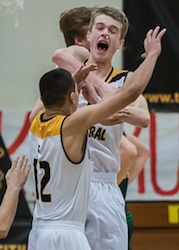
That connection between Schuba and his players was evident on the gym floor following Central’s win over West.
“It was a sea of people, and everyone was excited,” Mattson said. “I was about five feet away as I watched one of our players try to find (Schuba). He was seeking him out to give him a great big bear hug. And when he did, Travis had a huge smile on his face. It was something special as an athletic director to observe this from a distance. That’s what it’s about right there.”
It was another memory-maker for the young coach.
And as for that shot that took down St. Francis in the 2009 high school tournament, that one is hard to forget, too.
His brother, Chuck, who is 11 years older, was the Kalkaska coach at the time.
“I give that one to my brother,” Travis Schuba said. “He did his studies. We threw in a bunch of defensive sets, mixed it the whole game, and slowed them down.”
Ironically, Schuba was supposed to be the decoy on the game-winning play, but he ended up with the ball. The rest is history.
“I still have people ask me, ‘Do you remember that shot?’” he said. “Of course, I remember that shot. It was one of the coolest moments of my career.”
The game-winner for Madonna registers, too. The Crusaders had won eight games in Schuba’s freshman season – Emenhiser’s second at the helm. They had started the 2011-12 season 0-4 when Schuba hit the shot to upset Indiana Tech.
“There were two seconds left on the clock,” Emenhiser recalled. “We ran him off a screen. He went flying into the corner, caught the ball and shot it all in one motion – nothing but the bottoms. That propelled us. We won our next nine games. It was the beginning of that (63-win) run we had for three years. Before (Schuba’s class arrived), we had one winning season in program history. We were still trying to build a culture and change who we were. We had played some good games, but the guys didn’t yet believe we could be a great team. That shot really gave the guys a ton of confidence. It was a pivotal moment in our program.”
Madonna later went on to a win a conference tournament title and play in the NAIA national tournament.
Schuba, who still holds the Madonna career records for 3-pointers made (399) and 3-point accuracy (better than 40 percent), wants his Central players to embrace success as well.
And it seems to be working.
“Coach Schuba does a great job instilling in us that we should expect to win,” Schwannecke said.
So far, so good.
 Dennis Chase worked 32 years as a sportswriter at the Traverse City Record-Eagle, including as sports editor from 2000-14. He can be reached at [email protected] with story ideas for Manistee, Wexford, Missaukee, Roscommon, Ogemaw, Iosco, Alcona, Oscoda, Crawford, Kalkaska, Grand Traverse, Benzie, Leelanau, Antrim, Otsego, Montmorency, Alpena, Presque Isle, Cheboygan, Charlevoix and Emmet counties.
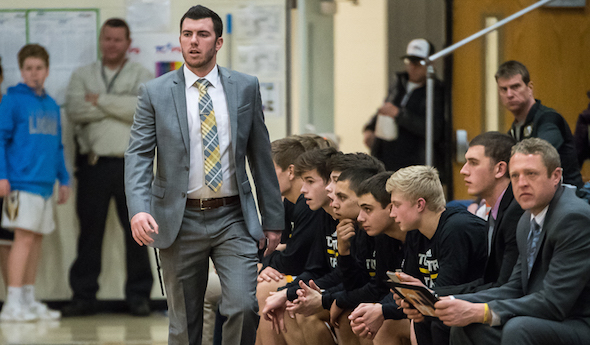
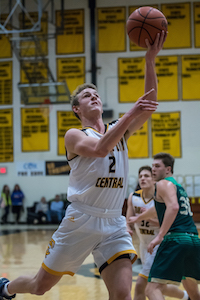
PHOTOS: (Top) Traverse City Central coach Travis Schuba watches his team work during its game against Grand Rapids Forest Hills Central this season. (Middle) Traverse City Central's Tobin Schwannecke gets to the basket a week ago against Traverse City West. (Below) Central players celebrate their win over the Titans. (Photos by Rick Sack/TC Rick Photo.)