

Esler Pilots DeLaSalle Back to Final Week
By
Tom Markowski
Special for Second Half
March 19, 2018
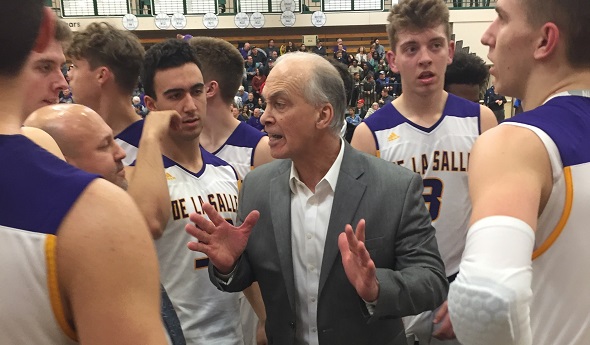
WARREN – There isn’t much that Greg Esler hasn’t seen or experienced as a coach and as a father.
 Through it all he’s learned to take nothing for granted, in life and as a coach.
Esler, 63, coached St. Clair Shores Lake Shore to its first and only MHSAA boys basketball title in 1994, in Class B. That team was led by Travis Conlan, who finished second in the voting for Mr. Basketball that season. Conlan would go on to play at University of Michigan, one of a number of Esler-coached players who went on to the college – and for some – professional ranks.
Esler is in his 31st season as a head coach, with the last 24 at Warren DeLaSalle. Twenty-one times the Pilots have won a District title with Esler on the bench. In 2007, DeLaSalle reached a Class A Semifinal for just the second time in school history, as it lost to Manny Harris and Detroit Redford 56-50. (Note: In addition to two Class A Semifinal appearances, DeLaSalle also reached a Class B Final in 1982).
Consistency has been a hallmark of Esler’s programs, and even after all these years a fire burns in his stomach. He’s retained a burning desire to compete and to win. As the years have piled up, Esler has become more appreciative of the success his program has achieved and the experiences gained.
So when DeLaSalle defeated Macomb Dakota, 56-51, in a Regional Final last Wednesday, there was reason to celebrate. As good as DeLaSalle has been recently, it hadn’t won a Regional title since 2010. The Pilots have been to the Detroit Catholic League final each of the last three seasons and have won five District titles since 2010 including the last three. But the end of last season stung more than most. DeLaSalle reached a Regional Final and then lost to Troy, 48-40, in an ugly game where the Pilots shot less than 30 percent from the field.
Most of that team is back as the Pilots head into the final week of this season. Esler has nine seniors including two of the top players in the league in point guard Justin Fischer and guard-forward Luke Pfromm, the starting quarterback on the Division 2 championship football team.
Esler started coaching at Warren St. Anne grade school in 1983, then went to DeLaSalle for three seasons beginning in 1985 under then-coach Gary Buslepp. Esler got his shot as a head coach in 1987 at Lake Shore and quickly made that program relevant. Lake Shore reached the Class B Semifinals in 1993 before losing to coach Norwaine Reed and Saginaw Buena Vista.
Esler took over the DeLaSalle program at the start of the 1994-95 season. His career record stands at 530-216 heading into tonight’s Class A Quarterfinal against Detroit U-D Jesuit.
“We instilled a system here,” he said. “The first thing is to have your players in condition. Second is defense. I’ve always stressed defense. And third, and maybe this should be first, is talent. We’ve always had really good players here. And the players we’ve had want to get better.”
What often goes unnoticed in a basketball program is the work of the assistant coaches. Esler has been blessed with loyal and knowledgeable assistants. His top assistant is Tom Mehl, who played for Esler for two seasons at Lake Shore. Mehl was on staff for Esler’s last four seasons at Lake Shore and has been with Esler every step of the way at DeLaSalle.
Jeff Becker is in his 13th season as an assistant, and another, Dave Grauzer, recently left the program and now is an assistant at Traverse City West.
 “Surrounding yourself with good people is at the top of the list,” Esler said. “One thing about Tom, there’s no one I’ve seen who can go to a game to scout and pick up something no one else would see. Like a player who takes two dribbles before driving to his right or left. For Becker, it’s organization. He works well with the kids, and he’s got the post players. Mehl has the guards.
“Over the years I’ve listened. Listened to other coaches. I don’t have all the answers. I talk to Steve Hall at (Detroit) Cass Tech all the time. He’s been a great friend over the years.”
This team has a closeness not always seen. The fact that there are nine seniors is one reason. Esler points out that he’s been with this group for more than 100 days this season, and when you’re around a group that long tempers can flare – so it’s important to keep the present in perspective and realize they all want to reach the same goal.
“We do a lot of things outside of basketball,” Esler said. “Last week four of my captains read to the students at (St. Clair Shores) St. Germaine grade school. My wife, Renee, is a fourth and fifth grade teacher there, and it’s way for the players to interact with the younger students.
“I read an article recently on (Michigan) coach (John) Beilein and how the game has changed. The kids have changed. We watch game film but not like we used to. Their attention span isn’t like it used to be. The technology now, with Facebook and texting, it’s unbelievable. We might watch film for 20 minutes where we used to watch for hours.
“My players will tell you, I love the practices much more than they do. Games are like taking a test. If you didn’t win, maybe you failed at some area that cost you. They love each other and they do a good job of listening. All five starters have scored 20 points or more in a game this season. And they don’t get rattled. We were down four to Dakota with four minutes to go and Pfromm came to me in the huddle and said, ‘Don’t worry coach. We got this.’ I can see why they won a state title in football.”
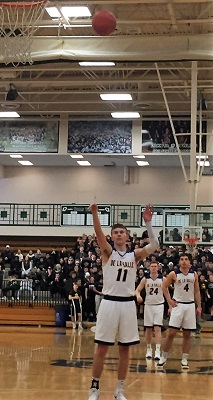
Fischer has matured significantly as a leader and force offensively. A three-year starter, he has signed with Lake Superior State.
Fischer came into the program as a skinny 5-foot-10 freshman. By the time he was a junior, he had grown five inches. Now he’s 6-4 and weighs 185 pounds.
“I was a pass-first guard as a sophomore,” he said. “I’ve worked on my shooting, just working on my total game.
“We were pumped up for that Dakota game. We got the crowd going crazy. We were down and Luke hit a couple of 3s. I had a dunk and hit four free throws late.”
DeLaSalle (18-7) will play Catholic League Central rival Detroit U-D Jesuit (22-3) next. The Class A Quarterfinal will be played Tuesday at 5 p.m. at Calihan Hall, the site of the Catholic League final. Jesuit won that game, 71-64. In fact, Fischer has lost nine consecutive games to U-D as a varsity player.
He shouldn’t feel alone. DeLaSalle hasn’t defeated U-D since 2014 when the teams tied for the Catholic League Central regular-season title – a streak of 14 straight defeats to the Cubs. U-D won this season’s meetings 64-45, 59-57 and 64-55.
Esler keeps U-D recent domination of his program on the light side.
“I’ve said I’d have to coach until 2031 to get to .500 against them,” he said.
 Tom Markowski is a columnist and directs website coverage for the State Champs! Sports Network. He previously covered primarily high school sports for the The Detroit News from 1984-2014, focusing on the Detroit area and contributing to statewide coverage of football and basketball. Contact him at [email protected] with story ideas for Oakland, Macomb and Wayne counties.
PHOTOS: (Top) Warren DeLaSalle coach Greg Esler talks things over during his team’s Regional Final win against Macomb Dakota. (Middle) Justin Fischer launches a free throw during the 56-51 victory.
Breslin Bound: 2025-26 Boys Report Post-Break
By
Geoff Kimmerly
MHSAA.com senior editor
January 5, 2026
Holiday break is showcase season for several basketball teams all over the state, and there’s plenty to catch up on as "Breslin Bound” returns for the start of calendar year 2026.

While championship hopefuls will continue to play in special events (mostly on Saturdays) over the next many weeks as well, there were 58 tournaments and one-or-several-day showcases over the last two weeks featuring Michigan boys hoops teams.
“Breslin Bound” is powered by MI Student Aid and based on results and schedules posted for each school at MHSAA.com.
Week in Review
The countdown of last week’s five most intriguing results:
1. Rockford 81, Bloomfield Hills Brother Rice 78 (2 OT) The Rams won a classic at the D Zone Showcase and remain undefeated at 8-0 while the loss was the second over three games for Brother Rice (7-3).
2. Auburn Hills Avondale 50, Grand Blanc 49 In another D Zone Showcase nail-biter, Avondale (8-1) bounced back from losing to Freeland two days before to hand Grand Blanc (8-1) its only defeat this season.
3. Grand Haven 77, Freeland 74 (OT) Grand Haven (8-1) handed Freeland (7-1) its lone defeat, during the Cornerstone University Holiday Showcase.
4. Clinton Township Chippewa Valley 69, Detroit Cass Tech 67 Chippewa Valley (7-1) has been consistently successful over several seasons, but defeating Cass Tech (5-3) at the D Zone Showcase certainly earned additional attention.
5. East Lansing 62, Bloomfield Hills Brother Rice 41 The reigning Division 1 champion Trojans (8-0) have had a few close calls this winter but impressed against one of their most highly-regarded foes.
Watch List
With an eye toward March, here are two teams in each division making sparks:
DIVISION 1
Grand Blanc (8-1) The Bobcats have won at least a District title every season this decade, and appear on the right track for another run with their only loss by a point to Avondale (see above). Grand Blanc also has navigated a one-point overtime victory over Hamtramck and three-point win over Saginaw United, and perhaps most impressively downed Clarkston 54-47 at its home Charlie Carmody Classic to begin this month. Friday’s game at Grand Haven (8-1) will be another that could shake up rankings.
Ypsilanti Lincoln (8-1) The Railsplitters have continued to roll after finishing last season 16-10 but with six wins over their last seven games including a District title clincher. After finishing fourth in the Southeastern Conference Red last winter, Lincoln is the early leader in the SEC White. Its lone loss was during the first week of December to Wayne Memorial, and the Railsplitters have four wins by one or two points.
DIVISION 2
Benton Harbor (10-0) The Tigers are among five teams statewide that have reached double-digit wins, with six of those first 10 coming during showcase games including by two over Detroit Douglass and three in overtime over Berrien Springs. Benton Harbor has several more matchups of note coming up; circle Jan. 13 at Niles Brandywine, Jan. 17 against Detroit Catholic Central at Westland John Glenn’s Rocket Classic and Feb. 7 against Warren Lincoln at Grand Rapids Community College’s 2K26 Showcase.
Grand Rapids South Christian (7-1) The Sailors are coming off a 20-5 season that included sharing the Ottawa-Kent Conference Gold title and winning their District despite opening 1-3. They’re off to a much faster start this winter, already avenging last-winter losses to Grand Rapids Christian and Grand Rapids Catholic Central – the latter which ended South Christian’s 2024-25 season. The Sailors shared last year’s league title with Grand Rapids Northview and will see the Wildcats for the first time Friday.
DIVISION 3
Beal City (7-0) The Aggies opened the new year with wins over Mason County Central and Vestaburg to win the Reed City Holiday Tournament, and total five of their seven victories have come over teams currently with winning records. Beal City handed Highland Conference rival McBain its only loss and sits tied atop the league standings with LeRoy Pine River, with their first matchup slated for Jan. 20. Beal City finished second in the league to McBain last season and ended their tournament run with a Regional Final loss to the Ramblers.
Menominee (7-1) The Maroons began this season with a defeat against Division 2 contender Freeland at Petoskey’s Sean Pollion Invitational, but haven’t lost again – a substantial bounce-back from last year’s 2-4 start on the way to a 13-12 finish. The difference in part has been wins over Negaunee, Crystal Falls Forest Park and Green Bay West (Wis.) – after losses to those opponents during last winter’s start – and it’s important to note as well that all seven wins this season have come by at least 23 points.
DIVISION 4
Dollar Bay (6-1) Although the Blue Bolts are coming off a loss to Division 1 Marquette last week, a 49-45 overtime win over Forest Park has highlighted this early run and avenged an 18-point loss to the Trojans a year ago. Dollar Bay went on last season to share the Copper Mountain Conference title and win its District, and the Blue Bolts will see the other two co-champions Wakefield-Marenisco and Ewen-Trout Creek this month, as well as Bessemer – which ended Dollar Bay’s 2024-25 season in a Regional Semifinal.
Pickford (7-0) The Panthers just missed out on a trip to Breslin last season, falling to Forest Park by two points in their Quarterfinal while finishing 23-3 overall. They’ve already avenged last year’s regular-season loss to Harbor Springs as they opened this winter with six wins by at least 18 points before handing Harbor Springs Harbor Light Christian its only loss, 59-54 last week. Undefeated Cheboygan on Jan. 17 could present another intriguing challenge.
Can’t-Miss Contests
Be on the lookout for results of these games coming up:
Wednesday – Fowler (7-0) at Pewamo-Westphalia (5-1) – The only loss between these Central Michigan Athletic Conference rivals this winter was P-W’s by two points to Division 1 Grandville.
Friday – Detroit Loyola (8-0) at Dearborn Divine Child (8-2) – The Catholic High School League AA kicks off its second half with a rematch of a season-opening 62-56 win by league leader Loyola.
Friday – Frankenmuth (7-0) at Freeland (7-1) – These two are both undefeated in early Tri-Valley Conference Red play, with the only loss between them Freeland’s to Grand Haven noted above.
Saturday – Wayne Memorial (4-0) vs. Muskegon (4-0) at East Kentwood – These are two of 10 remaining undefeated Division 1 teams, and they face off at 4:45 p.m. in the Gottagetit Classic.
Saturday – Rockford (8-0) vs. East Lansing (8-0) at East Kentwood – These are two more of the Division 1 unbeatens, and they play in the 8:15 p.m. slot at East Kentwood.
MHSAA.com's weekly “Breslin Bound” reports are powered by MI Student Aid, a division within the Department of Lifelong Education, Advancement, and Potential (MiLEAP). MI Student Aid encourages students to pursue postsecondary education by providing access to student financial resources and information. MI Student Aid administers the state’s scholarship and grant programs that help make college Accessible, Affordable and Attainable for you. Click to connect with MI Student Aid and find more information on Facebook and X @mistudentaid.
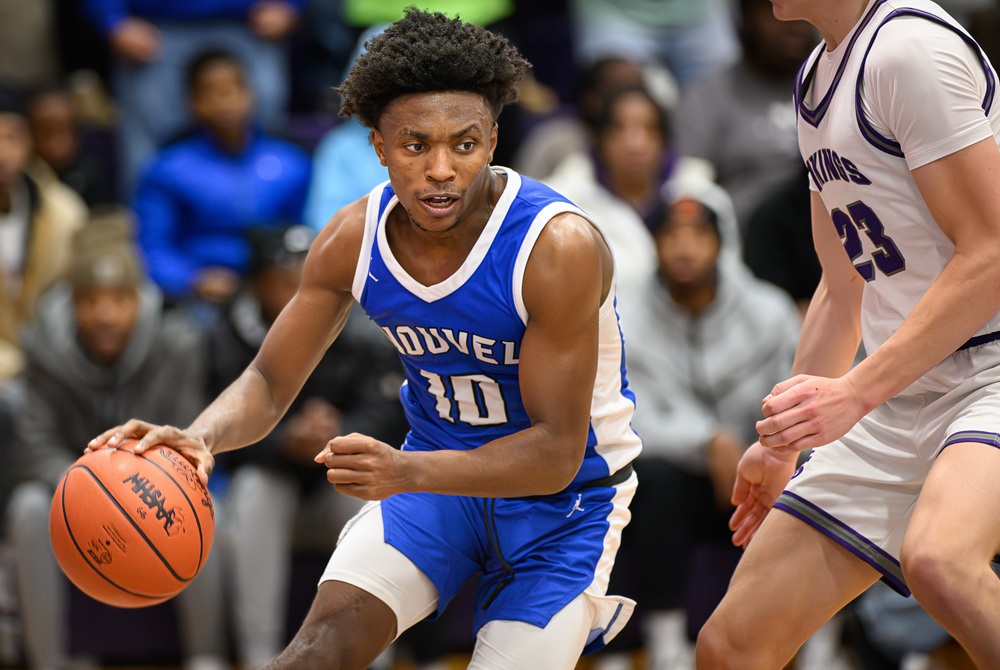
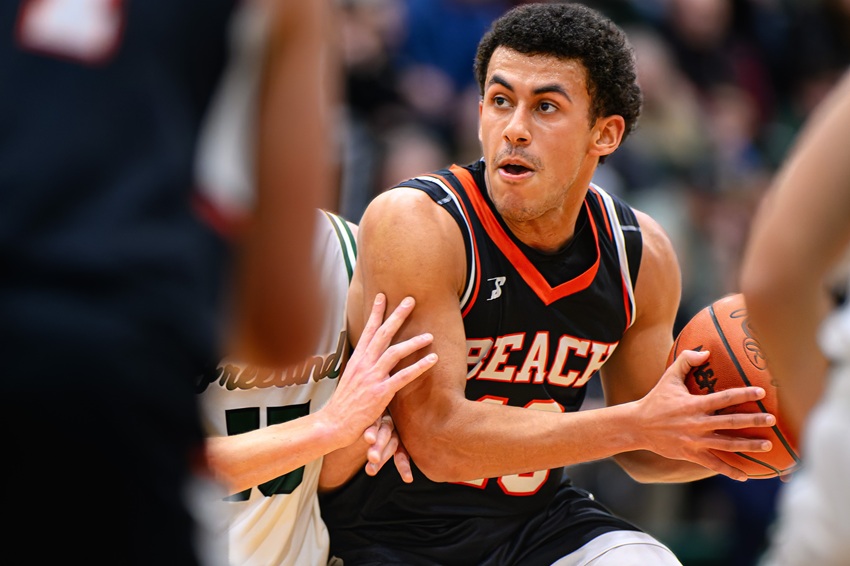
PHOTOS (Top) Saginaw Nouvel Catholic Central senior Rahmaan Kelley Jr. drives to the basket during the third quarter for two of his team-leading 20 points in the Panthers’ 44-35 victory over Saginaw Swan Valley on Dec. 17. (Middle) Harbor Beach guard Benson Harper works his way through the paint toward a second-quarter basket in his team’s Jan. 2 game against Freeland. (Photos by Kolleth Photo.)