

Ewen-Trout Creek Grad Rekindles Memories of 'The Barn' in 8-Part Docu-Series
By
Jon Ross
MHSAA Director of Broadcast Properties
February 7, 2023
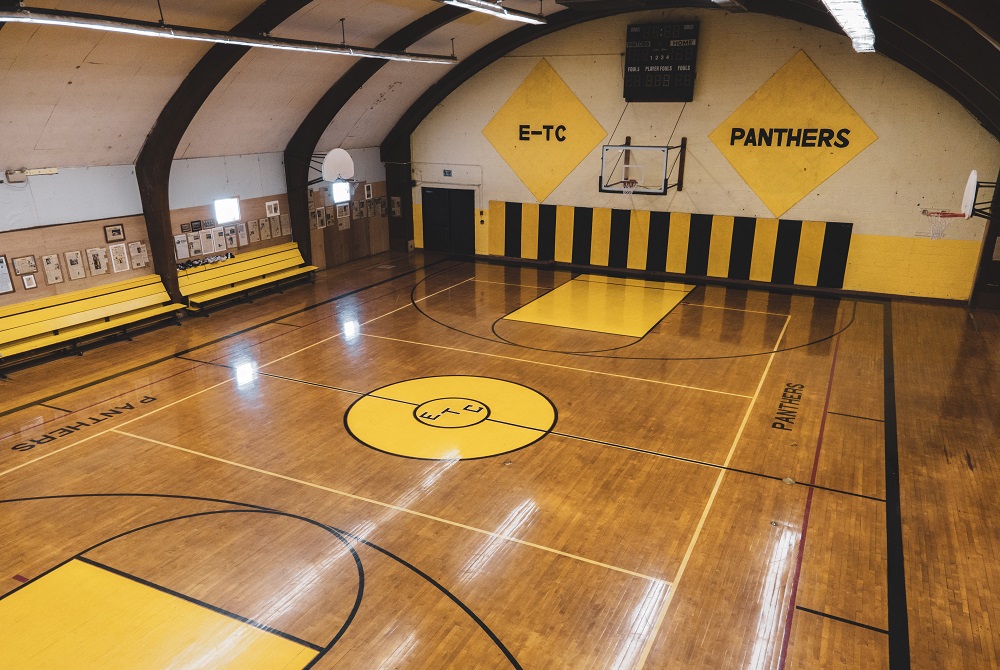
It was known as “The Barn.” And it was home to the 1972 Class D boys basketball champion, the 1973 Class D girls basketball champion and the 1982 Class D boys basketball runners-up.
The Upper Peninsula’s all-time winningest female basketball coach coached at The Barn, as did the Upper Peninsula’s all-time winningest male basketball coach. And when Ewen-Trout Creek advanced to the 2022 Division 4 Final, its roster was littered with names from E-TC’s past:
► Leading scorer Jaden Borseth’s dad played on the 1995 team that advanced to the Class D Regional Final.
► Kelsey Jilek’s dad played on the 1992 team.
► Brendan Polkky’s dad is currently an assistant coach for E-TC and played on the 1991 team that also advanced to the Class D Regional Final.
► Caden Besonen’s dad Dave starred on the 1982 state runner-up team. Caden’s uncle Brad is the E-TC head coach. And Brad’s dad, Bryan, played on the 1972 championship team.
The Barn hosted its final E-TC game in 1998 and is now owned by Gary Fors, who also played on the 1972 title team. It’s now a community gym of sorts, and many members of the 2022 team worked out there growing up.
E-TC grad Kristin Ojaniemi – an award-winning documentary film maker and photographer, and the TV producer and host of “Discovering” for 906 Outdoors – is taking a look at the history of “The Barn” as well as its ties to the 2022 team in an eight-part series called “Born in the Barn.” The first two parts are complete, and the entire series will be available to view at KristinOjaniemi.com.
I had a chance to ask Ojaniemi about the project and why it’s so special to so many people.
Kristin, how did you come up with the idea to document the history of The Barn?
The idea to document the history of The Barn and E-TC basketball developed over time. Five years ago I had a conversation with Dan Truckey of the Beaumier Heritage Center at Northern Michigan University, and when I told him where I went to high school, we got on the topic of basketball and how E-TC was a powerhouse and that "there must be something in the water" here. Fast forward to 2021, and I saw on Facebook some photos of the inside of The Barn and all the newspapers Gary Fors had lined the walls with, sort of like a museum. February of 2022 I realized it was 50 years since the 1972 boys state championship and 40 years since the 1982 state runner-up seasons. I like anniversaries in history and thought it would be the perfect time to do some sort of documentary. Originally my focus was Gary and The Barn and more of the 70s and 80s boys and girls seasons, but once the 2022 boys started advancing in the tournament, that obviously changed.
What did the 2022 team’s run to the Finals mean to the players from the ’72 and ’82 teams?
The 2022 run meant a lot to the players of '72 and '82 because many of those boys are sons, grandsons, great-nephews of those guys. Bryan Besonen of the '72 team is coach Brad Besonen's father. Many of them traveled to every tournament game, and watching the 2022 season brought back memories of their glory days. They're definitely very proud of the 2022 team and the tradition that E-TC has continued through the years. Watching them watch those games was just as fun as watching the court. The 2022 team's run to the Finals meant a lot to the whole community. So many others traveled all the way to Lansing to cheer them on, and there is just a ton of pride in this team. I went to the banner unveiling a few weeks ago, and it was a huge crowd at the game to watch those few seconds of history being made.
What is your history with The Barn?
I graduated from Ewen-Trout Creek in 2000. We were in the "new" school then, but I spent four years – seventh-10th grade – in the "old" school, which had so much more character than the new one! I did play basketball seventh-10th – junior high and junior varsity. I was a benchwarmer most of those years. I loved the game but didn't spend any time offseason playing or practicing like others. I was also a cheerleader those years too, and if you look closely at one of the newspaper photos from the last game in the Barn, I'm in the background. Ha ha! This was back when girls basketball was in the fall and boys in the winter, so you could do both. As others in the documentary mention, The Barn was also where you hung out at lunch, and gym class was in there, and homecoming activities. Filming in there brought back a lot of memories.
What did Nancy Osier (U.P.’s winningest female basketball coach) and Tom Caudill (U.P.’s winningest male basketball coach) think made The Barn such a difficult place for opposing teams to play?
Thinking back to Nancy and Tom's interviews, I think the difficulty for other teams really boiled down to the atmosphere and the E-TC fans and that intimidation factor. E-TC had the ultimate homecourt advantage in The Barn, and their players spent hours upon hours practicing on that floor. And the school's history and tradition of rarely losing a home game is also intimidating.
There’s obviously a lot of family ties from the 2022 team to earlier teams – and it was the 50th anniversary of the ’72 win – did they feel more pressure along the way because of that?
I think the 2022 boys had this feeling that they wanted to one-up their grandfathers/fathers. I think it was Kelsey Jilek that told his grandfather, George Hardes (1972), that they had one more game in their schedule so they could potentially have a better record if they won all their games. But none of them came out and mentioned that the anniversary put pressure on them, but I’m sure it was there. They set out to win it all from the beginning and put the work in, and it paid off. There are a lot of parallels in these winning seasons.
When will the next part of the series be released?
Part 3, I should have done by the end of February. Part 3 focuses on the 1973 girls state champs; 1973 was the first year there was a state final for girls basketball after Title IX, and E-TC won the Class D title. And then I plan to release each part every two months with the final, Part 8, done by the end of 2023. This is just a fun hobby/personal project, I guess you'd say, so I only have so much time to dedicate to it after all my "real" work.
(PHOTOS of "The Barn" courtesy of Kristin Ojaniemi.)
Breslin Bound: Boys Report Week 6
January 15, 2013
By Geoff Kimmerly
Second Half editor
Undefeated teams quickly are becoming few as boys basketball season heads into mid-January.
But this week's list of teams making noise includes a handful that remain perfect – although a few more will face their toughest challenges soon.
Records and scores below are based on those submitted to the MHSAA.com Score Center.
1. New Haven (6-0) – Coming off 21 wins last season, the Rockets had high expectations – and made great on a good start with a 101-98 double-overtime win over Mount Clemens on Friday; Mount Clemens hadn’t lost.
2. Detroit Pershing (9-0) – The Doughboys just keep proving their status as Detroit's best, downing Detroit Martin Luther King 78-64 and then Detroit Douglass 73-67 in overtime last week.
3. Stevensville Lakeshore (7-0) – A Class B Semifinalist a year ago, Lakeshore is surging again with only one win by fewer than 11 points this season – and that was against South Bend St. Joseph of Indiana.
4. Holt (10-1) – The Rams further cemented themselves as the class of Greater Lansing this season by beating reigning Class B champion Lansing Sexton 50-46 on Friday.
5. Frankenmuth (8-0) – This week’s “Battle of the Fans” contestant will need all the support against rival and top Tri-Valley Conference East competitor Bridgeport on Friday, but the Eagles survived a 50-46 win over Essexville Garber a week ago.
6. Climax-Scotts (8-0) – The Panthers got their first test this season in a 51-42 win over Bellevue on Friday, but no other opponent has come within 14 points.
7. Muskegon Western Michigan Christian (7-3) – After opening 1-3, the Warriors have won six straight and handed Spring Lake its first loss, 49-47, on Saturday.
8. Ithaca (7-0) – The Yellowjackets know how to play football, but they’ve long had a strong hoops program as well and have an early lead in the TVC West.
9. Lake Linden-Hubbell (7-0) – The Lakes had to survive overtime against Hancock and then three more against Calumet in December, but have won four straight by at least 18 points.
10. DeWitt (6-2) – A relative newcomer to Class A, the Panthers shocked the local competition with a 56-54 win last week over Okemos, and also own a five-point victory over improved Grand Ledge.
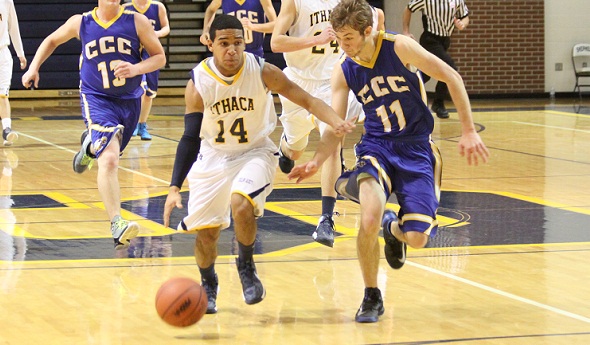
PHOTO: Ithaca's Markes Gadlen (14) pushes the ball upcourt against Carson City-Crystal this season. (Click to see more at HighSchoolSportsScene.com.)