


Film Fills In Picture of 'Fennville Flash'
By
Ron Pesch
MHSAA historian
December 28, 2017
We’ve been here before, but not in this way.
The last time was for a retrospective, covering one of the most impressive and awe-inspiring prep careers in Michigan high school history. That time was in print, and included a handful of still images that tried to illustrate the unbelievable.
But this time, the story is in documentary form. It’s woven together from grainy, scratched, faded silent film, a format of capturing memories familiar to thousands of people from generations past, as well as a series of modern-day high-resolution interviews.
Here, the basketball life of the athlete known as the “Fennville Flash” delivers on many levels. Yes, there is a Richie Jordan.
JordanVille, a documentary by John Mooy & Anne Colton, recalls a time when legend spread via word of mouth, newsprint and AM radio.
While it’s hard to comprehend for many today, the exploits of our athletic heroes were formed by “poets in the press box” who sat with pencil and paper, a typewriter, a microphone or a telephone, and described to their audience what they witnessed. On the receiving end, readers and listeners conjured up visualizations based on the facts, phrases and superlatives designed to create an image.
“Traveling left to right on your radio dial” helped listeners feel they were a member of the crowd, seated in the stands, in on the action and a witness to the mayhem. “Packed to the rafters,” reminded fans the importance of what was happening. An exciting game, presented by those with skill, created an event you longed to see. If a broadcast couldn’t be picked up on a transistor or tube radio, the final result might not be known, at the earliest, until the following day’s newspaper arrived.
I’ve told Jordan’s story via the MHSAA before; how he latched on to athletic training, weights and repetition to mold himself into a well-rounded athlete, able to leap to heights unexpected for a kid with a 5-foot-7 frame. The tales of his unfathomable accomplishments slowly leaked beyond the city limits of Fennville into Kalamazoo and greater Southwestern Michigan, then to Detroit. When Detroit Free Press writer Hal Schram relayed Jordan’s feats, the secret traveled across the state and beyond its drawn borders.
From there the legend of Jordan’s accomplishments grew. In Fennville, as in many small towns across the country, the city shut down when a game was played. The Jordan story was so enticing that thousands would travel vast distances to see him play with their own eyes. Today, his single season scoring average of 44.4 points per game during the 1964-65 campaign still remains the top mark in the MHSAA record book.
 JordanVille runs just shy of a half hour. Contained within is insight into the athlete that is challenging to relay in print form. Thanks to access to home movies and a series of interviews with Jordan, former teammates, past opponents and his high school coach, the determination, dedication and drive of a kid who wouldn’t let physical size be a deterrent from achievement radiates from the screen. On display is small town America at its finest, and perspective formed over 50+ years.
For Mooy, it completes a filmmaking journey started six years ago. But the story of Jordan, in his eyes, date back to his school days. Mooy first heard about Jordan as a 7th-grader from a math teacher. A second-team all-St. Joseph Valley League selection, Mooy played at Marcellus High School and scrimmaged against Jordan and the Fennville Blackhawks.
He couldn’t believe his eyes.
“Everyone wanted to see this kid play,” said Mooy in 2011. “He was the first high school player I saw sign an autograph.
Today, with the interviews complete, and the film ready for viewing, Mooy sees more than just a sports story:
“With the benefit of years now passed, I look at the Rich Jordan story with a new respect. JordanVille created a place that was welcoming no matter who you were, or what color your skin happened to be. It was the 1960s. Rich was growing up Jewish, the Civil Rights Movement was in full swing, and the Vietnam War was on everyone's mind. And in Fennville, Michigan, from 1961 to 1965, the Jordan high school years, there were lessons beyond sports being learned by everyone that would last a lifetime. The Jordan household, under the guidance of (his parents) Tuffy and Sylvia Jordan, is where the story begins."
The film speaks of a time that has departed. Competition for our attention was less focused; phones hung on walls or sat on tabletops, communities were tighter, the training table featured peanut butter and chocolate milk instead of protein powder. A city could easily be renamed for a day.
The film also reminds us that those days were far from perfect.
If all goes as planned, the public will see the finished product come the flip of the calendar. In West Michigan, JordanVille is scheduled to show on New Year’s Day at 6 p.m. on WGVU, and will repeat on WGVU-Life at 7:30 p.m., Friday, Jan. 5.
Seek it out, and spread the word, just like in days of old.
 Ron Pesch has taken an active role in researching the history of MHSAA events since 1985 and began writing for MHSAA Finals programs in 1986, adding additional features and "flashbacks" in 1992. He inherited the title of MHSAA historian from the late Dick Kishpaugh following the 1993-94 school year, and resides in Muskegon. Contact him at [email protected] with ideas for historical articles.
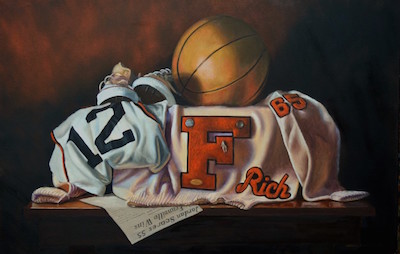
PHOTOS: (Top) Richie Jordan runs Fennville's offense during his thrilling high school career in the 1960s. (Middle) Jordan memorabilia, as captured by Bill Williams.
Breslin Bound: 2025-26 Boys Report Week 2
By
Geoff Kimmerly
MHSAA.com senior editor
December 15, 2025
The calendar year may be drawing to a close, and schools soon shutting down for break. But there will be little rest for basketball fans seeking to see several of the state’s title contenders in action over the next three weeks.

Several leagues have either started play or will over the next few days, and this weekend starts full schedule of boys hoops showcases that will see many teams across the state playing at least once over the holidays before the regular-season schedule falls into routine in January.
“Breslin Bound” is powered by MI Student Aid and based on results and schedules posted for each school at MHSAA.com.
Week in Review
The countdown of last week’s five most intriguing results:
1. Arts & Technology Academy of Pontiac 60, Warren Lincoln 59 Last season’s Division 3 runner-up Lions (2-0) earned one of their most impressive wins over the last two winters by edging reigning Division 2 champ Lincoln (2-2) at the Best of Michigan Tournament at Detroit Mercy.
2. East Lansing 41, Detroit Martin Luther King 40 The reigning Division 1 champion Trojans (4-0) answered their closest call of the early season to win one of the most notable matchups at the Moneyball Tip-Off Classic at Don Johnson Fieldhouse.
3. Ishpeming Westwood 59, Kingsford 54 These two both made Semifinals at Breslin Center last season, and Westwood (5-0) came back from 17 points down to avenge a seven-point loss from last year to the Flivvers (3-1).
4. Lansing Sexton 86, Detroit Cass Tech 81 Sexton (2-1) opened this season with a loss at East Lansing but has rebounded to make a statement about its potential to build on last season’s Division 2 Quarterfinal run with this win over the Division 1 Technicians (3-1) at Don Johnson.
5. Grand Rapids Northview 50, Grand Rapids Catholic Central 44 The Wildcats (3-1) returned to The Invite at Calvin University and downed the Cougars (0-2), also Division 2 semifinalist last season.
Watch List
With an eye toward March, here are two teams in each division making sparks:
DIVISION 1
Auburn Hills Avondale (4-0) Winners of 16 games both of the last two seasons and runners-up in the Oakland Activities Association Red last winter, the Yellow Jackets may have more in store after this solid start including a 69-51 win over West Bloomfield on Thursday. Avondale’s holiday break slate is loaded with notable matchups against Freeland, Grand Blanc, Detroit Mumford and Hamtramck.
Jackson (3-0) The Vikings are off to a solid start as they look to build on last season’s 12-12 finish and tie for second in the Southeastern Conference White. Jackson opened league play Friday with a 60-47 win over Tecumseh, one of the other two teams that also tied for second in the league last season, and will get a first look at reigning champion Adrian on Friday.
DIVISION 2
Ludington (5-0) The Orioles’ fast start has included handing Spring Lake it’s only loss, 55-46 on Dec. 4, and delivering a first defeat to Fremont on Friday, 73-67 in overtime. Ludington lost to Spring Lake twice last season on the way to finishing 16-9, and the Orioles also are the early leaders in the West Michigan Conference Lakes after finishing second to Whitehall last winter.
Romulus Summit Academy (6-0) Last season’s Division 2 runner-up has not slowed down a bit, with a 35-29 win over Warren Fitzgerald on Saturday adding to a 65-59 overtime win over Detroit Edison and 65-54 victory over Detroit U-D Jesuit among notables during a busy but successful opening two weeks. Friday’s home game against Arts & Technology Academy of Pontiac could end up deciding the Charter School Conference Gold title.
DIVISION 3
Gobles (4-0) The Tigers have improved from four, to nine, to 12 wins over the last three seasons and could add to that climb after four double-digit victories to open this one. The team’s fast start included last week a 55-45 win over Bloomingdale – avenging a last season loss – and a 50-36 victory over Delton Kellogg, with which Gobles split Southwestern Athletic Conference Central meetings last winter.
Onsted (4-0) The Wildcats have won at least 18 games every season this decade and finished 21-2 in sharing the Lenawee County Athletic Association title with Adrian Madison last winter. Onsted split with Madison last season and won their first meeting again this time, 45-38 on Friday, with the rematch Jan. 29. Also worth noting: Onsted is in Division 3 this season after previously playing in Division 2 and Class B before that.
DIVISION 4
Concord (5-0) A 53-51 win over Bronson on Friday kept Concord perfect to start this season, with that also their first single-digit game of this winter. The Yellow Jackets finished the last one 17-10 and tied for second in the Big 8 Conference, and the Bronson win also avenged a December loss from a year ago – as did the 67-57 victory over Battle Creek St. Philip on Dec. 5. Concord will see reigning league champion Stockbridge for the first time Jan. 8.
Traverse City Christian (5-0) The Sabres finished 23-3 last winter, when they also started 5-0 before running into Lake Leelanau St. Mary. Those two faced off Friday, and this time TC Christian handed St. Mary its first loss, 55-36. Onekama and Bellaire were the other teams to defeat the Sabres last season, and neither is on the regular-season schedule this time – but matchups against Mount Pleasant Sacred Heart on Jan. 19, Traverse City St. Francis on Feb. 6 and Lake Leelanau St. Mary again Feb. 10 should be circled.
Can’t-Miss Contests
Be on the lookout for results of these games coming up:
Dec. 18 – Detroit Cass Tech at Detroit Martin Luther King (1-2) – They finished a combined 40-10 last winter, splitting their regular-season meetings. With Cass Tech defeating reigning champ Detroit Renaissance on Friday, this matchup could weigh much more heavily on the Detroit Public School League Blue title chase.
Dec. 20 – Grand Rapids Catholic Central (0-2) vs. Ann Arbor Huron (5-0) at Hazel Park – Arguably the top matchup at the D Zone Showcase will feature two teams that won Regional titles last season.
Dec. 28 – East Lansing (4-0) vs. Bloomfield Hills Brother Rice (5-0) at Ferndale – This Motor City Roundball Classic matchup will feature two of the favorites in Division 1.
Dec. 29 – Schoolcraft (2-1) vs. Grand Rapids South Christian (3-1) at Cornerstone University – These two are joined by Grand Rapids Forest Hills Northern and Paw Paw in the Green bracket.
Jan. 3 – Clarkston (4-0) at Grand Blanc (3-0) – This matchup might be the best of a strong slate at the annual Carmody Classic.
MHSAA.com's weekly “Breslin Bound” reports are powered by MI Student Aid, a division within the Department of Lifelong Education, Advancement, and Potential (MiLEAP). MI Student Aid encourages students to pursue postsecondary education by providing access to student financial resources and information. MI Student Aid administers the state’s scholarship and grant programs that help make college Accessible, Affordable and Attainable for you. Click to connect with MI Student Aid and find more information on Facebook and X @mistudentaid.
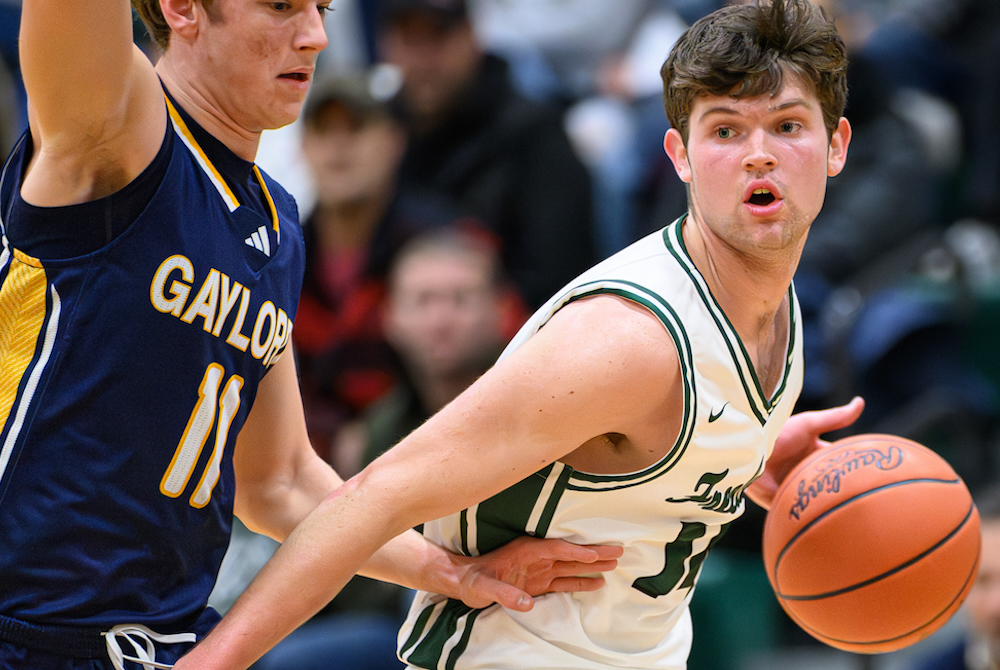
PHOTO Freeland senior forward Wilson Huckeby, right, navigates around a defender during the first quarter of last week's 70-47 Falcons win over Gaylord. (Photo by Kolleth Photo.)