

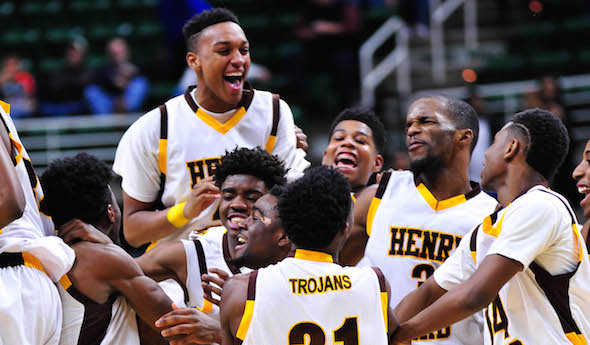
Ford's Drive Ends With School's 1st Title
March 26, 2016
By Geoff Kimmerly
Second Half editor
EAST LANSING – The final celebration of the 2015-16 Michigan high school basketball season started during the final seconds when a Detroit Henry Ford assistant coach slapped hands of everyone sitting on the bench.

After the buzzer, the crowd moved to the south end of the Breslin Center floor, before players and coaches arm in arm made their way upcourt to the opposite baseline and into position to receive the first MHSAA championship trophy in school history.
Saturday night’s Class B Final was guaranteed to produce a first-time winner in boys basketball. It ended up being the team that fell just one victory short the season before – from a school that had never won a title in any sport in Finals competition.
Henry Ford, runner-up in 2015, is champion in 2016 thanks to a 61-47 win over Stevensville Lakeshore, which like the Trojans entered the postseason unranked but more than topped that expectation.
“Ever since the loss, we’ve been preparing in the gym to get back here, and not just to get here but to win it,” Henry Ford senior guard James Towns said. “It took a lot of work to get back here. It’s almost like losing everything when you get back here and lose.
“This year they doubted us; nobody had us winning. We were the bottom of Class B, and we came up here and proved them wrong.”
Henry Ford became the 13th school from the prestigious Detroit Public School League to win an MHSAA boys basketball title, giving the league two in two seasons after Detroit Western International also won its first boys hoops championship in 2015, in Class A.
The Trojans (20-6) fell in last season’s Class B Final 85-68 to Wyoming Godwin Heights, another first-time champion at the time.
This trip, Henry Ford was faced with multiple styles, first charged with shutting down guard-driven Williamston in the Semifinal (which it did 70-48) and then matched against a Lakeshore team boasting 6-foot-11 senior Braden Burke and 6-7 junior Max Gaishin. The tallest players in Ford’s regular rotation were 6-4.
Burke and Gaishin both had four points as Lakeshore stayed within a point during the first quarter, trailing 11-10 at the break. But they were unable to have an effect during a second quarter that saw the Lancers make only 1 of 7 shots from the floor and turn the ball over five times as Ford went on a 16-3 run to open up a 14-point advantage by halftime.
Burke and Gaishin would still lead a Lakeshore run. Burke had seven points and Gaishin four during the third quarter as their team cut into Ford’s lead substantially. The Trojans led 34-28 with a quarter to play. Another Burke bucket made the margin six again at 36-30 with 7:17 left on the clock.
 “It’s a shame we got ourselves down in the first half. I’m not sure we reacted as well as we needed to the physicality of the ballgame in the first half,” Lakeshore coach Sean Schroeder said. “The second half, I think we did. We were one or two plays from really getting ourselves back in it.
“We had the momentum. If we get a stop, cut it to four, maybe it gets more interesting.”
Instead, Ford hustled to create its breakaway moment after Lakeshore did just about everything possible to prevent it.
After Burke's basket, a 3-pointer by sophomore Deonta Ulmer pushed the Trojans’ lead back to nine. Towns stole the ball on Lakeshore’s ensuing possession and pushed it into the post, where Burke and Gaishin blocked consecutive shots.
But 6-3 junior Malik Harris came up with the ball after the second block and moved it to Towns, who found senior Jeremy Crawley in the corner for a back-breaking 3-pointer that pushed Ford’s advantage to 42-30.
“We gave up so much size all season. You can’t question the size of our hearts though,” Ford coach Kenneth Flowers said. “These guys play with so much passion, so much desire, and understand that the game is really won in the trenches. These guys always battle, always played against bigger guys, but they knew how to be tough down there.”
Burke, who scored a game-high 19 points, continued to battle and got the deficit back to seven with 1:48 to play. But nine of the game’s final 11 shots were made Trojans free throws.
Crawley scored 18 points, and Towns closed his high school career with 15 points and three assists. Senior forward Alston Hunter, who with Towns started on last year’s team, had 11 points, 10 rebounds and three steals. Ford outrebounded Lakeshore 30-19 and had 17 second-chance points.
Senior guard Logan Steffes added 10 points for Lakeshore, and Gaishin finished with nine points, five rebounds and two blocks.
The Lancers were playing in their second MHSAA Final and also finished Class B runner-up in 2012. They will graduate seven including four starters.
“When this class was growing up, we knew we had Braden and we knew we had Logan coming through,” Schroeder said. “But to see the development of some of these other kids, we had a tremendous senior class, a tremendous amount of leadership.
“A kid like Logan Steffes, who has put so much time and energy into this program. You saw at the end, he was trying to will us to win the game. He steals it, misses the shot, gets the ball back, misses. He wanted badly to win that game.”
The Boys Basketball Finals are presented by Sparrow Health System.
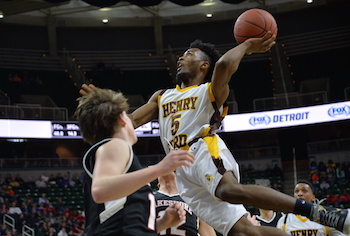
PHOTOS: (Top) Detroit Henry Ford players celebrate their first MHSAA championship in any sport Saturday. (Middle) The Trojans' James Towns soars as he prepares to launch.
Glen Lake Dials Up Winning Number
March 22, 2018
By Geoff Kimmerly
Second Half editor
EAST LANSING – The numbers may not lie, as the saying goes. But sometimes they tell an unexpected story.
Monroe St. Mary Catholic Central entered Thursday’s Class C Semifinal undefeated, and then made 52 percent of its shots from the floor.
But Maple City Glen Lake will play for its first MHSAA boys basketball championship since 1977 thanks to one other number in particular – the powerful 3.
The Lakers made 10 3-pointers – and three players combined to score all of their points – as they handed St. Mary its first and only loss, 62-56 at the Breslin Center.
The numbers nearly caught up to Glen Lake. After leading by as many as 13, the Lakers saw their advantage dwindle to two with two minutes to play. But junior guard Xander Okerlund scored four of his game-high 23 points to close out the historic victory.
“The way we looked at it is (it’s) another good basketball team that knows what they’re doing,” Glen Lake senior forward Cade Peterson said. “We expected coming into the game that they were going to make their runs. We were going to make our runs. What I love about this team is just we bounce back no matter what. Even after our two (regular-season) losses to a really good Buckley team, we come back, we just keep on going. It doesn’t matter who we’re playing.”
Glen Lake (24-2) earned its first championship game appearance since 1996 and will take on Detroit Edison in Saturday’s 4:30 p.m. Final.
The Lakers’ first four baskets Thursday were 3-pointers. They made 10 of 22 from beyond the arc – 46 percent of their tries, better than the 42 percent they shot from the field overall.
 “I thought we did a nice job of not forcing them. We didn’t want to come out and start firing them,” Glen Lake coach Rich Ruelas said of the long-range shots. “Our big thing is inside-out – let’s get touches inside, and once they collapse, let’s open it up. We have guys who can absolutely knock them down … but we wanted to really make that defense work.
“We didn’t always take the greatest shots. But for the most part, we did.”
Monroe St. Mary (25-1) also plays inside-out, and had plenty of success inside. Senior 6-foot-8 forward C.J. Haut made 7 of 12 shots for 15 points as St. Mary scored 32 total in the paint, compared to Glen Lake’s 12.
Junior guard Hunter Kegley added 13 points, and senior guard Mitchell Sherrard and junior forward Tyler Welch both had 10 points.
But the Falcons had a hard time containing Glen Lake’s big three. In addition to Okerlund’s 23 points, Peterson finished with 20 and sophomore guard Reese Hazelton had 19.
The 62 points were the second-most St. Mary had given up this season – opponents had averaged only 40.4 points per game against the Falcons heading into this weekend.
“We got a lot of good shots. I just felt like early we gave up too many 3s,” St. Mary coach Randy Windham said. “We let them be a little comfortable. I just felt that they settled in, and when teams settle in and get their feet under them – our whole thing is to make them uncomfortable, get them off their spot.”
This was St. Mary’s second Semifinal – its first was in 2013 – and the Falcons took the next step after falling in the Quarterfinal a year ago.
“This final game doesn’t define us as people. We still had a really rewarding season,” Haut said. “We were 25-0 coming into this game, and we were undefeated in our league. We were ranked number one in the state for a long time. I don’t think this game has anything to do with the success of our season. We were still very successful.”
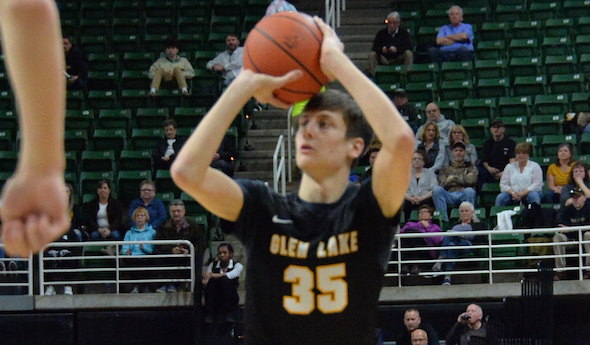
PHOTOS: (Top) Maple City Glen Lake’s Reece Hazelton launches a 3-pointer Thursday at the Breslin Center. (Middle) Monroe St. Mary’s Mitchell Sherrard works to get a shot around Glen Lake’s Cade Peterson.