

Frankfort Advances in Memorable Fashion
March 14, 2019
By Geoff Kimmerly
Second Half editor
EAST LANSING – Either way late in Friday night’s Division 4 Semifinal, Frankfort was headed to the record book.
For most of the first three quarters, it seemed the Panthers were cruising toward reaching the MHSAA championship round for the first time.
Then, over six minutes of game time, they found themselves running the risk of being on the wrong end of the largest comeback in Finals weekend history.
After senior Ethan Ness’ free throw with eight seconds left on the clock, and then one more stop on the other end of the court, Frankfort emerged with a 44-43 win over Wyoming Tri-unity Christian to reach the final day of the season for the first time in this sport.
The Panthers will take on Southfield Christian in Saturday’s first Final at 10 a.m., after a day to recover from also watching a 23-point lead dissolve between the third and fourth quarters.
“We trust our teammates. If we go down, we get ready, we get back up, and we trust everyone on this team,” Frankfort sophomore guard Jack Stefanski said. “Everyone is here for a reason. We’ll fight through anything.
“This has never happened in Frankfort history for boys, and no one thought we’d be good this year. … We knew we had to step up this year, with a new coach and new players. We had to start our legacy, and this is how we started.”
And for all the reasons mentioned above, it was unforgettable.
Frankfort (21-5) did graduate its top six players from last season, and coach Dan Loney did take the program over this winter after previously serving as an assistant. The Panthers did finish second in the annually-strong Northwest Conference – but then lost to sub-.500 Buckley in the regular-season finale and needed overtime wins twice to get to Breslin Center.
Thursday’s start, against a Tri-unity program with four Class D championships and four more runner-up finishes, was truly impressive. In part with a 10-0 run to finish the first half, Frankfort took a 26-12 advantage into the break, then opened the third quarter with nine more consecutive points to make it 35-12 with 2:22 to go in the period.
 But longtime Tri-unity coach Mark Keeler had a card or two left to play – namely, a defensive press that contributed to 10 Frankfort turnovers over an ensuing 27-2 comeback.
“I’ve had that happen before, having coached as long as I have. The key is we need to focus on defense – but saying it and doing it are two different things,” said Keeler, who has led the team to 599 wins over 32 seasons.
“When we went to the press … they finally made up their minds that they wanted to give it everything they had. All of a sudden they were focused on defense, not focused on offense, and that takes the pressure off. You relax, and all of a sudden you’re getting shots to fall.”
The Defenders (22-4) took a 39-37 lead on senior Elijah Badgero’s basket with 4:08 to play.
But like in nine other games won by six or fewer points this season, Frankfort came through. First, senior guard Will Newbold tied the score with 3:26 to play. Ness gave the Panthers a three-point lead at 2:39 with a long-range shot, and Newbold made the margin four with a free throw with 55 seconds left.
They needed every one of those points, as Tri-unity senior Brayden Ophoff and freshman Brady Titus sunk buckets to bring the score even at 43-43 with 20 seconds to play. But Ness was fouled on the next possession and connected on one of two free-throw tries to take back the lead once more. A group of Panthers held their ground in the lane on Tri-unity’s final attempt for the win, and Frankfort celebrated.
“I’m not sure why it keeps coming down to this,” Loney said. “We knew they would make a run at some point tonight. It was not going to be a blowout by any means. When they brought that full court pressure, it rattled the guys a little bit.
“(But) these guys have found ways to win close games all year. They’re a resilient bunch, no matter what the score is. I can’t tell you guys how many close games we’ve had like this this year, and these kids have stepped up to the plate and ended with a win.”
Newbold led the Panthers with 16 points and four steals. Ness finished with 11 points and six rebounds, Stefanski had seven points and 13 rebounds and senior forward Jack Reznich had five assists and six rebounds.
Senior Bennett Sinner led Tri-unity with 16 points and six steals, and grabbed eight rebounds. Badgero had 10 points and 13 rebounds.
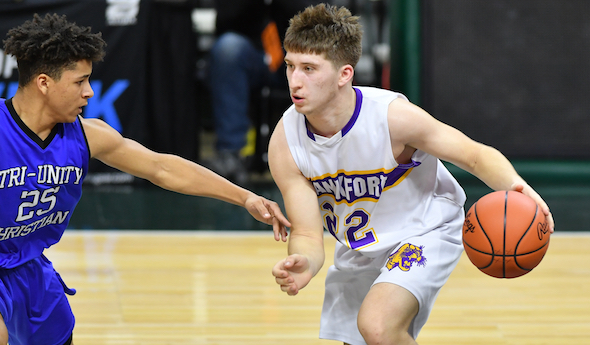
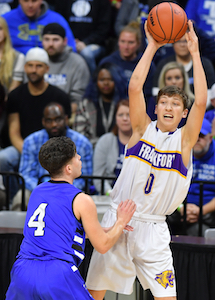
PHOTOS: (Top) Frankfort’s Ethan Ness (22) sets up the offense while Brady Titus defends. (Middle) Jack Stefanski (0) looks for an open teammate Thursday with Brayden Ophoff applying pressure.
Breslin Bound: Boys Report Week 2
December 20, 2012
By Geoff Kimmerly
Second Half editor
As with football during the fall, Second Half tries to hit all classes and all corners of the state for these weekly boys and girls basketball reports.
But sometimes, focusing on the powers in Class A and B is simply unavoidable.
Most of this week's 10 notable performances came from some of our biggest and best-known schools. (Results and records based on those reported to Score Center at MHSAA.com)
1. Warren DeLaSalle (3-0) – The Pilots have been the Detroit Catholic League team to beat for half a decade, and that could continue this winter. DeLaSalle beat Farmington Hills Harrison 64-50 before edging Class B power Grand Rapids Christian 77-76 in double overtime.
2. Gibraltar Carlson (2-0) – The Marauders’ 70-53 win over Saginaw Buena Vista might not have earned the biggest headline from Saturday’s Metro Detroit Saginaw Valley Challenge at West Bloomfield. But given Buena Vista’s rich tradition, it was still intriguing – although Carlson is coming off a run to its Regional Final too.
3. Romulus (2-1) – I hope to avoid repeating teams on this list from week to week. But Romulus beating reigning two-time Class B champion Lansing Sexton 67-52 makes the Eagles a must again.
4. Grand Rapids Christian (1-3) – It’s been a tough go for these Eagles, who are expected to contend in Class B. But despite finishing the week with that close loss to DeLaSalle, they did beat reigning Class A runner-up Rockford 48-39 earlier on.
5. Rockford (1-2) – The Rams also opened with a couple of losses, but finished the week with a 63-53 win over Muskegon – which made this list last week and is considered a possible contender this season.
6. Bessmer (5-0) – After going 10-11 in 2011-12, Bessemer is halfway to matching that win total. Last week’s were close ones – 50-48 over Hurley, Wis., and 55-51 over Ironwood.
7. Lansing Eastern (2-1) – The Quakers have had three Division I college prospects graduate or move to schools out of state over the last two years, but keep rolling. They picked up solid wins over Williamston (68-58) and East Lansing (55-50).
8. East Jackson (4-0) – The Trojans are off to another nice start coming off a 15-win season. They opened last week beating Brooklyn Columbia Central 51-45 before doubling up Manchester 102-61 – after another high-scoring 100-94 win over Manchester a year ago.
9. Saginaw (4-0) – The reigning Class A champion is on the move again. After beating Midland 86-77 and then Saginaw Heritage 81-34, the Trojans came back Saturday to beat a strong Detroit Southeastern team 57-56 in the MDSV Challenge.
10. Flint Southwestern (3-1) – The Knights are already halfway to last season’s win total, thanks in part to victories last week over Flint Northwestern (63-59) and Flint Powers Catholic (70-39).
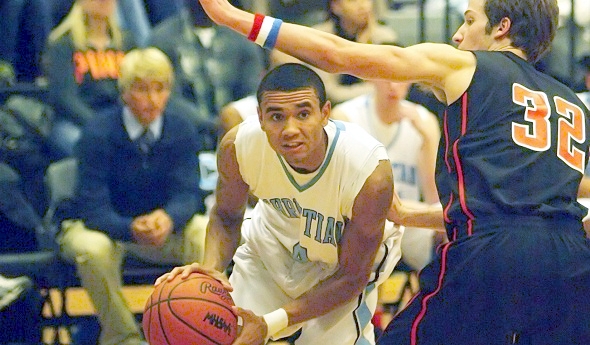
PHOTO: Grand Rapids Christian's Drake Harris attempts to drive around a Rockford defender during last week's win against the reigning Class A runner-up. (Click to see more at HighSchoolSportsScene.com.)