

Freshman Shines As Eagles Repeat in D
March 23, 2013
By Bill Khan
Special for Second Half
EAST LANSING — There was no need for Eugene Brown to sit quietly in the background and ease his way into a prominent role on Southfield Christian's basketball team.
One game was all it took for the freshman guard to prove he belonged on the defending MHSAA Class D Finals champion.
When Brown scored 17 points and grabbed 10 rebounds in a season-opening overtime victory over traditional Class A power Orchard Lake St. Mary's, it justified coach Josh Baker's decision to put a ninth-grader in the starting lineup of a team with Breslin-or-bust aspirations.
"To come in as a freshman, that's a pretty good first game against a great team," Baker said.
Brown was a mere spectator at the Breslin Center when the Eagles won their first championship last season. He thrived under the bright\ lights on Saturday as Southfield Christian repeated as Class D
champion with a 65-46 victory over Wyoming Tri-unity Christian.
He jump-started the Eagles' championship victory, scoring 11 of his 13 points in the first half and helping Southfield Christian build a 16-point second-quarter lead. Brown shot 5 for 8 from the field,
3 for 3 from the line, grabbed nine rebounds, dished out four assists and had three steals.
 Freshman jitters? Not in this kid.
"I just tried to come out and not be nervous," Brown said. "Just play the game like you know how, just go out and do your best."
Baker wasn't concerned how his freshman phenom would respond on the big stage, just as he was confident that Brown could handle making his high school debut against a team like St. Mary's in early December.
"He's usually pretty cool and casual under pressure," Baker said. "Part of that is his problem, because he's not aggressive enough all the time. We wanted him to be aggressive. We've been on him all year to be aggressive. He did it tonight, and he showed he can make plays. He's so skilled as a freshman. When he's aggressive and he keeps the ball low, he's really good."
As Brown started sinking shots during a decisive second quarter, the Southfield Christian student section chanted, "He's a fresh-man!" It was a warning to the rest of Class D that Brown will have to be reckoned with for three more seasons. For that matter, the entire program could dominate Class D for years to come.
It's not too early to begin speculation that Southfield Christian is a dynasty in the making. Winning back-to-back championships is an excellent start. All 65 of the Eagles' points against Tri-unity were scored by players who are eligible to return next season.
The team's only two seniors didn't play until a 58-40 lead had been built midway through the fourth quarter. The Eagles started a freshman, two sophomores and two juniors.
"We can only get better," said 6-7 junior Damarco White, who had 15 points and five blocks.
"The sky's the limit," added junior guard Lindsey Hunter IV, who scored 11 points.
A man who is an expert on Class D dynasties is Mark Keeler, who has coached four MHSAA Finals champions and four runners-up in his 26 seasons at Tri-unity.
"Seeing how young their team is, they're definitely going to be a force in Class D," said Keeler (499-142), who was trying to celebrate a Finals championship and his 500th victory on the same day.
The Eagles rebuilt on the fly after winning the title last year. Their returning players combined for only 12 points in last year's MHSAA Final, with Hunter scoring eight of them.
After a 3-4 start, Southfield Christian won its final 20 games.
"We knew we had the potential. It's just that early on we struggled with understanding the work ethic you have to put in," Baker said. "It's not just handed to you. Every game you play, every team is going to come after you. That's why we started off 3-4. We just got drilled by some guys. When they understood the work ethic and what it takes every game, we started to go on a nice run."
Tri-unity (25-3) got out to an 8-6 lead, but Southfield Christian took the lead for good by scoring the next nine points to ignite a 26-8 run. The lead reached 34-18 with 3:48 left in the second quarter. The Eagles didn't score the rest of the half, while the Defenders cut the margin to 34-23 at the intermission.
Matt Wachter's basket with 7:04 left in the third quarter trimmed the deficit to single digits at 34-25, but Tri-unity didn't put together consecutive scores again until Southfield Christian was comfortably ahead, 56-34.
Tri-unity forward Joey Blauwkamp, The Associated Press' Class D Player of the Year, was held to seven points on 2 for 9 shooting before fouling out with 2:38 left in the game.
"For us coming into halftime, being down only 11, I wasn't too concerned," Keeler said. "But when Joey picked up three and four (fouls) so quickly, it definitely messes with you."
Sophomore Bakari Evelyn scored 11 points for Southfield Christian, which shot 22 for 42 from the field and 17 for 21 from the line.
Daniel Cole scored 21 points and Wachter 11 for Tri-unity.
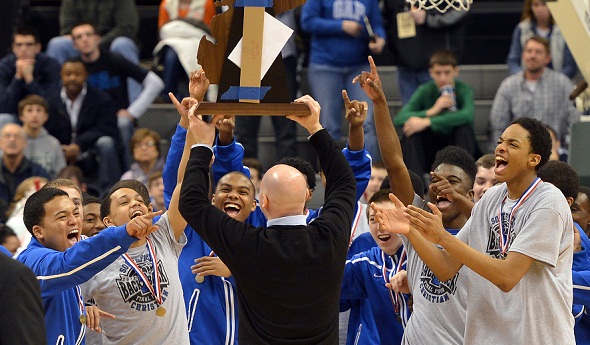
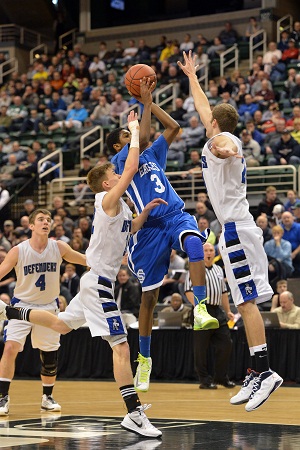
PHOTOS: (Top) Southfield Christian coach Josh Baker presents the championship trophy to his team Saturday at the Breslin Center. (Middle) Eagles freshman Eugene Brown goes up for a shot against Wyoming Tri-unity Christian's Joey Blauwkamp (4) and others. (Click to see more at HighSchoolSportsScene.com.)
Energy, Competition, Moments & More Continue to Spark Unity Coach Soodsma
By
Steve Vedder
Special for MHSAA.com
February 15, 2023
HUDSONVILLE – The pep band is blaring the school fight song, the boisterous crowd of a couple of thousand fans has long grown weary waiting for the opening tip-off, and the antsy players are crowded behind the locker room doors ready to spring like a pack of lions.
It's like the scene from the epic basketball movie "Hoosiers" where coach Norman Dale pauses before entering a rollicking and packed Friday night gymnasium to mutter to himself, "Welcome to Indiana basketball."
Scott Soodsma not only grasps the significance of that scene firsthand, it's why after four decades he still loves coaching.
"The fierce competition, the band, your heart pounding like a dog – it's still like it was 30 years ago," said Soodsma, the Hudsonville Unity Christian coach and dean of West Michigan basketball coaches in his 41st season of a run that’s included two states and three schools.
"How does it get any better than that? I'm always telling the kids to live for the moment. You can't replace all that; I still get the shivers. I've had so many moments like that."
Among those highlight moments are being one of just three Michigan coaches to win both girls and boys MHSAA Finals championships (Paul Cook of Lansing Eastern boys/Lansing Catholic girls and Johnny Jones of Lansing Everett were the others), and the moment he claims is easily No. 1 on his all-time personal list: coaching his daughter Amber as part of the 2006 Class B champ. Unity Christian also won a 2019 boys state title. He also won a third Finals championship with the boys at McBain Northern Michigan Christian.
Soodsma, 63, admits there have been myriad changes in coaching basketball since his first season at North Dakota's James Valley Christian High School in 1983 and coming to Unity Christian in 1993. For starters, players are bigger and stronger and are more schooled in the game through AAU and offseason programs. In addition, the influence of parents – for better or worse – has increased dramatically. As for the on-court game, Soodsma unabashedly admits he at first fought the institution of the 3-point shot. And the emphasis on winning has definitely only increased pressure on many coaches.
Soodsma, a member of the Basketball Coaches Association of Michigan Hall of Fame who ranks ninth on the state's all-time boys wins list with 635, said he's adapted to the times. He wants to win as much as he ever has, still broods for days after losses and still considers himself receptive to the changing Xs and Os aspect of coaching.
But where his booming voice routinely used to resonate loudly into the middle sections of the Unity Christian bleachers, most of those comments now are only audible to fans perched in the first couple rows of the stands. Which is probably a good thing, Soodsma adds sheepishly.
 Coaching, he readily contends, is still coaching – and winning still heads the list of priorities. He does add one disclaimer, however, in terms of winning. Whereas it used to be about a young coach building a resume through wins, it's now about what winning can do for today's teenager athlete. An old-school coach? Yeah, probably. But one who has learned much about himself, players and parents after 41 years.
"I've learned to enjoy the kids more; I'm definitely a different kind of person in the ’90s as opposed to now in the 2000s," he said. "I am a stubborn man, and it took a long time (to change). But winning? Oh, yeah. I've never backed down. The winning and losing hasn't changed, and I make no excuses that I still want to win."
Which is then strange, perhaps, that he doesn't list being just one of two coaches to win Finals titles in both girls and boys basketball as the zenith of coaching for 41 seasons. That honor goes to having his daughter, who went on to a stellar career at Dort College, on the state championship club.
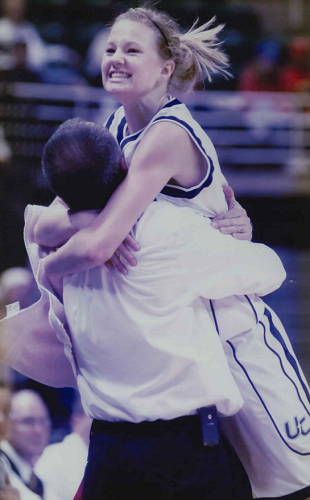
"It's not that big of a deal," he said of being on the bench for what likely will never happen again as boys and girls basketball are now in the same season. "To me it's not an accomplishment I would rank (at the top). I'm just being honest. Winning a state title with Amber, and the picture I have of her and me in my office, that's the best."
How well has Soodsma adapted his coaching style over the years? Two people in a position to know offer their own opinions on the topic, including 22-year assistant Bruce Capel and Randy Oosterheert, who with son Rylan are the only father/son combination that Soodsma has coached.
"Scott has always been vocal on the sidelines as a coach. As I sit in the stands and watch as a spectator, same Scott," said Randy Oosterheert who played for Soodsma in 1992-93 and 1993-94 and whose son is a current Unity Christian player. "I will say that my son and I agree, if you do something wrong on the floor, he is the first person to greet you on the sidelines and point out your failure. However, if you do good, he is the first person to greet you on the sidelines and tell you good job.
"The latter is done at a little lower decibel level than the offense, and those with a watchful eye from up in the stands unfortunately (don’t) get to hear the praise, only the punishment. Scott is obviously very competitive, then and now. He expects a lot but gives a lot."
As far as the competitive side, Capel hasn’t seen much of a difference over their two decades together.
"Certainly, coaching is a lot different in how you approach kids from more than 20 years ago," he said. "There's a difference in society and you have to change with it, and he's done that. I don't think it's as much life and death with Scott anymore. But in terms of winning, I haven't seen that go away."
It's a coin flip as for how much longer Soodsma will be directing traffic from the sidelines. He broke into the top 10 among the all-time winningest boys coaches in Michigan history by passing Warren De La Salle's Bernie Holowicki and Ray Lauwers of Morley Stanwood last season. Next on the list is Big Rapids' Kent Ingles (644). When you factor in Soodsma's win total as both boys and girls coach, the 742-and-counting combined wins rank eighth in state history.
He does admit the desire to spend more time with wife Mary, the longtime away scorekeeper for the program, and 11 grandkids scattered from Denver to Seattle to San Diego. Retirement could strike when this season ends in March, or it could still be several Marches away. But when the end comes he anticipates making a contented transition from arguing with officials, coming to an "understanding" with parents and devising new Xs and Os. Soon, he mused, will come time for much-anticipated passions such as hunting, fishing and pickleball.
"For the first time I've contemplated it," he said. "There are a lot of things I'd like to do. I'm not a basketball junkie."
That may be true. But it'll still be tough to surrender those noisy pep bands, bright gymnasium lights and the din of Friday night crowds.
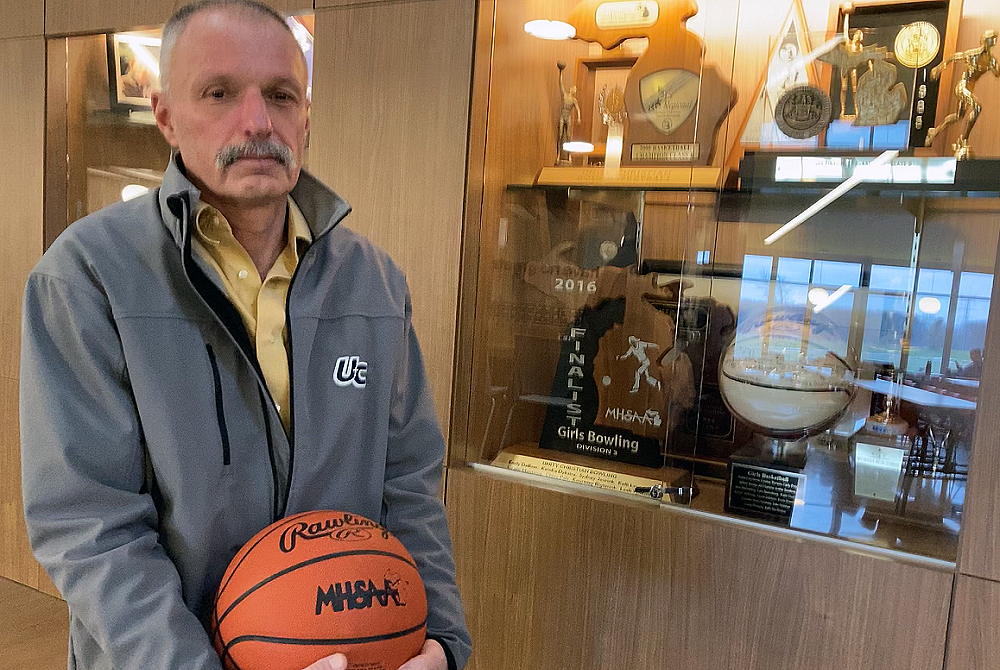
PHOTOS (Top) Hudsonville Unity Christian boys basketball coach Scott Soodsma stands in front of a portion of the school’s trophy case, which he’s helped fill over decades coaching basketball. (Middle) Soodsma and daughter Amber embrace during their team’s 2006 Class B Final victory. (Top photo by Steve Vedder. Middle photo courtesy of the Soodsma family.)