

'Hooping for a Cure' a Slam Dunk
March 29, 2012
Brent Crossman was 12 years old in 1982 when his mother, now Sonja Reithan, was diagnosed with breast cancer.
It was impossible for him to understand at that point all that she went through with chemotherapy and a mastectomy. Thankfully, she survived.
He was much older when his sister Kenna Crossman died in 1998 after battling a brain tumor.
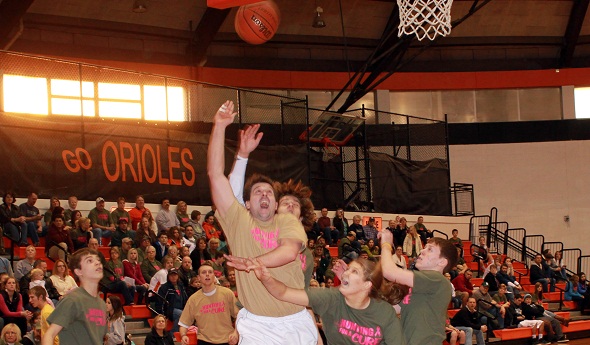
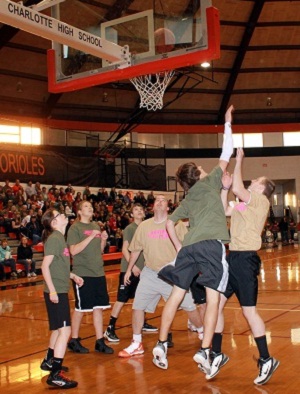
Charlotte High School's “Hooping for a Cure” players vs. teachers basketball games began as a way to honor his mom and raise money for the American Cancer Society. But this month’s game, the fifth in what is now an annual event, hit home again for the Orioles community.
On Jan. 2, Tina Droscha – whose son Adam is the senior class president – died after a 14-year battle against breast cancer. Then, on Feb. 4, former standout athlete Blake Rankin (class of 2011) died after fighting mouth cancer.
 “I tell people, I wish I was one of these guys who just picked this cause and decided to be passionate about it. But it picked me,” said Crossman, who was the girls varsity coach from 1998-2007 and also has coached baseball and golf at the school. “When I lost my sister in 1998, it changed my life. I watched her go from a wonderful, healthy person with no issues to bed-ridden and I’m-carrying-her-to-the-bathroom kind of stuff.
“It got me all fired up. I was passionate and gung-ho about it. And when I started coaching basketball and became a teacher here, I was active and involved anyway and I knew I had avenues others didn’t have.”
This season's Hooping for a Cure game was played March 10 and raised $6,500.
It is set up with the usual four quarters – but with freshmen playing the first, sophomores the second, juniors the third and seniors the fourth. Each grade has 15 players made up of both boys and girls. They take on a team of teachers and staff that also rotates in and out of the line-up.
The first game raised roughly $2,000. That donation doubled the next year.
This year, Crossman’s crew sold more than 900 “Hunt for a Cure” shirts in honor of Rankin, a passionate outdoorsman (and the teams also wore them for the game). Balls autographed by Michigan State coaches Tom Izzo, Suzy Merchant and Mark Dantonio were raffled, and spectators also were treated to performances by local and school dancers and the Orioles’ drum line. Droscha and his band Smash the Hall played after the game.
PHOTOS courtesy of Charlotte High School.

Countdown to Calvin: Girls Report Week 2
December 17, 2018
By Geoff Kimmerly
Second Half editor
Calendar year 2018 is drawing to a close, but anticipation is just starting to ramp up as girls basketball teams head into the holidays.
 For many, there won’t be much of a break as they prep to play in a number of showcase events around the state.
Saturday saw the Best of Michigan Classic at Detroit Edison and a number of top Division 1 and 2 teams compete – we highlighted a few of those below. Similar events will follow over the next three weeks, before the schedule shifts to league competition and taking the next steps toward playing meaningful games at the end of February and into March.
Countdown to Calvin is powered by MI Student Aid and based on results and schedules posted for each school at MHSAA.com. To offer corrections or fill in scores we’re missing, email me at [email protected].
Week in Review
The countdown of last week’s five most intriguing results:
1. Detroit Renaissance 61, Ypsilanti Arbor Prep 38 – The Phoenix bounced back from an opening loss to Harper Woods Chandler Park to down Division 3 contender Ypsilanti Arbor Prep at the Best of Michigan Classic at Detroit Edison.
2. Columbus Africentric Early College (Ohio) 65, Detroit Edison 60 – We don’t usually highlight a Michigan team’s out-of-state loss, but falling by only five to an Ohio power with a University of Tennessee recruit featured by Sports Illustrated last month is still quite a showing.
3. East Lansing 45, DeWitt 41 – With the first of two regular-season meetings this close, it’s a good bet these two will determine a league champion and possibly more again this winter.
4. Southfield Arts & Technology 68, Flint Carman-Ainsworth 55 – A&T is a two-point loss to Saginaw Heritage from a 4-0 start, and Carman-Ainsworth is another well-respected team from Division 1.
5. Corunna 54, Goodrich 53 – Last week was an early indication this could be a special season for the 4-0 Cavaliers. In addition to beating the always-contending Martians, Corunna finished with an overtime win over Flint Hamady.
Watch List
With an eye toward March, here are two teams in each division making sparks:
DIVISION 1
• Brighton (3-0) – After three straight 14-win seasons, the Bulldogs could be candidates to take another step and enter Kensington Lakes Activities Association West play as one of three unbeaten teams. Brighton opened with a two-point win over Marquette at Petoskey and has followed with two double-digit wins including a 23-pointer over Okemos last week.
• Wayne Memorial (2-0) – The Zebras graduated a Miss Basketball finalist from last season’s Class A semifinalist team but haven’t missed a beat. They opened last week nearly doubling up Division 2 hopeful Williamston and then beat Illinois power Chicago Whitney Young 71-56 at the Best of Michigan Classic.
DIVISION 2
• Comstock (3-0) – The Colts have one of the state’s sharpest shooters in 1,000-point scorer Daisy Ansel and should have high aspirations after last season’s 19-2 run. Comstock is looking to first three-peat in the Berrien-Cass-St. Joseph Conference Red and finished its week with a 58-31 win over reigning league runner-up Niles Brandywine.
• Edwardsburg (4-0) – The Eddies haven’t lost a league game the last two seasons and earned their first Wolverine Conference South win this winter against Three Rivers on Friday. Edwardsburg, coming off a 22-2 run, has three wins by 20 or more points so far – with the fourth victory a three-pointer over Southwestern Michigan Athletic Conference West co-leader Portage Central.
DIVISION 3
• Adrian Madison (4-0) – Last season saw the end of Madison’s six-season hold on the Tri-County Conference title; the Trojans finished second. But they bounced back into league play last week with a big win over Sand Creek coming off solid nonconference showings versus Blissfield and Hudson.
• Ishpeming Westwood (5-0) – The Patriots opened with an overtime win over Menominee and have just kept rolling. Last week’s 66-40 win over rival Ishpeming avenged last season’s District loss, and at this rate Westwood soon should be circling Jan. 18 and Feb. 15 dates with also-unbeaten Negaunee.
DIVISION 4
• Martin (3-0) – The Clippers improved five wins last season to 13-11 and tied for fourth in the Southwestern Athletic Conference Lakeshore. Over this season’s first two weeks, Martin has beaten Saugatuck – the other fourth-place team from last winter – and avenged two losses to last season’s runner-up Coloma with a 46-40 victory.
• Onaway (3-0) – The Cardinals are making their move early after finishing 10-10 last season. They beat Posen by 10 in their opener after losing twice to the Vikings last winter, and last week’s 40-26 win over Central Lake further avenged an early 2017-18 defeat.
Can't-Miss Contests
Be on the lookout for results of these games coming up:
Thursday – Plymouth (3-0) at Brighton (3-0) – These two look early like possible favorites in the KLAA West; Plymouth was second in the former Black and Brighton third in the Gold last season.
Thursday – Macomb Dakota (4-0) at Grosse Pointe North (3-1) – These two shared the Macomb Area Red title last season before North won their Regional meeting by two on the way to making the Class A Semifinals.
Friday – Freeland (3-1) at Saginaw Heritage (3-0) – Heritage is, of course, the reigning Class A champion, and Freeland is always one of the best from the Saginaw area as well.
Saturday – Detroit Edison (3-1) vs. Detroit Country Day (1-2) at Lawrence Tech – Country Day won Class B last season, and Edison won C and could be the Yellowjackets’ biggest obstacle in the new Division 2.
Saturday – Ypsilanti Arbor Prep (4-1) at Muskegon Oakridge (3-0) – The Gators’ tour of the state’s best heads west, where Oakridge is yet to have a game closer than 17 after going 22-4 a year ago.
Second Half’s weekly “Countdown to Calvin” reports are powered by MI Student Aid, a part of the Student Financial Services Bureau located within the Michigan Department of Treasury. MI Student Aid encourages students to pursue postsecondary education by providing access to student financial resources and information, including various student financial assistance programs to help make college more affordable for Michigan students. MI Student Aid administers the state’s 529 savings programs (MET/MESP) and eight additional aid programs within its Student Scholarships and Grants division. Click for more information and connect with MI Student Aid on Facebook and Twitter @mistudentaid.
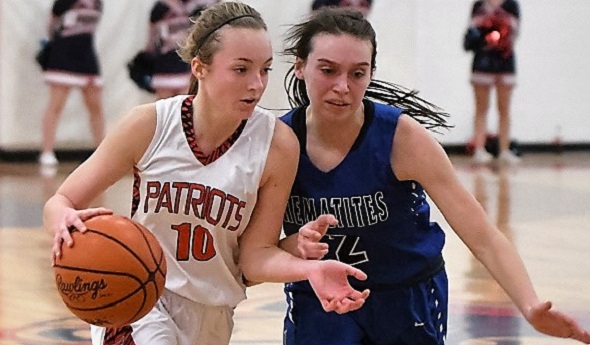
PHOTO: Ishpeming Westwood's Madelyn Koski (10) drives to the basket last week with Ishpeming's Emma Poirier (2) defending. (Photo by Cara Kamps.)