

Hoops on Film: 1961 Class D Boys Final
July 27, 2015
By John Johnson
MHSAA communications director
A battle of undefeated teams from schools both no longer in existence is highlighted this week as part of MHSAA.tv’s Hoops On Film Series.
From the late 1940’s to the mid 1970’s the Michigan High School Athletic Association shot portions of the action at its boys and girls basketball finals on 16mm film. The films were loaned out, primarily to the participating schools, to help them relive the moments of playing in a championship game.
While many of the old films have wandered astray over time, about 60 games still exist in the MHSAA archives. Anyone in possession of such a film is encouraged to contact John Johnson at the MHSAA Office ([email protected]) to discuss having the film converted to a digital format.
Some of the films only have portions of the second half and the post-game awards; some have most of the action. None of the films have sound. They range in length from 10 minutes to about an hour. A new film will be posted online each Monday through the week of August 17. DVD’s may be purchased directly from the MHSAA.tv Website – just click the Get DVD button below the player.
Here’s a look at this week’s game, with recap courtesy of MHSAA historian Ron Pesch:
Marquette Pierce 68, Freesoil 61 – 1961 Class D Boys Final - After 35 years as a coach in the Upper Peninsula, Vic Hurst was rewarded with his first MHSAA title as Marquette Pierce downed a determined Freesoil squad, 68-61, in a Class D battle of the undefeated. Dave Benson led the Warriors with 17 points, while teammates Dennis DeMerse and the Laurich brothers – Conrad and Larry – each added 15. The matchup came after each school's first Regional crown and ended up the only time either school would ever reach the Finals. Pierce would close after the 1961 season, and its only other Regional appearances came back-to-back in 1955 and 1956. Freesoil would win four more Regional titles during its history – three consecutive form 1966-68. The high school closed after the 2006-07 school year and was absorbed into the Mason County Eastern school district.
Previous releases:
1958 Class A Boys Final: Detroit Austin 71, Benton Harbor 68 - Watch
1976 Class D Girls Final: Lake City 58, Perkins 48 - Watch
1971 Class A Boys Final: Flint Northern 79, Detroit Kettering 78 - Watch
1954 Class A Boys Final: Muskegon Heights 43, Flint Northern 41 (OT) - Watch
1973 Class C Boys Final: Detroit East Catholic 50, Saginaw St. Stephen 49 - Watch
Breslin Bound: Boys Report Week 6
January 15, 2018
By Geoff Kimmerly
Second Half editor
We’re heading into the midpoint of this boys basketball season, and the surprises keep coming.
 Detroit Henry Ford and Grand Ledge were full of them last week, and Berkley has been one of the state’s most intriguing all season. We touch on those a little bit below, along with a number of others that most recently caught our attention.
Breslin Bound is powered by MI Student Aid and based on results and schedules posted for each school at MHSAA.com. To offer corrections or fill in scores we’re missing, email me at [email protected].
Week in Review
The countdown of last week’s five most intriguing results:
1. Detroit Henry Ford 63, Detroit Cass Tech 60 – The Trojans should be back in the Class B title talk after handing a first loss to one of the major favorites in Class A.
2. Grand Ledge 59, East Lansing 53 – The Comets are 6-1 but weren’t getting much attention until this upset broke East Lansing’s 45-game regular-season winning streak.
3. Frankfort 69, Buckley 53 – The Panthers handed the reigning Class D runner-up this defeat after falling to Buckley by 39 and then only three last season.
4. Detroit Cass Tech 85, Muskegon 78 (OT) – The Technicians did not waste time bouncing back from the Henry Ford loss, downing Muskegon in overtime the next day at Grand Rapids Ottawa Hills.
5. Macomb Dakota 64, Clinton Township Chippewa Valley 62 – The Cougars took big losses early to Detroit U-D Jesuit and New Haven, but are undefeated in the Macomb Area Conference Red after handing Chippewa Valley its first defeat in the league and overall this winter.
Watch List
With an eye toward March, here are two teams in each class making sparks:
CLASS A
Ann Arbor Skyline (7-0) – The Eagles have been building toward a start like this, even winning the Southeastern Conference Red title a year ago. They started the new year with a 20-point win over second-place Ann Arbor Pioneer on Saturday and have impressive wins by 14 over Belleville, one over Detroit Pershing and 20 over frequent nemesis Ann Arbor Huron.
Berkley (8-0) – The Bears have doubled their win total from last season after going 4-17, and they’re only a few more from guaranteeing a first winning season since 2010-11. They’ve pulled off a few close ones including a two-point victory over MAC Bronze leader Madison Heights Madison a month ago. Next up is Rochester with first place in the Oakland Activities Association Blue on the line.
CLASS B
Detroit Henry Ford (7-2) – The 2015-16 Class B champion still made the Regional last season despite finishing 13-11 overall, and another big run could be on the way. Ford opened this season with a two-point win over 2017 Class A semifinalist West Bloomfield, and has beaten a series of Class A teams including Cass Tech (see above). The losses came to Class A powers Grand Rapids Ottawa Hills and Hazel Park, the latter in overtime.
Ovid-Elsie (5-1) – The Marauders have hovered around .500 the last few seasons, but might have something more in store over the next two months after a fast start. Ovid-Elsie sits atop the Tri-Valley Conference West standings and hasn’t lost since its opener (to still-undefeated Fowler). Coming up Friday is a matchup with second-place Hemlock.
CLASS C
Norway (5-2) – The Knights moved over to the Skyline Central Conference after sharing the Mid-Peninsula Conference title last season and finishing 18-3 overall. They’ve won four straight and hold a half-game lead in the SCC’s Large School division. The two losses came in December in overtime to Powers North Central and by eight to nemesis Iron Mountain, which knocked Norway out of the tournament last season. Those two will face off again Feb. 9.
Sanford Meridian (7-1) – The Mustangs are playing for a second straight Jack Pine Conference championship and already have wins against usual annual contenders Beaverton and Clare. Meridian’s only loss was by 10 in early December to Class A Saginaw Heritage, and it’s got another similar test coming up against Midland Dow in two weeks.
CLASS D
Cedarville (7-2) – The Trojans are approaching the season’s midpoint in position to take back the Eastern Upper Peninsula Athletic Conference title after tying for second a year ago. Cedarville got past reigning champion Pickford 67-59 last week and has lost only to undefeated Hillman and Class B Boyne City.
Frankfort (6-0) – The Northwest Conference sent Buckley all the way to the Class D title game last year, and early this winter it’s Frankfort that could be setting up for a run. The Panthers held onto first place all alone in the league last week with a win over the Bears, and now face the other two teams with only one conference loss – Kingsley on Tuesday and Maple City Glen Lake on Thursday.
Can't-Miss Contests
Be on the lookout for results of these games coming up:
Tuesday – Rapid River (7-0) at Powers North Central (6-1) – The Rockets ended North Central’s record 84-game winning streak Dec. 7, but the Jets can make it six straight by taking the rematch.
Tuesday – Orchard Lake St. Mary’s (7-2) at Warren DeLaSalle (6-2) – In a strong Detroit Catholic League Central, these are two of the best; DeLaSalle leads and St. Mary’s is third after falling to second-place U-D Jesuit by a point last week.
Thursday – Bellevue (8-0) at Camden-Frontier (8-2) – Both are pushing for Southern Central Athletic Association titles; Bellevue is tied for first in the West and Camden-Frontier is second in the East, and this game counts in the standings for both.
Thursday – Maple City Glen Lake (5-1) at Frankfort (6-0) – The Panthers also must survive Kingsley on Tuesday to keep their perfect start going, and Glen Lake is aiming to gain a share of first place in the Northwest Conference too.
Friday – Hazel Park (8-0) at West Bloomfield (3-3) – Hazel Park and reigning Class A champion Clarkston have been the talk of a strong OAA Red, but West Bloomfield also is undefeated in league play after opening with three tough nonleague losses including two by only two points apiece.
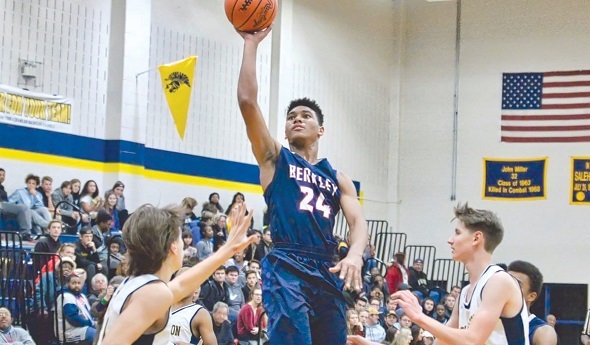
PHOTO: Berkley, here against Clawson in December, is one of this season’s biggest surprises. (Photo courtesy of C&G Newspapers.)