

Improved Dundee Enjoys Memorable Start
By
Geoff Kimmerly
MHSAA.com senior editor
January 12, 2017
By Geoff Kimmerly
Second Half editor
The Dundee boys basketball team has stacked up a pair of accomplishments already this winter – one to enjoy right now, and another to take pride in for years to come.
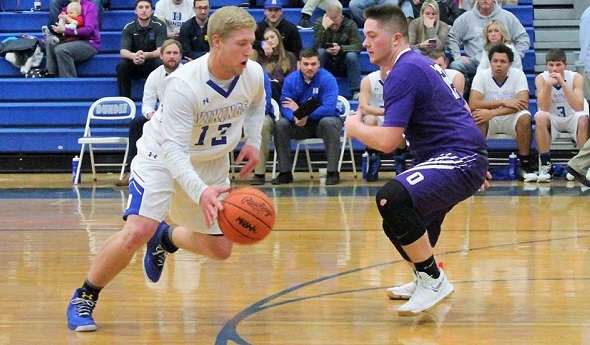
 The Vikings, after finishing last season 10-11, are off to an 8-0 start this winter. The early run has included a 67-64 win on Dec. 15 over Onsted, last year’s Lenawee County Athletic Association champion.
The significance of that accomplishment is easy for players to get, especially since the majority of this year’s rotation went through the growing pains of last season. But the historic meaning of the win that came after Onsted probably will take some more time to sink in – even as it’s bound to be one of the most lasting achievements of these players’ careers.
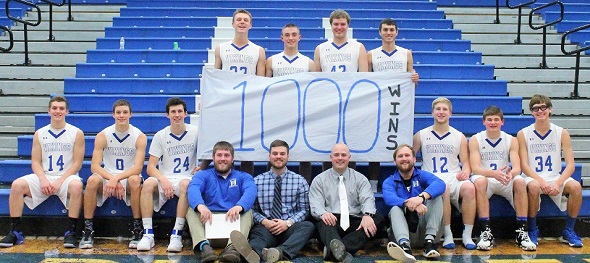
Dundee’s 60-50 win over Carleton Airport on Dec. 20 was the 1,000th victory in program history, making the Vikings one of at least 12 in Michigan high school history to have reached that milestone and the first from Monroe County.
“I don’t think at their age they understand how big of an accomplishment that is – that you’d basically have to go undefeated 50 straight years to get to 1,000,” said second-year coach Jordan Bollin, who is in his 11th season total as a coach in the southeast part of the state. “We tried to explain it to them, and I think they do (get it more) now.”
Dundee is the Applebee’s “Team of the Month” for December in part for both headlining moments this season, pulling off its first five wins during that first month and seven of eight so far by double figures.
The Vikings are paced by six seniors, including four who start alongside junior Ben Miller, who also started last season as a sophomore and leads with team with 12.6 points and 10.1 rebounds per game. To make this season's jump, they put in the necessary time; Bollin said he held four-player workouts three times a week during the offseason, in addition to the players honing their skills during open gyms and over a busy summer.
Bollin also emphasized that while the program has undergone a system change – introducing a more free-flowing offense and shorter practices this winter – it’s maintained the same culture of toughness that exists throughout the community and is often most recognizable with the school’s best-known team – a wrestling program that has won three of the last four MHSAA Division 3 championships.
“I’ve coached at a couple places, and the kids at Dundee are tougher bred,” said Bollin, who graduated from Temperance Bedford, then assisted there and at Blissfield before coming to Dundee as an assistant three seasons ago. “I don’t know how to explain it. The parents do a great job of raising them. A lot of the parents played at Dundee, and it’s a well-versed culture there. It’s a very tough community … and it’s always ‘Yes coach. No coach,’ very respectful kids.
“The wrestling program sets the tone, and if our kids ever get tired or feel that our practice is tough, we ask, ‘Do you want to go wrestle?’ Tim (Roberts) is one of the best coaches probably in the nation, and they probably outwork any team in any sport in the state, and I can say that in confidence.”
It’s certainly worth noting that Dundee’s basketball program also is making this impressive run sharing winter athletes with that wrestling program in a school of just under 500 students. That might make the Vikings’ basketball depth notable as well; Bollin said in 11 seasons he’s never had a team with this many contributors, as six players have scored at least 13 points in a game. Senior guard Brayden Federer is another top scorer, pouring in 12 points per game while also serving as the leading lockdown defender.
For Dundee’s next game after winning 1,000, against Flat Rock on Dec. 22, the Vikings welcomed the school’s 1987-88 team that advanced to the Class C Semifinals and is considered the program’s best of all-time (Dundee’s 1937-38 team also made the Class C Semifinals, but no team has won a Regional title since 1988). Those past players were recognized with an on-court ceremony and visited the locker room before the game to meet the current players before these Vikings went on to a 44-30 win to close the month.
Bollin had an idea before this season that this team might be lined up for a special run too. So far it’s included a couple of meaningful accomplishments, and the Vikings hope they’re just getting started.
“We’re a starless team … and even in my second year, I’m improved as a coach. We’re prepared for anything they see, but a lot of it is on them,” Bollin said of his players. “People take it for granted, that experience, but it’s a big deal. These guys don’t get rattled much this year. Last year if a team switched defenses on them, it would set them back a couple of plays.
“(And) we’re a really close-knit unit, and they don’t let each other slack. It’s easy to coach when you have a team like that.”
Past Teams of the Month, 2016-17
November: Rockford girls swimming & diving - Report
October: Rochester girls golf - Report
September: Breckenridge football - Report
PHOTOS: (Top) Dundee’s Tyler Turner looks to get past an Onsted defender during the Vikings’ three-point win last month. (Middle) Dundee players and coaches commemorate the program’s 1,000th win after defeating Carleton Airport. (Photos courtesy of the Dundee boys basketball program.)
Breslin Bound: 2025-26 Boys Report Week 6
By
Geoff Kimmerly
MHSAA.com senior editor
January 12, 2026
Believe it or not, Michigan’s boys basketball teams have played six weeks of their regular season – and have only six weeks left until the start of District tournaments.

And that makes now a perfect time for our annual introduction to Michigan Power Ratings (MPR), which are used to seed all teams for that first round of the MHSAA playoffs.
MPR is determined by considering a team’s success (total wins) and strength of schedule based on games against opponents also playing in the MHSAA Tournament. You can follow how teams rank all season long on the MPR page, where you can search not only by Division and school, but District grouping as well.
“Breslin Bound” is powered by MI Student Aid and based on results and schedules posted for each school at MHSAA.com.
Week in Review
The countdown of last week’s five most intriguing results:
1. East Lansing 80, Rockford 71 (OT) These are the top two teams in Division 1 MPR, and the No. 1 Trojans (11-0) remained undefeated by handing the Rams (8-1) their only loss as they met to finish the GottaGetIt Classic at East Kentwood.
2. Crystal Falls Forest Park 69, Kingsford 68 The Trojans (7-2) won this matchup of teams that both reached MHSAA Semifinals at Breslin last season.
3. Frankenmuth 47, Freeland 43 The Eagles (9-0) ended a nine-game losing streak against the rival Falcons (8-2), picking up their first win in this Tri-Valley Conference series since March 4, 2021.
4. Grand Rapids Northview 43, Grand Rapids South Christian 41 (OT) This could prove to be one of the most important results in the Ottawa-Kent Conference Gold, as Northview (8-2) and South Christian (8-2) shared the title a year ago.
5. Grand Haven 57, Grand Blanc 51 The Buccaneers (11-1) continued their terrific start by ending a week of three close wins with this arguably most notable one over the Bobcats (9-2).
Watch List
With an eye toward March, here are two teams in each division making sparks:
DIVISION 1
Bloomfield Hills Brother Rice (10-3) The Warriors are unbeaten aside from a three-game stretch from Dec. 19-28 that saw them lose to two of the state’s best in East Lansing and Rockford (in double overtime) and another Catholic High School League Central contender in Toledo Central Catholic. Since, Brother Rice handed Concord its only defeat and got past Grand Rapids Northview 59-52 on Saturday at East Kentwood. A Friday win over Detroit Catholic Central also kept Rice among five teams with one league loss atop the CHSL Central.
Hudsonville (10-0) The Eagles, after reaching the Regional Finals last season, are attempting to catch rival Rockford both among the statewide elite and locally in the Ottawa-Kent Conference Red after finishing second to the Rams a year ago. They face off for the first time Friday, and Hudsonville enters with plenty of impressive wins during the first half including an avenging of that Regional Final defeat to Byron Center and victories over Grand Rapids Christian, Hudsonville Unity Christian and Port Huron Northern.
DIVISION 2
Hudsonville Unity Christian (7-2) A pair of losses to Division 1 contenders listed above – Rockford and Hudsonville – are the only blemishes on an otherwise spotless start. An early 65-48 win over Grand Rapids South Christian has remained among the most notable, but add a 68-58 victory over Macomb Dakota at Saturday’s Hudsonville Showcase as the Crusaders look to carry momentum into the heart of the O-K Black schedule. They’re currently atop the standings with Zeeland East also without a league loss early.
Lansing Sexton (8-1) The J-Dubbs made serious noise with last season’s run to the Division 2 Quarterfinals following a heart-breaking loss that led to them finishing runner-up in the Capital Area Activities Conference White. The volume remains high as Sexton opened this season falling to East Lansing but came back to defeat reigning CAAC White champ Portland to start an eight-game winning streak that’s also included victories over Detroit Cass Tech and Holt.
DIVISION 3
Detroit Loyola (10-2) After finishing 25-2 in 2022-23, Loyola fell back to 12-14 the following winter, then 13-13 last year before making major strides again this season. Loyola did fall 60-59 in overtime last week to Dearborn Divine Child – and those two are tied for first in the CHSL AA after Loyola won their first meeting of the season. But last week’s defeat has been the Bulldogs’ only in-state loss – the other also came in overtime, 70-66 to Cincinnati Western Hills.
Elkton-Pigeon-Bay Port Laker (7-1) Laker seems well on its way to a seventh-straight season with a winning record and could be in store for more coming off last winter’s 14-9 finish. Wins last week over Caro (in overtime) and reigning champion Millington helped the Lakers gain some separation in the Big Thumb Conference White standings, and they can gain more with Wednesday’s first matchup of the season with league co-leader Reese.
DIVISION 4
Crystal Falls Forest Park (7-2) The win over Kingsford was the program’s first since 2017 and came after back-to-back losses to Menominee and Dollar Bay, which are both 8-1. The Kingsford game also was the first this season for previously-injured Forest Park all-stater Vic Giuliani, and more big things should be on the way with a healthy lineup. The Trojans opened this season with a notable win at Norway but will see the Knights one more time and also will face Marquette on Feb. 17 at Northern Michigan University.
Fowler (9-1) Last season’s Division 4 runner-up did suffer its first loss last week, to rival Pewamo-Westphalia, but has otherwise been nearly unstoppable with seven double-digit wins including an especially notable one over Mount Pleasant Sacred Heart in a rematch of last year’s Regional Semifinal. Fowler will face P-W again Feb. 5, potentially with first place in the Central Michigan Athletic Conference on the line once more, and Saturday’s meeting with Concord could be one of the top Division 4 matchups of the regular season.
Can’t-Miss Contests
Be on the lookout for results of these games coming up:
Tuesday – Central Montcalm (8-0) at Grant (9-0) – This is the only meeting of undefeated teams this week in Michigan, and they are leading their respective divisions of the Central State Activities Association.
Tuesday – Clarkston (9-2) at Auburn Hills Avondale (10-1) – They will head into their first of two meetings tied for first in the Oakland Activities Association Red.
Thursday – Colon (7-1) at Mendon (10-0) – The Hornets are first in the Southern Central Athletic Association West and Colon second after Mendon won their first matchup 80-73 in overtime.
Friday – Rockford (9-1) at Hudsonville (10-0) – A lot could change between now and this game with Rockford set to face East Kentwood and Hudsonville taking on Grand Haven on Tuesday, and those four among five O-K Red teams entering league play undefeated or with only one loss.
Friday – Saginaw Heritage (9-3) at Mount Pleasant (9-1) – This will be the lone regular-season meeting between these Saginaw Valley League North co-leaders.
MHSAA.com's weekly “Breslin Bound” reports are powered by MI Student Aid, a division within the Department of Lifelong Education, Advancement, and Potential (MiLEAP). MI Student Aid encourages students to pursue postsecondary education by providing access to student financial resources and information. MI Student Aid administers the state’s scholarship and grant programs that help make college Accessible, Affordable and Attainable for you. Click to connect with MI Student Aid and find more information on Facebook and X @mistudentaid.
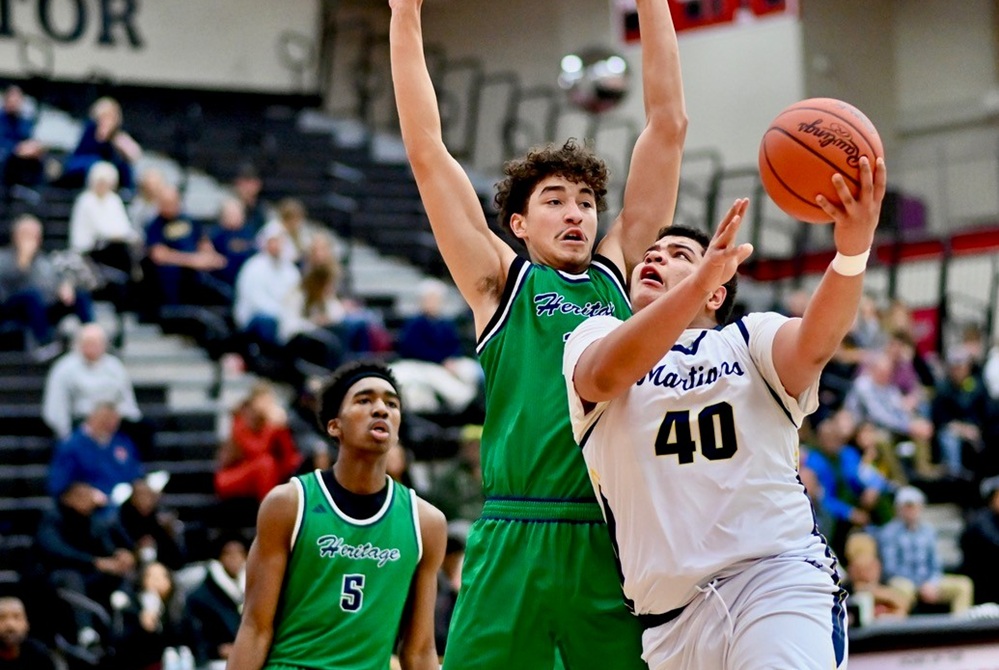
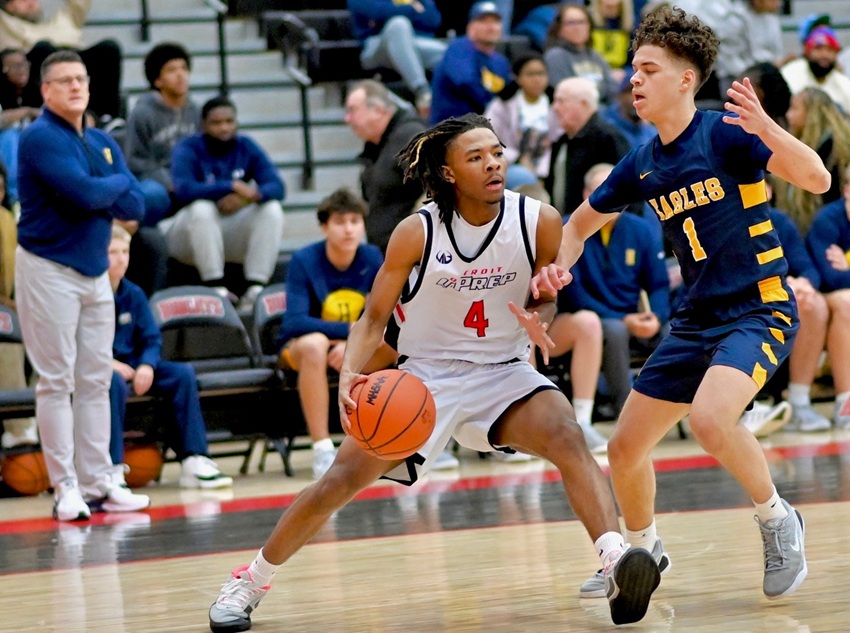
PHOTOS (Top) Goodrich’s Miles Washington (40) works to get a shot up past a Saginaw Heritage defender during the Martians’ 65-48 win Jan. 3. (Middle) Hudsonville’ Jovaan Daniels (1) defends while Detroit University Prep’s Tony Dent drives during the Eagles’ 72-56 win also on Jan. 3. (Photos by Terry Lyons.)